
My neighbor’s grandmother spoke no English whatsoever. She would come downstairs in the morning, hand me a cup of tea I hadn’t asked for, and say something that sounded like “meer.” That was it. Just that one sound. Her granddaughter told me later it was the Russian word for peace. What she didn’t tell me until months after that was the part I couldn’t stop thinking about — the same word also means world. Not in a poetic stretch-the-metaphor way. Literally the same word. Mir. Peace. World. Pick one. Or don’t, because Russian speakers have always held both meanings inside a single word and apparently nobody ever felt the need to split them apart.
That’s the thing translation tables miss completely. You get a column for the language, a column for the word, maybe a pronunciation if you’re lucky. You don’t get the part where a single word has been doing double duty for centuries and nobody’s bothered to fix it.
But tables are still useful. So here’s one.
How to Say Peace in Many Languages – Full List With Pronunciation
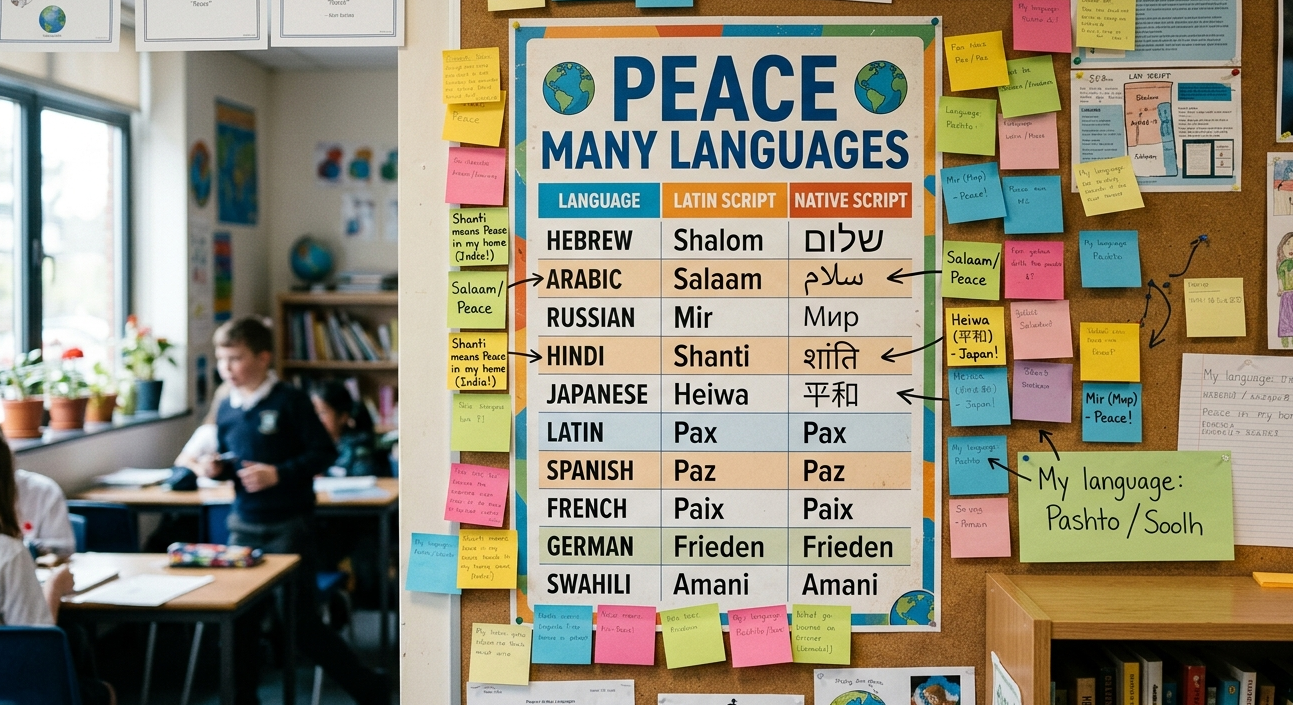
Most pages give you the word and skip the pronunciation, which is basically useless if you’re trying to write a speech or teach a classroom or put together an International Peace Day display. The “Say It Like This” column below is written for someone who has never studied phonetics — it’s approximate on purpose.
| Language | Peace | Say It Like This | Script |
|---|---|---|---|
| Arabic | Salaam | sa-LAAM | سلام |
| Hebrew | Shalom | sha-LOM | שָׁלוֹם |
| Spanish | Paz | pahz | — |
| French | Paix | peh | — |
| Portuguese | Paz | pahz | — |
| Italian | Pace | PAH-cheh | — |
| German | Frieden | FREE-den | — |
| Dutch | Vrede | VRAY-duh | — |
| Russian | Mir | meer | мир |
| Hindi | Shanti | SHAAN-tee | शांति |
| Sanskrit | Shanti | SHAAN-tee | शान्तिः |
| Mandarin Chinese | Heping | huh-PING | 和平 |
| Japanese | Heiwa | HAY-wah | 平和 |
| Korean | Pyeonghwa | pyung-HWA | 평화 |
| Swahili | Amani | ah-MAH-nee | — |
| Turkish | Barış | BAH-rish | — |
| Persian/Farsi | Solh | solh | صلح |
| Urdu | Amn | am-n | امن |
| Greek | Eirini | ee-REE-nee | Ειρήνη |
| Latin | Pax | pahks | — |
| Ukrainian | Myr | meer | мир |
| Polish | Pokój | POH-kooy | — |
| Hausa | Salama | sa-LAH-ma | — |
| Yoruba | Alaafia | ah-LAH-fee-ya | — |
| Amharic | Selam | SEH-lam | ሰላም |
| Tagalog | Kapayapaan | ka-pa-ya-PA-an | — |
| Thai | Santiparb | san-TI-parp | สันติภาพ |
| Vietnamese | Hòa bình | hwah bing | — |
| Malay/Indonesian | Damai | dah-MY | — |
| Afrikaans | Vrede | FREH-duh | — |
Something worth noticing: linguists currently count around 7,000 living languages on earth. Every single one of them developed a word for this.
The Part Translation Tables Leave Out
On Shalom.
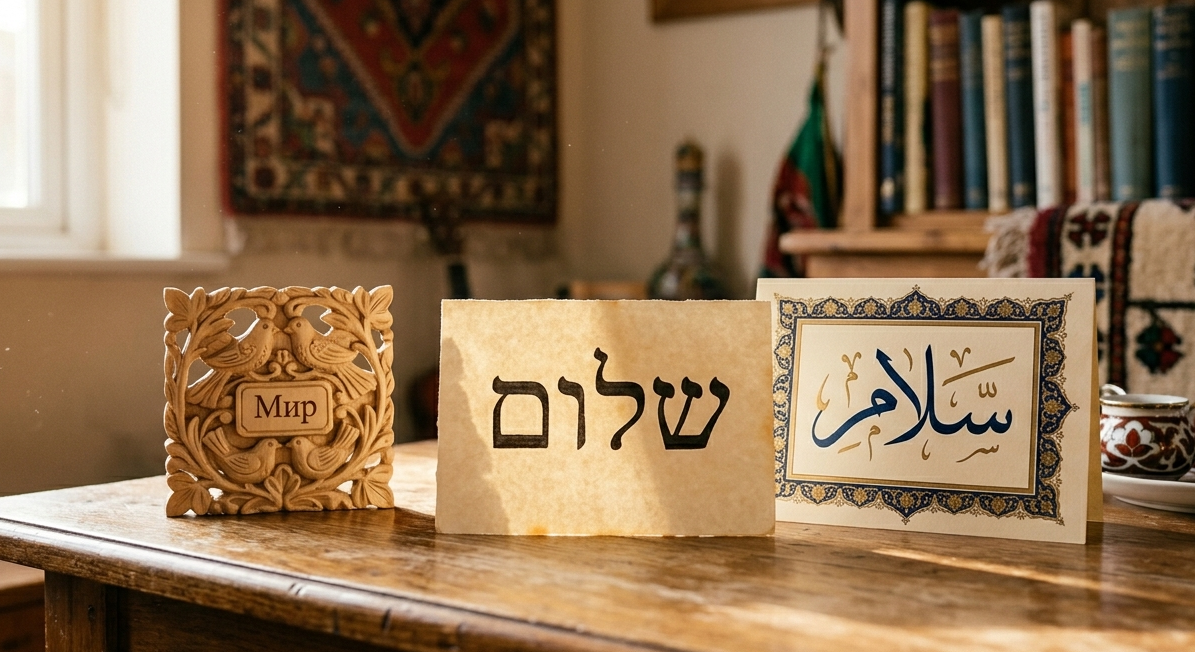
The root is shalem. It means whole. Complete. Undamaged. So when someone says shalom in Hebrew, the underlying content of that word is something closer to “I wish you a life where nothing important is broken” than it is to “I hope there’s no fighting nearby.” Those are different wishes. The same root is sitting inside the name Jerusalem — Yeru-shalom — which scholars translate either as “city of peace” or “city of wholeness” depending on who you ask. Some say both, which is probably the honest answer. That root has been in continuous use for over three thousand years.
On Salaam.
Same ancient Semitic root as shalom — linguists write it as š-l-m, and it’s at least four thousand years old. As-salamu alaykum is used as a daily greeting by somewhere around 1.8 billion Muslims, spread across maybe 50 countries, from Senegal to Indonesia. Think about that for a second. Every morning. As a basic hello. A word wishing safety on a stranger that has been in active daily use across that span of people and geography for over a thousand years. Writing “salaam = peace” in a table is technically accurate and misses almost everything interesting about it.
On Shanti.
This one doesn’t translate cleanly into English at all. In Hindu and Buddhist practice, shanti describes an interior condition — a stillness that exists regardless of what’s happening around you. Not peace in the sense of an absence of war. Not even peace in the sense of a quiet room. Something internal that doesn’t actually depend on external circumstances. It’s chanted three times at the end of certain rituals — once for the body, once for the mind, and once for something larger that different teachers describe differently. “Inner peace” is the closest English phrase. It’s not quite right.
On Mir.
Back to the word I started with. Russian. One word. Mir. Means peace. Also means world. Not two separate words that happen to look the same — genuinely one word that native speakers use comfortably in both directions, reading context from surrounding sentences. When the Soviet Union named their space station Mir in 1986, that name could be read as “we come in peace” or “we represent the world” or both simultaneously. Whether that ambiguity was intentional is one of those questions the name was built not to answer.
On Eirini.
Greek. 2,500-plus years of documented use. Comes from Eirene, one of the Horae in Greek mythology — goddesses associated with natural order, with the right timing of things, with seasons arriving when they’re supposed to. The concept of peace in ancient Greek wasn’t just “no fighting.” It was closer to “the world functioning correctly.” A cosmic regularity. The name Irene — still common in Spain, Greece, Italy, Russia, Portugal — comes directly from this word and has been carrying that original meaning forward without most people realizing it.
Why Five Languages Basically Have the Same Word
Shalom. Salaam. Selam. Salama. Shlama.
All five go back to that Proto-Semitic root, š-l-m, at minimum four thousand years old. Hebrew kept shalom. Arabic developed salaam. Aramaic — the everyday spoken language across much of the Middle East during the first century, the language Jesus would have used in ordinary conversation — produced shlama. Amharic, spoken in Ethiopia, developed selam. Swahili picked up salama through centuries of contact with Arabic-speaking traders working the East African coast.
What you’re looking at is a single idea that traveled — by trade routes, by religious expansion, by migration — across forty centuries and most of the known world. Words for peace moved the same routes as goods and religion. That’s worth sitting with, partly because it’s genuinely remarkable, and partly because those routes weren’t always peaceful.
The Latin pattern works the same way but in a different direction. Pax spread with Roman expansion and seeded an entire family. Spanish paz, Portuguese paz, French paix, Italian pace, Romanian pace — all the same word with roughly fifteen centuries of gradual change applied. English got pacify, pacific, and pacifist from the same root. When Magellan named the Pacific Ocean, he called it after the calm water he saw after rounding South America. The word for peace became the name of the largest body of water on earth.
Japanese heiwa and Chinese heping share characters — 和平 in Chinese, 平和 in Japanese, the same two symbols swapped. Harmony. Calm. Rearranged. Centuries of Chinese influence on Japanese written language, still visible in the characters both countries use today.
Understanding why words carry more than their definitions — the cultural and historical weight that travels inside them — connects to something the post on Language Lessons for a Living Education makes a real argument for: that context and story are what make language stick, not vocabulary lists alone.
Peace in Ancient Languages
Latin’s pax might be the single most consequential peace word in Western history just in terms of what it named and how far it traveled. The Pax Romana — roughly two centuries of relative internal stability in the Roman Empire starting around 27 BC — gave later powers a template. Pax Britannica. Pax Americana. The same construction lifted and reused every time a dominant power wanted to describe its version of order. Whether any of those eras actually earned the label depends on where you were and who you were inside them.
Aramaic’s shlama has an unbroken documented history as a peace greeting stretching back two thousand years. Aramaic-speaking Christian communities — particularly in Iraq, Syria, and parts of Iran and India — still use it as a greeting today. That’s the same word, carrying the same wish, in communities that have passed it person to person through Jewish, Christian, and Islamic periods of history without it disappearing.
Sanskrit’s shanti connects through Proto-Indo-European roots to Latin sanus — meaning healthy, whole, sane. Two language families, separated by geography and thousands of years, ended up linking peace and health inside the same linguistic ancestry.
Peace Posters, Classrooms, and International Peace Day
September 21st is the United Nations International Day of Peace. It’s been observed since 1982. Schools in particular have made it into something real — multilingual walls where every student contributes the word from their home language, calligraphy projects, collaborative displays that cover an entire classroom from floor to ceiling.
A poster showing peace in many languages with native scripts included does something before anyone stops to read individual words. It shows, visually, that this idea doesn’t belong to any one tradition or any one part of the world. That point is genuinely hard to make from a textbook.
For classroom use, organizing the table by region — African languages grouped together, Asian languages together, European ones separately — gives students a geographic frame alongside the linguistic one. Including the scripts means the project ends up teaching writing systems at the same time. In practice, the entry that stops students most often is always mir. The word that means two things at once tends to need some explaining.
The question of universality across different communication systems — including non-spoken ones — gets complicated fast. Is American Sign Language Universal covers something that genuinely surprises people: sign languages developed independently in different deaf communities worldwide, which raises real questions about whether any concept is expressed universally across human communication systems.
Peace Symbols in Different Cultures
The dove with an olive branch is old. The Biblical origin is the flood story — the dove returning to Noah with the branch signaling that land existed. But its current life as a global peace symbol owes a significant debt to Pablo Picasso, who drew a white dove for the 1949 World Peace Congress in Paris. That image moved fast. Within a few years it was effectively fixed in the global visual vocabulary in a way that hasn’t moved since.
Japan’s symbol is the crane, and the story that made it permanent is Sadako Sasaki. She was twelve years old, a Hiroshima survivor, hospitalized with leukemia from radiation exposure years after the bombing. She started folding paper cranes — the traditional belief holds that folding a thousand grants a wish. She died in 1955 before finishing them. The paper crane has carried real grief inside its peace symbolism in Japan ever since. It’s not decorative. It’s memorial.
The lotus in Hindu and Buddhist traditions represents peace and purity together — a flower that grows through murky water and surfaces clean. The United Nations placed olive branches on both sides of its emblem, framing a map of the world. Old symbol. Chosen deliberately.
Frequently Asked Questions
How do you say peace in many languages?
Starting with the most spoken: Arabic — salaam, Hebrew — shalom, Spanish and Portuguese — paz, French — paix, Hindi — shanti, Japanese — heiwa, Russian — mir, Swahili — amani, Mandarin Chinese — heping, Greek — eirini. Pronunciations and native scripts for thirty languages are in the table above.
What is the most widely spoken word for peace in daily life right now?
Salaam and its variants. Used as a daily greeting by over 1.8 billion Muslims across dozens of countries. On any given morning it’s probably the most repeated peace-related word on earth, and by some distance.
What does shalom mean beyond peace?
The root shalem means whole, complete, undamaged. It’s used in Hebrew as hello, as goodbye, and as a blessing. The same root is in Jerusalem. The wish inside the word is less about absence of conflict and more about nothing being broken.
What’s the Latin word for peace?
Pax. Source of pacify, pacific, pacifist, and the Pacific Ocean. Direct ancestor of Spanish paz, French paix, Italian pace, Portuguese paz. Also the Pax Romana, and every Pax something that came after it.
Why does the Russian word for peace also mean world?
Linguists think both meanings grew from a shared early concept — a community living in settled, undisrupted order. Peace and a functioning world were the same idea. The word never split. Modern Russian just lives with both meanings in the same place, which honestly works.
How do you write peace in Arabic?
سلام — salaam. Arabic runs right to left. The س is the first letter.
Not every language will make it. Linguists estimate around 7,000 living languages currently exist and that number could drop significantly within a century as smaller languages lose speakers without documentation. UNESCO tracks endangered languages at and the Endangered Languages Project maintains active records at including languages that have their own words for peace that may not survive to be collected in anyone’s table.
Seven thousand languages. One thing that every human community, independently, developed a specific word for.
That’s not a small thing to notice.