
You learned to read in a classroom. You probably picked up cooking from a parent standing next to you at the stove. And at some point, likely at 11pm before a deadline, you figured out half of Excel from a random YouTube video nobody assigned you to watch. All three count as education. None of them look remotely alike.
That gap is basically the whole reason the types of education matter as a topic. School is one path, not the only one. Whether you’re a student figuring out which route actually fits, a parent weighing options for a kid, or just curious how people learn things outside a classroom, this guide covers the three foundational types, the modern variations layered on top of them, real examples pulled from actual institutions, and a comparison table worth bookmarking.
What Is Education, Really?
Strip away the buildings and diplomas and education is just the ongoing process of picking up knowledge, skills, and judgment. It doesn’t stop the day you leave school — it starts in early childhood and, in practice, never really finishes. Someone in their sixties fumbling through a new smartphone app is still doing it, whether they’d call it “education” or not.
What trips people up is assuming the word only applies to school. It doesn’t. A tutoring session counts. So does a work training program, or a grandmother teaching her grandkid to bake bread on a Sunday afternoon. Once you separate education from the image of a classroom, the different types of education stop feeling like a technicality and start actually making sense.
Why the Types of Education Actually Matter
Here’s a fairly practical reason to care: picking the wrong kind of learning for what you’re trying to do wastes real time. A working adult chasing one specific coding skill for a promotion doesn’t need four years of university — a tightly focused non-formal course will probably get them there faster and cheaper. A kid genuinely curious about how volcanoes work might get more out of a documentary and a backyard baking-soda experiment than a textbook paragraph, at least at first.
Matching the type of learning to the actual goal, rather than defaulting to “classroom” every time, is really the point of knowing this stuff at all.
What Are the Main Types of Education?
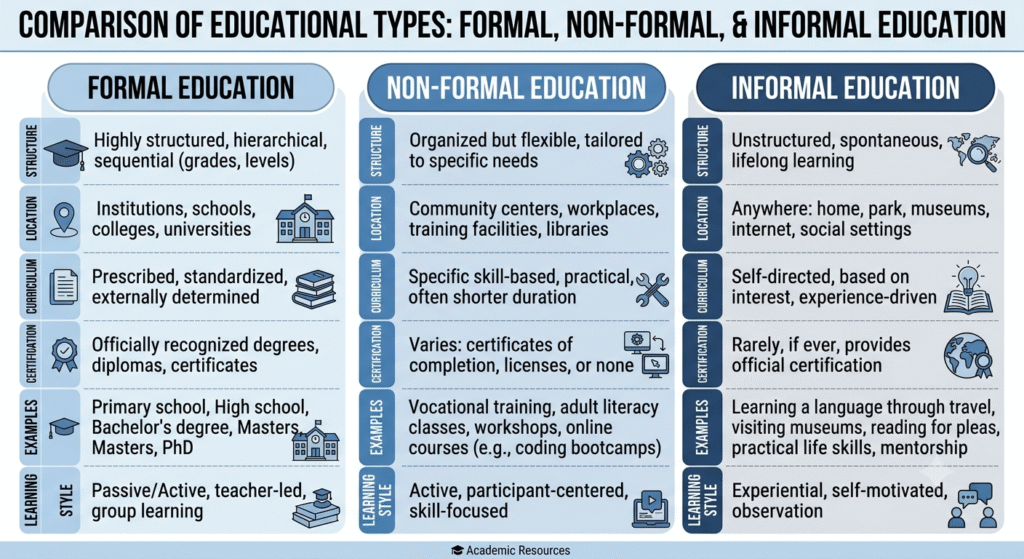
Most educators — and international bodies like UNESCO, whose ISCED classification framework underpins how most countries categorize their own systems — break learning into three foundational categories: Formal, Non-Formal, and Informal education. Everything else, online courses, homeschooling, vocational training, corporate learning programs, is really some blend of these three roots rather than a separate category entirely.
Formal Education
If you’ve ever sat through a school timetable running 8 a.m. to 3 p.m., five days a week, you’ve already lived formal education. Fixed schedules and an approved curriculum are what separate it from everything else on this list.
It’s the one everyone pictures first: schools, colleges, universities, structured coursework, and a diploma or degree waiting at the end. Students move through defined stages, one grade building on the last, taught by instructors who generally hold specific qualifications for their subject. Content itself isn’t chosen freely — it’s set by an education authority, delivered within fixed academic terms, and evaluated through exams and assignments that lead to official certification. Attendance and participation requirements usually come with real consequences for skipping them.
Real examples: government primary and secondary schools, universities like Oxford or Harvard, K-12 systems broadly, accredited online degree programs, and professional certification tracks like a CPA license or medical board exam.
The upside here is fairly obvious — recognized qualifications, consistent teaching quality, a clear runway toward a career. The catch is just as real. Formal education can be rigid. It’s often exam-focused in a way that rewards memorization over genuine understanding, and at the university level specifically, it’s frequently expensive enough to shape someone’s financial decisions for a decade afterward.
Informal Education
Picture a teenager teaching themselves video editing over a few weekends using free software, purely because they wanted to. Nobody’s grading the work. There’s no certificate at the end. Yet a few months in, that teenager might have a genuinely marketable skill they’d never have picked up in a classroom. That’s informal education, working exactly as it’s supposed to.
It sits at the opposite end of the spectrum from formal schooling. No curriculum, no exams, nothing official waiting at the finish line — just the learning that happens by living. A kid absorbing their parents’ native language without ever studying grammar is informal education. So is learning to ride a bike, or figuring out how to negotiate a better price at a market because you watched an uncle do it a dozen times growing up.
It’s unstructured and spontaneous by nature, runs across a whole lifetime rather than a fixed stretch of years, and has no syllabus or certification attached — the learner decides what actually matters. Nobody assigns it, and it’s usually free.
Real examples: learning to cook by watching a parent, picking up conversational skills from friends, teaching yourself Photoshop through scattered YouTube tutorials, absorbing a second language from months of watching foreign films without subtitles.
In practice, this is how a surprising share of real-world, practical skills get learned. The tradeoff is consistency. Nobody’s checking your progress, there’s no formal recognition of what you’ve picked up, and the quality of what you learn depends almost entirely on your own initiative and whatever resources happen to be nearby.
Non-Formal Education
Somewhere in between sits non-formal education — organized and intentional like formal schooling, but living outside the traditional system and usually skipping the rigid grading and multi-year commitment. Workshops, vocational courses, adult literacy programs, and short skill-based training all fall here.
It’s flexible around the learner’s actual schedule rather than a fixed academic calendar, aimed at a specific practical outcome rather than broad theory, and entirely voluntary — people show up because they want the skill, not because attendance is mandatory. Some programs hand out a completion certificate. Plenty don’t bother with formal assessment at all.
Real examples: a Google Career Certificate, a Coursera or Udemy course, a weekend entrepreneurship workshop, an adult literacy class, a carpentry seminar run out of a community center.
This is the category that’s grown the fastest over roughly the last decade — mostly because it’s the quickest route for adults to pick up one specific, immediately useful skill without committing years to a formal program.
Formal vs. Informal vs. Non-Formal: Quick Comparison
| Formal Education | Non-Formal Education | Informal Education | |
|---|---|---|---|
| Structure | Highly structured | Structured but flexible | Unstructured |
| Setting | Schools, colleges, universities | Workshops, training centers, online platforms | Home, workplace, daily life |
| Certification | Degrees, diplomas | Sometimes — completion certificates | None |
| Curriculum | Fixed, authority-approved | Goal-specific | None |
| Cost | Often significant | Varies, often lower | Usually free |
| Best For | Long-term career qualifications | Specific skill-building | Life skills, personal growth |
None of these is objectively better than the other two. A surgeon needs formal education, full stop. A freelance illustrator might do just fine on a mix of non-formal courses and years of informal, self-taught practice.
Are There 4 Types of Education?
Some sources add a fourth category — usually online or digital education — on top of the traditional three. It’s a fair addition in some ways, since so much learning now happens through screens, but it’s worth noting that online learning isn’t really a separate root category the way formal, non-formal, and informal are. An accredited online university degree is still formal education, just delivered digitally. A free YouTube tutorial series is informal education happening on a screen instead of over someone’s shoulder. So “4 types” is a reasonable way to describe how education gets delivered today, even if the underlying three-category structure hasn’t actually changed.
Modern Types of Education You’ll Actually Encounter Today
The three-category model is still the foundation, but a lot of how people learn today doesn’t sit neatly inside just one bucket.
Online education delivers structured coursework over the internet and can be formal or non-formal depending entirely on the provider. Distance education is the broader umbrella — correspondence courses and any structured program where the learner isn’t physically present with an instructor. Hybrid or blended learning mixes in-person and online instruction, and it’s become far more common across both K-12 and higher education since institutions built out the infrastructure during the pandemic and mostly kept it.
Vocational education targets a specific trade — electricians, plumbers, IT technicians — and can fall under either formal or non-formal depending on accreditation. Homeschooling is formal in structure (curriculum, assessment) but delivered outside an institutional setting, usually by a parent or private tutor. Adult and continuing education programs are built specifically for working adults returning to study, often for career advancement rather than a first-time credential. Special education adapts instruction for students with learning differences, typically within formal school systems but using customized methods. And competency-based education lets students advance based on demonstrated mastery of a skill rather than time spent sitting in a classroom — a model gaining ground fast in vocational and online formats.

If you’re weighing something bigger than just choosing where to enroll — like starting your own learning-focused business — our piece on how to start an early childhood education franchise covers what that path actually involves on the formal-education side of things.
Levels of Education
Separate from the type of education is the level — where someone sits in the overall educational journey, regardless of whether that stage happens to be formal, informal, or non-formal.
Early childhood education comes first, generally ages 3 to 5. Primary education follows, roughly 6 to 11. Secondary education covers middle and high school years. After that comes higher education — undergraduate study, then postgraduate and doctoral work for those who continue. Vocational and adult education can slot in almost anywhere past secondary school, entirely dependent on someone’s career path and timing.
How to Choose the Right Type of Education
There’s no universal right answer, but a few questions tend to clarify things fast. Working toward a specific licensed profession — medicine, law, engineering? That almost always requires formal education; there’s really no way around it. Trying to pick up a practical skill for a career pivot without years of commitment? Non-formal is usually the faster, cheaper route. Just chasing curiosity or a hobby? Informal learning, self-study, and free resources will probably get further than any paid course would.
Plenty of people end up mixing all three without ever really labeling it that way — a formal degree, a couple of non-formal certificates rounding out specific skills, and a lifetime of informal learning quietly filling in whatever gaps the other two never covered.
Common Mistakes People Make
Assuming formal education is always the “serious” option and everything else is somehow lesser — a lot of hiring managers have actually moved past that assumption faster than the general public has. Skipping structured learning entirely and relying only on scattered informal self-study for something that genuinely needs a credential — healthcare, law, engineering — is another one that can backfire badly. And treating a non-formal certificate as equivalent to a full degree when applying somewhere that specifically requires the degree trips people up more often than it probably should.
Study Habits Matter as Much as the Type of Education You Choose
Something most guides on this topic skip entirely: picking the right type of education only gets you halfway there. How you actually study within that structure matters just as much, whether that’s a formal lecture hall or a non-formal course worked through at your own pace on a laptop. If that side of things feels shaky, our piece on 3 secret study tips that actually work is worth a look regardless of which educational path you’re on.
The Future of Education
A few shifts are reshaping how all three types of education actually function day to day. OECD reports have repeatedly pointed to AI-driven, personalized learning tools changing how instruction gets delivered in ways that simply weren’t possible a decade ago. Lifelong learning has stopped being a nice phrase in a mission statement and become an actual expectation — adults returning to education repeatedly across a career rather than finishing school once and calling it done. Skill-based, competency-driven programs are gaining ground over pure time-based progression, and blended formats mixing formal structure with non-formal flexibility are becoming the norm rather than the exception, especially in professional development.
Frequently Asked Questions
What are the 3 types of education?
Formal, Non-Formal, and Informal education. Formal happens through structured schooling with certification, non-formal is organized but flexible skill-based learning outside traditional schools, and informal is unstructured learning through everyday experience.
What type of education is required for a veterinarian?
Veterinarians need formal education — typically a bachelor’s degree followed by a Doctor of Veterinary Medicine (DVM) program, plus licensing exams, since it’s a regulated medical profession with no informal shortcut available.
What type of education is required to be a lawyer?
Formal education, specifically — an undergraduate degree followed by law school and passing a bar examination, since practicing law requires official licensing in virtually every jurisdiction worldwide.
What type of education is required for a marine biologist?
Formal education, generally a bachelor’s degree in marine biology or a closely related science field, with many research and academic roles requiring a master’s or doctoral degree on top of that.
What type of education is needed to be a nurse?
Formal education — typically a nursing diploma, associate degree, or bachelor’s degree in nursing, followed by licensing exams, since nursing is a regulated healthcare profession in nearly every country.
What are the types of assessments in education?
Formative assessment covers ongoing checks during learning, like quizzes. Summative assessment covers final exams or projects. Diagnostic assessment identifies gaps before instruction even begins, and performance-based assessment evaluates practical skill application directly rather than through a written test.
Is online education formal or informal?
It depends entirely on the provider. An accredited online university degree counts as formal education, a free standalone tutorial series is informal, and a paid skills course without full accreditation typically falls somewhere in non-formal territory.
Can informal education lead to a career?
Yes, particularly in creative fields, freelancing, and tech, where a strong self-taught portfolio can sometimes outweigh formal credentials — though most regulated professions still require formal qualifications regardless of how skilled someone became informally.
Final Thoughts
Understanding the types of education isn’t really an academic exercise. It’s a practical filter for deciding how to spend time and money on learning something specific. Formal education still matters enormously for regulated professions and long-term credentials. Non-formal education has become the fastest route to picking up one useful, specific skill. And informal education quietly does more of the actual teaching in most people’s lives than either of the other two ever really gets credit for. Most people, honestly, end up using all three without ever consciously labeling them — which is more or less how it should work.
For broader context on education as a global priority, UNESCO’s education overview is a solid primary source and covers the ISCED framework referenced earlier in more depth. The OECD’s education data and reports offer a useful international comparison for anyone researching how different countries structure their systems differently.