
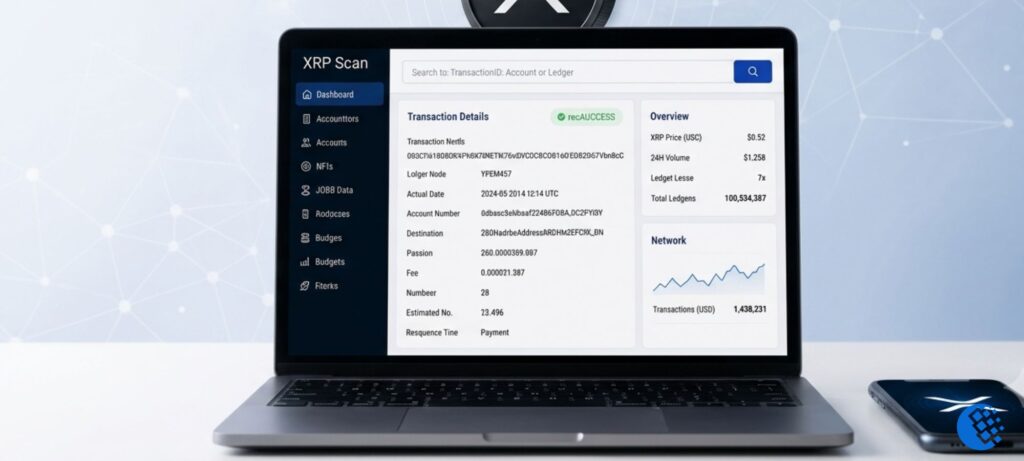
Imagine being able to pull up the complete payment history of any bank account in the world — no court order, no paperwork, just a free search tool and a few seconds of your time.
That’s essentially what the XRP Ledger makes possible, and it’s been doing it since 2012.
Every transfer, every wallet balance, every network fee is sitting out in the open, and tools known as XRP Scan explorers exist specifically to help you read that data — no technical background required.
Why Blockchain Transparency Changes the Game for Crypto Users
Traditional bank transfers are a black box.
You hit “send,” and somewhere between your account and the recipient’s, the money disappears into a system you have zero visibility into.
Crypto — and the XRP Ledger in particular — flips that model entirely.
Every piece of transaction data is written permanently onto a distributed ledger the moment a payment is validated, making it tamper-proof and publicly readable by anyone on earth.
This matters most when something goes wrong: a transfer that seems stuck, a wallet address you’re not sure about, or a payment amount that doesn’t match what you expected.
Rather than filing a support ticket and waiting days for an answer, you can pull up the raw on-chain data yourself within seconds.
For anyone actively holding or trading XRP, knowing how to use a ledger explorer is one of those practical skills that seems unnecessary — right up until the moment you actually need it.
Three Explorer Tools Worth Knowing About
Several blockchain explorers support the XRP Ledger, but three have earned their place as the go-to options for most users.
XRPSCAN is the most comprehensive of the bunch.
It goes well beyond simple transaction lookups, offering real-time data on NFT activity, automated market maker (AMM) pools, validator node performance, and a live leaderboard of the largest XRP wallets on the network.
Whether you’re a first-time user checking a single payment or a developer pulling metrics for an application, XRPSCAN has enough depth to be useful at every level.
Bithomp earns its spot for a different reason: its NFT browsing experience and token-tracking features are among the strongest available for the XRPL.
Its username and domain lookup capability is particularly handy when you want to verify whether a wallet belongs to a known organization or project rather than an anonymous address.
The official XRPL.org Explorer, hosted at livenet.xrpl.org, is the open-source option maintained by the core development community.
It’s stripped down compared to the others, but that simplicity is a feature for users who want straightforward balance checks and live ledger monitoring without any third-party involvement.
Reading XRP Transaction Data Without Getting Lost
Opening a blockchain explorer for the first time can feel like walking into an air traffic control tower — lots of numbers, lots of fields, and no obvious starting point.
Here’s what actually matters when you run a search.
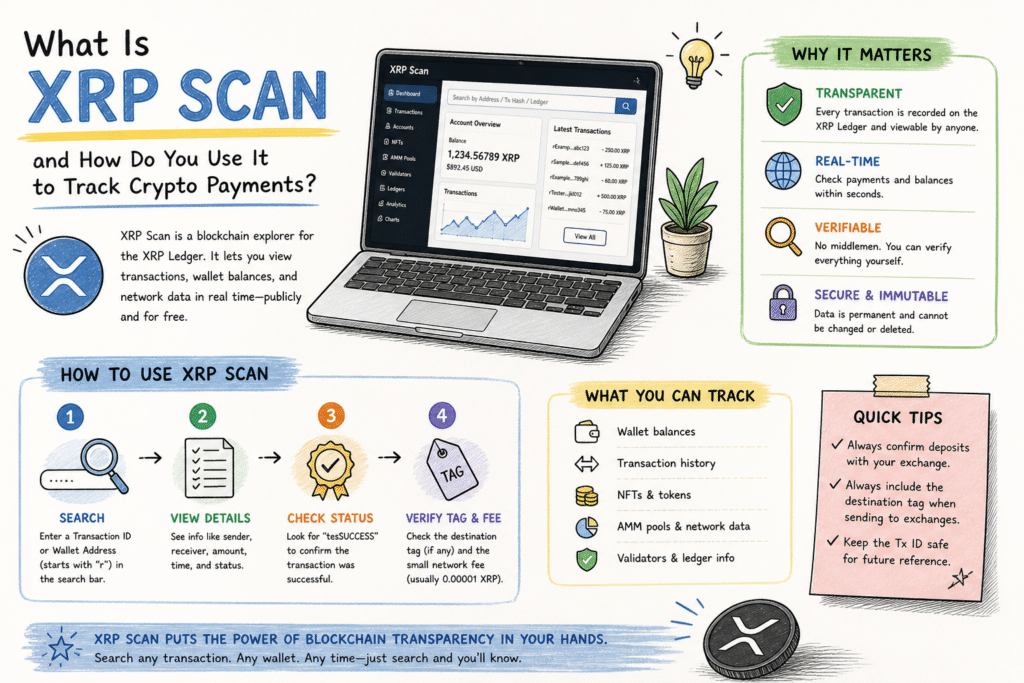
If you’re tracking a specific payment, you need the transaction ID — a long string of letters and numbers that your exchange or wallet generates the moment a transfer is broadcast to the network.
Paste it into any XRP Ledger explorer, and you’ll instantly see who sent it, who received it, the exact amount, the timestamp, and whether the transaction completed successfully.
A status reading of “tesSUCCESS” is exactly what you want to see — it confirms the network validated and settled the transfer, a process that typically wraps up within 3 to 5 seconds on the XRPL.
If you’re researching a wallet address, paste it directly into the search bar instead.
Every XRP address begins with the letter “r,” and once you look one up, you’ll see its current balance alongside a full chronological list of every transaction it has ever been involved in.
One field that deserves special attention is the destination tag.
When you send XRP to an exchange, most platforms require this numeric code alongside the wallet address — it’s how they figure out which customer account the incoming funds belong to.
Leaving it blank doesn’t just slow things down; it can route your transfer to an unidentifiable pool where recovery becomes a genuine headache.
Network fees on the XRPL are almost negligibly small, starting at 0.00001 XRP per transaction, though they adjust upward slightly during periods of unusually high network activity.
Beyond Basic Lookups: How Different Users Benefit
The use cases for XRP Ledger explorers extend further than most people initially realize.
For individual holders, the most common scenario is simply confirming a withdrawal from an exchange arrived safely before considering the transaction closed.
For merchants and businesses that accept XRP as payment, on-chain data provides an immutable audit trail that can be matched against internal records with zero ambiguity.
Developers building products on top of the XRPL use explorer data to monitor contract behavior, observe liquidity patterns in AMM pools, and track validator reliability over time.
The ledger has accumulated over 100 million validated ledger closes since going live in 2012, and not a single one has been deleted or altered — that entire history remains open and searchable, free of charge, through any reputable XRPL explorer.
Conclusion
Blockchain explorers don’t require any expertise to use, and the XRP Ledger’s public architecture means the data you need is never more than a search away.
Whether you’re settling a nagging question about a pending transfer, doing due diligence on an unfamiliar wallet, or just satisfying your curiosity about how the network operates under the hood, an XRP Ledger explorer hands you the answers directly.
Ready to start trading? MEXC provides a simple, accessible entry point for buying and exchanging XRP alongside hundreds of other digital assets.