
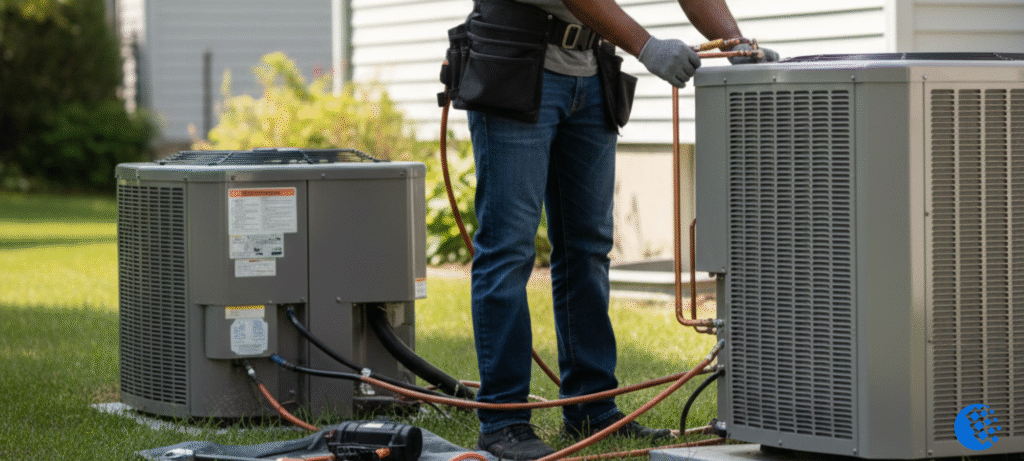
If you have ever opened a quote to replace your air conditioner and felt your jaw hit the floor, you aren’t alone. It’s a common frustration: why does swapping out an old unit cost so much more than what people seem to pay for a “simple” installation in a new home? The reality is that AC replacement is expensive compared to installation because you aren’t just paying for a metal box; you are paying for a complex surgical procedure on your home’s mechanical heart.
In the world of home maintenance, we often look for the “hidden gems” or value, much like the logic behind The Benefits of Classical Education where the value lies in deep, foundational work rather than a quick surface fix. To truly understand that price tag, we have to look at the intersection of federal regulations, rising material costs, and the heavy lifting required to modernize an outdated system in 2026.
1. Equipment Cost and Technology Upgrades
The single biggest driver of the price is the equipment itself. If your current AC was installed fifteen years ago, the machine replacing it is a different species entirely.
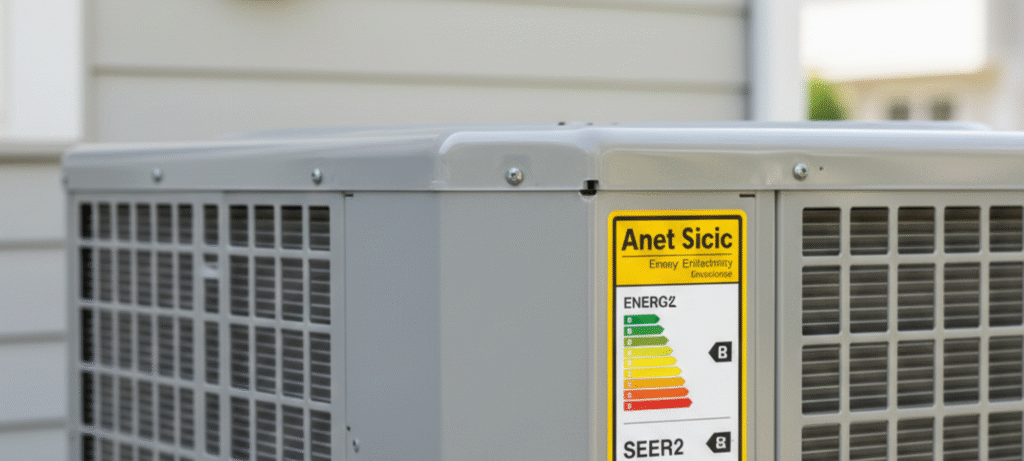
- Higher Efficiency Standards: Since 2023, the Department of Energy has enforced stricter minimum SEER2 (Seasonal Energy Efficiency Ratio) ratings. While this is great for your monthly utility bill, it means “entry-level” units today are more sophisticated—and therefore more expensive—than the mid-range units of a decade ago.
- Advanced Internal Components: Modern systems have moved away from basic “on/off” motors. Today’s units often feature variable-speed compressors and inverter technology. These components act like a brain for your HVAC, managing power consumption with surgical precision, which significantly raises manufacturing costs.
- New Refrigerant Costs: We are in the middle of a massive environmental shift. Older units used R-410A, which is now being phased out. New systems are designed around eco-friendly (but more expensive) alternatives like R-454B and R-32. This transition forced manufacturers to redesign every coil and valve, a cost reflected in your invoice.
2. Labor-Intensive Installation (Removal & Modification)
When a contractor installs an AC in a new house, they are working with a clean slate. When they replace your AC, they are dealing with “demolition” and “retrofitting.”
- Removal and Disposal: Technicians can’t just cut the lines and toss your old unit in a dumpster. They must use specialized machines to recover the old refrigerant to prevent it from escaping into the atmosphere (an EPA requirement). Then, they have to haul away a several-hundred-pound metal carcass and pay disposal fees.
- System Incompatibilities: A new unit rarely fits perfectly onto an old concrete pad or connects seamlessly to existing refrigerant lines (line sets). This often requires modifications to ductwork, electrical wiring, or piping to ensure the new “sensitive” equipment doesn’t fail prematurely.
- Expertise Required: Modern systems are essentially high-powered computers. Technicians today need to understand high-voltage electricity, plumbing, and thermodynamics. Much like a medical professional must understand Grading Sprains to provide the right treatment, an HVAC tech must be a specialist.
3. External Factors and Market Trends
It is no secret that the world has become more expensive. The HVAC industry has been hit by a “perfect storm” of economic factors.
- Increased Component Costs: An air conditioner is a giant heat exchanger made of copper, aluminum, and steel. Global prices for these metals have spiked, and those costs are passed directly to you.
- Labor Shortages: There is a significant shortage of skilled HVAC professionals. To maintain a solid workforce, companies have to pay higher wages. This labor overhead is a major reason why AC replacement is expensive compared to installation.
- Regulatory Changes & Tariffs: New EPA regulations and lingering tariffs on imported components (like compressors and control boards) have pushed prices significantly higher—sometimes doubling them compared to 2019 levels.
4. Added Value Components
A replacement quote often includes more than just the outdoor unit. Because an outdoor unit won’t work with an old indoor coil, you are usually buying a “matched system.”
- Comprehensive Upgrades: You may be getting a new evaporator coil, a smart thermostat, and improved air filtration. These aren’t just “add-ons”—they are necessary for the new system to meet its efficiency ratings.
- Long-Term Savings: While the upfront “sticker shock” is real, a properly installed new system can slash your cooling bills by 20% to 40%. You are trading a high initial investment for a decade of reliability and lower monthly overhead.
People Also Ask
Why does replacing AC cost so much? Replacing AC involves purchasing advanced SEER2 equipment, removing and disposing of old components under EPA guidelines, and modifying existing infrastructure (like ductwork and electrical) to fit modern, more sensitive technology.
Is AC installation cheaper than replacement? In new construction, installation is often cheaper because there is no old equipment to remove, no refrigerant to recover, and the ductwork is designed specifically for the new unit from day one.
What is the average cost to replace an AC system? According to industry leaders like Fire & Ice Heating and Air, a standard residential replacement in 2026 can range from $5,500 to $16,000 depending on size and efficiency level.
Frequently Asked Questions
Does a higher SEER rating really matter? Yes. Higher SEER2 systems use significantly less energy. Over the life of the unit, the energy savings often offset the higher initial price tag.
Why can’t contractors reuse my old parts? New systems are designed as matched sets. Using an old coil or line set with a new high-efficiency condenser can void your warranty and cause the system to fail within months.
Are prices likely to go down? It’s unlikely. With the current transition to GWP (Global Warming Potential) refrigerants and rising labor costs, industry experts expect prices to remain stable or continue to climb.
Final Thought
When you first ask why AC replacement is expensive compared to installation, the answer seems like it should be simple. But as we’ve seen, it’s a mix of advanced technology, environmental regulation, and the sheer labor required to rebuild a system in a pre-existing space. Air conditioning is no longer a basic mechanical box; it’s a highly regulated, engineered system. While the price is high, the comfort and reliability in extreme heat are often worth every penny.