

Idioms for writers work best as seasoning, not the main course. Slip one into the right sentence and it can carry a whole feeling in three or four words. Slip five into the same paragraph and suddenly the writing reads like it was bolted together from spare parts. Knowing idioms isn’t really the hard part, honestly. Most people already know hundreds of them without ever thinking about it. The hard part is knowing which ones actually earn their spot, which ones have gone stale from getting used to death, and which ones just don’t belong anywhere near a formal essay, no matter how well the meaning fits.
This guide goes through a wide range of them, sorted roughly by what kind of writing they suit, with meanings, example sentences, and some honest notes on when to just leave them out.
What Are Idioms in Writing?
An idiom is basically a fixed phrase where the overall meaning has drifted pretty far from what the individual words actually say. Take “burn the midnight oil.” There’s no real oil involved, no actual burning, nothing close to either. It just means working late into the night to get something done. Someone hearing it for the very first time could translate every single word correctly and still completely miss the point, since the meaning lives in the phrase as a whole, not in its individual pieces.
Context ends up doing most of the heavy lifting here. Someone who’s never encountered “back to the drawing board” before can usually still work out that a plan failed and it’s time to start over, as long as the surrounding sentence gives them enough to go on. Strip that context away, though, and the phrase can land strangely, especially for readers who didn’t grow up hearing it.
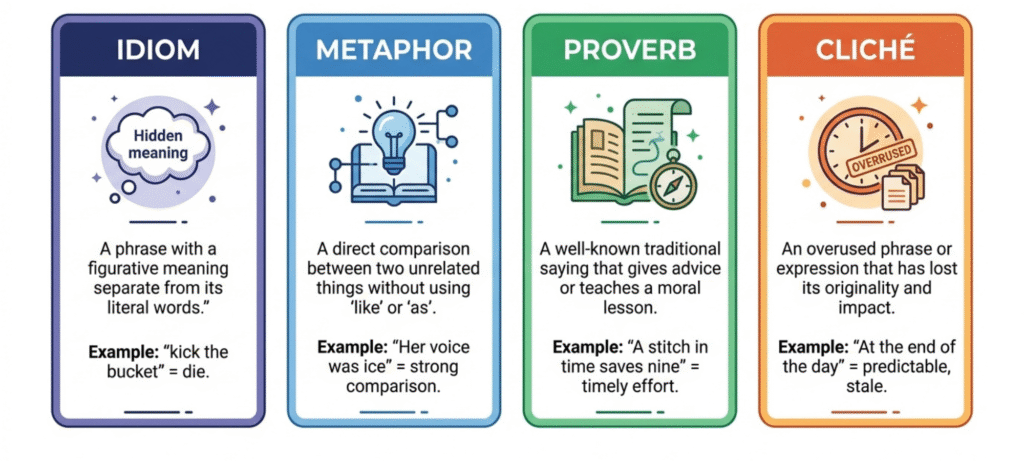
It’s worth untangling a few terms people constantly mix up. An idiom is a fixed figurative phrase. A metaphor is more of a one-off comparison, something invented on the spot to create an image rather than pulled from everyday common usage. A proverb is a traditional saying, usually dishing out some kind of advice, like “a stitch in time saves nine.” A cliché is any expression at all, idiomatic or not, that’s been worked so hard it no longer surprises anyone. An idiom can absolutely turn into a cliché over time, sure, but that doesn’t mean every idiom eventually becomes one, and plenty of clichés were never idioms to begin with either.
Why Should Writers Use Idioms?
Do it right, and idioms handle a few specific jobs pretty well. Give a narrator’s voice some personality. Give a character’s dialogue some too. Compress a whole feeling into something small and familiar, five words like “she was on cloud nine” doing the work three full sentences of describing her joy would otherwise need. Make dialogue sound like something a person would actually say, because real speech runs on idiomatic shortcuts nobody even registers anymore. And in casual, personal writing, idioms bring a conversational texture that plain, overly literal sentences just don’t have.
Doesn’t mean stack more, though. Cram a paragraph full of expressions and it stops feeling like writing, starts feeling like a performance, like someone’s flexing a vocabulary list instead of telling a story. The sentence’s job comes first, no exceptions: does this specific phrase say the thing better, clearer, more naturally than plain language would? No? Then cut it.
100+ Idioms for Writers With Meanings and Examples
Instead of one giant undifferentiated list, it helps way more to sort idioms by what kind of writing they fit. Some work pretty much anywhere. Others only really belong in dialogue, or only in relaxed personal writing, and dropping them somewhere else can feel a little off.
Idioms for Descriptive Writing
These earn their keep when you’re trying to sketch a scene or a feeling fast.
- A breath of fresh air — something pleasantly different from what came before. Her honesty was a breath of fresh air after weeks of vague answers.
- At the crack of dawn — very early in the morning. They left at the crack of dawn to beat the traffic.
- A sight for sore eyes — someone or something a welcome relief to see. The coastline was a sight for sore eyes after three days at sea.
- In the blink of an eye — extremely quickly. The storm rolled in and the sky darkened in the blink of an eye.
- On cloud nine — extremely happy. She’d been on cloud nine since the acceptance letter arrived.
- Walking on air — feeling elated. He left the interview walking on air.
- Under the weather — feeling slightly unwell. She stayed home, feeling a bit under the weather.
- A ray of hope — a small sign things might improve. The test results offered a ray of hope after a difficult year.
- The calm before the storm — a quiet stretch right before something rough hits. The office felt unusually quiet, the calm before the storm of the annual audit.
Idioms for Essays and Composition Writing
A handful of idioms slot into argumentative or reflective essays without feeling out of place, so long as you’re not writing for a strict academic audience that expects strictly literal language.
| Idiom | Meaning |
|---|---|
| Hit the nail on the head | Describe something with exact accuracy |
| Get the ball rolling | Start something in motion |
| In the long run | Over an extended period of time |
| A double-edged sword | Something with both benefits and drawbacks |
| The tip of the iceberg | A small visible part of a much larger issue |
| Go the extra mile | Put in more effort than expected |
| Back to the drawing board | Start over after a failed attempt |
| A blessing in disguise | Something bad that leads to a good outcome |
| Easier said than done | Something that sounds simple but is hard in practice |
| The last straw | The final problem that makes a situation unbearable |
For general essays and reflective pieces, most of those hold up fine. For strict academic papers in the sciences or law, you’re usually better off reaching for the plain version instead. “This represents a small part of a larger problem” says exactly what “the tip of the iceberg” says, minus the risk of a tone mismatch in a formal report.
If you’re working on essay structure alongside your word choice, it’s worth pairing idiom use with a clear outline for the essay itself, since even a perfectly placed idiom can’t save a paragraph that wanders without ever making a point.
Idioms for Creative Writing
Fiction gives idioms a lot more room to breathe, particularly around tension, atmosphere, or whatever’s going on inside a character’s head.
- Heart of stone — someone who seems incapable of compassion. The judge had a reputation for having a heart of stone.
- A storm in a teacup — a small issue blown way out of proportion. The whole argument turned out to be a storm in a teacup.
- On thin ice — in a precarious or risky spot. After the last mistake, he knew he was on thin ice with his editor.
- Break the ice — ease tension, usually at the start of a conversation. She cracked a joke to break the ice before the negotiation began.
- Keep someone at arm’s length — avoid getting too close to someone. He kept his new colleagues at arm’s length for the first few months.
- See the light — finally understand or accept something. After the third failed attempt, he finally saw the light.
Idioms for Storytelling
These push a narrative along or mark a shift in the plot without slowing anything down.
- Out of the blue — happening completely unexpectedly. The offer came completely out of the blue.
- Before you know it — very soon, often used to speed through time in a story. Before you know it, the whole summer had slipped by.
- In the nick of time — just barely in time. The rescue team arrived in the nick of time.
- Once in a blue moon — very rarely. He only visited his hometown once in a blue moon.
- The tables turned — a situation flipped. Once she got promoted, the tables turned completely.
- Come hell or high water — no matter what gets in the way. She promised to finish the manuscript, come hell or high water.
- A twist of fate — an unexpected turn of events. It was a strange twist of fate that brought them back together.
Idioms for Dialogue
Dialogue is honestly where idioms sound most natural, since real conversation runs on informal shorthand. Written speech that avoids idioms entirely tends to come off stiff, almost robotic.
“Don’t worry about the contract yet. We’ll cross that bridge when we come to it.”
“You really hit the nail on the head with that pitch.”
“Relax, I was only pulling your leg.”
“Speak of the devil, here she is now.”
Notice how each of those still sounds like something a person might actually say out loud. That’s really the whole test: if the idiom would sound weird coming out of a real person’s mouth in that specific moment, it probably doesn’t belong in that line of dialogue either.
Idioms for Writers With Meaning and Example Sentences
A short reference table beats a long scrolling list most of the time, especially if you’re just hunting for one specific phrase.
| Idiom | Meaning | Example |
|---|---|---|
| Burn the midnight oil | Work late into the night | Maya burned the midnight oil to finish her manuscript. |
| Back to the drawing board | Start again after a failure | The failed outline sent him back to the drawing board. |
| Read between the lines | Notice a meaning that isn’t directly stated | Readers had to read between the lines to catch the narrator’s doubt. |
| Hit the nail on the head | Describe something with exact accuracy | The reviewer hit the nail on the head with that observation. |
| Walk on thin ice | Be in a risky or delicate situation | The journalist knew she was walking on thin ice with that headline. |
| A blessing in disguise | Something bad that leads to something good | Losing the job turned into a blessing in disguise. |
| Bite the bullet | Face something unpleasant with courage | He bit the bullet and rewrote the entire third chapter. |
| Spill the beans | Reveal a secret | She accidentally spilled the beans about the surprise ending. |
| Cost an arm and a leg | Be extremely expensive | The printing run cost an arm and a leg. |
| Beat around the bush | Avoid getting to the point | Stop beating around the bush and tell me your final decision. |
Idioms About Books and Writing
Some idioms come straight out of the world of books and reading. Others just borrow book imagery to describe something completely unrelated. Both are worth knowing.
- Judge a book by its cover — form an opinion based only on appearance. He almost skipped the novel, but he shouldn’t have judged a book by its cover.
- Read between the lines — notice a meaning the text doesn’t state outright.
- An open book — someone easy to understand, nothing hidden. She’s an open book once you get to know her.
- By the book — following rules exactly, no deviation. The editor insisted on doing everything by the book.
- Turn the page — move on from something, usually a rough period. It was time to turn the page on that chapter of her life.
- Close the book on something — consider a matter finished. The publisher closed the book on the sequel after poor early reviews.
- Nothing to write home about — unremarkable, not exactly impressive. The ending was fine, but nothing to write home about.
Only “read between the lines,” “an open book,” and “close the book on something” are literally connected to books and reading. The rest just borrow that imagery for something else entirely, which is a decent little example of how far idioms can drift from where they started.
Idioms Used in Formal Writing
Can idioms be used in formal writing? Yes, but selectively. Some carry enough precision and a neutral enough tone to sit comfortably in a report or an academic paper. Others just sound too conversational and can make otherwise careful writing feel casual or sloppy.
Usually fine in formal contexts: in the long run, a double-edged sword, the tip of the iceberg, a turning point.
Usually best left out of academic or professional writing: piece of cake, spill the beans, hit the sack, kick the bucket, raining cats and dogs.
What decides it, most of the time, isn’t the idiom itself but the discipline and the audience reading it. A humanities essay has way more room for figurative language than a lab report or a legal brief, where literal precision usually beats style.
Idioms for Different Types of Writing
| Writing type | Idioms appropriate? | Best approach |
|---|---|---|
| Creative writing | Yes | Use freely for voice and imagery |
| Dialogue | Yes | Match the character’s natural speech patterns |
| Descriptive writing | Often | Choose vivid, less overused phrases |
| Personal writing or diary entries | Yes | Keep the tone conversational |
| General essays | Selectively | Use sparingly, don’t stack several together |
| Academic writing | Carefully | Prefer literal precision in most disciplines |
| Business writing | Selectively | Avoid clichés that sound insincere |
How to Use Idioms Without Making Your Writing Sound Clichéd
A few habits keep this feeling deliberate, not automatic. First rule: don’t grab whatever idiom pops into your head first, that’s almost never the right one. Ask instead, does it match the tone of what’s around it. Stack two or three in one sentence and you’re not being colorful, you’re being lazy, that’s just how it reads. Not sure of the exact wording? Check before you use it. A garbled version trips up readers who actually know the real phrase. And honestly, if a specific, fresh description would say more than the tired old phrase anyway, skip the idiom entirely and just write that instead.
Here’s what that actually looks like.
Weak: “It was a dark and stormy night, and John was scared stiff while it was raining cats and dogs.”
Better: “Rain hammered the windows while John stood in the hallway, listening for footsteps upstairs.”
The second version swaps three tired expressions for one specific, sensory image. It doesn’t need the idioms to communicate fear or bad weather. The details already do that work on their own.
Common Idioms Writers Should Avoid Overusing
Some idioms have been worked so hard they’ve drifted into cliché territory, even though technically they’re still fine and understandable. Busy as a bee. Quiet as a mouse. Raining cats and dogs. Dark and stormy night. At the end of the day. Think outside the box. Go the extra mile. In this day and age.
None of these are “wrong” in any strict sense. The problem is a reader has probably already seen each one a hundred times, so they land with a lot less punch than something more specific to the actual scene. An idiom crosses over into cliché the moment it stops surprising anyone or adding something the plain sentence didn’t already have.
How to Choose the Right Idiom for Your Writing
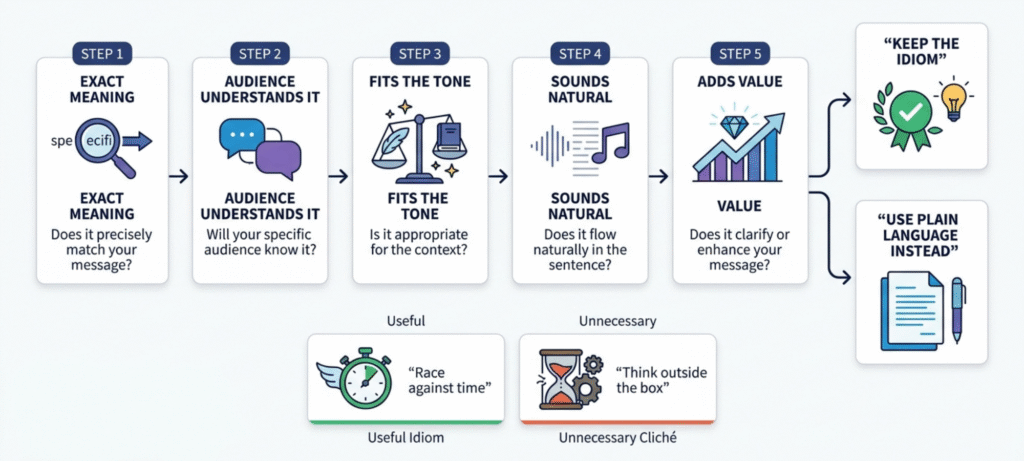
A simple run of questions helps here. Does the idiom mean exactly what you need it to mean? Will your audience actually get it? Does it fit the tone of the piece? Does it sound natural in that exact sentence? Does it add anything a plain sentence wouldn’t? If an idiom fails more than one of those, it’s usually safer to just cut it.
Idioms vs Metaphors vs Proverbs vs Clichés
Idiom: a fixed expression whose overall meaning differs from its literal wording. Kick the bucket means to die, nothing to do with any actual bucket.
Metaphor: a comparison, often invented on the spot, used to create an image. Her voice was ice isn’t a fixed phrase at all; it’s a comparison built for that one sentence.
Proverb: a traditional saying that usually hands out advice or a general truth. A stitch in time saves nine teaches a lesson about acting early rather than waiting.
Cliché: any expression or idea, idiomatic or not, that’s become so familiar it doesn’t hold much interest anymore. At the end of the day has become a cliché through sheer repetition, even though it started out as a perfectly ordinary idiom.
How to Learn and Remember English Idioms
Learning idioms off isolated lists rarely sticks, honestly. It works a lot better to group them by theme, learn the meaning and the context together instead of the definition alone, read a bunch of example sentences, and actually notice idioms when they show up in books, shows, or conversation. Writing a few original sentences with a new idiom cements it far better than just re-reading a definition over and over. Resources like the Cambridge Dictionary’s idioms section come in handy for checking exact wording and meaning when you’re not sure, since a slightly garbled idiom can throw off readers who know the correct version.
Students working through a rhetorical analysis or a close reading assignment run into figurative language questions like this all the time, and it helps to look at how a rhetorical analysis essay is usually structured, since idioms and other figurative devices show up constantly as analysis points in that kind of writing.
Common Mistakes When Using Idioms in Writing
The most frequent slip-ups: using an idiom with the wrong meaning, misquoting the wording slightly, dropping one into a context where it just doesn’t fit, blending two idioms into a garbled hybrid, stacking several in a row, choosing an overly casual idiom for formal writing, or picking an expression your specific audience probably won’t recognize. Any writing center’s style guide, Purdue’s Online Writing Lab included, will tell you the same thing: clarity for the reader always beats the urge to sound clever with an unusual phrase.
Frequently Asked Questions
What are idioms for writers?
They’re fixed figurative expressions writers use to add personality, imagery, or natural-sounding dialogue to a piece, as long as the phrase actually fits the tone and audience.
What are idioms for writers with meaning?
Same expressions, just paired with a plain-language explanation, since an idiom’s individual words rarely give away what the phrase actually means.
What are some good idioms for composition writing?
Expressions like “hit the nail on the head,” “in the long run,” “a double-edged sword,” and “a turning point” tend to work well in general essays without sounding too casual.
Can idioms be used in formal writing?
Yes, but selectively. Idioms that sound neutral and precise can work fine in formal writing, while highly conversational ones usually clash with academic or professional tone.
What are some idioms about books? “
Judge a book by its cover,” “an open book,” “read between the lines,” and “close the book on something” are common ones, though only a few are literally about books.
How do idioms improve writing?
They can compress emotion or meaning into a short, familiar phrase and make dialogue sound like something a real person would say, though they don’t automatically make writing better on their own.
What is an example of an idiom in a sentence?
“She burned the midnight oil to finish the report” uses “burn the midnight oil,” meaning she worked late into the night.
How many idioms should I use in an essay?
No fixed number really, but using a handful sparingly across the whole piece works better than piling several into one paragraph.
What is the difference between an idiom and a cliché?
An idiom is a fixed figurative phrase, while a cliché is any expression that’s been overused to the point it doesn’t feel fresh anymore, whether it started as an idiom or not.
Conclusion
The best idioms for writers aren’t the rarest ones sitting deep in some reference list. They’re the expressions that match the meaning you actually need, the tone of the piece, and the audience reading it. One well-placed idiom in a line of dialogue or a description can do more work than a full paragraph of plain explanation, but only when it earns that spot instead of just filling space out of habit. Learn a handful properly, pay attention to how they show up in the books and conversations around you, and reach for them when they genuinely say something plain language couldn’t.