
Picture the old idea of school. A chalkboard, a teacher up front, rows of desks. That’s still true for a lot of classrooms, but it’s not the whole story anymore. Someone can learn to speak Spanish just by talking to their neighbor every week. Someone else can become an electrician through years of hands on apprentice work. And plenty of people now earn a real, usable certificate without ever stepping foot on a campus. The way of education somebody chooses usually comes down to three things: what they’re trying to learn, how much guidance they need, and what’s actually available to them.
Let’s go through the main types of education, the different ways people actually learn today, the teaching methods behind all of it, and how tech and AI are changing pieces of the puzzle, without pretending they’ve replaced everything else.
So What Exactly Is a Way of Education?
In plain terms, it’s just how learning happens. Where it takes place, who’s guiding it, how much structure is involved, and how anyone checks if it actually worked. It’s a bigger idea than “school,” because school is only one place where learning happens, not the only one.
Think about it in pieces: where the learning occurs, how it gets delivered, who’s teaching or guiding it, how loose or structured it is, and how results get measured, whether that’s a final exam, a finished portfolio, or just someone getting better at their job.
A lot of people ask what the single best way of education is. Honestly, there isn’t one. A kid learning multiplication tables needs repetition and a teacher correcting mistakes along the way. A plumber learning to sweat a copper joint needs someone standing over their shoulder the first dozen times. An adult trying to get faster at Excel might just need a decent YouTube video and an afternoon of trial and error. All three count as real education. Comparing them head to head doesn’t really make sense, because they’re solving completely different problems.
The Three Big Types of Education
Most people who study this stuff sort education into three broad buckets. It’s not a perfect system, and plenty of learning doesn’t fit neatly into one box, but it’s still the most common way to talk about it.
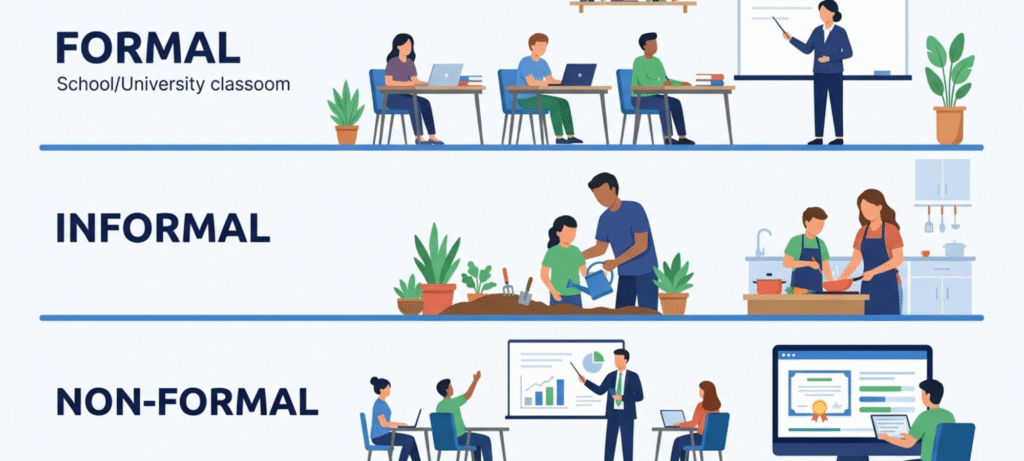
Formal education is the one everyone pictures first. It follows a set curriculum inside a school, college, or university, taught by trained teachers, and it usually ends with some kind of diploma or degree. The upside is consistency. Everyone covers roughly the same ground, and the credential at the end means something to employers. The downside is that it’s rigid. If you’re a fast learner or someone who needs extra time, tough luck, the class moves at one pace.
Informal education is the opposite. No fixed curriculum, no official instructor. It’s what you pick up from a parent showing you how to cook, a coworker who’s better at spreadsheets than you, or just reading things on your own time. It’s flexible and often surprisingly useful, but there’s no paper to show for it, and the quality really depends on who or what you happened to learn from.
Non formal education sits in the middle. Think community classes, a weekend certification course, or an online program that teaches you a specific skill. There’s structure and a clear goal, but it doesn’t drag on for years the way a degree does.
| Type | Structure | Where it happens | Example | Biggest win |
|---|---|---|---|---|
| Formal | High | Schools and universities | A four year degree | A recognized credential |
| Informal | Low | Home, work, everyday life | Learning to cook from a parent | Flexible and practical |
| Non formal | Medium | Workshops and online courses | A coding bootcamp | Quick, focused skills |
7 Practical Ways of Education
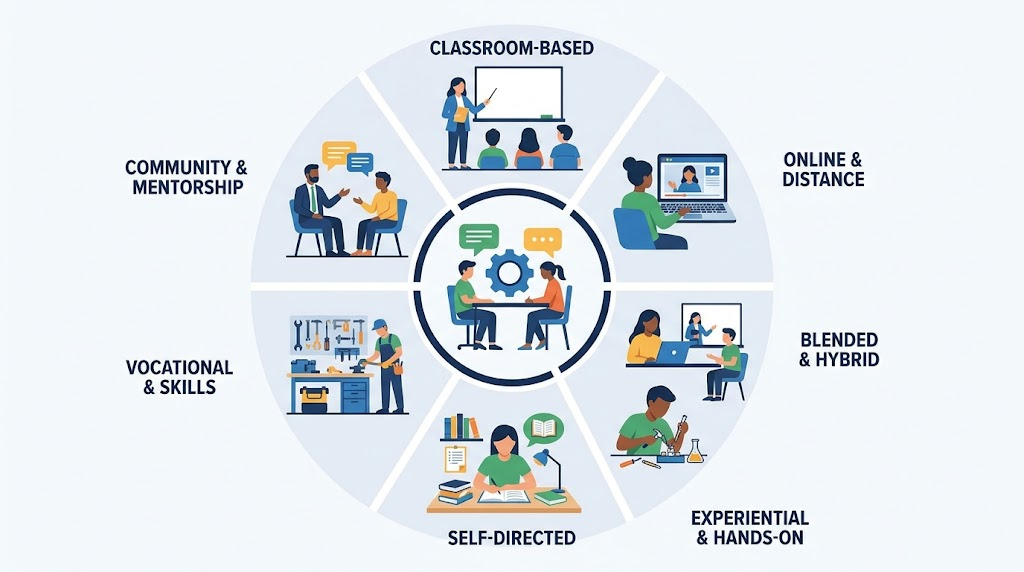
Inside and across those three buckets, learning actually happens through a handful of specific methods. Here are the seven that cover most of it.
- Classroom based education. Teacher, students, a room. It’s still great for subjects where you need feedback right away, like a lab class or early reading lessons. The catch is that a room full of thirty students moves at one speed, whether that fits you or not.
- Online and distance education. Everything delivered remotely through video, assignments, and discussion boards. It works well for people who can’t be physically present, like working parents or folks in remote areas. It’s rougher for anything that needs hands on supervision, like nursing or welding.
- Blended and hybrid learning. A mix of in person classes and online work. A lot of schools stumbled into this setup during the pandemic and just never went back. It offers structure without demanding your full physical presence every day.
- Experiential and hands on learning. You learn by doing, whether that’s a lab, an internship, or fieldwork. People remember this stuff longer because they’re the ones actually producing the outcome, not just watching someone else do it. It does usually need more supervision or access to real world settings than sitting in a lecture does.
- Self directed learning. You set your own goals and your own pace. Think of a teenager teaching themselves photo editing off YouTube, or an adult grinding through a coding course at night after work. Great for motivated, independent people, not so great if you need someone keeping you accountable.
- Vocational and skills based education. Training built around one specific trade, like plumbing, culinary work, or medical assisting. The point isn’t broad theory, it’s getting good at one job fast. It usually gets you working sooner than a traditional degree, though it’s narrower in what it covers.
- Community, mentorship, and informal learning. Knowledge passed down through tradition or a mentor relationship, like a young craftsman learning under someone who’s been doing the work for decades. You won’t get a certificate for it, but it shapes judgment in ways a classroom often can’t.
If you want more detail on how these categories fit together, our breakdown of the types of education goes a bit deeper into the differences.
Teaching Methods Aren’t the Same Thing as a Way of Education
Here’s where people often get confused. A way of education is the overall setup, the delivery structure. A teaching method is what actually happens once you’re inside that structure. They’re related, but not the same thing.
A few of the most common methods:
Lecture based learning, where the teacher just explains things directly. Fast for covering material, but not great for long term memory on its own.
Inquiry based learning, where students dig into a question themselves and figure out the answer along the way.
Project based learning, where a real (or realistic) project becomes the way multiple skills get practiced at once.
Collaborative learning, where students work in groups, picking up teamwork skills alongside the subject itself.
Personalized learning, where the pace adjusts to the individual student instead of the whole class moving together.
Technology based learning, where apps, software, and digital tools do some or all of the teaching.
Experiential learning, learning by doing and then reflecting on what happened afterward.
A classroom based setup might lean heavily on lectures, or it might run mostly on group projects inside that same room. The setting and the method are two different layers stacked on top of each other.
What This Actually Looks Like in Real Life
A college student sitting through daily lectures and taking semester exams is going through formal, classroom based education, plain and simple.
Someone working a full time job who finishes a data analytics certificate on weekends is mixing non formal and online education.
A teenager who taught themselves how to edit video through online tutorials is doing self directed, informal learning.
An apprentice plumber who studies the theory part time but spends most hours actually working under a licensed plumber is combining vocational training with hands on experience.
What all these examples really show is that most people move through more than one way of education, sometimes in the same month, sometimes in the same week.
Don’t Let Schooling Get in the Way of Your Education
This phrase pops up a lot in searches, and honestly, it points at something real. Schooling is the structured, official side of learning: attendance, grades, standardized tests. Education is bigger than that. It includes what you read on your own time, what you learn from experience, and the problems you work through outside of anything graded.
That doesn’t mean school is pointless. It gives structure, it exposes you to subjects you might never pick on your own, and the credential at the end opens doors. The warning is really about not treating grades as the whole point. Somebody who aces every test but never actually learns to think for themselves has finished schooling without gaining much real education.
There are a couple of related sayings floating around too. “Don’t let education get in the way of learning” is basically a reminder that classes should help you actually understand something, not just produce the right answer on a test. “Don’t let school get in the way of your education” says the same thing from another angle: the institution is a tool you use, not the finish line itself.
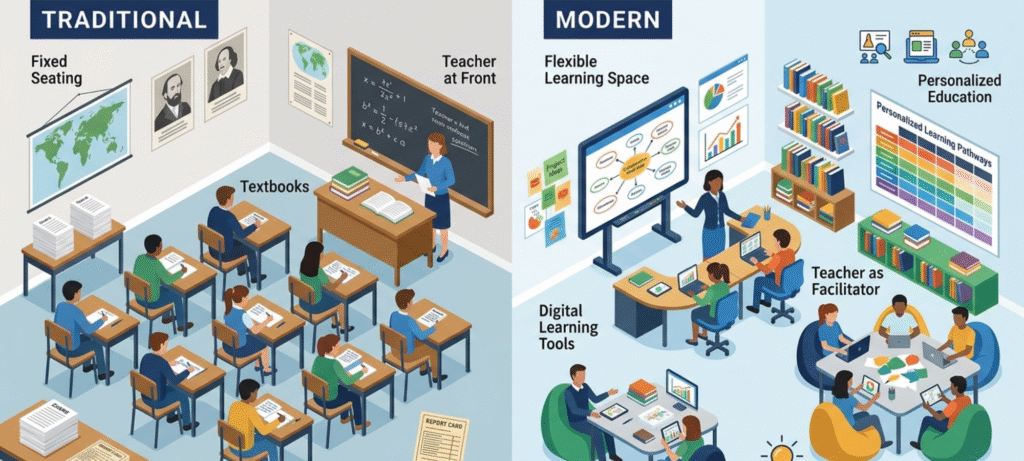
Old School vs. Modern Way of Education
| What’s Compared | Traditional way | Modern way |
|---|---|---|
| Teacher’s role | Main source of knowledge | Guide and facilitator |
| Setting | Physical classroom | Physical plus digital spaces |
| Pace | Same for everyone | Often personalized |
| Materials | Textbooks | Digital content, videos, interactive tools |
| Grading | Mostly exams | Exams plus projects and portfolios |
| Tech involved | Barely any | Central to how it runs |
| Flexibility | Low | Much higher, especially online |
Traditional methods still hold up well for things you build step by step, like basic math, and for younger kids who do better with routine. Modern setups give flexibility that helps working adults and remote learners. Neither one wins across the board. It really depends on the subject and the person learning it.
How Tech and AI Are Actually Changing Things
Digital learning used to be a nice extra. Now it’s just expected in a lot of schools. Learning management systems, recorded lessons, and platforms that adjust difficulty based on how you’re doing have all become normal. That’s genuinely useful for accessing material outside class hours.
But there’s a real downside too. The digital divide isn’t a theory, it’s a fact. Kids without reliable internet or a laptop at home fall behind classmates in schools that just assume everyone’s connected. Organizations like UNESCO track this kind of access gap globally, and it’s a bigger issue than people sometimes assume.
AI showed up in classrooms more recently, through tutoring apps, writing help, and automatic feedback tools. It’s not some miracle solution, and it’s not something to panic over either. Used well, it helps both students and teachers. Used carelessly, it opens up real problems around accuracy, privacy, and cheating. A few things that separate smart use from careless use:
- Treat AI as an assistant, not a replacement for actually thinking.
- Double check anything it tells you before trusting it.
- Keep student data and privacy protected on whatever platform is being used.
- Be upfront about when and how AI was used on an assignment.
- Don’t use it to fake your way through graded work.
- Keep an actual teacher in the loop for grading and support.
- Teach students to question what AI spits out instead of just accepting it.
Schools trying out AI in the classroom are honestly still figuring out where it genuinely helps and where it’s just noise. We wrote more about this in what AI powered classrooms could mean for teachers and students, if you want to dig into that a bit more.
7 Ways to Deal with Education’s Biggest Headaches
- Unequal access. Targeted funding and community programs help chip away at the gap, though it’s not something that fixes itself overnight.
- The digital divide. Getting devices and internet into more homes helps, but doesn’t completely close the gap.
- Teacher burnout. Better staffing and realistic class sizes take pressure off, when schools can actually afford it.
- Outdated curriculum. Regular updates that involve actual input from current industries keep material relevant.
- Too much focus on exams. Mixing in projects and portfolios paints a fuller picture of what a student can actually do.
- Not enough practical skills. More room for vocational and hands on learning helps students graduate ready for real work.
- Students checking out mentally. Project based, student centered teaching tends to hold attention better than a straight lecture.
Vocational Training and Career Focused Education
Not everyone needs a four year degree to build a solid career. Vocational programs, apprenticeships, and professional certifications offer a much more direct path into skilled trades like electrical work or healthcare support. These programs are built around actual job skills, not general theory.
The best results usually come from mixing classroom knowledge with real supervised practice. Someone learning wiring codes in a classroom and then applying that knowledge on actual job sites tends to build sharper judgment than someone who only studied the theory, or someone who just winged it with zero formal instruction.
Do Exams Actually Measure Learning Well?
Exams are decent at certain things: remembering facts, thinking fast under pressure, and showing command over a set body of material. What they’re genuinely bad at capturing is harder to pin down. Creativity, communication, teamwork, sticking with a long project over weeks, none of that shows up well in a timed written test. That’s a big reason a lot of modern grading now mixes exams with projects, portfolios, and presentations instead of relying on one test to sum everything up.
Can Education Actually Get Someone Out of Poverty?
Education can genuinely improve someone’s financial situation. Literacy, real qualifications, and useful skills tend to open up better paying, more stable jobs. But it’s not the whole answer either. Outcomes also hinge on things like school quality, cost, healthcare access, housing, and what the local job market actually looks like. Groups like the OECD publish research on this kind of thing regularly, and their data usually backs up that it’s about a mix of factors, not education alone. It works best as one piece of a bigger picture, not a guaranteed fix on its own.
On a more personal level, education shapes life in some pretty concrete ways too. It builds the kind of knowledge that helps with everyday decisions, from budgeting to figuring out what’s actually true online. It sharpens communication skills that matter in nearly every job. None of it guarantees a specific outcome, but it does keep widening the number of options someone has down the road.
Where Is Education Headed Next?
A few trends are already reshaping how learning looks. AI assisted personalization is becoming a lot more common in schools and on online platforms. Hybrid setups that blend in person and digital learning seem to be sticking around for good, not just a temporary pandemic fix. Micro credentials and digital certificates are also getting more respect alongside traditional degrees, especially in tech and skilled trades.
How will education change over the next ten years? That’s a fair question, and honestly the answer is an educated guess, not a certainty. Expect more blended learning, AI acting more like a support tool than a teacher replacement, and continued pressure to grade people on more than just standardized tests.
As for what education looks like by 2050, treat any prediction as a scenario, not a promise. Technology, job markets, and policy will all shape that together, and none of it is locked in yet.
Which Way of Education Actually Fits You?
Need a recognized credential? Formal education is usually the way to go. Need flexibility around a job or family life? Online or blended learning fits better. Want practical, job ready skills fast? Vocational or apprenticeship training gets you there quicker. If you’re the type who learns best on your own terms, self directed study is worth trying.
Frequently Asked Questions
What is a way of education?
It’s basically how learning happens, where it takes place, who’s guiding it, how structured it is, and how anyone measures the results.
What are the three main types of education?
Formal, informal, and non formal education.
What are 7 ways of education?
Classroom based, online and distance, blended and hybrid, experiential and hands on, self directed, vocational and skills based, and community or mentorship based learning.
What’s the real difference between formal and informal education?
Formal education runs on a set curriculum inside a recognized school and ends with a credential. Informal education just happens through everyday life, with no set structure.
What is the best way of education?
There really isn’t one single answer. It depends on the person, what they’re trying to learn, and how much structure works for them.
What does “don’t let schooling get in the way of your education” actually mean?
It’s basically a reminder not to treat school as the whole point of learning, since real education also comes from experience and independent thinking.
Can education really pull someone out of poverty?
It can genuinely help, but it’s not a guarantee on its own. Access, quality, and the local economy all play a role too.
Wrapping It Up
There’s no single right way of education, and honestly, trying to find one is kind of missing the point. What works for a kid learning algebra looks nothing like what works for someone learning to weld, or an adult picking up a new skill on their own time after work. Formal, informal, and non formal education all serve different purposes, and the seven ways of learning covered here overlap way more than they compete. The best approach is really just whichever one fits the learner’s goals, time, and need for structure, not whatever happens to be trending online.