

If you’re wondering how many credits to graduate high school in Arkansas, the general answer is at least 22, based on the current state minimum set by the Arkansas Department of Education, for both public high schools and public charter schools. That figure has stayed the minimum for a while now too, including 2020, 2021, and 2022, even as some specific course rules and additional requirements shifted around it over time. So 22 is worth committing to memory, but it’s not the entire story. Certain districts ask for more, and a handful of non-credit requirements are baked into the rules, ones that are genuinely easy to overlook if you’re only focused on that 22-credit total. Here’s the full breakdown, subject by subject.
How Many Credits to Graduate High School in Arkansas?
The Arkansas State Board of Education has set the state minimum at 22 credits for both public high schools and public charter schools. That’s the floor everyone has to clear, period.
Here’s where it gets a bit tricky. Local school districts are allowed to set their own graduation policy on top of that state minimum, and some genuinely do. Springdale School District, for one, requires students to earn 24 units instead of the standard 22, according to the district’s own graduation requirements page. So technically, a student could satisfy every state requirement and still come up short of what their own school actually expects at graduation. The safest approach is checking your district’s graduation requirements directly, or asking a counselor, since the state minimum and your school’s actual diploma requirement aren’t guaranteed to line up.
Arkansas High School Graduation Requirements at a Glance
Here’s the current 22-credit breakdown, based on the Arkansas DESE graduation requirements documentation.
| Requirement | Credits |
|---|---|
| English Language Arts | 4 |
| Mathematics | 4 |
| Science | 3 |
| Social Studies | 3 |
| Physical Education | 0.5 |
| Fine Arts | 0.5 |
| Oral Communication | 0.5 |
| Health and Safety | 0.5 |
| Career Focus or Content Electives | 6 |
| Total | 22 |
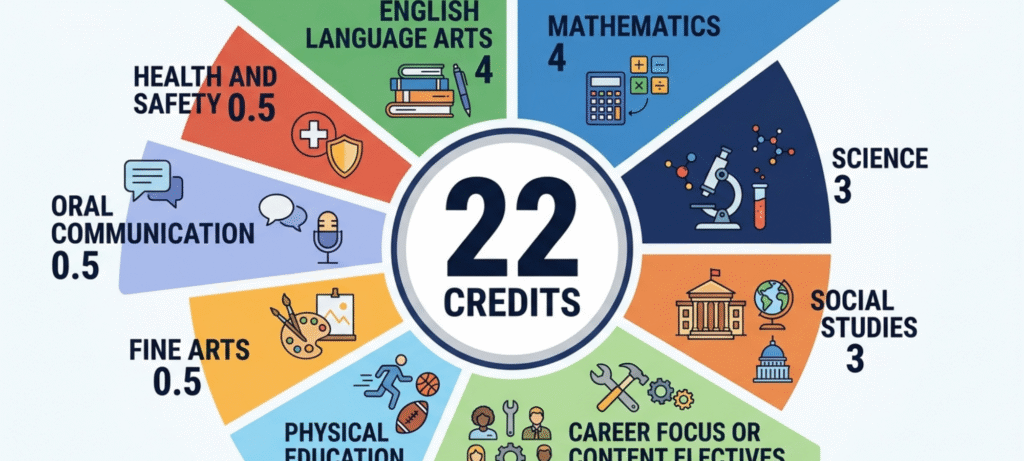
How the 22 Credits Add Up
It helps to see the math laid out plainly, since the table alone can be a lot to absorb at once.
English Language Arts: 4 Mathematics: 4 Science: 3 Social Studies: 3 Physical Education: 0.5 Fine Arts: 0.5 Oral Communication: 0.5 Health and Safety: 0.5 Career Focus or Content Electives: 6 Total: 22 credits
The four core academic subjects, English, math, science, and social studies, add up to 14 credits by themselves. The remaining 8 credits come from four half credit requirements plus the 6 credit Career Focus or Content Elective category, which is really where most of a student’s schedule flexibility comes from.
How Many English Credits Do You Need to Graduate in Arkansas?
Arkansas requires 4 English Language Arts credits for graduation. These are usually earned through English I, English II, English III, and English IV, or another ADE approved equivalent course. Schools sometimes offer alternatives like AP Language, AP Literature, or dual credit English through a local college in place of a standard course, and those can count too, as long as they’re approved. The point isn’t that every student has to follow one exact four year sequence. It’s that the state requires 4 full ELA credits by graduation, however a school structures the path to get there.
How Many Math Credits Are Required to Graduate in Arkansas?
Arkansas requires 4 mathematics credits. The current state framework includes Algebra I, Geometry, Algebra II or Transitional Quantitative Reasoning, and one additional ADE approved mathematics or Computer Science Flex Credit.
That last slot is where a lot of the confusion comes from. It doesn’t mean computer science simply swaps in for math whenever a student wants. It means the state allows an approved computer science course to fill that specific flex credit position under the graduation framework, and the exact course options can vary by school.
There’s also a distinction worth knowing about between the standard math pathway and Smart Core, which is Arkansas’s more rigorous college and career prep track. Smart Core generally expects students to complete Algebra II itself rather than substitute Quantitative Reasoning. If you’re not sure which track applies, the DESE curriculum guidance is the place to check, and a school counselor can confirm how it applies to a specific student.
How Many Science Credits Are Required?
Three credits. Biology is required, along with a physical science course, which can be Physical Science, Chemistry, or Physics depending on what a school offers.
The third science requirement can be met through an ADE approved science course, or through an approved Computer Science Flex Credit option under the state framework, similar to the math flex slot. It’s worth confirming the exact course combination with your school, since course approval and how the flex option gets applied can vary from one school to another.
How Many History Credits Do You Need to Graduate in Arkansas?
This is one of those questions where the honest answer requires a small correction. Arkansas doesn’t list “history” as its own separate graduation category. It falls under Social Studies, which totals 3 credits, broken down like this:
World History, 1 credit U.S. History, 1 credit Civics, 0.5 credit Economics with Personal Finance, 0.5 credit
So World History and U.S. History together make up 2 of the 3 social studies credits, with Civics and Economics filling in the rest. Calling the whole 3 credit block “history credits” isn’t quite accurate, even though that’s how most people phrase the question, and now you know what’s actually inside that number.
What Other Credits Are Required?
Beyond the four core subjects, Arkansas fills out the 22 credit total with a handful of smaller requirements:
Physical Education, 0.5 credit Fine Arts, 0.5 credit Oral Communication, 0.5 credit Health and Safety, 0.5 credit Career Focus or Content Electives, 6 credits
Those four half credit courses add up to 2 full credits. The 6 credit Career Focus or Content Elective block gives students room to fill out their schedule with whatever fits their program, which depending on the student and school might include career and technical education courses, additional academic classes, electives, or other approved coursework.
Do All Arkansas High Schools Require Exactly 22 Credits?
No, and this is genuinely one of the most useful things to understand here. The state sets 22 as the minimum, but individual districts are allowed to require more.
Springdale School District is a clear example. Their official graduation requirements page states that the district requires 24 units, two more than the DESE minimum. Other Arkansas districts follow the 22 credit state framework more closely, without adding extra requirements on top.
The takeaway is simple: meeting the state minimum doesn’t automatically mean a student has met their own school’s graduation requirement. Always check with your specific district, because “22 credits” on the state’s page and “22 credits” on your school’s actual diploma checklist aren’t guaranteed to be the same thing once local policy gets added in.
What Else Do You Need to Graduate in Arkansas?
Credits aren’t the entire graduation checklist. Arkansas has added several requirements over the past few years that sit outside the 22 credit total, and they’re easy to miss if you’re only looking at coursework.
Arkansas Civics Exam
Students must pass the Arkansas Civics Exam with a score of at least 60 percent, subject to any applicable exemptions.
Personal and Family Finance
Students must earn credit in a course that meets Arkansas’s personal and family finance standards. This is generally folded into the Economics with Personal Finance credit mentioned in the social studies breakdown.
CPR Training
Arkansas graduation requirements include hands on CPR and AED training, completed as part of the overall graduation process rather than a standalone academic credit.
Computer Science Requirement
A one credit approved Computer Science or Computer Science related CTE course is required under the current Arkansas graduation framework, for students covered by the applicable implementation year. Because this requirement was phased in rather than applying retroactively to every past graduating class, it’s worth double checking with a school counselor which year’s rules apply to a specific student, especially for anyone working from an older graduation plan.
Community Service Requirement
Students in the graduating class of 2027 and later must complete a minimum of 75 documented community service hours during grades 9 through 12, under Arkansas Code Annotated § 6-16-1901. This one is separate from the 22 credit total, and it’s exactly the kind of newer requirement that an older article or outdated school handout might not mention at all.

What Is Smart Core in Arkansas?
Smart Core is the college and career readiness curriculum track most Arkansas students follow by default. It’s not a separate credit total from the 22 credit minimum. Instead, it shapes which specific courses fill certain requirements, generally leaning toward the more rigorous option, like expecting Algebra II rather than a Quantitative Reasoning substitution in math.
| State Graduation Minimum | Smart Core | |
|---|---|---|
| Purpose | Meets the basic 22 credit graduation requirement | Designed as a more rigorous college and career prep pathway |
| Structure | 22 credit framework across required subjects | Same general framework, with specific course expectations layered in |
| Flexibility | Local districts may add credits on top | Can affect which courses count and how a transcript looks for college admissions |
Students who follow a different pathway, sometimes through a parent or guardian request, may end up with a slightly different course sequence. The exact opt out process and how it’s handled can vary and may change over time, so it’s not something to assume without confirming current DESE guidance or checking with a school counselor directly. What matters most for planning purposes is that Smart Core affects course choices and college readiness, not whether a student technically graduates.
How Many Credits Were Required in Arkansas in 2020, 2021, and 2022?
If you’re checking an older transcript or planning document, here’s the short version.
| Graduation Year | State Minimum |
|---|---|
| 2020 | 22 credits |
| 2021 | 22 credits |
| 2022 | 22 credits |
Twenty-two credits held as the statewide minimum across all three of those years, but that doesn’t mean every course rule or extra requirement stayed the same the whole time. Arkansas has tweaked some specific requirements and rollout timelines over the years, things like the computer science credit and the community service requirement, neither one existed for earlier graduating classes. Working from an older graduation plan? Worth checking DESE’s documentation from that exact year, or pulling your school’s own records, instead of assuming today’s course structure applied the same way back then.
How Many Credits Do You Need to Graduate With Honors?
No single statewide credit total in Arkansas automatically hands a student an honors diploma. Honors criteria get decided at the school or district level instead, and depending on where you are, that could mean GPA thresholds, course rigor, class rank, or a set number of honors and AP courses.
Piling on more than 22 credits doesn’t automatically translate into honors, in other words. Chasing honors recognition? Go straight to your school’s counseling office and ask about their exact GPA and course requirements, since these standards shift noticeably from one Arkansas high school to another.
What Is a High School Credit?
A credit gets earned by finishing an approved course, following whatever rules and grading policy the school has in place. Year-long courses usually run 1 full credit. Semester-long ones typically land at 0.5 credit, though the exact setup can shift depending on how a school structures its schedule.
What Happens If You Are Short on Credits?
If you’re short on credits, the first step is talking with a school counselor and figuring out exactly which requirement is missing. From there, a few common options usually come up.
Credit recovery programs let a student retake or make up a failed or incomplete course, often in a shorter, more focused format than the original class. Summer school covers similar ground during the break instead of extending into the next school year. Approved online coursework can help students who need more scheduling flexibility fill in a specific gap. Some students and schools work out an alternative schedule, adding an extra class period or an additional semester to catch up.
Arkansas also has a Credit by Demonstrated Mastery pathway, where a student can earn credit by proving mastery of a subject through assessment and an artifact review process, rather than repeating the entire course. It’s not the right fit for every situation, but it’s worth asking about for a student who already has strong knowledge in the specific subject they’re behind on.
Arkansas High School Graduation Requirements Checklist
22 credits total, made up of: 4 ELA credits 4 math credits 3 science credits 3 social studies credits 0.5 Physical Education 0.5 Fine Arts 0.5 Oral Communication 0.5 Health and Safety 6 Career Focus or Content Electives
Plus these additional requirements: Arkansas Civics Exam passed Personal and Family Finance requirement met CPR training completed Required computer science credit earned, based on applicable implementation year 75 community service hours, for the class of 2027 and beyond Local district requirements confirmed directly with your school
Helpful => SAT Reading and Writing Tips
Frequently Asked Questions
How many credits to graduate high school in Arkansas?
22 credits is the state minimum, subject to any additional local district requirements.
How many high school credits do you need to graduate in Arkansas?
The same 22 credit minimum applies statewide, though your specific district may require more.
Is 22 credits enough to graduate high school in Arkansas?
22 credits is the Arkansas state minimum for the standard public school graduation framework, but a local district may require additional credits or other requirements on top of that.
How many math credits are required to graduate in Arkansas?
Four math credits, generally Algebra I, Geometry, Algebra II or Transitional Quantitative Reasoning, and one additional approved math or computer science flex credit.
How many history credits are required to graduate in Arkansas?
History falls under the 3 credit Social Studies requirement, which includes World History, U.S. History, Civics, and Economics with Personal Finance.
Can an Arkansas school require more than 22 credits?
Yes. Local districts can set additional requirements above the state minimum, as Springdale does with its 24 credit policy.
How many volunteer hours are required to graduate from high school in Arkansas?
For the graduating class of 2027 and later, Arkansas requires 75 documented community service hours completed during grades 9 through 12.
How many credits do you need to graduate high school in Arkansas with honors?
There’s no single statewide honors credit requirement. Honors recognition is generally determined by the student’s school or district and can involve GPA, course rigor, honors or AP coursework, or other criteria that vary by school.
How many credits were required to graduate high school in Arkansas in 2022?
22 credits, the same as the current state minimum, though some specific requirements like the computer science and community service rules weren’t yet in place.
Can you graduate high school early in Arkansas?
Early graduation is possible for students who complete all applicable requirements ahead of schedule, but it depends on district and school policy, so it needs to be planned out with a counselor well in advance.
Conclusion
The short answer to how many credits to graduate high school in Arkansas is 22, set by the Arkansas Department of Education as the statewide minimum for public schools and public charter schools. But that number is really just the starting point. Between district specific requirements like Springdale’s 24 credit policy, non credit rules like the Civics Exam and the newer community service hours, and details tucked inside subjects like math and social studies, there’s more to track than a single number suggests. The safest approach is to treat 22 as the baseline, then confirm the specific details directly with your own school, since graduation in Arkansas depends on both state and local requirements working together.
read more => Easygrader