

Finding an online calculus 3 for credit community college transfer option can be harder than simply finding an online math class. The course itself usually isn’t the hard part. Plenty of schools offer it. What’s actually difficult is figuring out whether the credit you earn will be accepted by the college or university where you plan to use it. College credit and transferable credit sound like the same thing, but they aren’t, and mixing them up can cost you both time and money.
This guide walks through where to find Calculus III online, how community colleges fit into the picture, what the course actually covers, and how to verify that your credit will transfer before you pay for anything.
Key Takeaways: Calculus 3 & Credit Transfer
Get written approval from your academic advisor or registrar.
Pacing vs. Policy: Both self-paced and traditional semester-based courses can transfer successfully. Ultimately, the receiving school’s specific policy matters most.
Course Overview: Calculus 3 is also known as Multivariable Calculus or Vector Calculus, and it typically carries 3 to 4 semester credits.
The Transfer Reality: Earning credit is not the same as earning transferable credit. The receiving school always makes the final decision about what it accepts.
Your Main Options: You can choose from a community college, a university self-paced course, or an independent provider.
Crucial Pre-Enrollment Steps: Before signing up anywhere:
Check the institution’s accreditation status.
Compare the course syllabus with your home institution’s requirements.
How to Find an Online Calculus 3 for Credit Community College Transfer Course
Yes, students can take Calculus III online for legitimate college credit, and there are a few different paths to do it. Community colleges, four year universities, and a handful of independent providers all offer online sections. Some are self paced. Others run on a traditional semester schedule.
Here’s the part that trips people up. Earning credit and transferring credit are two separate steps. A course can be fully accredited and still get rejected by a specific receiving school if the content, credit hours, or grading structure don’t line up with what that school actually requires. Before you enroll anywhere, it helps to have a rough sense of your options and a plan for checking transferability, which is what the rest of this guide walks through.
What Does Transfer Credit Actually Mean for Calculus 3?
Transfer credit means your receiving college or university agrees to count coursework you completed somewhere else toward your degree. That doesn’t automatically mean the course will replace its exact Calculus III requirement.
In some cases, a course transfers in as the specific Calculus III equivalent. In other cases, it might come in as a general math elective, or as unassigned transfer credit that doesn’t satisfy a required course at all. The difference matters a lot if you’re taking Calculus III specifically because your program requires it.
There’s a simple way to think about it. Course credit is what you earn by completing the class. Accepted credit is what your receiving school agrees to count. Degree requirement credit is confirmation that the course specifically satisfies the Calculus III requirement in your program, not just a generic elective slot. Getting all three lined up before you enroll is really the whole point of this guide.
What Is Calculus 3?
Calculus 3 goes by a few names depending on the school. Multivariable Calculus, Calculus III, or sometimes Vector Calculus. These terms often overlap, although the exact course content and title can vary by institution.
Where Calculus I covers single variable functions and Calculus II moves into integration techniques, sequences, and series, Calculus III extends everything into three dimensional space. Instead of working with one variable at a time, you’re working with functions of two or more variables, along with vectors that describe direction and magnitude.
What Topics Does Calculus 3 Cover?
A typical online multivariable calculus course touches on:
Vectors and 3D geometry
Vector valued functions
Partial derivatives and gradients
Double and triple integrals
Vector fields
Line integrals and surface integrals
Green’s theorem, Stokes’ theorem, and the divergence theorem
These topics matter beyond just passing the class. When you’re trying to confirm transfer credit later, the receiving school will often compare this exact list of topics against your course syllabus.
Where Can You Take Calculus 3 Online for College Credit?
There are a few categories worth knowing about.
Community Colleges
Many community colleges run online Calculus III sections, especially in summer and fall terms. Some allow visiting or non-degree students to enroll specifically to earn credits for transfer.
Four Year Universities
Some universities offer self paced, enroll anytime Calculus III courses built for exactly this kind of transfer situation. The University of North Dakota is one well known example, offering an enroll anytime Calculus III course with a minimum completion window. You can review the current course details directly on the University of North Dakota’s online course page before enrolling.
Self Paced Online Providers
Independent providers, like Westcott Courses, partner with accredited institutions to issue transferable credit outside a traditional college enrollment.
SUNY Online and Similar State Systems
State systems also offer virtual multivariable calculus sections that are open to students outside their home institution. If that route interests you, SUNY Online lists current course offerings and enrollment details for visiting students.
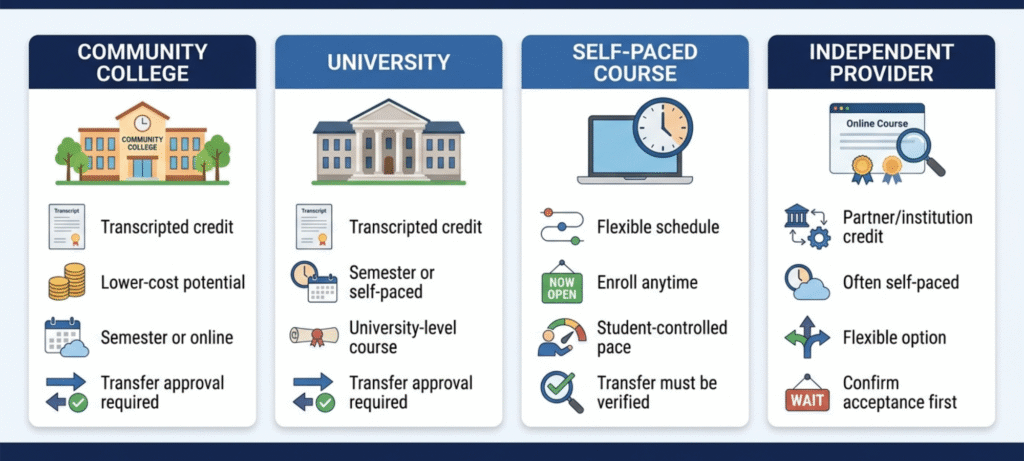
Community College vs University vs Independent Provider
Here’s a quick side by side comparison to help narrow things down before you start researching individual schools.
| Option | Credit Type | Typical Format | Cost | Transfer Check |
|---|---|---|---|---|
| Community College | Transcripted college credit | Semester or online | Often lower, especially in state | Required |
| University | Transcripted college credit | Semester or self paced | Varies by school | Required |
| Independent Provider | Partner or institution issued credit | Usually self paced | Varies by provider | Especially important |
None of these categories is automatically the best choice. What matters is whether the specific course lines up with what your target school wants. When comparing options, look at credit hours, course format, prerequisites, accreditation, tuition, exam requirements, and transfer policy.
Online Calculus 3 for Credit Through a Community College
A community college is often the most straightforward route if traditional transcripted credit is your goal. Tuition tends to be lower than a university course, you get an official transcript, and most community colleges already have established transfer agreements with in state four year schools.
Availability shifts by term, so not every community college offers an online Calculus III section every semester. Some schools cap enrollment for non degree or visiting students, so it’s worth checking early rather than assuming a seat will be open.
If you’re weighing your options and want a sense of how advisors typically guide students through this kind of decision, this piece on why advising matters for community college students covers the kind of questions worth asking before you commit.
What If Your Community College Doesn’t Offer Calculus 3 Online?
If your local community college doesn’t have an online Calculus III section this term, you don’t necessarily have to wait until the next one. A few options worth checking first are nearby community colleges in your state, statewide online course systems, visiting student enrollment at another campus, and accredited universities offering distance sections.
The important part stays the same no matter which route you pick. Get transfer approval from your home institution before you enroll somewhere else, not after.
How to Make Sure Calculus 3 Credits Will Transfer
This is the part that actually protects your time and money, so it’s worth doing in order.
Identify the exact course. Make sure it’s labeled Calculus III, Multivariable Calculus, or Vector Calculus, not a lower level course with a similar name.
Check the credit hours. Most Calculus III courses run 3 to 4 semester credits, but this varies.
Check the institution’s accreditation status, and more importantly, confirm with the receiving college that the specific course will satisfy your degree requirement. Accreditation is an important part of the evaluation, but it does not guarantee transfer acceptance on its own.
Read the full syllabus and compare it against your target school’s course description.
Check any transfer equivalency database your receiving school publishes, if one exists.
Contact the registrar or your academic advisor directly.
Ask specifically whether the course satisfies your exact degree requirement, not just a general math elective.
Confirm the minimum grade needed for transfer. Some schools require a C or better.
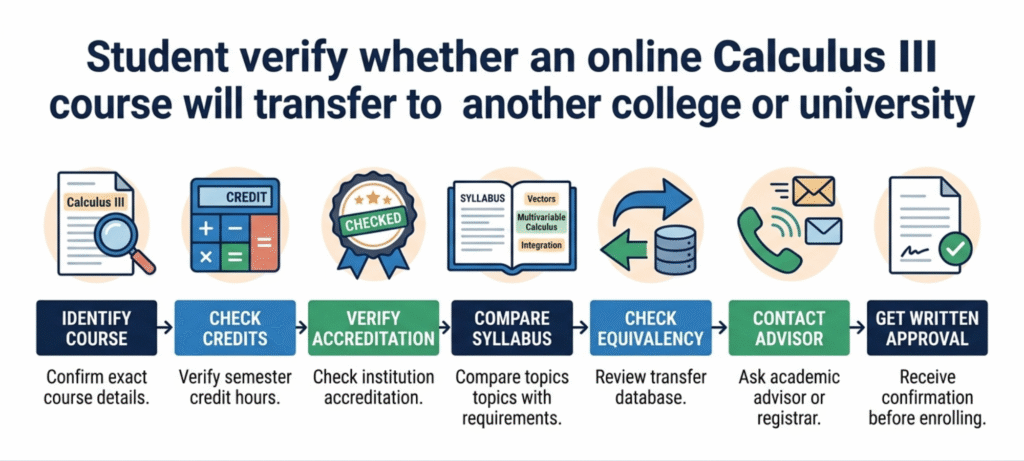
Get the approval in writing before you enroll or pay.
Save the syllabus, course description, and any written confirmation for your records.
Taking a course for college credit is not the same as knowing your target school will accept that credit. Skipping this verification step is one of the most important mistakes to avoid when searching for an online calculus 3 for credit community college transfer option.
A short email to your advisor can cover most of this at once. Something like: “I’m planning to enroll in this course at this institution. Could you confirm whether it satisfies the Calculus III requirement for my program and how it would transfer.”
What to Look for in a Calculus 3 Syllabus
When you’re comparing a syllabus against your target school’s course description, focus on the actual topic list rather than the course title alone. Check that it covers vectors and vector geometry, functions of several variables, partial derivatives, multiple integrals, vector fields, line and surface integrals, and the major theorems, Green’s, Stokes’, and the divergence theorem.
Also look at how the course is graded and structured. Note the exam and assessment format, whether exams are proctored, and the total credit hours. If a syllabus is missing several of these core topics, that’s worth flagging to your advisor before you enroll, since it could affect whether the course is treated as a true Calculus III equivalent.
Transcripted Credit vs ACE or NCCRS Credit
It’s worth understanding the difference between these two before you commit to a provider. A transcripted course appears directly on an official college or university transcript, issued by the school that taught it. ACE or NCCRS credit recommendations work a bit differently. Those are evaluations that suggest a course is worth college credit, but each receiving institution still decides independently whether it wants to award credit based on that recommendation.
If Calculus III is a required course in your major, transcripted credit from an accredited college or university is often more straightforward to get evaluated, simply because it’s a familiar format for most registrars. That said, your receiving institution still makes the final call either way, so this distinction doesn’t remove the need to confirm acceptance in advance.
Self Paced vs Semester Based Online Calculus 3
Self paced Calculus III courses tend to appeal to working students and anyone juggling an unpredictable schedule, while semester based courses offer more structure and regular instructor contact.
| Feature | Self Paced | Semester Based |
|---|---|---|
| Schedule | Flexible | Fixed |
| Deadlines | Often flexible | Set by the term |
| Pace | Student controlled | Instructor controlled |
| Exams | Usually required and proctored | Scheduled around term dates |
| Best for | Busy or nontraditional students | Students who want structure |
| Transfer | Must be verified individually | Must be verified individually |
Neither format automatically transfers better than the other. A self paced course from an accredited institution can transfer just as well as a semester based one. The deciding factor is always the receiving school’s own evaluation of that specific course.
Online Calculus 3 Summer Courses
Summer sections exist mostly because students need to keep a degree plan on track. Maybe you dropped Calculus II in the spring, or you’re trying to free up your fall schedule, or a transfer deadline is coming up faster than expected.
An accelerated summer Calculus III course packs the same material into a shorter window, which means the weekly workload is heavier than a standard sixteen week term. It’s a reasonable option if you’re organized and can put in consistent hours each week, but it’s worth checking the exact course length before assuming it will fit comfortably around a summer job or other commitments.
Can You Take Calculus 3 Online for Free?
Free learning resources and free college credit are not the same thing. Plenty of platforms offer free lectures, practice problems, and conceptual walkthroughs of multivariable calculus, which are genuinely useful for review or self study. Most of them don’t issue a transcripted, transferable college credit on their own though.
If your goal is genuinely free credit, look specifically for ACE or NCCRS credit recommended options. These can sometimes be accepted as elective credit, but many math heavy programs, including engineering, require a direct college transcript for core courses like Calculus III. Confirm with your specific program before assuming an ACE or NCCRS recommendation will count.
University of North Dakota Calculus 3 Online
UND offers an online, self paced Calculus III course through its distance program, built around an enroll anytime structure. It’s one of the more commonly searched options because that flexibility appeals to students trying to fit the course around an existing schedule.
Course details, credit hours, and pricing can change from term to term, so it’s worth checking UND’s current course page directly rather than relying on older information. The bigger point still holds either way. The fact that UND awards college credit doesn’t guarantee every receiving school will accept it. Course numbering, topic coverage, and credit hour requirements vary by institution, so confirm with your target school before enrolling, using the same verification steps outlined earlier in this guide.
Westcott Courses Calculus 3
Westcott Courses offers a Calculus III option with semester credit intended to be transfer applicable toward a four year degree. It’s partnered with accredited institutions, which is part of why it comes up frequently in discussions about independent credit providers, including on forums like Reddit where students share their own enrollment experiences.
Those kinds of student posts can be useful for getting a feel for the course, but they aren’t a substitute for official transfer policy. Before enrolling, ask your receiving institution whether Westcott’s specific Calculus III credit satisfies your requirement. Independent providers can be a good fit once you’ve confirmed acceptance, but confirming first, rather than after paying, saves a lot of frustration.
How Much Does Online Calculus 3 Cost?
There’s no single universal price, since cost depends heavily on where you enroll. Community college tuition is often the cheapest route, particularly for in state or in district students, though nonresident rates can be significantly higher. University courses and independent providers tend to charge flat per course rates that don’t depend on residency, which can occasionally make them cheaper for out of state students.
On top of tuition, budget for application fees, textbooks or course materials, and proctoring or exam fees if the course requires them. Because tuition and fees change fairly often, it’s worth checking the current pricing page for whichever school or provider you’re considering rather than relying on a number you saw somewhere else.
What Are the Prerequisites for Calculus 3?
Most programs require Calculus I and Calculus II before you can register for Calculus III. Calculus II is a common prerequisite, although requirements vary by institution. A solid algebra and trigonometry background helps too, since 3D geometry and vector work lean on those fundamentals. Some familiarity with vectors from physics or precalculus can make the transition smoother, though it’s rarely a strict requirement.
Exact prerequisites vary by institution, so it’s worth double checking the specific course page rather than assuming your prior coursework automatically qualifies.
Is Online Calculus 3 Hard?
Many students find Calculus III challenging because of the shift to three dimensional thinking and multiple variables. Visualizing surfaces, working with multiple variables at once, and keeping partial derivatives and multiple integrals straight all take practice.
A few things help. Work problems consistently instead of cramming. Draw out 3D diagrams even when it feels unnecessary. Keep a running formula sheet. And try not to fall behind, since accelerated summer sections in particular move fast enough that a missed week can snowball quickly.
If you want a broader refresher on exam prep habits before diving into an intensive course like this, this guide on how to study for a math exam covers strategies that carry over well to calculus heavy coursework.
How to Enroll in an Online Calculus 3 Course Step by Step
Once you’ve picked a course and confirmed it looks like a good fit, the actual enrollment process usually follows a similar pattern regardless of where you’re taking it:
- Find the course and confirm it’s labeled correctly as Calculus III, Multivariable Calculus, or Vector Calculus.
- Check that you meet the prerequisites, usually Calculus I and Calculus II.
- Apply as a visiting or non-degree student if you’re not already enrolled at that institution.
- Get transfer approval in writing from your home school’s registrar or advisor before you pay.
- Register for the course and pay tuition and any associated fees.
- Complete the course, including any required proctored exams.
- Request an official transcript once the course is finished and graded.
- Send that transcript to your receiving school and follow up to confirm the credit posted correctly.
Note: Missing a step here, especially the written approval, is usually what causes problems later, so it’s worth treating this as a checklist rather than a rough guideline.
Which Online Calculus 3 Option Is Best for Transfer Students?
There isn’t one universal best option. It depends on what you actually need:
Choose an independent provider only after your receiving school has confirmed it will accept that specific course.
Choose a community college if you want traditional transcripted credit and a straightforward transfer process.
Choose a university course if your target school needs a specific university level equivalency.
Choose a self-paced option if your schedule is unpredictable and you need flexibility.
Choose a summer course if you’re racing a transfer or graduation deadline.
Choose free resources if you only need to learn or review the material, not earn transferable credit.
Online Calculus 3 Transfer Checklist
Before enrolling anywhere, confirm:
- The course is titled Calculus III, Multivariable Calculus, or Vector Calculus
- The correct number of credit hours
- The institution’s accreditation status
- The full syllabus matches your target course
- Prerequisites are satisfied
- Exam and proctoring requirements fit your situation
- Transfer equivalency has been checked
- Your registrar or advisor has approved it
- You have written confirmation saved
- The minimum required grade is clear
Tip: Keep a folder with the syllabus, course description, and any written approvals. You’ll likely need them later when you submit transfer paperwork.
FAQs
Can I take Calculus 3 online for college credit?
Yes. Community colleges, universities, and some independent providers all offer online Calculus III for legitimate credit. Whether that credit transfers depends on your receiving institution.
Where can I take Calculus 3 online?
Options include community college sections, university self paced courses like UND’s, and independent providers such as Westcott Courses.
Can community college Calculus 3 transfer to a university?
Often, yes, but it depends on course equivalency, accreditation, and the receiving school’s evaluation, not on the community college alone.
Is there a free online Calculus 3 course for college credit?
Free resources exist for learning the material, but transcripted, transferable credit almost always requires a paid, accredited course.
Can I take Calculus 3 online during summer?
Yes, many schools offer accelerated summer sections, though the pace is faster than a standard term.
Is there a self paced Calculus 3 course?
Yes. Several universities and independent providers offer self paced, enroll anytime options.
What is Calculus 3 also called?
Multivariable Calculus and Vector Calculus are the most common alternate names.
How many credits is Calculus 3?
Most courses carry 3 to 4 semester credits, though this varies by institution.
Can I take Calculus 3 without Calculus 2?
Usually not. Calculus II is a common prerequisite for Calculus III, although individual colleges may have different prerequisite or placement policies.
How do I verify Calculus 3 transfer credit?
Contact your registrar or academic advisor, compare the syllabus to your degree requirement, and get written approval before enrolling.
Does Calculus 3 transfer to engineering programs?
Often, yes, if the course matches the program’s Calculus III requirements, but many engineering schools require a direct college transcript and specific topic coverage. Confirm with the department directly.
How long does an online Calculus 3 course take?
Standard terms usually run 12 to 16 weeks. Self paced courses often allow a few months to complete. Accelerated summer sections can run as short as 6 to 8 weeks with a heavier weekly load.
Final Thoughts
An online calculus 3 for credit community college transfer search usually comes down to one thing. Verification. The course itself is easy enough to find. Community colleges, universities, and independent providers all offer solid options. What separates a smooth transfer from a wasted semester is whether you confirmed acceptance with your receiving school before you enrolled.
The safest path is simple. Find the course, check the credit hours and accreditation, compare the syllabus, contact your advisor, and get written approval. Do that first, and the rest of the process tends to fall into place.
This article is meant as general information about online Calculus 3 options and transfer considerations, not academic or admissions advice. Policies vary by institution, so always confirm the details with your own registrar or advisor before enrolling.