
So, what are basic facts in math, really? Think of them as the go-to number relationships tied to addition, subtraction, multiplication and division — the ones a student is expected to pull out instantly, without second-guessing. Pairs such as 7 + 5, 12 − 5, 3 × 4 or 12 ÷ 3 show up buried inside nearly every bigger problem a kid will come across.
Where exactly the line gets drawn depends on who you ask. Some curriculums keep basic math facts strictly to single-digit pairs. Others widen the net to cover anything involving 10, or push all the way to the 10 × 10 multiplication table. None of that disagreement is a big deal — the underlying goal stays the same either way: a learner should get to a point where these numbers click without needing to count them out on fingers.
What follows in this guide covers all four fact types, walks through solid basic math facts examples, breaks down fact families and fluency, and hands you a practice routine you can start using right away this week.
What Are Basic Facts in Math?
In ordinary conversation, calling something a “fact” just means it’s true. Math works a bit differently — a fact there is a relationship between numbers that stays fixed no matter what. Add seven and five and you’ll get twelve, every single time, forever. Because that connection never shifts, it’s something a mind can store away permanently instead of working it out fresh each time it’s needed.
That’s the real answer when someone asks what are basic facts in math — teachers are pointing to the tiniest, most reusable building blocks in this category, the small-number relationships tied to the four core operations.
Take this equation:
7 + 5 = 12
The connection between 7, 5 and 12 is a basic addition fact. Once a student owns that relationship, three more come almost free:
- 5 + 7 = 12
- 12 − 5 = 7
- 12 − 7 = 5
That grouping has a name, and we will get to it shortly.
The difference between a basic fact and a larger calculation is scale, not type. 7 + 5 is a fact. 47 + 35 is a computation that uses facts. A student who owns the fact can concentrate on regrouping and place value. A student who does not is solving two problems at once, and the second one usually collapses.
What Are the Four Types of Basic Math Facts?
Basic facts sit inside four operations. Each one has its own vocabulary, its own patterns, and a link back to the operation before it.
Basic Addition Facts
Examples:
- 2 + 3 = 5
- 4 + 6 = 10
- 7 + 8 = 15
- 9 + 9 = 18
The numbers being joined are addends and the answer is the sum. Two ideas make addition facts far easier than brute memorization. First, the commutative property. Since 4 + 6 and 6 + 4 give the same sum, the number of separate facts to learn drops by almost half. Second, anchor patterns. Doubles facts such as 6 + 6 and 8 + 8, along with making ten combinations like 7 + 3 and 8 + 2, give students number bonds they can reason from while recall is still developing.
Basic Subtraction Facts
Examples:
- 8 − 3 = 5
- 12 − 4 = 8
- 15 − 7 = 8
The starting number is the minuend, the number removed is the subtrahend, and the answer is the difference. Subtraction facts are the inverse of addition facts, and that is the single most useful thing a student can understand about them. A child who knows 8 + 7 = 15 already holds 15 − 7 = 8. Nobody has shown them that they hold it.
Basic Multiplication Facts
Examples:
- 2 × 5 = 10
- 4 × 6 = 24
- 7 × 8 = 56
The numbers multiplied are factors and the answer is the product. Multiplication is repeated addition organised into equal groups, so 4 × 6 means four groups of six. Arrays help enormously here. A grid of four rows by six columns makes the product visible instead of abstract, and rotating it makes the commutative property obvious without any explanation.
Basic Division Facts
Examples:
- 10 ÷ 2 = 5
- 24 ÷ 6 = 4
- 56 ÷ 8 = 7
The number being split is the dividend, the number you split by is the divisor, and the answer is the quotient. Division facts mirror multiplication facts the same way subtraction mirrors addition. Knowing 7 × 8 = 56 already means knowing 56 ÷ 8 = 7. Students who treat division as a fresh set of unrelated facts carry twice the load for no reason at all.
What Counts as a Basic Math Fact?
Nobody’s put together one master checklist that pins down every single basic math fact — that kind of thing just doesn’t exist. Walk into most elementary classrooms, though, and you’ll find teachers using the term for something specific: those small-number calculations kids need to handle fast and without much thought, particularly single-digit addition, subtraction, multiplication, and whatever division facts naturally tag along. And here’s the part people miss — it was never about memorizing a worksheet full of correct answers. Kids also need to catch how those answers link up with each other.
Take this as an example. A student who’s got 8 + 7 = 15 down cold has, almost without realizing it, also picked up 15 − 8, 15 − 7, and a handful of other combinations tied to those same numbers. Multiplication works the exact same way — once 6 × 7 = 42 sticks, both 42 ÷ 6 and 42 ÷ 7 are more or less already learned. That’s the whole reason basic math facts practice lands better when kids are pushed to notice these patterns and connections, instead of approaching every new equation like it dropped out of nowhere.
Basic Math Facts Examples
Here is a compact set of examples across all four operations.
Addition: 6 + 7 = 13 and 8 + 5 = 13
Subtraction: 13 − 6 = 7 and 15 − 8 = 7
Multiplication: 6 × 4 = 24 and 7 × 8 = 56
Division: 24 ÷ 6 = 4 and 56 ÷ 8 = 7
Look closely and that is not eight separate items. The first addition fact and the first subtraction fact share the numbers 6, 7 and 13. The first multiplication fact and the first division fact share 6, 4 and 24. The relationships repeat, which is exactly the point. Elementary math facts come in connected sets, never in isolated pieces.
What Are Fact Families in Math?
A fact family is a small group of equations built from the same three numbers. It is one of the most efficient ideas in elementary mathematics because it turns four things to remember into one thing to understand.
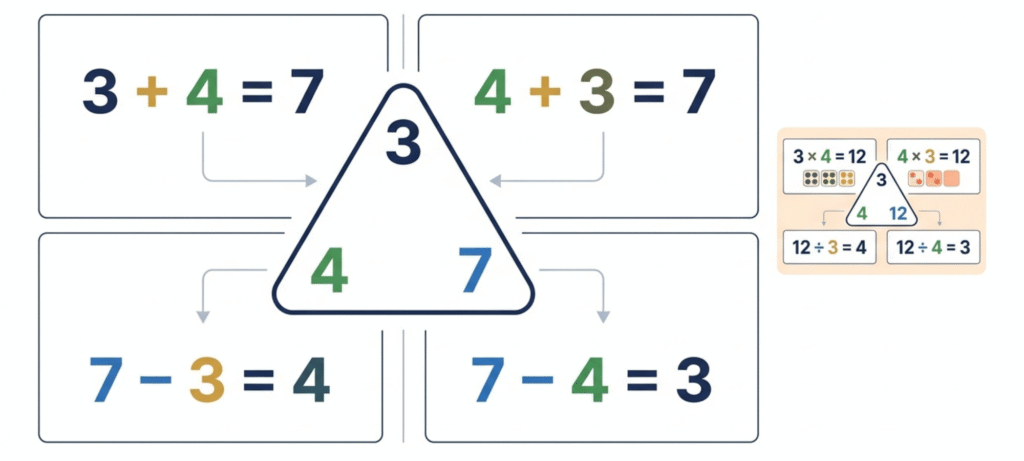
Using 3, 4 and 7:
- 3 + 4 = 7
- 4 + 3 = 7
- 7 − 3 = 4
- 7 − 4 = 3
Using 3, 4 and 12:
- 3 × 4 = 12
- 4 × 3 = 12
- 12 ÷ 3 = 4
- 12 ÷ 4 = 3
Fact families in math do two jobs at once. They cut the memorization load dramatically, and they teach the relationship between inverse operations, so subtraction undoes addition and division undoes multiplication. Fact triangles, where the three numbers sit at the corners of a triangle, exist for exactly this reason. Cover one corner and the child has to produce the missing number using whichever operation fits.
Why Are Basic Math Facts Important?
The honest answer is about attention rather than speed for its own sake.
They free up working memory. A student solving 234 × 7 has to track place value, regrouping and a sequence of steps. If every small multiplication also demands effort, nothing is left over for the procedure itself. Fluent recall reduces how much attention simple calculations consume, which leaves room for the harder thinking.
They make mental math possible. Estimating a bill, checking change, doubling a recipe. None of that works if every small step needs paper.
They support fractions, decimals and ratios. A student who knows 3 × 4 = 12 handles a common denominator of 12 without friction. A student who does not is fighting two battles in one question.
They also extend to bigger numbers. The University of Chicago’s Everyday Mathematics program describes this as fact extensions. A child who knows 3 + 4 = 7 can apply the same relationship to 30 + 40 = 70 and then to 300 + 400 = 700. One fact, many uses.
What math facts do not do is guarantee mathematical success on their own. Memorized answers with nothing underneath tend to collapse under pressure or in an unfamiliar format. Recall is a tool that makes room for reasoning. It is not a replacement for it.
What Is Math Fact Fluency?
Fluency is where most of the confusion lives, so the two ideas are worth separating.
Knowing a fact means a student can produce 7 + 8 = 15 eventually, perhaps by counting on from eight.
Fluency means producing it accurately and efficiently, through recall or a quick reliable strategy, without counting from one.
Notice what fluency is not. It is not raw speed. A child who answers in two seconds using a solid strategy, thinking that 7 + 8 is 7 + 7 plus one more, is fluent. A child who blurts answers fast and wrong is not. Timed tests measure one narrow slice of arithmetic fluency and, for anxious learners, often measure anxiety instead.
These days, math instruction usually bundles math fact fluency into three things happening together: accuracy, efficiency, and flexibility. Out of those, flexibility carries the most weight. What that really means is a student isn’t stuck with just one way to reach an answer — so if their memory blanks for a second, it doesn’t leave them completely stuck.
What Is the Difference Between Math Facts and Math Fact Fluency?
Math facts are the individual number relationships themselves, while fluency is a different thing entirely — it’s about how smoothly a student can actually put those facts to work. Someone might technically know that 9 × 6 = 54 and still need a few seconds every time to land on it. Once fluency builds up, though, that same fact stops being a separate step and just folds naturally into whatever bigger problem they’re solving.
This distinction isn’t just semantics — it matters because fluency doesn’t show up overnight. Kids typically start out counting objects, then shift toward strategies like doubling, making ten, or splitting a multiplication fact into smaller, easier pieces, and only later does quick, automatic recall kick in. Solid basic math facts practice is built around supporting that whole journey, not around expecting a student to have everything memorized by the end of week one.
When Do Kids Learn Basic Math Facts?
Be careful with any source that presents a fixed grade schedule as universal law. Schools introduce facts progressively and the exact timing varies by curriculum, by school and by student.
The general progression usually looks like this. Early elementary focuses on addition and subtraction facts. Middle elementary moves into multiplication. Division follows once multiplication is secure. Fact families, mental math and fact extensions run across all of those years rather than belonging to any one of them.
Curriculum specific expectations do exist. Everyday Mathematics, for instance, expects automatic recall of basic addition and subtraction facts by the end of Grade 2 and multiplication facts by the end of Grade 4 within its own program. Other publishers set different milestones, and the Common Core State Standards describe fluency expectations in their own terms.
The sequence matters more than the calendar. If a fourth grader is struggling with multiplication, checking their addition facts first is usually more productive than more multiplication drill, because the foundation is where the leak actually is.
How Can Kids Learn Basic Math Facts?
This is where good intentions most often go wrong. A hundred flashcards on day one is not a plan.
Start with understanding. Before drilling 6 × 7, make sure the child can show six groups of seven with counters or draw the array. Facts practiced without meaning are brittle.
Teach patterns rather than a hundred separate items. Doubles. Making ten. Multiplying by 2 as doubling. Multiplying by 5 as half of the 10 times fact. Multiplying by 9 through the 10 times shortcut minus one group. Each pattern collapses a dozen facts into a single idea.
Use fact families. Learn one relationship and unlock four equations.
Keep sessions short and frequent. Five to ten focused minutes daily beats a punishing forty minute session on Sunday. Spacing is what moves facts into long term memory.
Make it a game. Dice, playing cards, matching games and number puzzles deliver more repetitions per minute than worksheets, and children volunteer for them. Teachers building a bank of these will find plenty of options in this roundup of math activities for elementary school teachers, and most of them work just as well for parents at the kitchen table.
Use visual models. Number lines, ten frames, counters and arrays give abstract facts something concrete to sit on.
Mix practice with mental math. Ask for 30 + 40 right after 3 + 4. The extension makes the fact feel useful instead of arbitrary.
Basic Math Facts vs Memorization
These two are not enemies, and framing them as opposites has confused a lot of parents.
Memorization sounds like this. I know 7 × 8 = 56.
Understanding sounds like this. I know 7 × 8 = 56 because 5 × 8 = 40 and 2 × 8 = 16, and 40 + 16 = 56.
Both have a place. Recall is faster. Understanding is more durable and repairs itself when recall fails. The strongest students carry both. They retrieve instantly most of the time and they keep a fallback strategy for the handful of facts that stay slippery, usually 7 × 8 and 6 × 7.
The failure mode worth avoiding is memorization with nothing underneath. When that fact is forgotten, the student has nowhere left to go.
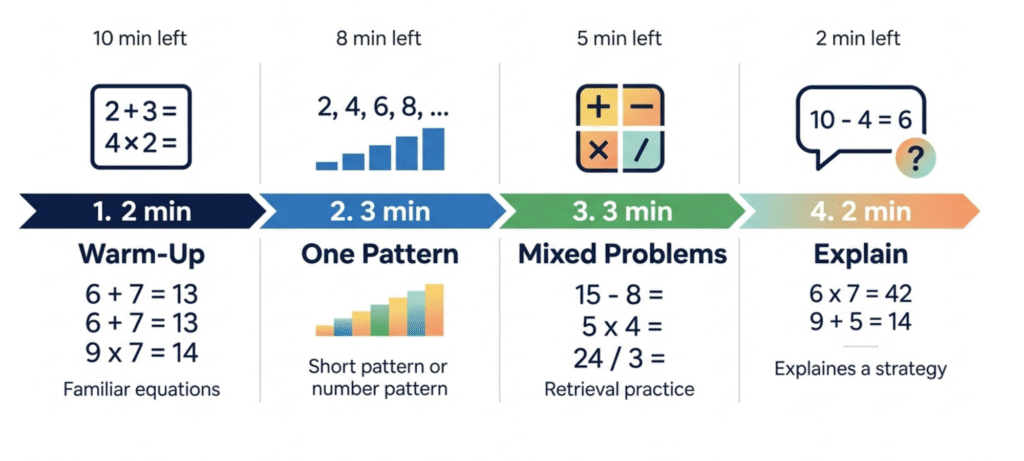
Basic Math Facts Practice: A Simple 10 Minute Routine
Structure beats good intentions. Try this.
Two minutes warming up on known facts, because starting with success matters more than people think.
Three minutes on one pattern only. Doubles today, making ten tomorrow. One idea per session.
Three minutes of mixed problems. Interleaving forces genuine retrieval practice instead of autopilot.
Two minutes explaining one strategy out loud. Verbalizing is where understanding gets locked in.
A worked example for that final stretch looks like this. For 6 × 7, think 5 × 7 = 35, then add one more 7, which gives 42.
Teachers planning this into a full year instead of a single week will find the sequencing logic useful in these 3rd grade math lesson plans, where fact work is folded into broader units rather than sitting in an isolated drill block.
Common Mistakes When Learning Math Facts
Trying to learn everything at once. Pick one pattern, master it, move on.
Relying only on timed tests. They measure a narrow band and can create anxiety that suppresses the very recall you are testing.
Ignoring number relationships. Treating a hundred multiplication facts as a hundred unrelated items is the hardest possible route.
Moving to multiplication before addition is secure. That gap does not close on its own.
Treating errors as failure. Mistakes are diagnostic information about which pattern needs attention next.
Practicing facts with no grasp of the operation. A child who cannot explain what division means will not retain division facts for long.
Math Facts Practice Questions
Addition: 6 + 7, 8 + 5, 9 + 4, 7 + 7, 6 + 8
Subtraction: 13 − 6, 15 − 7, 18 − 9, 12 − 5, 16 − 8
Multiplication: 3 × 4, 5 × 6, 7 × 8, 9 × 4, 6 × 7
Division: 12 ÷ 3, 20 ÷ 5, 36 ÷ 6, 42 ÷ 7, 56 ÷ 8
Answer key. Addition: 13, 13, 13, 14, 14. Subtraction: 7, 8, 9, 7, 8. Multiplication: 12, 30, 56, 36, 42. Division: 4, 4, 6, 6, 7.
How Much Practice Do Basic Math Facts Need?
The amount of practice depends entirely on the learner. Some students develop automatic recall quickly, while others need repeated exposure over weeks or months. Short regular practice is generally more manageable than trying to learn a large collection of facts in one sitting. Mixing familiar facts with a small number of newer ones also helps students practice retrieval without turning every session into a test.
Parents and teachers can track progress by looking at more than speed. Accuracy, the strategies a child reaches for, whether they can explain their thinking, and whether they can apply a known fact inside a new problem all say something useful about developing math fact fluency.
How Basic Facts Connect to More Advanced Math
Every procedure taught after elementary school assumes this layer is already in place.
Column addition and subtraction rely on single digit facts plus regrouping. Long multiplication is a sequence of multiplication facts organised by place value. Long division alternates division and multiplication facts at every step. Fractions need fluency with factors and multiples to find common denominators or simplify. Decimals, percentages, ratios and early algebra all sit on the same foundation.
Here is the concrete version. A student who knows 6 × 7 = 42 can work through 126 × 7 by concentrating on place value and the procedure. A student who has to rebuild 6 × 7 in the middle of the question is managing two cognitive tasks at the same time, and that is where errors multiply.
This is why reference sources such as Math.net’s overview frame them as the complete set of one digit combinations rather than a list to survive. They are infrastructure, and everything above them depends on how solidly they were built.
FAQs
What are basic facts in math?
Basic facts in math are the simple number relationships formed by addition, subtraction, multiplication and division using small numbers, combinations like 7 + 5 = 12 or 6 × 8 = 48 that students learn to recall accurately and efficiently. If you want practical ways to build them, start with these math activities for elementary school teachers and this reference on basic facts from Math.net.
What are the four basic math facts?
Addition, subtraction, multiplication and division facts. Each operation has its own set and each set connects to another through inverse operations.
What are examples of basic math facts?
6 + 7 = 13, 15 − 8 = 7, 7 × 8 = 56 and 24 ÷ 6 = 4 are all basic facts. They use small numbers and one operation.
What are math facts?
Math facts is the common shorthand for basic number facts, the single digit combinations across the four operations.
What is a fact family in math?
A fact family is a set of equations built from the same three numbers, such as 3 + 4 = 7, 4 + 3 = 7, 7 − 3 = 4 and 7 − 4 = 3. It shows how operations relate to each other.
What is math fact fluency?
Fluency means solving basic facts accurately, efficiently and flexibly, through recall or a reliable strategy, rather than counting from one. It is not the same as raw speed.
Why are basic math facts important?
They reduce the mental effort simple calculations demand, which frees attention for multi step problems, fractions and algebra.
When should kids learn math facts?
Progressively. Usually addition and subtraction first, then multiplication, then division. The exact timing varies by curriculum and student, so sequence matters more than grade level.
How can I help my child learn basic math facts?
Build understanding first, teach patterns instead of isolated items, use fact families, practice in short daily sessions, and lean on games and visual models.
Are math facts just memorization?
No. Recall is part of it, but understanding why a fact works gives a student a fallback when memory fails and makes the knowledge far more durable.
Final Thoughts
So, what are basic facts in math? They are the small permanent number relationships sitting underneath every larger calculation a student will meet, the four operations applied to small numbers, learned well enough to use without stopping.
Getting them right is less about volume and more about approach. Understand the operation, look for patterns, learn facts in families instead of in isolation, practice in short regular sessions, and treat fluency as accuracy and flexibility rather than pure speed. Do that and the facts stop being a hurdle to clear before real math starts. They become the thing that makes real math possible.