
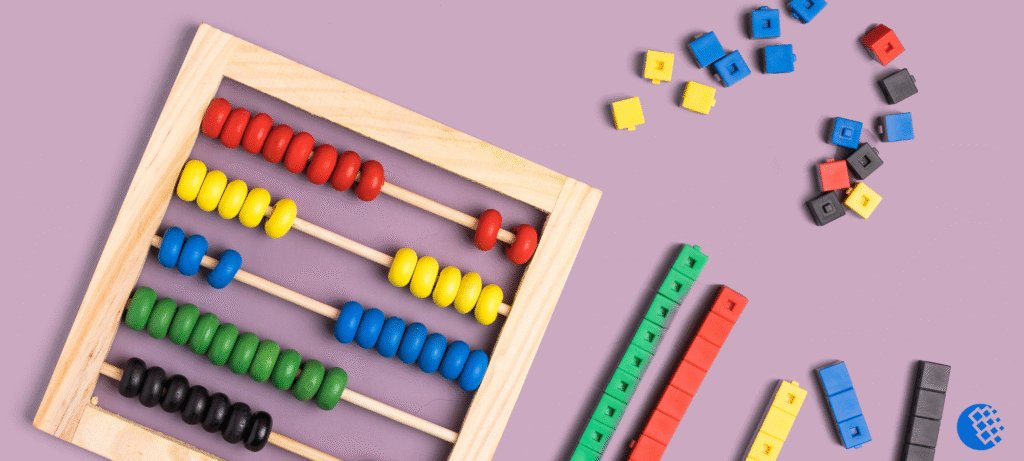
Effective 3rd grade math lesson plans are the backbone of a productive classroom. By the time kids hit third grade, they’re moving past basic arithmetic and jumping into the deep end with stuff like multiplication, division, and fractions. It’s a big shift, and it can definitely be a bit overwhelming for them. That’s exactly why your game plan for how you teach this matters so much.
Whether you’ve been in the classroom for years or you’re a parent homeschooling for the first time, this guide is here to give you the structure and practical tips you need to help your students really get it.
What Makes an Effective 3rd Grade Math Lesson Plan?
Let’s be real: a solid lesson plan isn’t just a to-do list. Think of it as your classroom roadmap. When you sit down to map out a 3rd grade math lesson plan, you’re trying to find that sweet spot between making sure they understand the “why” and helping them get fast at the “how.”
A successful lesson usually needs a few basic ingredients:
- Learning Objective: What’s the one thing they need to walk away knowing?
- Warm-Up: Give them 5 minutes to get their brains moving with some mental math.
- Direct Instruction: Keep your explanation sharp and show them exactly how it’s done.
- Guided Practice: Do a few problems together so they feel supported before they fly solo.
- Independent Practice: Let them try it on their own to see if it clicked.
- Exit Ticket: A super quick check at the end to see who’s got it and who needs a little more help.
Honestly, if you skip the warm-up or ditch the exit ticket, you’re flying blind. Teachers often get so busy teaching that they forget to check if the students are actually picking it up. Don’t let that happen to you—that data is gold.
Core Skills for the 3rd Grade Curriculum
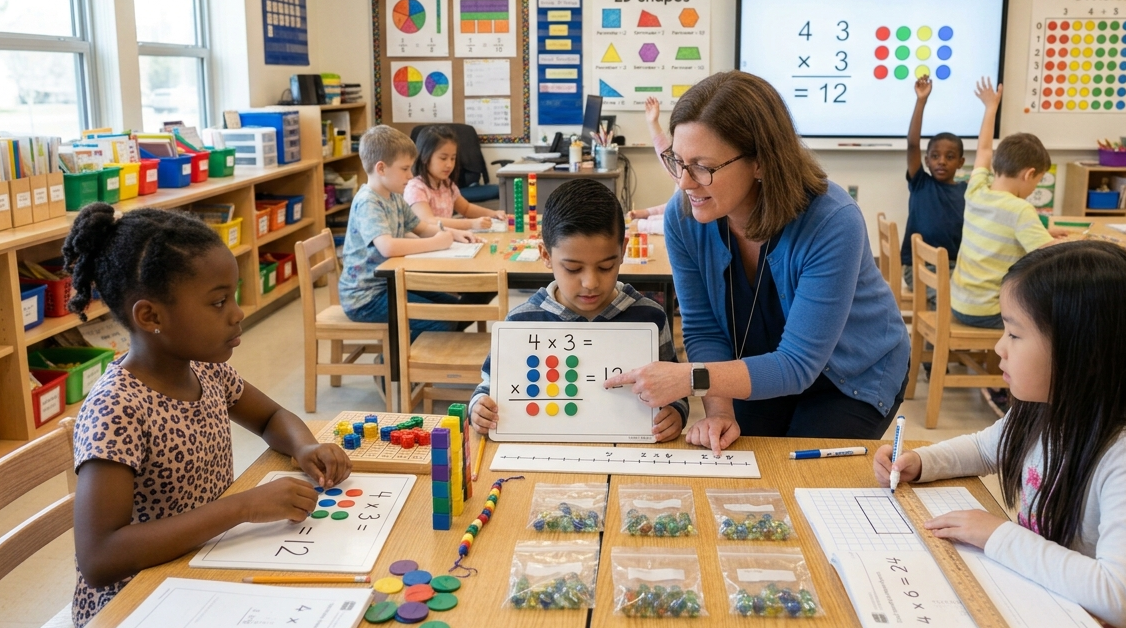
Think of third grade as the bridge year. This is where they leave basic addition and subtraction behind and start wrapping their heads around how multiplication works.
Multiplication and Division
This is the big one in 3rd grade. Kids need to see that multiplication is really just repeated addition, and division is the flip side of that. Don’t rush them into memorizing tables. Let them play with arrays, equal groups, and skip counting first so they see it. For a wider variety of engagement strategies, check out our 7 Best Math Activities for Elementary School Teachers.
Fractions as Numbers
This is where many kids hit a wall. Don’t just talk about it—show them. Use fraction bars or draw it out on a number line so they realize a fraction is just a piece of a whole thing. According to the National Council of Teachers of Mathematics (NCTM), visual models are crucial for developing conceptual understanding of rational numbers.
Area and Perimeter
This is your chance to get them out of their seats. Have them measure their own desks or the floor of the room. When they can physically measure something, math stops being just numbers on a page and starts making sense.
Weekly Lesson Plan Template
Don’t drive yourself crazy by trying to build a new system every week. Stick to a simple routine.
| Component | Time Allocation | Purpose |
| Warm-Up | 5–7 Minutes | Sharpens mental math and fact fluency. |
| Mini-Lesson | 10–12 Minutes | The “how-to” part where you model the concept. |
| Guided Practice | 15 Minutes | Working on problems together as a group. |
| Independent Work | 20 Minutes | Let them practice on their own or in centers. |
| Wrap-Up | 5 Minutes | Exit ticket to see what they learned. |
A Sample Lesson: Introduction to Multiplication
Objective: Get students to understand multiplication as repeated addition.
1. The Hook: Put 4 bags on your desk, each with 3 marbles in them. Ask the class: “How can we find the total without sitting here counting them one by one?”
2. Modeling: Write $3 + 3 + 3 + 3 = 12$ on the board. Then, show them the shortcut: $4 \times 3 = 12$. Explain that the first number is how many groups you have, and the second is how many are in each.
3. Guided Practice: Give everyone a mini-whiteboard. Give them scenarios, like “6 plates with 3 crackers each.” Have them draw the array and write out the addition and multiplication problems.
4. Independent Practice: Give them a worksheet where they have to match drawings to multiplication equations.
5. Exit Ticket: Ask them to draw an array for $3 \times 4$ and write the answer.
Common Mistakes Teachers Make
It’s easy to fall into a few traps. The biggest one? Pushing for speed before they have the concept down. If a kid memorizes $4 \times 4 = 16$ but doesn’t have a clue what that means, they’re going to be lost when they hit division later.
Also, don’t stop using hands-on tools. Even in 3rd grade, kids need stuff they can touch—blocks, counters, tiles. If a student is struggling, it’s usually because they’re trying to think about math in their head, and they really need to see it in their hands to have that “aha” moment. High-quality 3rd grade math lesson plans always include time for these concrete experiences.
Differentiation Strategies
Every student learns at their own speed. That’s life.
- For Struggling Learners: Keep the blocks and counters out. Use smaller numbers to build their confidence before making it harder.
- For Advanced Students: Give them a challenge. If they’ve nailed area, tell them to design a floor plan for a dream room that has to fit specific measurements.
- For English Language Learners: Use plenty of visuals. Make sure they know what words like “product” or “quotient” mean before you start the lesson. For more tips on supporting diverse learners, refer to our guide on Spanish 3 instructional methods, which can be adapted for math vocabulary.
Fostering a Growth Mindset in Math
You’ll hear kids say, “I’m just not a math person.” Shut that down early. It’s a bad habit that keeps them from trying.
When a student gets stuck, don’t just jump in and give the answer. Ask, “What have you tried so far?” or “Does this look like something we did last week?” You want them to realize that math is a way of solving problems, not just finding the right number. Research from Stanford’s YouCubed shows that adopting a growth mindset significantly changes student outcomes in mathematics.
How to Integrate Technology
Use tech to help, not to take over. Virtual blocks are great if you don’t have enough physical ones, and some websites are good for quick practice. But don’t lean on screens too much. There’s something about a kid actually writing numbers down with a pencil that helps them process it differently. Remember, even with digital aids, your 3rd grade math lesson plans should stay centered on human interaction and problem-solving.
Frequently Asked Questions
What should a 3rd grade math lesson plan include?
Keep it simple: a clear goal, a list of what you need, a step-by-step plan, and a way to check if they actually learned it.
How long should a 3rd grade math lesson be?
Try to stick to 60 minutes. It’s the sweet spot for keeping their attention.
What is the best way to teach multiplication?
Start with real objects, then draw pictures (arrays), and wait until they get the concept before you force them to memorize a table.
How can I make math more fun?
Games are your best friend. Card games, dice games, or just talking through different ways to solve a problem—anything that isn’t just a worksheet.
Are these lesson plans aligned with Common Core?
Most good 3rd grade math lesson plans are built with these standards in mind, which focus on making sure kids understand math rather than just repeating it.
Should I use math centers?
Yes! They’re perfect for small groups and give you a chance to work closely with kids who need a little extra help.
How often should I assess?
Check in every single day. A one-question exit ticket is enough to tell you if you need to re-teach the lesson tomorrow.
How do I handle homework?
Keep it short. Homework should just be for practice, not for teaching them something they haven’t learned yet.
Final Thoughts
At the end of the day, your 3rd grade math lesson plans are all about building a foundation that sticks. If you focus on making sure they really understand what’s happening, use different ways to teach, and keep a close eye on who’s keeping up, you’ll create a classroom where math makes sense.
Stay flexible. If you notice half the class looks totally lost, stop what you’re doing. Pivot. Pull out the manipulatives. Re-teach it a different way. That’s what makes a great teacher—caring enough to make sure the kids actually get it, rather than just worrying about finishing the curriculum map.