

Teacher vs student classroom management is a simple behavior-tracking game where the teacher and the class earn points against each other based on a handful of agreed classroom behaviors. It turns everyday routines like coming in quietly, raising hands, and staying on task into a light, visible competition instead of a running list of warnings. Done well, it isn’t the teacher “against” the students at all. It’s a shared scoreboard that makes expectations obvious and gives the room a reason to stay on track together.
Search around and you’ll find plenty of teachers running some version of this: two boxes on the whiteboard, a tally, a reward at the end of the week. What’s harder to find is a single place that explains the whole system, how the scoring actually works, which rules hold up in real classrooms, how to keep it fair, what to do when it backfires, and how it changes across grade levels. That’s what this guide covers.
What Is Teacher vs Student Classroom Management?
At its core, teacher vs student classroom management is a point-based behavior system. The teacher marks two columns on the board, one for the students and one for the teacher (or “the class”). When the class demonstrates an agreed target behavior, the students earn a point. When the class breaks that same expectation, the teacher earns a point instead.
It’s sometimes written as teacher vs students classroom management, and the underlying idea in student vs teacher classroom management is identical. It’s a matter of phrasing, not a different strategy. The mechanics stay the same either way:
- A small set of clearly defined behaviors
- Two visible score totals
- A consistent way of awarding points
- A time frame (a lesson, a day, or a week)
- A reward tied to the outcome
None of this replaces classroom management as a whole. It’s one tool that sits inside a bigger system of routines, relationships, and clear expectations, which is really where classroom management starts.
Why Is Classroom Management Important in Teaching?
Classroom management isn’t just about stopping misbehavior. It’s what protects instructional time. Every minute spent repeating directions, waiting for the room to settle, or redirecting the same two students is a minute not spent teaching. Strong classroom management means transitions happen faster, participation goes up, and students know what’s expected without being told every time.
This matters most in the moments that eat up a lesson quietly: the slow start after lunch, the chatter during a handout, the five minutes lost getting everyone seated. A teacher vs student classroom management game targets exactly those moments, because the behaviors it tracks are usually the small, repeated ones that cause the most friction over a week, not the rare big blowups.
What Is Classroom Management in Education?
In education, classroom management refers to the practices, routines, and structures a teacher uses to keep a class running smoothly and to support learning. That includes everything from seating arrangements and transition signals to how behavior expectations are taught and reinforced. It’s distinct from discipline in the narrow sense; good classroom management is mostly proactive, built to prevent problems rather than just respond to them once they happen. That’s also why it’s worth asking what is classroom management and why is it important separately from “how do I punish misbehavior,” since the two questions lead to very different classrooms.
How Does the Teacher vs Student Game Work?
Here’s the actual mechanism, step by step:
- Put two score areas on the board. Label one “Teacher” and one “Students” (or “Class”).
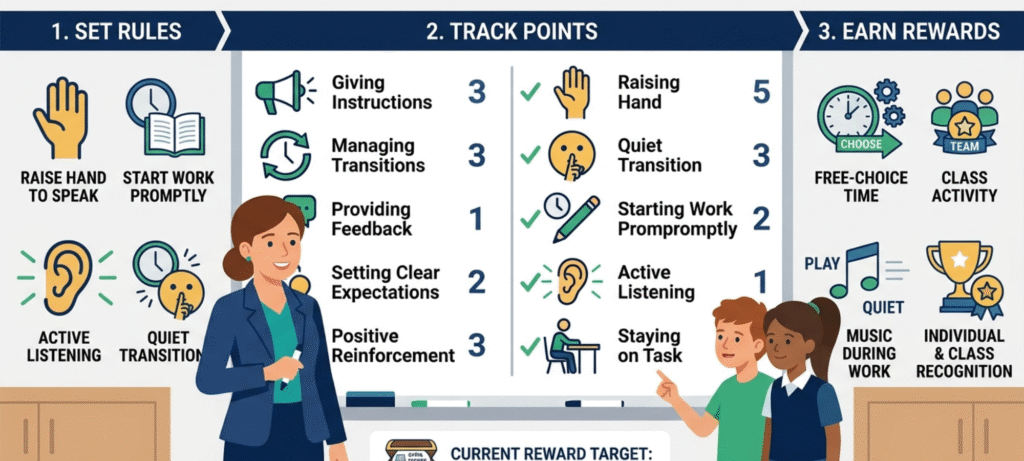
- Choose three to five target behaviors. Don’t try to track everything at once. Pick the specific habits that are causing the most disruption right now.
- Explain the rules clearly before starting. Students should know exactly what earns a point and what loses one.
- Award student points in the moment. When the class follows an expectation, such as a quiet transition, hands raised, or everyone starting work on time, mark a point for the students.
- Award teacher points the same way. When the class breaks the agreed expectation, mark a point for the teacher, without singling out individual students.
- Keep a visible, running tally. A whiteboard column or a sticky note works fine. The point is that students can see it.
- Set a winning condition. A practical approach is to total the score at the end of the day or week and decide the reward based on who’s ahead.
- Reset and adjust. Once a behavior improves, swap it out for a new target rather than tracking the same three things all year.
The reason this works better than a running list of warnings is feedback speed. Instead of a behavior going unaddressed until it becomes a bigger issue, the class gets an immediate, low-stakes signal, a point either way, and moves on.
A teacher vs student game classroom management strategy works best when the game is tied to two or three specific behaviors rather than every classroom rule at once. Trying to score everything at the same time is usually what makes the system collapse within a week.
Teacher vs Student Classroom Management Rules
Clear rules are what keep the game fair and keep it from turning into a shouting match over whether a point was “earned.” A simple table posted near the scoreboard helps:
| Target behavior | Who earns the point |
|---|---|
| Enter and start work without prompting | Students |
| Raise hand before speaking | Students |
| Move through transitions quietly | Students |
| Listen while a classmate is speaking | Students |
| Class ignores an agreed expectation after a reminder | Teacher |
The behaviors should be specific and observable. “Be respectful” is too vague to score consistently, but “raise your hand before speaking” isn’t. Three behaviors is usually manageable, and five is close to the practical limit; beyond that, the scoring starts to slow the lesson down instead of supporting it.
Teacher vs Student Competitions Ideas
The points system is the classic version, but there’s room to vary the format depending on what a class responds to:
- Points competition: the standard teacher-vs-students tally described above.
- Transition challenge: students race the clock to complete a transition, not each other.
- Trivia or review challenge: teacher vs. class on content review questions, useful right before a test.
- Reading or work-completion challenge: the class earns points toward a shared reading or task goal.
- Cleanup challenge: students beat a set cleanup time instead of the teacher’s count.
Broader “teacher vs student” activities, such as a pep rally teacher vs student game, a teacher vs student dress up day, or a teachers vs students basketball game, are worth mentioning too, but they’re school-wide community events rather than daily classroom-management tools. They build the same friendly-competition spirit, just on a bigger stage.
Student vs Teacher Classroom Management Rewards
Rewards don’t need to be expensive or even physical. What matters more is that the reward is consistent and that students know what they’re working toward. Common options include:
- Extra free-choice or game time
- A class-selected activity
- Music during independent work, where appropriate
- Bragging rights and recognition alone
- A short “teacher challenge” the class gets to assign back
Some teachers find that the competition itself is motivating enough. Winning, or simply closing the gap on the teacher’s score, can carry the game without a prize attached every single time. It’s worth testing that with your own class before assuming a tangible reward is required.
For more structured reward ideas that pair well with this kind of system, this rundown of free incentives for students is a useful next stop.
How to Keep the Competition Positive
The way the competition is framed can make a big difference between a game that works and one that backfires:
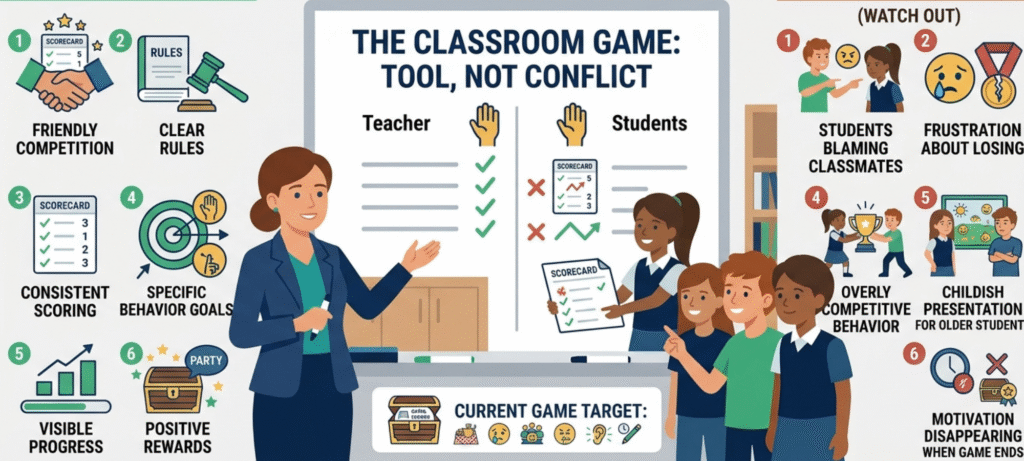
- Keep the tone playful, not adversarial; “vs” describes the scoreboard, not the relationship.
- Never let one student’s mistake be announced as the reason for a teacher point.
- Don’t let scoring turn into teasing between students.
- Keep the score achievable; a runaway lead in either direction kills motivation.
- Explain each point briefly so the scoring feels transparent, not arbitrary.
- Reset regularly so a bad day or week doesn’t carry over indefinitely.
This is also where it’s worth addressing the phrase teacher vs student fight directly. If the framing ever starts encouraging actual conflict, arguing, or singling students out, that’s a sign to change the format: swap to a whole-class goal instead of a competition, or pause the game for a few days. The “vs” should never describe how the room actually feels.
Teacher vs Student Game Variations
A few structural tweaks change how the game plays out:
- Team challenge: split the class into smaller teams instead of one large group, which can work better for bigger or more varied classes.
- Weekly reset: score clears every Friday, giving every week a fresh start.
- Mystery goal: students don’t know the exact reward until the target is reached, which can build anticipation.
- Whole-class goal: teacher and students aren’t competing at all; everyone works toward one shared target. This variation is worth keeping in your back pocket for classes that don’t respond well to head-to-head competition.
Classroom Management Games for Teachers
Beyond the core teacher-vs-students format, a few related games serve the same purpose: making expectations visible and giving students quick feedback.
- Table or team points for group-based classes
- A behavior bingo card tied to weekly goals
- A transition-time challenge with a visible countdown
- A class goal tracker building toward a bigger shared reward
You don’t need to run all of these at once. Picking one or two that fit your class keeps the system simple enough to maintain.
When Teacher vs Student Classroom Management Works Best
This approach tends to land well with:
- Classes that respond to friendly, low-stakes competition
- Groups where routines are already mostly established but need reinforcement
- Short-term, specific behavior goals rather than broad, vague ones
- Elementary and early-middle-school classrooms, and specialist or rotating classes where the teacher sees students for a shorter block
When the Teacher vs Student Game Can Backfire
It’s worth being honest about the limits. The system tends to struggle when:
- Students become genuinely upset about losing, rather than just competitive
- The class is highly competitive in a way that spills into blaming classmates
- Scoring feels inconsistent from one day to the next
- Older students find the format childish
- The reward becomes the only motivation, and the underlying behaviors slip once the game stops
In any of these cases, switching to a whole-class goal, individual recognition, or straightforward verbal reinforcement usually works better than pushing the competition format harder.
Teacher vs Student Classroom Management for Different Grade Levels
Elementary school: Short rounds, visual scoreboards, and simple, immediate rewards tend to work best. Students at this age respond well to seeing the score change in real time.
Middle school: Students want more autonomy here. Letting the class help set the target behaviors, and offering rewards that feel earned rather than childish, keeps engagement up.
High school: Straight point competitions can feel juvenile at this stage. Academic challenges, class-wide goals, or privileges tend to land better than a literal teacher-vs-students scoreboard.
Teacher vs Student Classroom Management vs Traditional Rewards
| Approach | Main idea |
|---|---|
| Teacher vs student game | Whole-group competition with visible scoring |
| Individual rewards | Reinforce specific students’ behavior |
| Team points | Smaller-group competition within the class |
| Whole-class goal | Everyone works toward one shared target |
| Verbal recognition | Reinforces behavior without a points system |
None of these is universally “better”; the right choice depends on the class. A common pattern is using the point-based game for a semester, then shifting to a whole-class goal or verbal recognition once routines are more established. For a broader look at how these strategies fit into a teacher’s overall approach, this piece on classroom management philosophy is a helpful companion read, and Edutopia’s roundup of research-based classroom management strategies covers several reinforcement techniques that pair naturally with a points system.
Frequently Asked Questions
What is teacher vs student classroom management?
It’s a behavior-management strategy where the teacher and the class earn points against each other based on a small set of agreed classroom behaviors, with a reward tied to the final score.
How does the teacher vs student classroom management game work?
Two score areas are tracked, one for students and one for the teacher. Students earn points for meeting agreed behaviors; the teacher earns a point when the class breaks one. The score is reviewed at a set time, like the end of the week.
What are good teacher vs student competitions ideas?
Points competitions, transition challenges, review trivia, reading or work-completion challenges, and cleanup challenges all work well as variations on the core format.
What are good classroom management games for teachers? Beyond the teacher-vs-students format, table points, behavior bingo, transition challenges, and class goal trackers all serve a similar purpose.
What rewards can be used for student vs teacher classroom management?
Extra free time, a class-chosen activity, recognition, or a “teacher challenge” the class assigns back all work, and rewards don’t need to be physical or expensive to be effective.
Can teacher vs student games work with older students?
Yes, but the format usually needs to shift. High schoolers tend to respond better to academic challenges or class-wide goals than to a literal points scoreboard.
Is a teacher vs student game the same as classroom management overall?
No. It’s one tool inside a larger classroom-management system that also includes routines, relationships, and clearly taught expectations. Edutopia’s guide to building strong teacher-student relationships is a good starting point for that broader foundation.
Conclusion
Teacher vs student classroom management works best when it’s treated as exactly what it is: a simple, visible scoreboard that makes a handful of classroom expectations easier to track and reinforce, not a replacement for the relationships and routines that hold a classroom together. Keep the target behaviors specific, keep the scoring fair and transparent, and be ready to adjust the format, or drop it, for classes where competition doesn’t land well. Used that way, it’s a light, flexible addition to a teacher’s classroom-management toolkit rather than the whole system.