
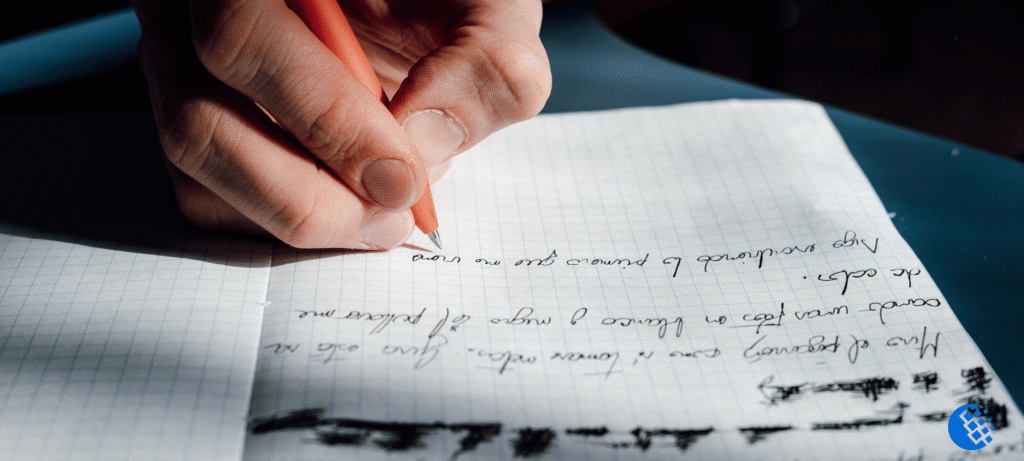
A mother’s flipping through her son’s homework one evening. Stops cold on a single line. He’s spelled “friend” three different ways on the same page, and one of them isn’t even close to right. She’s not panicking. Not yet, anyway. But she’s curious enough to start looking up examples of dyslexic writing, just to see whether what’s in front of her matches an actual pattern, or whether it’s just a nine year old having a rough Tuesday.
That’s usually how people end up here, if we’re honest. Not because some website’s going to hand them a diagnosis. They just want a real sense of what dyslexic writing can actually look like on paper, before deciding whether it’s even worth mentioning to a teacher.
Quick version: first, we’ll dig deeper after. Dyslexic writing often shows up as phonetic spelling, fone instead of phone, that kind of thing. Letters swapped or flipped, b for d. Words landing in the wrong order, form instead of from. Sometimes the exact same word gets spelled three different ways in one paragraph. Writing that just takes way longer than it reasonably should. None of that means much by itself, not really. It’s the pattern, showing up again and again over time, that actually matters.
What Is Dyslexic Writing?
Quick thing worth clearing up before going further. “Dyslexic writing” isn’t some official term, and it’s definitely not a writing style anyone chooses or gets taught somewhere. It’s really just shorthand, a way people describe writing that shows patterns sometimes linked to dyslexia. Persistent spelling trouble. Unusual letter order. Sound-based spelling. Writing that comes out noticeably slower than you’d expect for the person’s age.
Dyslexia itself is a specific learning difference. The current definition, the one the International Dyslexia Association uses, centers on difficulty with word reading and spelling, both accuracy and speed. Writing problems can follow on from that, sure, but they’re a consequence. Not the definition itself. So when someone throws around “dyslexic writing,” what they usually mean is writing carrying some of the fingerprints of a reading and spelling difficulty. Not some separate thing running on its own rules.
Examples of Dyslexic Writing
This is the part most people came for, so let’s not bury it. Here’s a quick table of the patterns that show up most often.
| Pattern | Example |
|---|---|
| Phonetic spelling | phone becomes fone, friend becomes frend |
| Letter reversal or confusion | b written as d, was written as saw |
| Letters in the wrong order | from becomes form, tired becomes tried |
| Inconsistent spelling | because, becos, becuase, all in one paragraph |
| Missing letters | friend becomes frend, little becomes litle |
| Extra letters | running becomes runnning, tomorrow becomes tomoroww |
| Homophone mix-ups | there for their, to for two |
| Odd punctuation or capitals | random capitals mid word, like wAtEr |
One thing worth saying clearly: any one of these showing up once means very little. Plenty of six and seven year olds write “saw” for “was” because their brains are still wiring up how letters map to sounds. Letter reversals during early literacy are common and expected. What tends to raise a flag is when these patterns keep showing up well past the age classmates have moved on, or when a few of them cluster together at once.
Phonetic or sound-based spelling. Someone spells the word how it sounds rather than how the dictionary says to. Phone becomes fone. Said becomes sed. Makes sense when you think about it. English spelling doesn’t always follow its own rules, so a person whose brain struggles to link sounds to specific letters will often just default to what they hear.
Letter reversals and similar-letter confusion. This is the one everyone already half knows about, mostly because “dyslexic people see letters backwards” has been repeated as fact for decades. It’s not quite that simple, and honestly that old explanation does more harm than good. What actually seems to happen is that visually similar letters, like b and d, or p and q, get mixed up, and this is common in early readers generally, not just dyslexic ones. Age and how often it keeps happening matter far more than the mix up itself.
Missing letters, and sometimes extra ones. Frend instead of friend. Litle instead of little. On the flip side, a writer might add letters that don’t belong, like runnning with an extra n. Neither is unusual on its own in early writing. It’s the frequency that matters.
Words in the wrong order. This one confuses people because it sounds more like a grammar problem. From becomes form. Tired becomes tried. The letters are all correct, they’re just sequenced wrong, almost like an anagram slipped in by mistake.
Spelling the same word differently within one piece of writing. Possibly the most telling pattern here. A student writes because, then a bit later writes becos, then later still writes becuase. It’s not that they don’t know the word. The spelling just hasn’t settled in their memory, so it shifts every time they try to recall it.
Dyslexic Writing Examples in Sentences
Single words only tell part of the story, so here’s what some of this can look like strung together in a full sentence. These are illustrative examples of possible patterns, not a template for how every dyslexic writer sounds. A real writing sample might show one or two of these things, or none of them, or a completely different mix.
Example 1
Standard: I went to the park with my friend because the weather was nice.
Illustrative version: I went to the park with my frend becos the wether was nise.
Example 2
Standard: My brother tried to bring three books from the library.
Illustrative version: My brother tyred to bring thre boks form the librery.
Break that second one down and you can see several patterns working together: tried becomes tyred, three becomes thre, books becomes boks, from becomes form, library becomes librery. That’s a lot of different pattern types packed into one short sentence, which is fairly typical of how real difficulties can stack up rather than showing up one at a time in isolation.
Example 3: A Short Writing Sample
Standard version:
Yesterday I went to the library with my sister. We looked for a book about animals and then walked home before dinner.
Illustrative version:
Yesturday I went to the libary with my siter. We loked for a bok about animels and then walkt hom befor diner.
This example combines several possible patterns: phonetic spelling, omitted letters, unusual letter combinations, and inconsistent spelling. Real writing samples do not necessarily contain all of these features, though. Some writers may show only one or two recurring difficulties, while others may have very different patterns.
These are illustrative examples rather than diagnostic writing samples. A person’s actual writing needs to be considered in relation to their age, development, education, language background, and writing history.
What Does Dyslexic Writing Look Like Beyond Spelling?
Spelling gets all the attention, sure, but dyslexia touches a lot more than individual words. It shows up in handwriting, in how sentences get put together, in punctuation, in how ideas end up organized on the page.
Handwriting first. Some kids with dyslexia produce handwriting that’s genuinely hard to make out, letters formed oddly, sizes all over the place, words drifting off the line entirely. Here’s something a lot of articles conveniently skip, though: plenty of dyslexic writers have perfectly neat handwriting. They’re just painfully, agonizingly slow at producing it. The mistake people keep making is assuming messy automatically means dyslexic and neat automatically means fine. Speed and legibility are two completely separate signals. You need to look at both.
Writing speed, then. Even when the final product looks totally fine on the page, actually getting there can take far longer than it reasonably should. This matters a lot in timed settings, exams especially, where a slow but perfectly accurate writer can lose marks simply because time ran out. Not because they didn’t know the answer. Just because writing it down took too long.
Is Messy Handwriting a Sign of Dyslexia?
Not necessarily, no. Messy handwriting on its own isn’t really a reliable sign of dyslexia. Plenty of people with dyslexia have neat, perfectly readable handwriting, they just take way longer than expected to actually write, spell, or organize their thoughts on the page.
Handwriting difficulties can also tie back to dysgraphia, or other motor and writing issues entirely. Which is exactly why it’s more useful to look at the whole pattern rather than one detail, spelling, word sequencing, writing speed, organization, whether the difficulty sticks around over time. A messy page by itself doesn’t actually tell you what’s causing anything.
Sentence construction and organization come next. Ideas might land out of order, punctuation goes missing or shows up scattered randomly, capital letters pop up mid word for no obvious reason at all. Organizing a paragraph, or a full essay, can be a genuine struggle too. Someone might know exactly what they want to say out loud, word for word, and still find it nearly impossible to get that same thought onto paper in any kind of sensible order.
Then there’s proofreading and revision. Spotting your own errors gets hard when the spelling patterns living in your head don’t quite match what’s actually sitting on the page. A lot of dyslexic writers reread their own work two, three times over and still miss things a fresh set of eyes would catch in seconds.
Why Does Dyslexia Affect Spelling and Writing?
Fair question, honestly, and it deserves a real explanation rather than just another list of symptoms tacked on. A big chunk of it comes down to phonological processing, basically how well the brain breaks spoken words down into individual sounds and then matches those sounds up to letters. When that connection’s shaky, spelling turns into a guessing game every single time, because the writer just can’t reliably predict which letters are supposed to represent the sounds they’re hearing in their own head.
There’s also word retrieval and automaticity to think about. For most people, spelling a familiar word becomes automatic after enough practice, you don’t consciously think through each letter. For someone with dyslexia, that automatic process often never fully kicks in, so spelling stays effortful even for words they’ve written a hundred times before. That effort adds up over a page, which is a big part of why writing speed suffers too.
When Should Writing Difficulties Be a Concern?
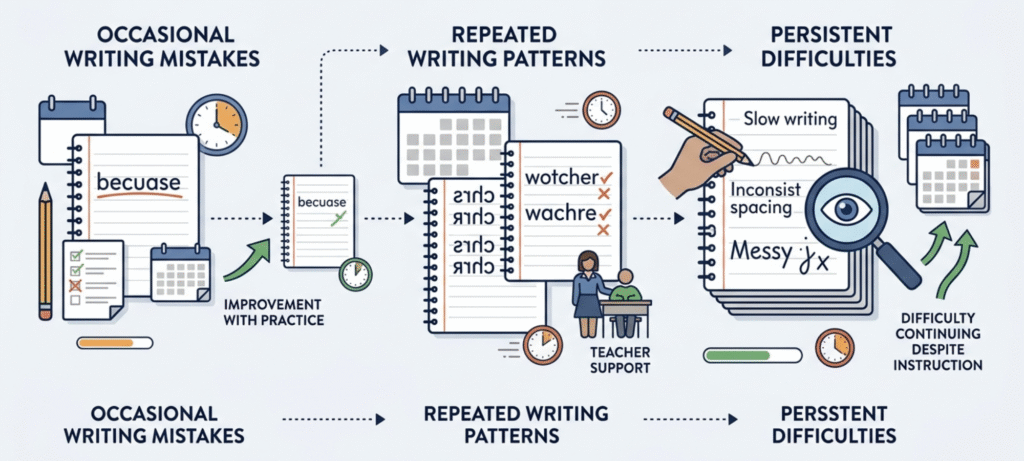
This is probably the single most useful thing in this whole article, so pay attention here. One mistake, or even a handful, doesn’t mean anything on its own. What actually matters is persistence.
| Probably nothing to worry about | Worth a closer look |
|---|---|
| Happens occasionally | Happens regularly, week after week |
| Common for the child’s age | Continues well past when it’s typical |
| Improves with practice | Stays unusually difficult despite practice |
| One isolated error | Several different patterns show up together |
| Doesn’t affect schoolwork much | Starts affecting reading, writing, or grades |
Persistence despite good teaching is actually part of how dyslexia gets formally described these days. Persistent difficulties despite appropriate instruction are more meaningful than an isolated spelling mistake or a skill that simply hasn’t been taught yet
Dyslexic Writing Examples by Age
Examples of dyslexia writing in adults can look quite different from the spelling mistakes seen in younger children. Dyslexia doesn’t look the same at six as it does at sixteen, or at thirty five for that matter. What counts as a normal mistake shifts as people get older, so it helps to break this down by stage.
Early years. Young children naturally make spelling mistakes while their brains are still learning how sounds map to letters. Sed for said, wuz for was, frend for friend, these show up in plenty of typically developing kids too. Reversals are common here and mostly resolve on their own. What educators tend to watch for is persistence, meaning these mistakes are still happening at a noticeably higher rate than classmates well after everyone’s supposed to have moved past them.
Primary school. By this stage spelling should be settling down for most kids. Inconsistent spelling of the same word, unusual sequencing, slow copying from the board, and written work that doesn’t match how well the child speaks or reasons out loud can all be more telling here than they were a couple years earlier. Punctuation that seems almost random is another one worth watching.
Secondary school and the teenage years bring their own shift. The struggle usually moves away from raw spelling and toward organization instead. Taking notes during a fast-moving lesson, structuring a longer essay, proofreading properly, getting through reading-heavy assignments without total exhaustion by the end, that’s typically where teens hit the wall hardest, even once their spelling’s improved with age. It’s also fairly common to see a real gap open up between how articulate someone sounds talking out loud and how much weaker those same ideas look once they’re actually written down.
Adults, then. Adult dyslexia doesn’t just vanish because school’s over and done with. It shows up in workplace emails riddled with inconsistent spelling, reports that take noticeably longer to draft than colleagues would expect, forms filled out slowly and carefully, word by word, spelling that falls apart specifically the moment there’s time pressure involved, and a habit of rereading everything two, three times before finally hitting send. A lot of adults have spent years quietly building their own workarounds around this, leaning hard on spellcheck, asking a colleague to proofread anything important, all without ever really naming what’s actually going on underneath it.
Dyslexia vs Dysgraphia: What’s the Difference?
Dyslexia mainly involves difficulty with word reading and spelling, meaning accuracy and speed at the level of individual words and how they’re decoded. Dysgraphia is generally used to describe significant difficulties with writing, which can include handwriting, transcription, spelling, or written expression depending on the framework being used, forming letters, controlling a pen, getting handwriting to come out legibly and at a workable pace.
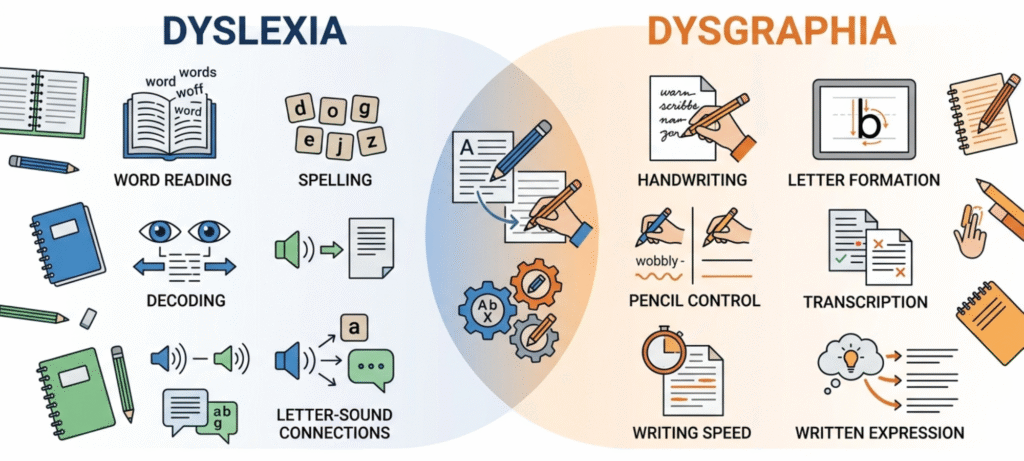
These two get lumped together constantly, and it’s worth pulling them apart properly.
| Feature | Dyslexia | Dysgraphia |
|---|---|---|
| Word reading | Can be affected | Not necessarily |
| Spelling | Common area of difficulty | May also be affected |
| Handwriting | May be unaffected | Can be a significant difficulty |
| Writing speed | Can be slower | Can be slower |
| Written expression | May be affected | May be affected |
| Can they occur together? | Yes | Yes |
A person can have one without the other, or both at once. Someone with dyslexia might spell words a dozen different ways but have lovely, easy to read handwriting. Someone with dysgraphia might spell everything correctly but produce handwriting that’s nearly illegible and take three times as long as classmates to finish a paragraph. Treating the two as interchangeable, which a lot of general dyslexia content out there does, actually makes it harder for parents and teachers to figure out what kind of support someone actually needs.
What Can Look Like Dyslexia but Have a Different Cause?
Worth flagging honestly, because a writing sample alone really can’t tell you the cause. A bunch of other things can produce writing that looks similar on the surface: normal early spelling development in young kids, limited writing instruction, learning to write in a second language, attention difficulties, general language delays, dysgraphia on its own, motor or fine-motor issues, or just not enough practice and repetition. Even plain fatigue can make anyone’s writing look shakier than usual.
None of that is a diagnosis of anything. It’s just a reminder that persistent writing struggles have more than one possible explanation, which is exactly why a proper assessment matters more than a list of examples ever could.
Can You Tell If Someone Is Dyslexic Just From Their Writing?
Short answer, not reliably. A writing sample can raise a reasonable question. It can’t hand you a diagnosis. The British Dyslexia Association is pretty clear that indicators like inconsistent spelling, odd letter sequencing, and repeated phonetic misspellings are patterns worth noticing, not a checklist that adds up to a formal answer on its own.
What a writing sample can reasonably tell you is whether it’s worth having a conversation with a teacher, a school’s learning support team, or an educational psychologist trained to run an actual assessment. That’s a very different thing from self-diagnosing off a blog post, however detailed the examples get.
Also worth saying plainly: one bad spelling week doesn’t mean dyslexia, and a kid who occasionally writes “saw” instead of “was” at age seven is almost certainly fine. Context and how the pattern holds up over months, not days, is what actually counts.
How Do Dyslexic People Write, Really?
There’s no single dyslexic writing style, and that might be the most important thing to take from this whole piece. Two people with the exact same diagnosis can look completely different on paper. One might struggle mainly with spelling while writing fluent, well organized sentences. Another might spell just fine but lose the thread of an argument halfway through a paragraph. A third might write slowly and carefully, checking every word, and end up with something clean that simply took them four times as long as it should have.
Dyslexia Does Not Mean Poor Writing Ability
Worth its own section, because this gets missed a lot. Someone can have brilliant, well developed ideas and still struggle badly to get those ideas onto paper. Oral language and written output aren’t the same skill, and for a lot of dyslexic writers there’s a real gap between the two, where what they say out loud is far more sophisticated than what ends up written down.
Spelling difficulty says nothing about how much someone knows or how well they think. According to the NHS, dyslexia is a learning difference, not a measure of intelligence, and plenty of dyslexic people are sharp, creative, and highly capable in areas that have nothing to do with spelling. Worth remembering before anyone treats a messy first draft as a verdict on someone’s ability.
How to Help Students With Dyslexia Improve Writing
For teachers. Give explicit spelling instruction rather than assuming it’ll be picked up through reading alone. Break writing tasks into planning, drafting, and editing as separate stages instead of one big pass. Reduce how much copying from the board is required where possible, allow assistive technology without treating it as a shortcut, and where it makes sense, assess content and spelling separately so ideas don’t get penalized twice for the same underlying difficulty.
For parents. Keep practice sessions short and frequent rather than long and occasional. Avoid correcting every single mistake in one sitting, it’s overwhelming and usually backfires. Build a personal word bank from that child’s actual recurring mistakes rather than a generic spelling list, read together often, and make a point of celebrating good ideas, not just accurate spelling.
For adults. Spellcheck and grammar tools aren’t cheating, they’re just tools. Speech to text can take a lot of pressure off getting ideas down in the first place. Having someone proofread anything important before it goes out, and using templates for repetitive writing tasks like emails or reports, can save a lot of stress.
Building spelling instruction around phoneme to letter relationships, syllables, word families, and prefixes and suffixes tends to work better than generic memorization, since it gives the brain a pattern to lean on rather than asking it to recall each word from scratch. None of this is a cure, and nobody’s claiming it is. It’s about giving someone tools that work with how their brain actually processes language, and it genuinely helps to pair that with solid writing fluency habits built early on.
Writing Activities Worth Trying
A few concrete activities tend to work better than another generic worksheet. Letter tile word building, syllable sorting games, missing letter puzzles, short dictation with immediate feedback, and sentence building cards all give hands-on repeated practice without feeling like more of the same drills that already weren’t working. Even simple picture to sentence exercises help someone practice getting an idea from head to page without the pressure of a full essay hanging over them.
Handwriting practice matters here too, separate from spelling. Working through structured handwriting exercises can build the physical muscle memory that makes writing feel less like a battle, even for kids whose main struggle is spelling rather than letter formation.
Apps for Dyslexia Writing: Tools That Can Help
You don’t need ten different apps to make a real difference, just the right categories covered. Speech to text lets someone get ideas down without spelling getting in the way first. Text to speech works the other direction, reading written material back so errors and awkward phrasing become easier to catch by ear. Predictive text and spelling assistance built into most word processors these days catch a lot before it ever reaches a final draft, and accessibility features in modern writing software, things like adjustable fonts and built in dictionaries, can quietly remove a lot of daily friction without anyone having to make a big deal out of it.
FAQs
What are some examples of dyslexic writing?
Common examples include phonetic spelling (fone for phone), letter reversals (b for d), words in the wrong order (form for from), and the same word spelled several different ways in one piece of writing.
How do dyslexics write?
There’s no single way. Some struggle mainly with spelling, others with organizing ideas, others with writing speed. Strengths and difficulties combine differently for each person.
Can dyslexia affect handwriting?
It can, but not always. Some dyslexic writers have neat handwriting and simply write slowly. Handwriting trouble specifically is more closely linked to dysgraphia, which sometimes overlaps with dyslexia but isn’t the same thing.
Can adults have dyslexic writing difficulties?
Yes. Adults often show inconsistent spelling, slow writing under time pressure, difficulty organizing longer pieces, and fatigue after extended reading or writing, even after building strong workarounds over the years.
Can you tell if someone is dyslexic just from their writing?
Not reliably. A writing sample can raise a reasonable question, but a formal diagnosis needs an actual assessment from a trained professional.
How can I help a dyslexic student with writing?
Break writing into smaller steps, build a personal word bank, teach spelling patterns directly, allow assistive technology, and give extra time where it genuinely helps.
Are there apps that help with dyslexic writing?
Yes. Speech to text, text to speech, predictive text, and spellcheck tools built into most modern word processors can all reduce the daily friction of writing.
If a writing pattern keeps showing up over weeks or months rather than fading with practice, that’s usually the point to loop in a teacher, a school’s learning support team, or an educational psychologist rather than trying to sort it out alone.
Conclusion
Examples of dyslexic writing can include inconsistent spelling, phonetic spellings, unusual letter sequencing, omitted or added letters, and slower written production. But no single spelling mistake or handwriting feature proves that someone has dyslexia.
What matters more is the broader pattern, how persistent it is, and whether the difficulty continues despite appropriate instruction and support. If writing problems keep affecting a child’s schoolwork or an adult’s everyday tasks, a teacher, learning-support professional, or qualified assessor can help determine what may be causing them.
Looking at examples of dyslexic writing can help parents, teachers, and adults recognize possible patterns, but it should be a starting point for a conversation rather than a substitute for an assessment.