

One teach one assist is a co-teaching model in which one teacher leads the whole-class lesson while the second teacher moves around the room, helping individual students, watching for confusion, and keeping everyone on task. Effective co-teaching practice often rotates the lead and assisting roles, so neither teacher becomes the permanent “helper.”
What Is One Teach One Assist?
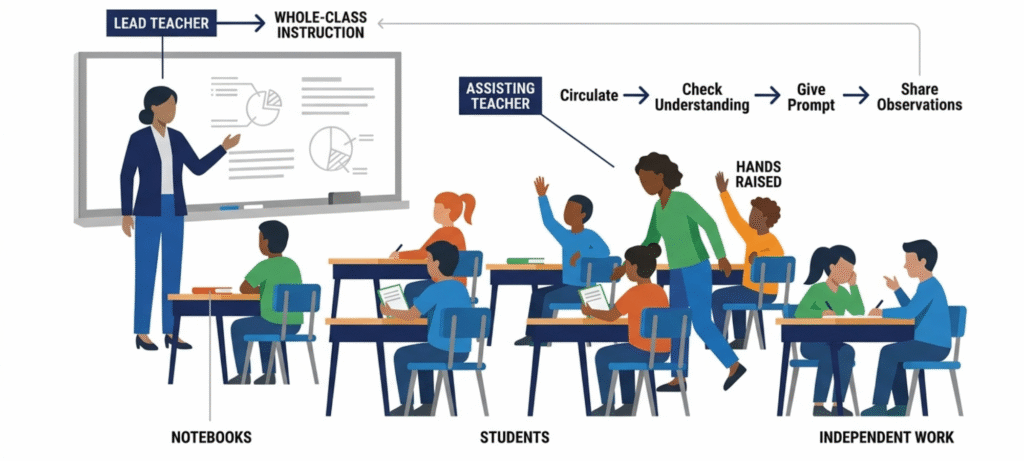
One teach one assist is a widely used co-teaching approach in inclusive classrooms. Two educators share a room, but only one stands at the front. That teacher delivers the main lesson, gives directions, and runs discussion. The other stays mobile. They look over shoulders, answer quiet questions, and catch the student who nodded along but has no idea what’s going on. The CSUSM co-teaching guide describes the model similarly: one teacher is free to help students in the moment while the other keeps instructing.
One reason schools use it is its simple structure. It generally needs less joint planning than parallel, station, or team teaching. That doesn’t mean no planning, though. The teachers still have to agree on roles and on how they’ll support students.
Who Uses One Teach One Assist?
The most common pairing is a general education teacher and a special education teacher sharing a class, since co-teaching grew out of inclusive education. Two classroom teachers working together can use it as well. In some settings a mentor teacher and a student teacher use a similar arrangement, though the exact setup depends on the school and program.
The pairing matters less than the habit behind it. Both adults need to know why one is leading and the other is circulating, and what each is expected to do.
How Does One Teach One Assist Work?
The model is easy to describe and harder to run well. A typical lesson goes like this.
Before class. The teachers agree on the objective and on who leads. They talk about which students may struggle, what kind of help fits (a prompt or a full re-explanation), and how they’ll signal each other. Five minutes here saves a lot of awkwardness later.
During direct instruction. The lead teacher presents. The assisting teacher isn’t parked at the back. They’re walking, glancing at notebooks, and quietly redirecting a student who has drifted. A tap on the desk often does the job.
During independent work. This is where the model earns its keep. Questions pop up one at a time, and the assisting teacher answers them while the lead teacher watches the whole room.
After class. The pair compares notes. Who needed help? Which mistake kept appearing? Should the roles switch next time? Skip this step and the model slowly turns into one teacher and one assistant.
What Does Each Teacher Do?
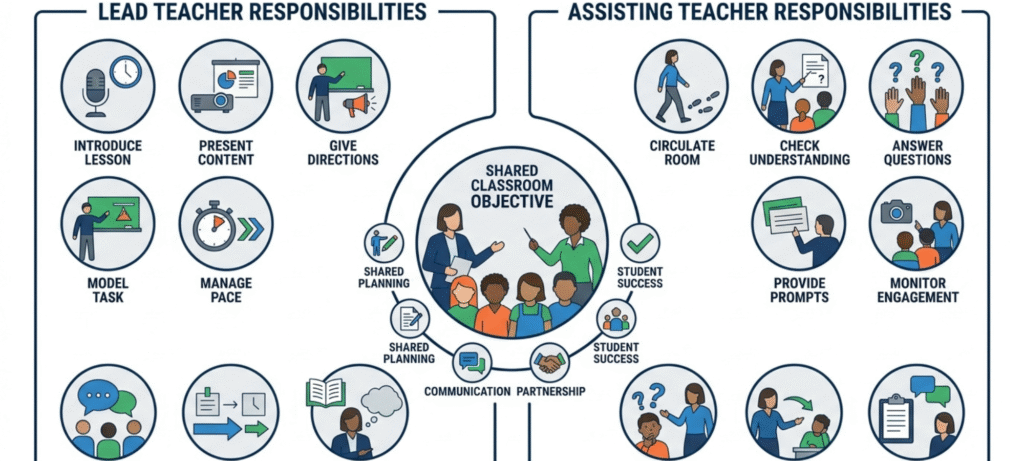
People often ask what the assisting teacher does beyond “walking around.” This breakdown answers that.
| Lead teacher | Assisting teacher |
|---|---|
| Introduces the lesson and objective | Circulates around the room |
| Presents core content | Checks understanding as students work |
| Gives whole-group directions | Answers individual questions |
| Models the task | Offers short prompts or clarification |
| Sets the pace of the lesson | Monitors engagement and focus |
| Leads class discussion | Notices shared misconceptions |
| Manages timing and transitions | Gives quiet behavior support through proximity |
| Reflects on how the lesson landed | Shares observations during the debrief |
The assisting column is mostly thinking work, not errands. If your assisting teacher spends the lesson handing out papers and sharpening pencils, something is off.
One Teach One Assist Example
Definitions only go so far, so here is a realistic scene: a Grade 4 math class working on equivalent fractions.
Teacher A stands at the board and shows how 1/2 becomes 2/4 by splitting each half in two. She uses fraction strips under the document camera. Teacher B walks the room while students copy the example and try a few problems.
Halfway through, Teacher B notices a boy staring at his strips without moving them. She crouches, asks what he thinks happens if he cuts each piece in half, and steps away. He gets one question, not a lecture. A minute later the strips are moving.
Then she spots something more useful. Four students in different corners have all written 1/2 = 2/2. Same mistake, four desks. She catches Teacher A’s eye and gives a small signal. Teacher A pauses, writes the mistake on the board without naming anyone, and asks the class what’s wrong with it. The confusion clears up for everyone.
The assisting teacher wasn’t just waiting for hands to go up. She was actively reading the room and feeding what she saw back to the lead teacher, which let the lesson change on the spot. In the debrief, they might decide Teacher B leads tomorrow so the roles stay balanced.
Benefits of One Teach One Assist
The biggest advantage shows up when a student gets stuck partway through a lesson. Without a second adult, the lead teacher has to choose between stopping the whole class and leaving that student stranded. With two, the lesson keeps going while help arrives quietly.
A few other benefits are worth naming.
Better monitoring. A second adult moving around notices off-task behavior early and can handle it without a public reminder.
Short, targeted support. A well-timed prompt often works better than a re-teach.
Close observation. The assisting teacher sees student work up close, which is hard from the front of the room. That’s useful formative assessment: who’s ahead, who’s lost, and what the class is misreading.
A lighter planning load. For a newly paired team still learning each other’s style, that matters.
A gentle way in for newer co-teachers. A teacher new to the class or the strategy can support students and watch a more experienced colleague teach before taking the lead. Understood’s guide to co-teaching models covers this model alongside the other five.
Advantages and Disadvantages of One Teach One Assist
No model is perfect, and this one has known weak spots. Here they are side by side.
| Advantages | Disadvantages |
|---|---|
| Immediate help for students | One teacher can look like the “real” teacher |
| Better monitoring of behavior and focus | Students may depend on the roaming adult |
| Whole-group lesson isn’t interrupted | The assisting teacher can be underused |
| Individual clarification without fuss | Constant movement can distract nearby students |
| Easy to organize with modest prep | Gets repetitive if roles never rotate |
| Useful for observing students | Can slide into always supporting the same students |
Most of the disadvantages trace back to status. When one teacher always leads and the other always assists, students notice. So do parents, and eventually so do the teachers.
How to Avoid the Assistant Trap
The assistant trap is what happens when a fully qualified teacher ends up functioning like an aide. One of the clearest risks of one teach one assist is that this slide happens without anyone deciding it. Research on co-teaching backs this up: a literature review notes that some studies found inequitable distribution of work, which can leave one teacher in a subordinate role to the other, and it also stresses that shared planning time makes co-teaching work. You can read it in Nápoles’s review of co-teaching research. doi
The fix is mostly habit.
Rotate roles on a schedule, by lesson, day, or unit. Students should see both adults teach and both adults help. Plan the assisting teacher’s job in advance, too. “Circulate” isn’t a plan. “Check the first three problems at every desk in the back half of the room” is.
Share ownership of the objectives. If only one person wrote the lesson, the other will feel like a guest in it. Watch your grouping habits as well. It’s easy for the assisting teacher to end up with the same handful of students every day, which quietly labels those students. Finally, ask the assisting teacher to jot down observations. A few notes turn a wandering role into an instructional one.
Good routines make all of this easier. Our piece on classroom management philosophy covers how expectations, movement, and behavior fit together.
One Teach One Assist Lesson Plan Template
Searchers often want something they can copy, so here’s a simple planning template. Fill it in together before the lesson, not during it.
| Planning question | Lead teacher | Assisting teacher |
|---|---|---|
| Lesson objective | ||
| Main instructional task | ||
| Students who may need support | ||
| Type of support (prompt, model, reteach) | ||
| Check for understanding | ||
| Signal for pausing the whole class | ||
| Post-lesson notes |
If you prefer a quick framework, use five steps:
- Learning objective: what students should be able to do by the end.
- Lead teacher task: what will be taught and modeled.
- Assisting teacher task: where they’ll circulate and what they’ll look for.
- Student support and checks: how you’ll confirm students understand, and who might need extra help.
- Reflection: what worked, what didn’t, and who leads next time.
How One Teach One Assist Can Support Diverse Learners
The model fits inclusive classrooms because help can be individual without being obvious. The assisting teacher can rephrase directions, check that a student can actually get into the task, give a targeted prompt, or adjust the level of challenge. That supports differentiated instruction without pulling a student out of the lesson.
It can also help teachers put accommodations into practice and track progress. A special education teacher in the assisting role might watch how a student uses a support listed in their IEP or 504 plan and jot down what they see. That said, who is responsible for which accommodation depends on the student’s plan and the school’s setup. Don’t assume the assisting teacher owns every one. The team should settle it beforehand.
When Should You Use One Teach One Assist?
This model fits best when:
- the lesson needs sustained whole-group explanation, such as a new concept or demonstration
- many students will likely need brief, individual clarification
- one teacher knows the content or strategy better than the other
- a second adult’s presence would help with focus or behavior
- you want to see how students respond before choosing a different approach
- the class benefits from discreet help rather than being split into groups
“If several of these conditions apply, the model may be worth considering.
When Is One Teach One Assist Not the Best Choice?
Sometimes another model does the job better. Consider switching when:
- students need to be taught in two smaller groups at the same time
- the lesson works better as rotating stations
- a small group needs intensive reteaching or enrichment
- both teachers should actively teach
- you need structured observation data on specific students
Using one teach one assist for everything is a common mistake. It’s a tool, not a default setting.
One Teach One Assist vs. Other Co-Teaching Models
Google’s related searches show people compare this model with its neighbors constantly. The literature usually describes six models suited to inclusive classrooms: one teach/one assist, one teach/one observe, station teaching, parallel teaching, alternative teaching, and team teaching. Here’s how they differ. sagepub
| Model | How it works | Main strength |
|---|---|---|
| One teach, one assist | One teacher leads, the other supports individuals | Immediate individual help |
| One teach, one observe | One teaches, the other gathers data on students | Focused observation data |
| Parallel teaching | Class splits in two, each half taught the same content | Smaller instructional groups |
| Station teaching | Students rotate between teaching stations | Differentiated instruction |
| Alternative teaching | One teacher works with a small group, the other with the rest | Reteaching or enrichment |
| Team teaching | Both teachers teach together | Shared ownership of instruction |
One teach one observe is more deliberate than “one teacher just doesn’t help.” The observer collects specific information, such as academic progress, engagement, behavior, or how a student is working toward IEP goals, and the team uses it to plan what comes next.
A rule of thumb: if you want the second adult mainly to support, choose assist. If you want them to gather information, choose observe. If you want them to teach, pick one of the other four.
Is One Teach One Assist the Same as a One-to-One Teaching Assistant?
No, and the overlapping words make the confusion understandable.
One teach one assist is a way of organizing a lesson. Two educators share responsibility for a class, and one takes the supporting role for that lesson. A one-to-one teaching assistant is a job someone is hired into. They typically work with a specific student, helping with things like following instructions, staying focused, using a support tool, or taking part in activities, depending on that student’s needs and the school’s staffing.
The two can look alike from the doorway, since both involve an adult beside a student. But in one teach one assist the assisting adult is a teacher who supports the whole class and rotates roles. A one-to-one assistant’s attention is dedicated to one learner.
Is It Related to Teaching Assistant Certification?
Not directly. One teach one assist describes how teachers share a classroom, and it isn’t a credential. Requirements for teaching assistant roles and certifications vary by region and employer. Anyone asking about a specific certification, such as how long a Level 1 credential lasts in a particular state, should check with the local education department or school district.
How to Tell If One Teach One Assist Is Working
Watch for these five signs:
- Both teachers have real instructional roles. Neither is stuck in a clerical or passive job.
- Students go to either teacher for help. If they only approach one, the status gap is showing.
- The assisting teacher spots misconceptions. They bring patterns to the lead teacher, not just individual questions.
- Support isn’t creating dependency. Students attempt the task before asking, and prompts replace answers.
- Instruction changes based on what’s observed. Teachers adjust the next lesson using what they saw.
If most of these are missing, try a different model for a few weeks.
Practical Tips and Common Mistakes
Talk before the lesson, even briefly. Agree on a quiet signal for “I need you to address this with the whole class.” Decide how much help is too much, since some students will happily wait for the roaming adult. Keep your movement calm and purposeful, spend a little more time where the work is hardest, and step back when a student is doing fine.
The mistakes that sink this model show up again and again:
- Never rotating roles. One teacher becomes “the teacher” in everyone’s mind.
- Assigning clerical work. Photocopying isn’t instruction.
- Always helping the same students. It labels them and limits the other teacher’s relationships.
- Giving answers instead of prompts. Students learn to wait for rescue.
- Skipping the debrief. Observations vanish and nothing improves.
- Hovering. Too much presence distracts as much as too little.
Frequently Asked Questions
What is one teach one assist?
One teach one assist is a co-teaching model where one teacher leads whole-class instruction and the other moves around the room helping individual students with academic, behavioral, or organizational needs.
What is an example of one teach one assist?
In a Grade 4 fractions lesson, one teacher introduces equivalent fractions at the board while the other circulates, gives quick prompts to students who are stuck, and spots a shared mistake to raise with the whole class.
What are the pros and cons of one teach one assist?
The pros are immediate help, better monitoring, and modest planning demands. The cons are role imbalance, student dependence on the roaming teacher, possible distraction, and the risk that the assisting teacher is underused.
What does the assisting teacher do?
They circulate, check understanding, answer questions, offer short prompts, notice misconceptions, support focus and behavior, and share observations with the lead teacher afterward.
What is the difference between one teach one assist and team teaching?
In one teach one assist, one teacher leads and the other supports. In team teaching, both teachers deliver instruction together and share the lead throughout.
What is the difference between one teach one assist and one teach one observe?
The assisting teacher helps students in real time. The observing teacher steps back and collects specific data on students or the lesson, usually without stepping in.
Final Thought
One teach one assist works because it solves an ordinary classroom problem: one adult can’t be everywhere at once. Give the second adult a real job, rotate the roles, and make time to share what you saw, and the model becomes far more than two people in a room. Those observations can also help teachers identify learning gaps before they become bigger problems. Use one teach one assist where it fits, switch models where it doesn’t, and keep both teachers teaching.