

A lot of students end up typing “how does ap classes affect gpa” into Google the night before they have to pick their schedule. Fair question, honestly. The short answer here is that AP classes can raise your weighted GPA, but they won’t touch your unweighted GPA at all, and the exact bump you get depends entirely on your school’s system.
That’s really it. Everything from here on is just the detail, plus some actual math you can run on your own grades if you want to see the real numbers.
Understanding How Does AP Classes Affect GPA With Weighted Grades
Weighted GPAs exist to reward the harder classes you take. If your school weights AP courses, the usual move is tacking on one extra point to whatever grade lands on your report card. An A that’s normally worth 4.0 in a regular class jumps to 5.0 once it’s AP. B turns into a 4.0. C turns into a 3.0.
But here’s where people get tripped up. Your GPA isn’t some savings account where an AP class just drops a point straight into your total. That AP grade is one single number, and it gets folded in with every other grade you’ve got.
Picture a student pulling a B in an AP class. Under a typical plus 1.0 weighted scale, that B converts to a 4.0. Does it help the average? Sure. Does it launch your whole GPA up by a full point? No, not even close. That 4.0 only applies to the one class, so your cumulative GPA shifts by a small amount, not a dramatic one.
One more thing worth shouting from the rooftops: that plus 1.0 rule isn’t some fixed law carved in stone anywhere. Plenty of schools do it differently. Some tack on 0.5 for honors and save the full 1.0 for AP. Others don’t add anything at all. A handful even run on 6.0 scales entirely. Whatever your school actually does, your handbook or your counselor will have the real numbers for your specific situation. Want to see the baseline scale before diving into any of this? Our guide to the high school grading scale breaks down exactly how letter grades turn into points.
Weighted vs. Unweighted GPA
Unweighted GPA treats every class the same. An A in AP Biology and an A in gym both equal 4.0. Difficulty doesn’t matter.
Weighted GPA gives extra credit for rigor. That’s how students end up with a 4.3 or a 4.6 and no one panics about the “impossible” number.
Most transcripts show both. Some show only one. And colleges often recalculate anyway, which we’ll get to.
Here’s a quick side by side using a common +1.0 example.
| Letter Grade | Regular Class | AP Class |
|---|---|---|
| A | 4.0 | 5.0 |
| B | 3.0 | 4.0 |
| C | 2.0 | 3.0 |
| D | 1.0 | 2.0 |
| F | 0.0 | 0.0 |
One thing to check: some schools do not award additional weighting for an F, so check your school’s GPA policy.
Does an AP Class Raise Your Unweighted GPA?
No. Not directly.
If your school reports an unweighted 4.0 scale, your AP A is a 4.0, same as any other A. The class doesn’t earn an unweighted boost. What it can do is help you indirectly, if you earn a strong grade in a subject you’d have otherwise taken at a lower level. But the AP label alone isn’t doing the work.
Some students feel cheated by this. They took the harder class and got nothing extra. Yes, it can feel unfair. Colleges are aware of it, though, which is why they look at course difficulty separately from your GPA.
How Much Does One AP Class Raise Your GPA?
Let’s do this with real numbers, because that’s where this topic gets clear.
Say a student has four regular classes with straight A’s this semester. That’s a 4.0 across the board. Now add a fifth class, AP, and they earn an A. Under the +1.0 system:
(4.0 + 4.0 + 4.0 + 4.0 + 5.0) ÷ 5 = 4.20
So in that one semester, the weighted GPA lands at 4.20 instead of 4.00. That’s the “one class” effect, and it looks big because we’re only averaging five grades.
Real life is messier. Your cumulative GPA includes every semester you’ve finished, so a single AP class gets diluted. Which brings us to the math most people actually need.
The Formula for Working Out an AP Class’s Effect
Here’s the simple version:
New GPA = (current grade points + new grade points) ÷ (current courses + new courses)
Grade points here means GPA times the number of courses, if every course counts the same. If your school uses credit hours, use credits instead of course counts. Same idea.
Let’s run it. A student has a 3.50 weighted GPA after 20 courses. That’s 70 total grade points (20 × 3.50). They take one AP class and earn an A, worth 5.0.
(70 + 5) ÷ 21 = 3.57
One AP A moves the GPA from 3.50 to 3.57. Not nothing. Not dramatic either.
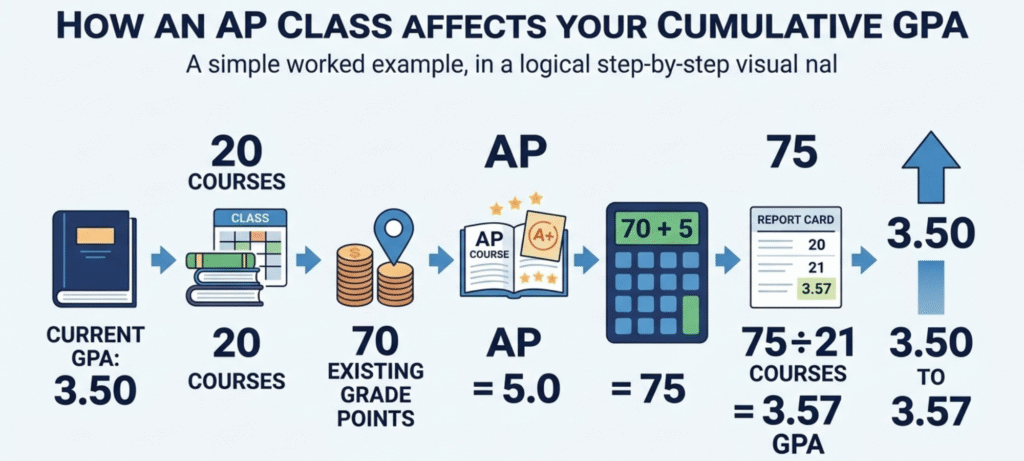
Now compare that with a regular A worth 4.0 in the same situation: (70 + 4) ÷ 21 = 3.52. So the AP weighting added about 0.05 more than a regular A would have. Small numbers like this add up over a few years, which is why students who take several AP classes end up above a 4.0.
Want a personal check? Say you have a 3.6 GPA over 24 courses. That’s 86.4 points. You earn an A in an AP class: (86.4 + 5) ÷ 25 = 3.66. Plug in your own numbers the same way. If you want the bigger picture of moving the number up over time, our post on how to raise your GPA covers the habits behind the math.
How Is AP GPA Calculated?
AP GPA is calculated by converting your class grades into grade points and then averaging those points. On a common weighted scale, an A in a regular class may be worth 4.0 while an A in an AP class may be worth 5.0. Your school may use a different weighting system, so its GPA policy should be the final reference.
Here’s how the same 3.50 GPA (20 courses) changes depending on the AP grade you earn:
| Current GPA | Courses Completed | AP Grade | New Weighted GPA* |
|---|---|---|---|
| 3.50 | 20 | A (5.0) | 3.57 |
| 3.50 | 20 | B (4.0) | 3.52 |
| 3.50 | 20 | C (3.0) | 3.48 |
*Using a common +1.0 AP weighting example.
Can AP Classes Lower Your GPA?
Yes. And this is the part nobody puts in the brochure.
If your school doesn’t weight AP courses, a B in AP is just a B. It counts as 3.0, exactly like a B in any other class, except you probably worked twice as hard for it.
Even on a weighted scale, a low AP grade can pull your average down. Take the same 3.50 student with 20 courses. If they earn a C in AP, worth 3.0 weighted:
(70 + 3) ÷ 21 = 3.48
That’s a small drop. And if the C had been a regular class, it would’ve been worth 2.0, so the GPA would’ve fallen further, to 3.43. So the weighting cushions the blow, but it doesn’t erase it.
The honest takeaway: the AP label doesn’t guarantee a higher GPA. The grade you actually earn does most of the work.
Is a B in AP Better Than an A in a Regular Class?
On paper, in a +1.0 weighted system, a B in AP equals a 4.0. An A in a regular class also equals 4.0. Same number. That’s where the popular “a B is an A in AP” idea comes from.
But numbers aren’t the whole story. Some schools rank students by weighted GPA, others by unweighted. Colleges often ignore your school’s weighting and recalculate. Do an AP B and a regular A look identical to an admissions officer? Not necessarily. Many of them read the transcript course by course.
So if you’re deciding between a comfortable A and a tough B purely for the GPA number, that’s a valid trade only if your school uses that exact formula. Ask before you decide.
What If Your School Doesn’t Weight AP Classes?
Then the GPA math is boring. An A is a 4.0. A B is a 3.0. Full stop.
The AP course still counts for something, though. Your transcript shows that you chose advanced coursework when it was available. Colleges see that. It also gives you access to the AP exam, which can earn college credit or advanced placement depending on the school.
Just don’t expect the GPA number itself to move.
Does the AP Exam Score Affect Your GPA?
Usually not. This trips up a lot of people.
The AP exam is scored by the College Board on a 1 to 5 scale. Your high school GPA comes from the grade your teacher gives you for the class. Two separate things. Getting a 5 on the exam doesn’t turn your class grade into a 5.0, and a 2 on the exam doesn’t lower an A you already earned.
So what does the exam score do? It can earn you college credit or let you skip an intro course, but every college sets its own rules. You can check specific schools using the College Board’s AP credit and placement policy search. And if you’re stressing about a score that just arrived, this breakdown of how to understand your AP exam score might help.
One more thing. If you self-study for an AP exam without taking the class, there’s no course grade going onto your transcript. So no weighted GPA benefit. The exam can still be worth it for credit, just not for GPA.
AP vs. Honors vs. Regular Classes
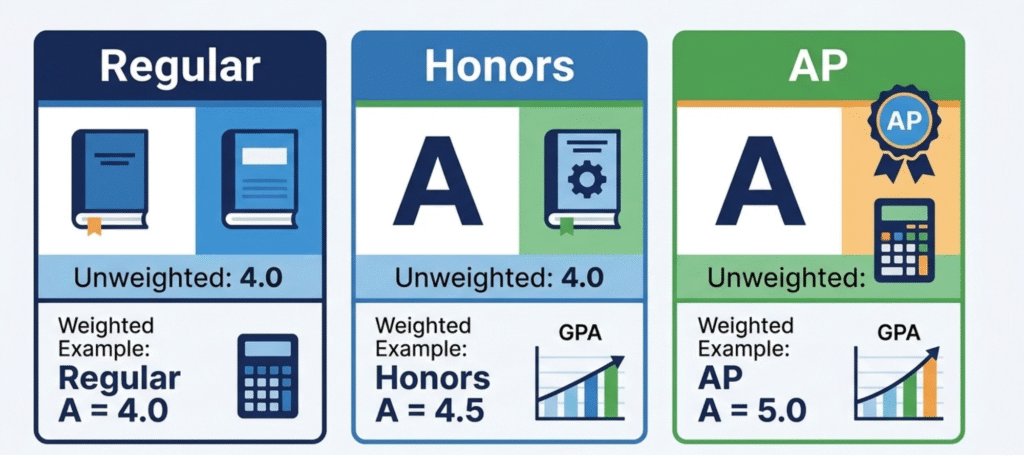
Many schools weight three tiers. The typical example looks like this:
| Course Type | Unweighted A | Weighted A (Common Example) |
|---|---|---|
| Regular | 4.0 | 4.0 |
| Honors | 4.0 | 4.5 |
| AP | 4.0 | 5.0 |
Again, these are examples. One school might give honors 0.5 and AP 1.0. Another might give both the same bump. Dual enrollment and IB classes get their own rules too. There’s no national standard, which is exactly why the same student can have a 3.9 at one school and a 4.4 at another.
What Is a Good AP GPA?
It depends on your school’s scale. On an unweighted scale, 4.0 is the maximum. On a weighted scale, a GPA can go above 4.0 because AP grades carry extra points.
That’s also why comparing GPAs between different schools can be misleading. A 4.3 at a school that adds 1.0 for every AP class isn’t the same as a 4.3 at a school that adds 0.5. So a “good” GPA is one that’s strong on your own school’s scale, backed by grades you earned in the classes that fit you.
How Many AP Classes Do You Need to Raise Your GPA?
There isn’t a magic number, and anyone who gives you one is guessing.
It depends on a handful of things. Your current GPA. How many courses you’ve finished. How many you’re taking now. Your school’s weighting rules. And, of course, your grades. A student with a 3.2 and five semesters left has more room to climb than a senior with a 3.9 and one semester to go.
Here’s a way to think about it. Every AP A you earn adds a little more than a regular A would. Every AP B adds roughly the same as a regular A. Every AP C is around a regular B. So the payoff only shows up if you can actually earn solid grades in those classes.
Stacking five AP classes in one year and getting three C’s is worse for your GPA than two AP classes and two A’s. The workload is real, so plan around it.
Do Colleges Look at Weighted or Unweighted GPA?
It depends. Many colleges recalculate GPA using their own method, because schools weight things so differently. The University of California, for example, recalculates GPA from your academic courses and caps how many honors points it counts. You can read their approach on the UC admissions GPA.
So the weighted number on your transcript matters most for your own school, rankings, and some scholarships. For college admissions, the story is usually bigger: your grades, the rigor of your classes, and what your school offered.
That last part matters. If your school only offers two AP classes, colleges know that. They judge you against what was available, not against a student at a school with thirty AP options.
Do AP Classes Matter Beyond GPA?
Yes, honestly, more than the GPA bump.
AP courses give you a preview of college-level work. Heavier reading, longer essays, faster pacing. If you can handle that in high school, freshman year hits softer. And a strong exam score might save you money and time on intro courses.
That said, don’t take AP History just to grab a weighted point if you hate the subject and your schedule is already packed. Burnout is real, and a dropped grade costs more than the bonus ever gave you.
Tips for Choosing AP Classes
Start with subjects you’re actually good at, or at least curious about. Interest carries you through the tough weeks.
Check how your school weights each course type before you sign up. Some schools only weight certain subjects.
Look at your total workload, including sports, a job, and family stuff. Three AP classes plus a part-time job is a real week, not a theory.
Ask about prerequisites, and talk to older students who took the class. They’ll tell you what the syllabus won’t.
And don’t pick AP purely for the extra point. The GPA effect is real but small. The workload is real and big.
FAQs
How does ap classes affect gpa?
On a weighted scale, AP classes usually add extra points to your grade, often one full point. On an unweighted scale, they don’t change anything. Your school’s policy decides which one applies.
How does an AP class affect your GPA if you only take one?
One AP class changes your cumulative GPA by a small amount, depending on how many courses you’ve already finished. A student with a 3.50 GPA over 20 courses would move to about 3.57 with an AP A.
Do AP classes raise your GPA?
They can raise your weighted GPA if your school adds points for AP courses. They don’t automatically raise your unweighted GPA.
Does an AP exam score affect GPA?
Generally no. The exam is scored 1 to 5 by the College Board, and your GPA comes from your class grade.
Can AP classes lower your GPA?
Yes. A low grade in an AP class can pull your average down, especially if your school doesn’t weight AP courses at all.
Is a B in AP better than an A in a regular class?
On a +1.0 weighted scale, they’re numerically equal at 4.0. But colleges may look at them differently, and schools weight courses in different ways.
Do AP classes affect unweighted GPA?
Not directly. An A in AP is still a 4.0 on an unweighted scale.
What happens if my school doesn’t weight AP classes?
Your AP grades count the same as any other class. The course can still show academic rigor on your transcript and give you the option to take the AP exam.
Final Thoughts
So, how does ap classes affect gpa? Mostly through weighting, and only if your school uses it. The bump is real, but it’s smaller than most people expect, because one class gets averaged in with everything else. The grade you earn matters more than the label on the course.
Check your school’s policy, run your own numbers with the formula above, and pick classes you can handle. That’s the whole strategy.