

What is written format? Basically, it’s how a piece of writing is laid out. The order of the parts, the headings, the spacing, and the small rules a reader expects to see. A lab report and a business letter both use words, sure, but you’d never confuse one for the other on the page. That difference in layout is the format.
Plenty of people mix format up with style or genre, and honestly, I get it. In everyday talk those words overlap. We’ll untangle them below. And if you like the rules side of writing, our post on what a writing convention is makes a decent companion. For now, let’s keep things practical.
Quick Answer: A written format is the structure and presentation of a piece of writing. It covers the order of sections, headings, paragraphs, spacing, margins, and other document rules. Essays, reports, business letters, research papers, and articles all use different formats.
What Is Written Format?
A written format works like a blueprint for a document. It shows the reader where everything sits and how it looks. Section order, headings, paragraph shape, and sometimes how you cite your sources.
Same bricks can be a pile in the yard or a house. Format is the difference.
Say a student writes a really sharp argument about solar power. Then hands it in as one huge block of text. No title, no introduction, no ending. The ideas might be great, but nobody can find them. Marks slip away, and the thinking was never the problem.
That’s what format does. It makes good writing easy to read.
Most formats answer four questions, whether the writer thinks about it or not:
- Which sections does this document need, and in what order?
- What should it look like on the page?
- Who’s reading, and what are they expecting?
- Do sources need to be cited a certain way?
Notice there’s nothing in that list about tone or word choice. That’s a separate thing, and we’ll get there soon.
The Five Things People Mean by “Format”
This is where the confusion starts. The word gets used in several ways, so when someone searches for a written format, they could mean any of these.
| Meaning | What it refers to | Example |
|---|---|---|
| Document structure | How a document is organized | Essay: introduction, body, conclusion |
| Document formatting | Font, margins, spacing, alignment | 12-point font, 1-inch margins |
| Writing mode or style | The purpose or voice of the writing | Narrative, persuasive |
| Citation style | How sources are credited | APA, MLA, Chicago |
| Publishing format | The physical or digital form | Paperback, ebook |
Most searchers want the first two. So that’s where most of this article lives.
Written Format vs. Style vs. Genre vs. Citation Style
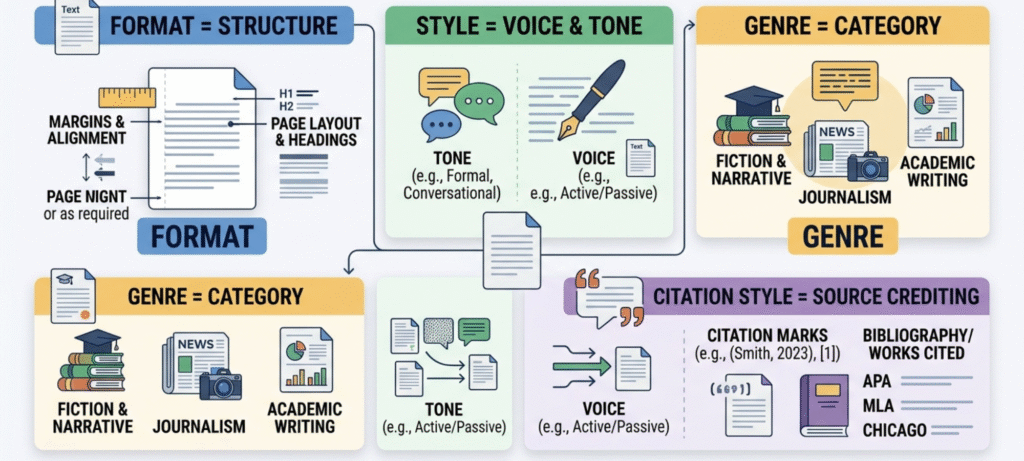
People swap these four terms constantly. Pulling them apart now will save you headaches later.
| Term | What it means | Example |
|---|---|---|
| Format | Structure and presentation | Research paper, business letter |
| Style | How the writing sounds | Formal, conversational |
| Genre | The category of the work | Fiction, journalism |
| Citation style | How sources are cited | APA, MLA |
Here’s a quick way to remember it. Format is the box. Style is the voice. Genre is the shelf in the bookstore. Citation style is the paperwork stapled to the side.
One more thing. The same format can wear different styles. A business email can sound stiff or friendly, but it still has a subject line, a greeting, a body, and a sign-off. The voice changes. The format doesn’t.
What Are Writing Formats?
Writing formats are the standard layouts for different kinds of documents. Every field has its own set. Once you know the patterns, you’ll notice them everywhere.
Think essay, research paper, report, business letter, memo, notice, resume, news article, blog post, screenplay. Each has a shape people recognize. Open a resume and you expect contact details on top and work history in the middle. Move things around and the reader gets thrown off, fast.
And that matters more than most writers realize. Readers lean on formats as shortcuts. They don’t want to hunt for your point. They already know where to look, and that makes your writing feel clear before they’ve even read a full sentence.
Different Formats of Writing
The easiest way to sort the different formats of writing is by where you’d actually use them.
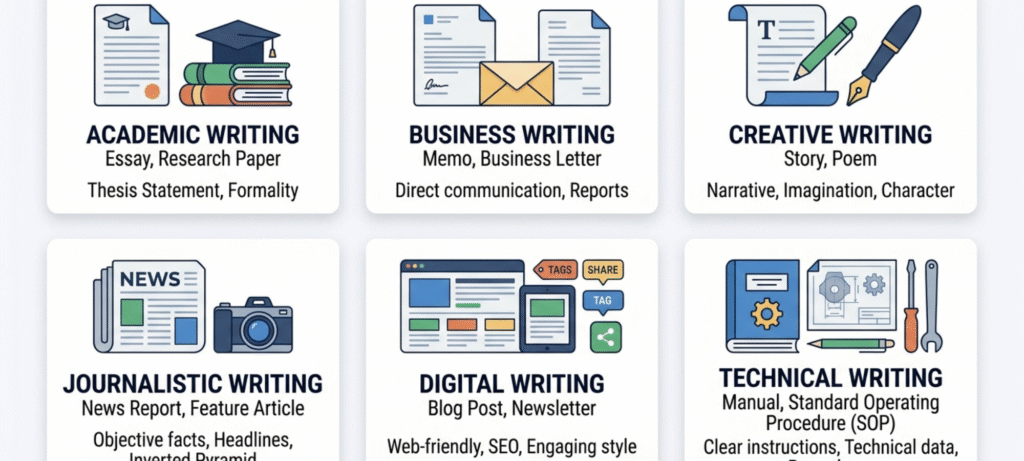
Academic Writing Formats
School and university writing leans hard on structure. Essays, research papers, theses, dissertations, literature reviews, lab reports, annotated bibliographies. All have set layouts, and most want a formal tone, solid evidence, and a specific citation style. If you’re building a paper from scratch, this high school research paper example shows how the pieces fit together on a real page.
Business Writing Formats
Business writing is about speed. Memos, emails, reports, proposals, business plans, executive summaries, business letters. The main point goes up top. Paragraphs stay short. Headings are clear. No wandering around.
Creative Writing Formats
Creative formats bend more rules, but they still have shapes. Short stories, novels, poems, plays, memoirs, screenplays. A screenplay has strict rules for scene headings and dialogue, and A traditional sonnet typically has fourteen line. So yes, even creative writing has rules.
Journalistic Writing Formats
News reports, feature stories, editorials, interviews, and opinion pieces live here. News puts the biggest facts first. Features take a slower, story-style route. We’ll compare the two in a bit.
Digital Writing Formats
Web writing is built for skimming. Blog posts, landing pages, newsletters, listicles, product descriptions, and social media posts all lean on short paragraphs, clear headings, and a simple call to action. Most people scan online, so the format has to allow for it.
Technical Writing Formats
Manuals, standard operating procedures, technical reports, quick reference guides, API documentation. They take complicated stuff and turn it into steps a person can follow. Being precise matters more than being clever.
What Are the Main Types of Writing?
When someone searches for “types of writing formats,” they could actually mean two completely different things. Document formats on one hand, or writing modes on the other. A lot of guides just blur these together without even noticing.
Expository, descriptive, persuasive, narrative, these four make up what most people call the classic writing modes. Take expository first. Its whole job is explaining or informing, nothing fancier than that, the kind of writing you’d find in a textbook or a how to guide. Descriptive goes a completely different route, relying on sensory detail to paint an actual picture in the reader’s head. Persuasive writing has an agenda though, it argues for a position and genuinely tries to win the reader over to that side of the argument. And narrative, well, that one just tells a story, the old familiar shape of a beginning, a middle, and an end.
Here’s the thing though, these describe your purpose, not the document itself. A single format can actually hold several modes at once. A feature story might be narrative and descriptive at the very same time, and an essay can be persuasive and expository within the same paragraph, no contradiction there.
So if someone brings up types of writing formats, it’s worth asking what they actually mean. Document layouts, or writing purposes? Because honestly, the answer changes everything about how you’d respond.
What Is an Example of a Written Format?
Let’s make this concrete. A common written format example is the essay: introduction, body paragraphs, conclusion. The main idea sits in the introduction, and each body paragraph backs it up.
A few more structures worth knowing:
Business letter: sender information, date, recipient details, salutation, body, closing, signature.
Report: title, executive summary, introduction, findings, conclusion, recommendations.
Research paper: title, abstract, introduction, methodology, results, discussion, references.
Here’s a quick reference table if you want everything in one place.
| Writing Format | Main Purpose | Common Structure |
|---|---|---|
| Essay | Explain or argue | Introduction, body, conclusion |
| Research paper | Present research | Abstract, introduction, methods, results, discussion |
| Report | Present findings | Introduction, findings, conclusion |
| Business letter | Formal communication | Address, salutation, body, closing |
| Feature story | Inform through narrative | Lede, context, quotes, development, ending |
| Notice | Share important information | Heading, date, message, sender details |
| Blog post | Inform or engage online readers | Title, introduction, sections, conclusion |
| Resume | Present qualifications | Summary, experience, education, skills |
What Is Written Format in Word?
In Microsoft Word, document formatting is about how text and page elements are arranged and presented. Fonts, margins, headings, page numbers, all of it.
The settings you’ll touch most:
- Font and size: lots of school papers use 12-point Times New Roman, though some guides allow other readable fonts.
- Margins: one inch on every side is a common default.
- Line spacing: double for many school papers, single for many business documents.
- Alignment: left aligned for body text, usually.
- Headings: use Word’s built-in heading styles so the structure carries into navigation tools.
- Page numbers and headers: often required on longer papers.
- Bullets and numbering: handy when readers need to scan a list.
One tip that saves a ridiculous amount of time: set your styles once instead of formatting line by line. Change the Heading 2 style and every Heading 2 updates. Do it by hand and you’ll end up with three slightly different fonts and no idea why.
Requirements shift from one assignment to the next, so check your rubric first. For citation-heavy papers, the APA Style website is the place to confirm current rules, since new editions come out.
What Format Is a Book Written In?
Trickier than it sounds, because “format” can mean three different things for a book.
Literary form first. A book can be prose, poetry, drama, or a graphic novel. Most novels are prose.
Then structure. Most books are split into chapters, sometimes grouped into parts. Around the main text you’ll usually find front matter (title page, table of contents, preface) and back matter (appendix, notes, index).
And then publishing format: hardcover, paperback, ebook, audiobook.
So the honest answer is that it depends on what you’re asking. A novel is written in prose, organized in chapters, and released in whatever form the publisher picks.
What Format Is a Hypothesis Written In?
A hypothesis doesn’t stand on its own. It’s a single testable statement, tucked inside something larger, a research paper, a lab report, a proposal.
The pattern almost always follows if then logic.
If [the independent variable changes], then [the dependent variable responds this way], because [the reason].
Take this example. If students sleep eight hours instead of six before an exam, then their test scores improve, because rest supports memory and focus.
What makes a hypothesis good? It names its variables. It states the relationship it expects to see. And it can actually be tested. Can’t picture an experiment that might disprove it? Then it’s not ready yet.
What Format Is a Feature Story Written In?
Feature stories lean on storytelling in a way straight news never does. News hits you with the key facts immediately, first sentence, no delay. A feature takes its time instead.
Here’s the typical shape. A headline pulls you in first. Then a lede, setting a scene or raising a question. Then the nut graf, one paragraph explaining what this is actually about and why it matters right now. Background comes next, then context. Quotes and details follow, pulled from interviews or direct observation. From there the story just develops, building toward a kicker, some final image or idea that lingers after you’ve finished reading.
News works backwards from that. It runs on the inverted pyramid, biggest facts up top, smallest ones trailing off at the bottom. Features chase atmosphere and people. News chases speed and clarity.
What Style Format Is a Business Letter Written In?
Business letters usually follow one of a few standard layouts, often called block styles.
| Layout | How it looks |
|---|---|
| Full block | A common layout in which every line begins at the left margin. |
| Modified block | The date and closing sit toward the right, while the body stays on the left. |
| Semi-block | Like modified block, but the paragraphs are indented. |
Whichever you pick, the parts stay the same: sender’s information, date, recipient’s name and address, salutation, an optional subject line, the body, a closing like “Sincerely,” and a signature.
Keep paragraphs short and the tone professional. Put your request in the first paragraph, too. Nobody wants to wade through three paragraphs before finding out what you’re asking for.
Notice Writing Format and Report Writing Format
Two more formats keep showing up in searches, mostly from students.
A notice is short and public. It’s usually brief and focused only on the essential information. Most include the organization’s name, the word “Notice,” the date, a clear heading, the key details (what, when, where), and the name and title of whoever’s issuing it. Direct, not chatty.
A report is longer and more formal. A common layout is title, introduction, main findings, conclusion, recommendations, and sometimes an appendix. The trick is letting each section do one job. Findings say what happened. Recommendations say what to do next. Don’t blend them.
Writing Format vs. Citation Format
Another spot where people trip. APA, MLA, Chicago, and IEEE aren’t writing formats in the broad sense. They’re citation and style systems. They control how sources are credited, and they often add rules for headings, margins, and reference lists. But they don’t decide whether you’re writing an essay or a report.
| Style | Common use |
|---|---|
| APA | Psychology, education, social sciences |
| MLA | Literature and the humanities |
| Chicago | History and publishing |
| IEEE | Engineering and computer science |
APA uses a References page. MLA uses a Works Cited page. Your instructor or publisher usually picks one for you. When in doubt, go straight to the source, like the MLA Style Center, and skip the random forum post.
How to Choose the Right Writing Format
Not sure which format fits? Ask yourself a few quick questions.
- Who’s reading this? A professor, a manager, a customer, the general web?
- What’s the purpose? To inform, persuade, tell a story, or give instructions?
- What has to be included? Data, quotes, a call to action, a bibliography?
- What category are you in? Academic, business, creative, journalistic, technical, or digital?
- Are there rules? A rubric, a style guide, a word limit, a required citation style?
If your answers are “professor, persuade, sourced evidence, academic, APA,” you’re writing an argumentative essay in APA. If they’re “new employees, instruct, steps, technical, company template,” you’re writing a procedure. The answers usually point straight at the format.
FAQs
What is a written format?
It’s the way a document is organized and presented, including its sections, layout, spacing, and conventions. It changes depending on the type of document and who’s reading it.
What are the different formats of writing?
The main groups are academic (essays, research papers), business (letters, reports, memos), creative (stories, poems, screenplays), journalistic (news, features), technical (manuals, procedures), and digital (blog posts, web pages).
What are the four main writing styles?
Expository, descriptive, persuasive, and narrative. They describe the purpose of the writing, not the document layout.
What is a writing format example?
An essay is the simplest one: introduction, body paragraphs, conclusion. A business letter is another, with sender details, date, recipient, salutation, body, closing, and signature.
What is written format in Word?
It’s how text and page elements are arranged in a Word document. That includes font, size, margins, line spacing, alignment, headings, page numbers, and lists.
What format is a book written in?
Most books are prose split into chapters, though some use poetry, drama, or graphic formats. Published formats include hardcover, paperback, ebook, and audiobook.
What format is a hypothesis written in?
As a testable statement, often in if-then form, inside a research paper, lab report, or proposal.
What format is a feature story written in?
It usually goes from headline and lede to a nut graf, background, quotes, story development, and a closing ending.
What style format is a business letter written in?
Business letters commonly use full block, modified block, or semi-block layouts. Full block, with every line starting at the left margin, is a common choice.
What is the difference between writing format and writing style?
Format is the structure and presentation of a document. Style is how it sounds, meaning tone, voice, and word choice.
Final Thoughts
So, what is written format? It’s the structure that turns loose words into something people can actually use. The order of your sections, the look of the page, the habits of the field you’re writing in.
Once you separate format from style, genre, and citation rules, the whole topic gets a lot simpler. Pick the format that fits your reader and your purpose, check whatever rules you’ve been given, and let the structure do the heavy lifting. Good ideas deserve a good container.