

Type “math is cool” into Google and you’ll notice the results don’t agree on what you’re actually looking for. Some point to a school competition. Others lead straight to Coolmath Games. A few just want to convince you that arithmetic is more interesting than it looks. All three are legitimate, and that’s really the point, math is cool depending on who’s asking, it can mean a competitive event for students, a browser gaming platform, or simply an appreciation for how numbers behave.
This guide covers all three angles. You’ll find out what the Math Is Cool competition actually involves, how Coolmath Games fits into the picture, whether it’s safe and educational, what’s going on with the oddly popular “There Is No Game” search, and a handful of tricks that show why numbers can be genuinely fun to play with.
What Does “Math Is Cool” Mean?
The phrase splits into a few distinct meanings, and knowing which one you’re after will save you some scrolling.
| What you’re searching for | What it actually refers to |
|---|---|
| Math Is Cool competition | A student math competition connected to Academics Are Cool, strongly associated with Washington State |
| Coolmath Games | A large browser-based gaming site with thousands of logic, puzzle and math titles |
| Math is cool games | A general search for entertaining ways to practice numbers, not tied to one brand |
| Math tricks | Mental shortcuts and number patterns that make calculation faster |
These aren’t competing definitions so much as different doors into the same general interest. A parent searching for “is cool math games safe” wants something completely different from a student typing “math is cool competition 2026 schedule,” even though both start with the same three words.
Which “Math Is Cool” Result Are You Looking For?
| Your goal | Go here |
|---|---|
| Enter a math competition | Math Is Cool Competition section |
| Find past tests or a PDF | Past Tests & PDFs section |
| Play online games | Coolmath Games section |
| Find games for younger kids | Coolmath4Kids vs Coolmath Games section |
| Check if the site is safe | Is Coolmath Games Safe? section |
| Find “There Is No Game” | There Is No Game section |
| Learn a fun math trick | Why Is Math Actually Cool? section |
What Is the Math Is Cool Competition?
Math Is Cool is a competition series for school students, run in connection with Academics Are Cool, a nonprofit that organizes academic contests. It’s most closely tied to Washington State, where the Washington Student Math Association hosts events under this name for students from elementary through high school.
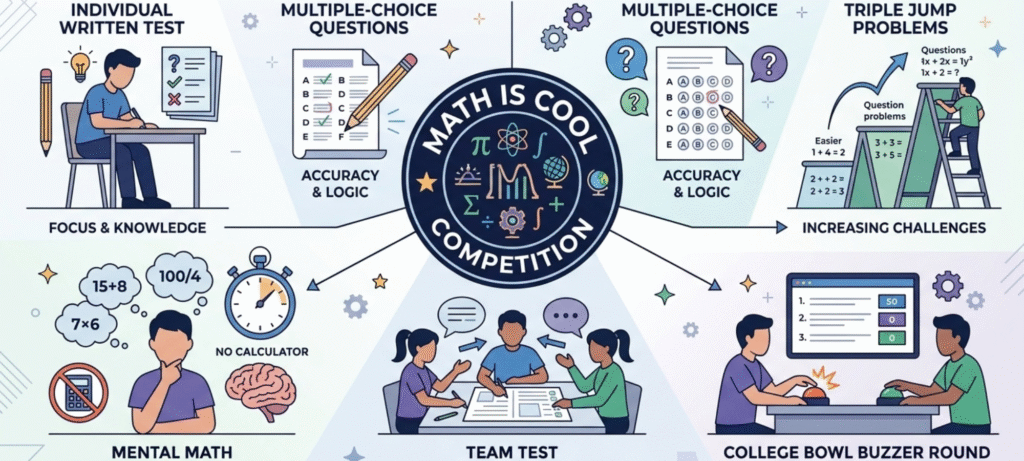
Unlike a standard classroom test, the competition mixes formats. Depending on grade level, students might face:
- An individual written test
- A multiple-choice section
- A team test worked on collaboratively
- A mental math round with no calculator
- Triple Jump problems
- A College Bowl-style buzzer round
That combination is deliberate. Math Is Cool isn’t just checking whether a student knows the material — it’s testing speed, composure under pressure, and the ability to work as part of a team, alongside the actual math.
Math Is Cool Championships and Masters
Two names show up alongside the general competition, and they’re not interchangeable. The Washington Student Math Association runs Math Is Cool Championships as the main open contest for elementary, middle, and high school categories — this is the entry point most schools and individual students sign up for.
Math Is Cool Masters sits a level above that. It’s described as an invitational event, meaning qualification usually comes through performance in a regular Championship rather than open sign-up, and the problems set for it tend to run harder than the regional competition. Team and individual formats broadly mirror the standard event, just with a tougher problem set and a smaller, more selective field. If you’re aiming for Masters, treating the regular Championship as practice first is the realistic path — check the current organizer’s page for exact qualification rules, since these can shift year to year.
Who Can Participate?
Competitions are generally split by grade band:
- Elementary: grades 4–6
- Middle school: grades 7–8
- High school: grades 9–12
Some Championship-level events run as open contests that any eligible school or student can enter, while Masters is invitational and tied to qualifying results. Exact eligibility, team sizes, and registration details vary by event and region, so it’s worth checking the current competition page for your specific grade before assuming a rule from a past year still applies.
How Does the Competition Work?
Most formats combine individual scoring with a team component. Mental Math and the Individual Test are typically solo events, while Multiple Choice, Team Test, Triple Jump, and College Bowl are worked in a team, usually of four students. Calculators are off the table in most rounds, which is why mental math practice tends to matter more here than it would for an ordinary exam.
Students preparing for it usually benefit from more than just solving practice worksheets. Useful areas to build up include:
- Mental arithmetic without reaching for a calculator
- Comfort with unfamiliar problem types, not just memorized formulas
- Working quickly and accurately under a time limit
- Explaining a solution fast enough for teammates to use it
Math Is Cool 2026: Schedule, Questions, Results and Past Tests
Many people searching for Math Is Cool are after practical information rather than a definition: competition dates, past tests, sample questions, and results.
2026 at a Glance
2026 did have real Math Is Cool activity — for example, an official online Grade 4 contest ran on April 1, 2026, keeping the standard six-event structure and delivered through a live session plus online answer sheets rather than an in-person hall. That confirms the competition kept running in its usual format this year, even where individual events moved online.
What it doesn’t confirm is a single universal date for every grade and region. Math Is Cool is organized locally as much as centrally, so a Grade 4 online contest date tells you nothing reliable about, say, a high school regional event in a different area. Since we’re now past most of the 2026 calendar, if you’re planning ahead, the practical move is to check the specific competition or grade-level page for the current or upcoming cycle rather than treating any one date as universal.
Past Tests & PDFs
Official past papers and sample tests exist, and some are distributed as downloadable PDFs directly through competition and event pages, particularly for the online contests. They’re useful for more than just checking answers — working through one under time pressure gives a much better sense of pacing and difficulty than reading a description of the format ever could. We won’t reproduce test content here, but the current competition or Academics Are Cool page for your grade is the right place to find the latest available set.
What Kind of Questions Appear?
Published samples cover a broad spread: arithmetic, algebra, geometry, probability, number sequences, and coordinate geometry, often phrased to reward speed and pattern recognition rather than long calculation. Students who do well tend to spend as much time practicing recognition — “I’ve seen this shape of problem before” — as they do practicing raw computation.
Where to Find Results
Results aren’t kept in one central archive. They’re published against the specific competition or Championship listing that produced them — so a Grade 4 online contest’s results sit on that contest’s own page, and a regional high school event’s results sit on its page. If you’re chasing “math is cool competition 2026 results” for a specific event, going to that event’s listing directly will get you further than a general search.
What Are Math Is Cool Games?
This phrase is broader than the competition above. When people search “math is cool games,” they’re usually after something to play rather than something to study for — arithmetic challenges, number puzzles, logic games, or timed problem-solving activities.
There’s also a strong overlap here with Coolmath Games specifically, since a lot of people use “math is cool” as a loose, misremembered way of searching for it. Coolmath Games currently says its team has hand-picked around 2,500 games, organized into categories that go far beyond arithmetic drills — logic, strategy, physics-based puzzles, and even coding games all sit under the same umbrella.
That’s worth keeping in mind if you’re choosing a game for a specific purpose. Not every title on a “math games” site teaches math directly. Many are built around spatial reasoning, planning, or memory instead, with the numerical content baked in less obviously.
2 Math Games to Try
If you just want a couple of concrete examples rather than a huge list, two of Coolmath’s own educational picks illustrate the difference well:
- Make 24 — you’re given a set of numbers and have to combine them with basic operations to reach a target total of 24. It rewards experimentation and flexible thinking over speed, since there’s usually more than one path to the answer.
- Math Clash — a faster-paced arithmetic game built around quick calculation under time pressure. It rewards speed and accuracy rather than creative problem-solving.
Picking between them comes down to what you’re practicing: Make 24 for flexible number sense, Math Clash for raw calculation speed.
Coolmath Games: What Is It?
Coolmath Games is a separate entity from the Math Is Cool competition, and mixing the two up is one of the more common points of confusion in this space. It’s a browser-based gaming platform, part of the wider Coolmath network alongside Coolmath and Coolmath4Kids, built around the idea that games can exercise logic, numeracy, and creative thinking without feeling like a worksheet.
The catalogue has expanded well beyond simple arithmetic over the years. Current categories include applied math, brain games, physics puzzles, strategy titles, and coding-adjacent games, which is a much wider net than the name alone suggests.
How Old Is Coolmath Games?
The Coolmath network dates back to 1997, which puts it at roughly three decades old. The platform itself has changed considerably in that time — what started closer to a straightforward arithmetic-practice site now looks much more like a general browser gaming hub with a thinking-skills slant.
Is Coolmath Games Educational?
The honest answer is: partially, and it depends on the specific game. Coolmath’s own material frames its collection as supporting skills like problem solving, concentration, processing speed, and creative thinking rather than claiming every title teaches a specific math concept.
That distinction matters because playing a game isn’t automatically the same as studying. A logic puzzle can strengthen reasoning without ever touching an equation. A strategy title might require planning and quick mental math without functioning as a lesson on its own. The more realistic way to think about it is as a supplement rather than a substitute — teach the concept first, let a game reinforce it, then check whether the skill transfers outside the game.
Is Coolmath Games Safe?
This question splits into two separate things worth keeping apart: what the games themselves contain, and who the site says it’s built for.
On content, the platform’s own safety information says games are screened before publication, with realistic violence, gore, alcohol or drug use, adult content, and foul language excluded, and open player-to-player chat isn’t permitted. Users also aren’t required to hand over a name, email, or phone number just to play, though the site is ad-supported and does use behavioral advertising.
On age, the platform’s terms currently describe CoolmathGames.com as designed for users 13 and older, with younger children pointed toward Coolmath4Kids instead. That’s a site-wide guidance line, not a content rating on any individual game — the content screening applies across the board, but the 13+ line is about who the main site is built for. So “safe” here means the site screens content and limits chat; it doesn’t mean every game is automatically the right fit for every age, and a bit of parental judgment on individual titles still applies.
How Old Do You Have to Be for Coolmath Games?
Thirteen, according to the site’s own terms — anything younger is directed to the Coolmath4Kids version instead.
Coolmath4Kids vs Coolmath Games
These are two separate destinations inside the same network, not two names for the same thing. Coolmath4Kids is built specifically for younger children, while CoolmathGames.com states its main site is designed for users aged 13 and older. If you’re choosing where to send a younger kid, Coolmath4Kids — not the main Coolmath Games site — is the one matching the platform’s own age guidance.
Why Is Coolmath Games Blocked?
If a school network blocks Coolmath Games, that’s almost always a decision made by the school or district, not a reflection of the site being flagged as unsafe. Schools commonly restrict gaming sites to reduce distraction during class time, manage bandwidth, or enforce a broader no-games policy on school devices — separate entirely from whatever content standards the platform itself follows.
If you’re a student running into this at school, the sensible move is to follow the school’s own technology policy rather than looking for a workaround, since the block is a network decision rather than a safety verdict on the games themselves.
What Is There Is No Game on Coolmath Games?
One of the odder searches in this space is some version of “cool math games there is no game” — and yes, there really is a title called There Is No Game on the platform.
It’s a point-and-click puzzle built around an unreliable narrator who insists, repeatedly, that there’s nothing to play. The player has to work against that narration to actually get the game going, which is where most of the humor and the puzzle-solving overlap. Coolmath currently categorizes it under Logic → Outside the Box.
As of the current listing, the original browser version is not playable because it relies on older Flash compatibility — so finding the game’s page doesn’t guarantee it will actually launch. It’s worth checking the page’s current status directly rather than assuming it works the way older reviews describe.
Is There Is No Game Actually a Game?
Yes — the title itself is the joke. The narrator spends much of the experience insisting there’s nothing here to play, while the player’s job is to poke, click, and interact anyway until a genuine game reveals itself underneath the denial. It’s less a walkthrough-friendly puzzle and more a short experience built around subverting the expectation set by its own title.
Why Is Math Actually Cool?
Setting the competitions and games aside for a moment, there’s a simpler reason the phrase sticks around: numbers really do follow patterns that feel almost like tricks once you notice them.
Multiplying by 11. Take a two-digit number, split the digits apart, and drop their sum in the middle. For 52 × 11: separate into 5 and 2, add them to get 7, and slot that in the middle to get 572. Try 34 × 11 the same way and you land on 374. When the sum runs past 9, you carry the extra digit — 78 × 11 gives 7 + 8 = 15, so the answer becomes 858 rather than a broken three-digit jumble. The reason it works is straightforward once you expand it algebraically: 11 is just 10 + 1, so ordinary multiplication naturally produces that middle-digit pattern.
Squaring a number ending in 5. Any number ending in 5, once squared, ends in 25 — no exceptions. To get the digits before that, take the number in front of the 5, multiply it by the next integer up, and place that result in front of the 25. For 25², the digit before the 5 is 2, and 2 × 3 = 6, giving 625. Scale it up: 115² has 11 before the 5, and 11 × 12 = 132, so the answer is 13,225. This comes from expanding (10n + 5)², which always produces that clean 25 at the end.
Dividing by 7. This one’s less tidy but arguably more interesting. 1/7 works out to 0.142857, repeating forever. What’s neat is that every other seventh — 2/7, 3/7, and so on — uses the exact same six digits, just starting from a different point in the cycle: 2/7 is 0.285714…, 3/7 is 0.428571…, and so on around the loop. It comes down to the limited set of possible remainders in long division by 7, which cycles back on itself before it ever has the chance to produce a genuinely different sequence.
None of this requires a textbook to appreciate. It’s the kind of thing that turns “when will I use this” into “wait, why does that work,” which is a much more interesting question.
How to Make Math More Fun
If you’re wondering whether your child may need more structured help with math, our guide to 5 Signs Your Child Needs Extra Math Support can help you recognize common signs to watch for.
- Match the activity to current ability — a multiplication game is useful while multiplication facts are still shaky, a logic puzzle makes more sense once basic arithmetic is solid.
- Keep sessions short. Ten to twenty minutes of focused play beats an hour of distracted clicking.
- Ask the learner to explain what they did afterward. That step turns “I beat the level” into “I actually understood the pattern.”
- Use games as warm-ups or fast-finisher activities rather than the entire lesson.
- Mix in real competitions or timed challenges occasionally — a bit of pressure changes how people engage with the same material.
The game or app doesn’t need to carry the whole educational load. It works best as one piece alongside actual instruction, not a replacement for it.
Math Is Cool Competition vs Coolmath Games
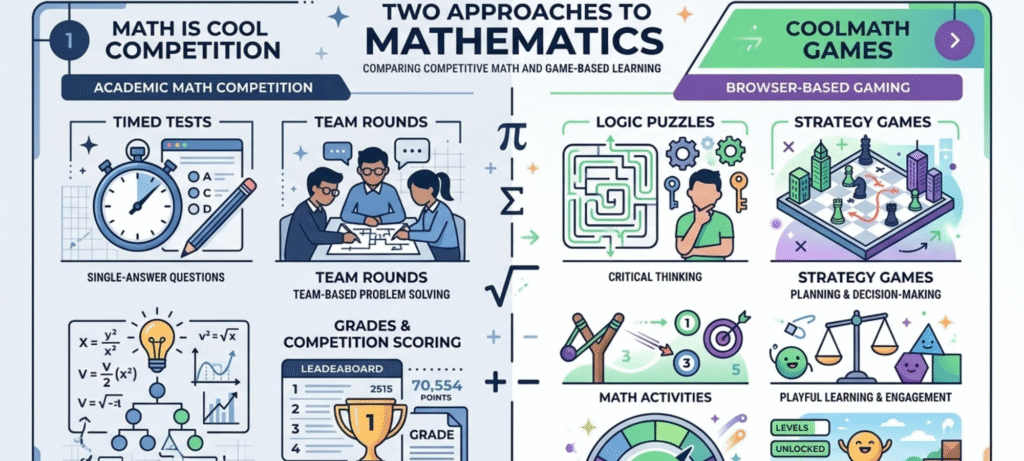
Since these two get mixed up constantly, here’s the split in one place:
| Feature | Math Is Cool Competition | Coolmath Games |
|---|---|---|
| Main purpose | Academic competition | Online games |
| Organization | Academics Are Cool | Coolmath |
| Main audience | School students | General gaming audience |
| Format | Timed tests and team rounds | Browser-based games |
| Math content | Direct competition problems | Varies by individual game |
| Teamwork | Central to team events | Depends on the specific game |
| Main skill tested | Mathematical problem solving | Logic, strategy, and general thinking |
They share a name-adjacent phrase and a general subject, but they’re built for completely different purposes.
How to Prepare for the Math Is Cool Competition
Preparation looks a little different from studying for a regular test, mostly because of the mixed format:
- Confirm your grade band and category, and register through the current organizer’s page rather than an old link.
- Work through official past tests to get a feel for pacing and typical question style.
- Practice mental arithmetic specifically — most rounds don’t allow a calculator, so speed without one matters.
- Time yourself on practice sets rather than solving them at a relaxed pace.
- If you’re on a team, practice explaining a solution out loud, quickly — Team Test and College Bowl rounds reward being understood fast, not just being right.
- Read the current competition’s own instructions closely, since round names and rules can shift slightly between events and years.
None of this replaces actually knowing the math, but it closes the gap between knowing a concept and being able to use it under a clock with three teammates watching.
Frequently Asked Questions
What is Math Is Cool?
It’s a school math competition series associated with Academics Are Cool, held primarily through the Washington Student Math Association, with events for elementary through high school grades.
Is Math Is Cool the same as Coolmath Games?
No. One is a competition, the other is a gaming platform. The overlapping name is where most of the confusion comes from.
What grades can compete in Math Is Cool?
Typically elementary (grades 4–6), middle school (7–8), and high school (9–12), though exact rules vary by specific competition.
Where can I find Math Is Cool past tests?
Through the competition’s own resources and Academics Are Cool materials, which include sample problems covering arithmetic, algebra, geometry, and probability. Some are available as downloadable PDFs on the event’s own page.
What is Math Is Cool Masters?
An invitational competition that sits above the standard Math Is Cool Championships, typically reached through qualifying results rather than open sign-up, with a harder problem set than the regional event.
Is Coolmath Games educational?
Some titles support numeracy, logic, and problem-solving skills, but the platform works better as a supplement to instruction than a replacement for it.
Is Coolmath Games safe?
The platform says it screens games for inappropriate content and doesn’t allow open player chat, though its terms list the intended minimum age as 13, with younger kids directed to Coolmath4Kids.
How old is Coolmath Games?
The wider Coolmath network dates to 1997, making it around 29 years old as of 2026.
Is Coolmath4Kids the same as Coolmath Games?
No. Coolmath4Kids is the version built for younger children, while CoolmathGames.com is the main site, designed for users 13 and older.
Why is Coolmath Games blocked at school?
Usually a network or device policy decision by the school itself, not a reflection of the platform being flagged as unsafe.
What is There Is No Game on Coolmath Games?
A point-and-click puzzle built around an unreliable narrator, filed under Logic → Outside the Box, with playability depending on browser compatibility at any given time.
Final Thoughts
“Math is cool” works as a phrase precisely because it can mean several different things depending on who’s typing it. A student prepping for the actual Math Is Cool competition is thinking about timed rounds and team strategy. Someone else typing the same words just wants a decent logic game to kill twenty minutes. Both are reasonable, and neither cancels the other out — mathematics turns out to be flexible enough to be a competitive sport, a casual pastime, and a source of genuinely strange number patterns, sometimes all at once.