

Some students just do better with the door shut. Put them in a quiet room with a stack of notes and give them forty uninterrupted minutes, and they’ll settle into focus quicker than they ever would sitting in a group. There’s actually a name for that preference: the solitary style of learning. It’s when someone picks up new material best on their own, through independent study, quiet reflection, and moving at whatever pace suits them, rather than through group discussion or constant back-and-forth with other people.
None of that means something’s wrong with the person, and it definitely doesn’t mean they dislike being around others. It’s just a preference in how they learn. And like any preference, it brings real strengths along with a few blind spots, plus some study habits that make the most of it. What follows is a full look at what solitary learning actually looks like day to day, how it stacks up against social and independent learning, and what the research says about whether “learning styles” hold up as well scientifically as a lot of blog posts like to claim.
What Is Solitary Style of Learning?
At the core of it, the solitary style of learning just means wanting to work through new information on your own terms. Instead of talking a chapter through with a study partner, you’d rather read it by yourself. Given a tough math problem, you’d rather sit with it for ten minutes than shoot your hand up right away. And taking notes isn’t something you do because a teacher told you to, it’s because putting things into your own words is genuinely what makes them stick.
You’ll also see this term used near intrapersonal learning or intrapersonal intelligence, especially in conversations tied to Howard Gardner’s multiple intelligences framework. There’s real overlap between the two, but they’re not quite the same thing. Solitary learning is specifically about a study preference, working alone rather than with a group, while intrapersonal intelligence is a wider concept about self-awareness and understanding your own inner world. People throw the two terms around interchangeably online fairly often, but it’s a distinction worth keeping in mind.
A solitary learner isn’t incapable of collaborating when it’s called for. They just don’t need a group around them to get their first real grip on something. One more thing worth flagging early: this kind of preference isn’t a fixed label. Someone who studies best completely alone on a Tuesday night might still genuinely enjoy a group lab on Thursday afternoon. Treat it as a flexible tendency rather than a box a person is stuck in.forever.
What Is an Intrapersonal or Solitary Learner?
An intrapersonal or solitary learner tends to process things by turning inward first. Before they’re ready to talk about an idea out loud, they want time to sit with it privately. Ask a solitary learner what they think about a new concept five minutes after it’s introduced, and you might just get a shrug. Ask again the next morning, after they’ve had a night to chew on it, and the answer usually comes out sharper and more their own.
That inward-first habit tends to show up as a strong internal sense of motivation, comfort with silence, and a preference for setting personal goals instead of waiting for someone else to set the pace. None of that means the person avoids people. It just means their thinking runs through themselves first before it runs through anyone else.
Characteristics of a Solitary Learner
A handful of patterns tend to show up again and again in solitary learners. It’s worth naming each one on its own, because each points toward a slightly different study habit.
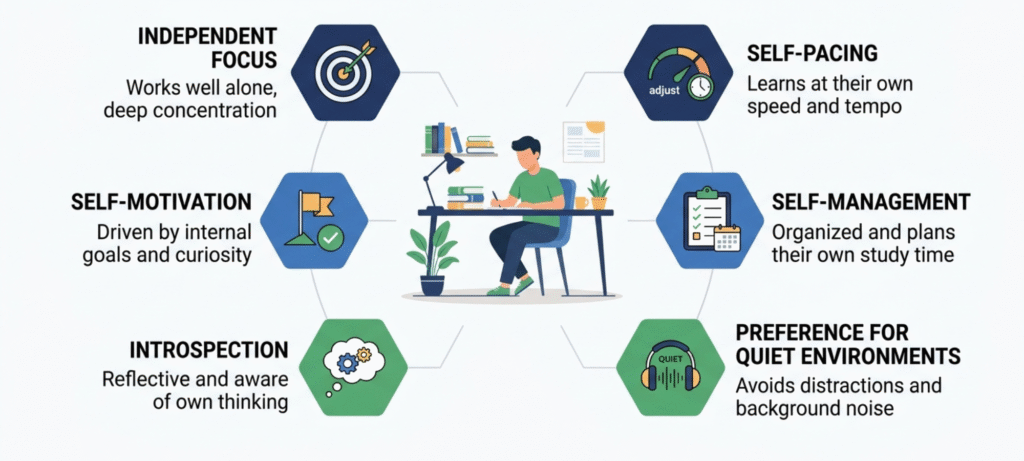
Independent Focus
Solitary learners tend to concentrate best without background chatter or competing input. A quiet room, or even just a quiet corner of a noisy building, usually helps them settle into focus faster than a group setting would.
Self-Motivation
Nobody has to remind a solitary learner to open the textbook. They tend to set their own deadlines, and honestly, they often push themselves harder than an outside structure would.
Introspection
This is the habit of turning an idea over privately, questioning it, connecting it to something already known, before deciding what to actually think about it.
Self-Pacing
A solitary learner likes to move quickly through material they already get and slow way down on the parts that haven’t clicked yet, without a classroom’s fixed schedule getting in the way.
Self-Management
Independent study tends to give this kind of learner a lot of chances to practice organizing their own time and their own workload. They usually know their weak spots and build a plan around them without needing to be told.
Preference for Quiet Environments
A library corner, a bedroom desk, a park bench away from foot traffic. Solitary learners tend to have one specific spot where their brain just switches into work mode, and they protect that space.
If you’re building a study routine around these traits, how to study smarter, not harder covers a lot of the same ground, since working with your natural rhythm instead of against it applies directly here too.
Examples of Solitary Learning Style
Definitions only get you so far. Examples make the whole idea click faster.
- A high school student reads an assigned chapter alone, then closes the book and writes a one-paragraph summary from memory before checking it against the text.
- A middle school student gets a science worksheet, reads the instructions on their own, looks up the terms they don’t recognize, and finishes the questions before comparing answers with classmates.
- A college student watches a recorded lecture at 1.5x speed, pausing to work through practice problems solo instead of waiting for the next study group meeting.
- A homeschooled student researches a history topic independently and builds their own notes and timeline, rather than following a group project outline.
- An adult learning a new language works through an app and a grammar book during their commute, without a conversation partner.
- A student preparing for an exam reviews old quizzes alone in a quiet room, testing themselves with flashcards instead of quizzing a friend.
- Someone learning new software sits with the tutorials at their own pace, replaying the parts that didn’t make sense the first time.
None of these examples involve avoiding other people completely. They’re all about choosing to do the first pass of learning alone, and saving group interaction for later, if it happens at all.
Advantages and Disadvantages of Solitary Learning Style
Like any preference, this one comes with real tradeoffs. A fair picture covers both sides.
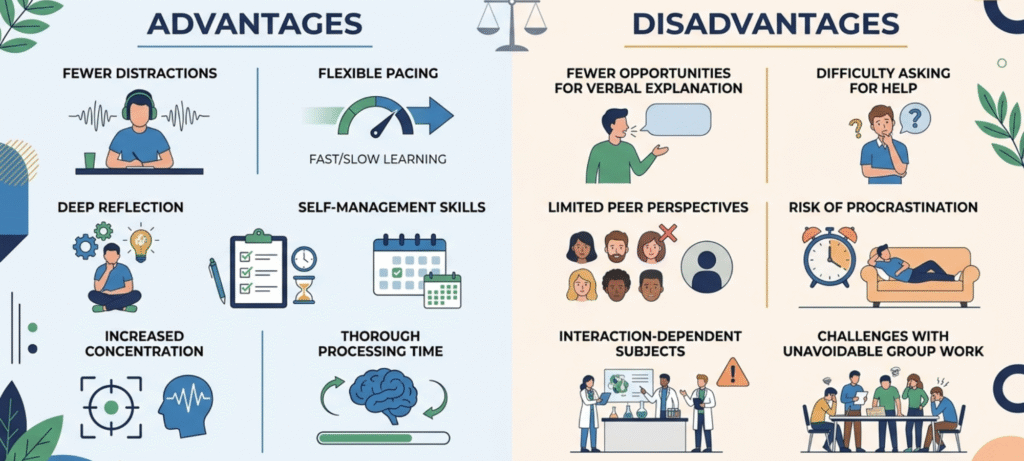
Advantages
- Fewer distractions during study sessions, since there’s no group conversation pulling attention away
- Full control over pacing, so difficult material gets more time and easy material gets less
- Built-in space for reflection, which tends to deepen retention over time
- More chances to practice self-management and personal organization
- Study routines that can be shaped entirely around personal energy levels and schedule
- Some learners find it easier to concentrate when the social side of group work is removed
- More time to fully process an idea before being asked to explain it to someone else
These benefits of solitary learning show up most when a student needs uninterrupted time to read, practice, or work through something genuinely difficult.
Disadvantages
- Fewer built-in chances to practice explaining ideas out loud, which is its own valuable skill
- Asking for help can feel harder, since the instinct is often “figure it out myself first”
- Less exposure to other people’s takes on the same material
- Without outside structure, procrastination can creep in more easily
- Some subjects, like a foreign language conversation class, genuinely need interaction to move forward
- Group work that’s unavoidable at school or on the job can feel draining instead of energizing
Solitary learning is a strength, not a flaw. But leaning on it exclusively, skipping every group project, every study partner, every class discussion, can leave gaps that are worth noticing early rather than later.
Best Study Strategies for Solitary Learners
Create a Quiet, Dedicated Study Space
Even a small corner works, as long as it gets used consistently for focused work and nothing else. Over time, the brain starts associating that spot with concentration.
Use Self-Paced Resources
Recorded lectures, independent modules, and books you can pick up and put down on your own schedule tend to be especially convenient for someone who likes controlling the pace of their own study.
Take Written Notes in Your Own Words
Copying verbatim doesn’t build understanding the same way rewording does. A solitary learner who paraphrases while reading usually retains a lot more than one who just highlights and moves on.
Keep a Learning Journal
A few sentences a day, summarizing what was learned and what’s still confusing, does more for long-term memory than it looks like it should.
Set Specific, Personal Goals
Vague goals like “study biology” don’t hold up well. “Finish chapter 4 and complete the review questions” gives a solitary learner something concrete to aim at.
Practice Self-Testing
Flashcards, practice quizzes, and closed-book recall exercises are useful ways to practice retrieval and check what you actually remember, and they fit naturally into an independent routine.
Build in Deliberate Reflection Time
Ten minutes at the end of a study session, just sitting with what was covered, often does more good than an extra chapter would.
Solitary Learning Activities
A few kinds of activities tend to suit this learning preference especially well:
- Independent reading with margin notes or a reading journal
- Personal research projects on a topic the student is genuinely curious about
- Solo writing assignments, from essays to creative pieces
- Recorded video lessons paired with practice problems
- Individual lab work or science experiments done at home
- Long-form journaling that connects new material to something already known
- Self-paced online courses with built-in quizzes
Solitary Learning in the Classroom
A classroom doesn’t have to be one long group activity to work for every kind of learner. In practice, solitary learning shows up through things like silent reading time, individual practice problems, written reflection prompts, and independent research assignments instead of constant partner work.
It also shows up in smaller moments most teachers already use without thinking of them as “supporting solitary learners.” Giving students a minute of think time before calling on anyone. Letting kids fill out an individual exit ticket instead of reporting back as a group. Building in a few minutes of independent prep before a group activity starts, so nobody walks in cold. Even a basic self-assessment checklist, filled out quietly at a desk, gives this type of learner a format that actually fits how they process things.
None of this means group work disappears. It just means there’s room in the day for students who need to think something through on their own first.
How Teachers Can Support Solitary Learners
- Offer independent work periods as a regular part of the class structure
- Give clear, written instructions alongside verbal ones, so a student who processes text better than speech isn’t left guessing
- Allow processing time before calling on someone to speak up
- Provide independent research options as an alternative to some group assignments
- Avoid forcing immediate verbal participation the moment a new concept gets introduced
- Still include occasional collaborative work, since that skill matters too. Just don’t make it the only mode in the room.
How Parents Can Support a Solitary Learner
- Set up a consistent, quiet study space at home and protect it from interruptions
- Help build a simple daily or weekly routine rather than leaving structure entirely open-ended
- Resist the urge to hover during homework time. Checking in occasionally works better than constant oversight.
- Set clear deadlines even for independent projects, since open-ended timelines tend to drift
- Actively encourage questions, since a solitary learner’s instinct to “just figure it out” can sometimes mean they don’t ask for help when they actually need it
- Include the occasional group activity anyway, so the skill of collaborating doesn’t get rusty
Families building a broader independent study routine may also find online study tools for students useful for adding self-paced practice and review into the mix.
Solitary Learning vs Social Learning
| Solitary Learning | Social Learning |
|---|---|
| Prefers independent work | Often prefers interaction |
| Processes ideas privately first | Often processes ideas through discussion |
| May prefer quiet study settings | May enjoy collaborative settings |
| Controls individual pace | Works within a shared pace |
| Can use written reflection | Can use conversation and peer feedback |
| Often suits independent practice | Often suits collaborative activities |
Neither column is the “correct” way to learn, and almost nobody fits neatly into just one. Most people lean one direction more than the other, but very few students are purely one type across every subject and every situation.
Solitary Learning vs Independent Learning
These two terms get used interchangeably a lot, but they aren’t quite the same thing. Solitary learning is specifically about a preference for working alone. Independent learning is a broader idea, more about a student taking ownership of their own learning process in general.
A student can absolutely learn independently while still asking a teacher questions, joining a class discussion now and then, or working with a partner on part of a project. Independence is about who’s driving the process. Solitary learning is more specifically about how much of that process happens alone versus with other people around. They overlap a lot in practice, but they’re answering slightly different questions.
Is Solitary Learning a Proven Learning Style?
Here’s where a lot of articles on this topic tend to overstate things, so it’s worth slowing down. There’s a real difference between a learning preference, which is legitimate and worth respecting, and a scientifically validated instructional method, which is a much bigger claim.
A widely cited 2008 review published in Psychological Science in the Public Interest looked at whether matching instruction to a student’s stated learning style actually improves outcomes, something researchers call the “meshing hypothesis.” The review, led by Harold Pashler and colleagues, concluded that solid evidence for customizing instruction to individual learning styles simply wasn’t there, despite a large body of literature on the topic. The authors weren’t saying people don’t have study preferences. They were making a narrower point: that a student’s stated preference isn’t the same thing as proof that they perform better when taught in a way that matches it.
More recent research has added some nuance to that picture. A 2024 meta-analysis published in Frontiers in Psychology looked at 21 eligible studies and found an overall positive effect from matching instruction to learning styles. But the crossover pattern needed to really support the matching hypothesis, where a style of instruction helps one group and actually hurts another, showed up in only a minority of the outcomes measured. Given that, along with the cost of implementing style-based instruction and some concerns about study quality, the authors didn’t think the evidence was strong enough to justify rolling it out widely.
So what does that mean for a solitary learner reading this right now? Honestly, not much needs to change. You can concentrate better alone, feel more confident after independent review, and genuinely prefer quiet study time, and none of that gets undone by a research paper. What the research pushes back on is the bigger claim that a teacher needs to sort a whole classroom by “learning style” and run separate instruction for each group. Use independent study because it works well for you, not because a label says it’s the only way you’re capable of learning.
Is Solitary Learning the Same as Introversion?
Not quite, and this mix-up trips people up more than it should. Introversion is a personality trait tied to how someone recharges energy, often through solitude rather than social interaction. Solitary learning is a study preference about how someone best absorbs new information. The two overlap a lot in real life, but they aren’t identical. An extroverted student can still strongly prefer studying alone. A more introverted student might genuinely thrive in a small, focused study group, as long as it’s not a big, loud classroom. Don’t assume one automatically predicts the other.
Frequently Asked Questions
What is solitary style of learning?
It’s a learning preference for picking up new information through independent study, private reflection, and self-paced practice, instead of group discussion or collaborative work.
What is an example of solitary learning?
A student reading a chapter alone, writing a personal summary from memory, and checking it against the original text is a classic example. Independent research projects and self-paced online courses are others.
What are the advantages of solitary learning style?
Fewer distractions, full control over pacing, deeper focus for some learners, more chances to practice self-management, and more space to genuinely process an idea before moving on.
What are the disadvantages of solitary learning style?
Fewer chances to practice explaining ideas out loud, a harder time asking for help, less exposure to other viewpoints, and a higher risk of procrastination without outside structure.
What is another name for solitary learning?
It’s sometimes mentioned alongside intrapersonal learning, a term tied to Howard Gardner’s theory of multiple intelligences, though the two ideas aren’t perfectly identical.
Is solitary learning the same as intrapersonal learning?
The terms are often used together, but they’re not necessarily identical. Solitary learning describes a preference for independent study, while intrapersonal learning is more closely tied to understanding one’s own thoughts, feelings, and internal motivations.
How can solitary learners study effectively?
By setting up a dedicated quiet space, using self-paced resources, taking notes in their own words, self-testing with flashcards, and building in a few minutes of reflection after each session.
Is solitary learning better than social learning?
Neither is objectively better. They’re different preferences, and most students do well leaning on their natural preference most of the time, while still practicing the other mode occasionally.
Final Thoughts
The solitary style of learning isn’t about avoiding people. It’s about needing quiet, unhurried space to make sense of new information before anything else happens. That preference comes with real strengths (deep focus, stronger self-management, real ownership over pacing) and a few genuine tradeoffs worth watching for, like the temptation to skip asking for help when it’s actually needed. The most useful way to think about it isn’t as a fixed identity, but as a flexible starting point: build study habits that respect the quiet, reflective process this style thrives on, while still leaving room for the occasional group conversation that sharpens understanding in a different way.