Building your vocabulary for a debate isn’t really about sounding smart. Think of the worst moment instead. Your opponent throws something at you that you never prepared for, the timer’s ticking, and you’ve got ten seconds, maybe less. Fancy words won’t save you there, but the right ones will. Below are the words, the phrases and the formal terms, and for each group I’ve said when it’s actually worth reaching for.
What Is Vocabulary for a Debate?
Vocabulary for a debate is the pile of words, phrases and technical terms people use to build arguments, answer opponents and keep a speech in order. Three groups, in my view. Mix them up and you get lost fast, which is exactly what happens to most beginners.
Group one: debate words. Claim. Evidence. Rebuttal. Single terms, nothing fancy. Group two: debate phrases, the ready-made chunks like “I respectfully disagree because…” that you can drop into a sentence without stopping to think. Group three: debate terminology. Motion, proposition, opposition, burden of proof. That’s the formal vocabulary of the activity itself.
All three? Eventually, yes. In a school English class, the first two will do. The third only starts to matter at a tournament, and the terms shift between formats anyway. “Point of Information” is normal in Parliamentary debate, yet another style might never use it. Want proof of how much the language varies? Have a look at the debating glossary from the English-Speaking Union.
Essential Vocabulary for a Debate
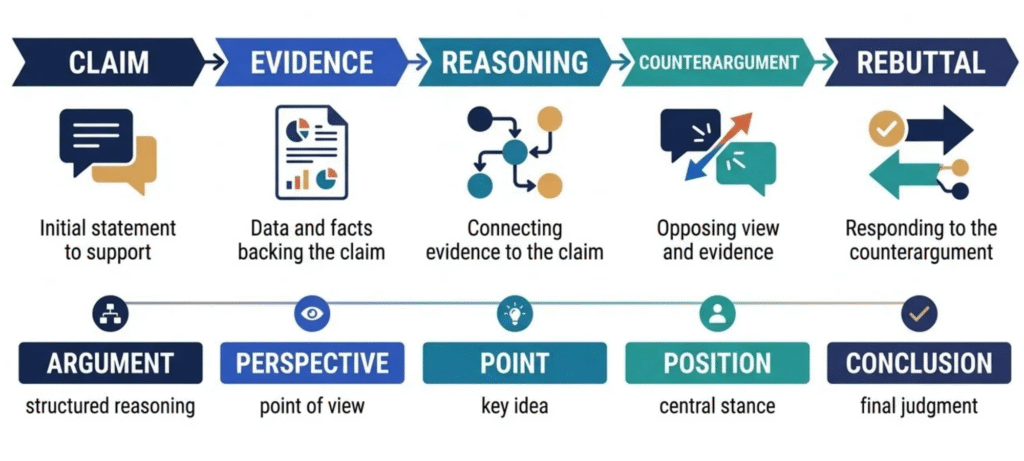
Start with these ten. They turn up in nearly every debate, whatever the format or level.
| Word | What it means | How you might say it |
|---|---|---|
| Argument | A reason that supports your position | “Our main argument is that…” |
| Claim | A statement you say is true | “Our claim is that homework should be optional.” |
| Evidence | Facts or data that back the claim | “The evidence shows…” |
| Reasoning | The logic connecting evidence to the claim | “The reasoning behind this is…” |
| Rebuttal | A direct answer to the other side’s point | “My rebuttal is simple.” |
| Counterargument | An argument for the opposite view | “The opposition argues that…” |
| Point | One single idea in your speech | “My second point is about cost.” |
| Position | The side you’re defending | “Our position is clear.” |
| Perspective | A way of looking at the issue | “From a teacher’s perspective…” |
| Conclusion | Where the argument ends up | “In conclusion…” |
Students mix up claims and evidence all the time, so here’s a quick example. “School uniforms improve discipline” is a claim. “A 2019 survey of 40 schools found fewer behaviour referrals after uniforms were introduced” is evidence. The claim tells the judge where you’re headed. The evidence is why they should come along.
Debate Words for Starting Your Speech
Openings are where nerves hit hardest. Learn two or three of these by heart and you won’t be staring at the ceiling.
To introduce the topic:
- Today we are debating…
- The motion before us is…
- The central question here is…
- This debate is really about…
To state your position:
- We believe that…
- Our side will argue that…
- From our perspective…
- I strongly support the view that…
To launch your first point:
- To begin with…
- First of all…
- The first issue we should look at is…
- My opening point is about…
None of these are fancy, and that’s the point. A plain “First of all” works better than “Allow me to elucidate,” especially when the judge is scribbling notes and just wants to keep up with you.
Vocabulary for Presenting Strong Arguments
After the opening, linking words stop your speech from sounding like a pile of random facts. Each one has a job, so use it for that job and not just to fill space.
- Furthermore, moreover, in addition add another supporting point. “Furthermore, the policy is cheaper to run.”
- For instance, for example, to illustrate bring in a real case. “For instance, Finland trialled this in 2016.”
- Therefore, as a result, consequently tie your evidence to a conclusion. “Therefore, the cost argument falls apart.”
- Because, since give the reason straight. “Because the data only covers one city, it can’t prove a national trend.”
- Specifically, particularly zoom in on the detail that matters. “Particularly for younger students, the effect was bigger.”
- It is important to note tells the judge to write something down.
- I would like to emphasize pulls attention to one fact.
One habit worth building: after you give evidence, add a sentence that starts with “This matters because…” Just that. It’s usually what separates a list of facts from an actual argument.
If you want to see these linking words working in a full written case, our guide on how to write an argumentative essay covers the same structure on paper. The skills carry over to speaking more than you’d expect.
Strong Debate Words for Persuasion
“Strong debate words” and “fancy words to use in a debate” are two of the most searched phrases on this topic, so here’s a short list of the ones that are actually worth learning. I’ve grouped them by what they do for you.
When you want to back up an argument, whether it’s yours or someone else’s, reach for compelling, credible, convincing, substantial, significant, reasonable, practical or beneficial. Going the other way, if you’re picking an argument apart, the useful ones are unsupported, misleading, inconsistent, questionable, simplistic, unrealistic, outdated and irrelevant. And when you need to spell out what happens if a plan goes ahead, harmful, costly, unavoidable, long-term and far-reaching all carry weight.
You can hear the difference in practice. Say “the opposition’s evidence is outdated” and it lands harder than “the opposition’s evidence is old.” Same with “their plan is unrealistic given the budget” next to “their plan won’t work.” The first versions sound like you’ve actually looked at the case.
But don’t lean on big words too much. A judge will happily forgive a plain sentence with solid reasoning behind it. A grand sentence with nothing underneath is another story. If a simple word says the same thing, use the simple word.
Vocabulary for Agreeing in a Debate
Agreeing sounds strange in an activity built on disagreement, but it’s a real skill. Give up a small point and you look fair. Judges tend to trust fair speakers.
- I agree with that point, and I’d like to build on it.
- That’s a valid observation about…
- My opponent is right to say that…
- I agree to some extent, but…
- I would support that view because…
The idea behind all of this is called a concession. You accept one limited point and keep your overall position. Say “My opponent is right that the upfront cost is high.” You haven’t lost anything. Follow it with “but the long-term savings outweigh it,” and you sound reasonable while steering the framing your way.
Vocabulary for Disagreeing Politely
You’ll probably use this section more than any other. Be sharp on the ideas and easy on the person.
- I respectfully disagree.
- I’d challenge that point.
- I see the argument, but the evidence doesn’t support that conclusion.
- That argument overlooks…
- I would question the assumption that…
- There’s another way to read this data.
- That conclusion doesn’t follow from the evidence.
- I must take issue with the claim that…
Compare “You’re wrong” with “I’d question the assumption that more homework means better results.” The first is just a reaction. The second is an argument, and it also tells the judge exactly what you’re going after, which gives them something to put on the flow sheet.
English learners get extra mileage here. These phrases already carry the polite tone, so you don’t need more vocabulary. The sentence structure does the softening for you.
Vocabulary for Rebuttals and Counterarguments
“Rebuttal” and “counterargument” get swapped all the time, as if they were one word. They aren’t. Once you can tell them apart, you sound a lot more precise.
A counterargument is the case for the other side. Your opponent might make it, or you might see it coming and deal with it first. What you say back to it is the rebuttal. Take that further, showing step by step why the argument doesn’t hold, and you’ve got a refutation. A counterexample is much smaller: one case that breaks a general claim. Need a quick way to remember what a rebuttal is? The ESU glossary describes it as material that answers the other speaker’s points directly.
Starters for the rebuttal moment:
- The opposing side argues that…, but this overlooks…
- That claim assumes…, and we don’t think that’s safe.
- The evidence does not establish…
- A counterexample is…
- Even if we accept that point, it still doesn’t prove…
- The problem with this argument is…
“Even if we accept that point” deserves a special mention. It lets you grant something for the sake of argument and still win. Experienced debaters use it constantly.
Formal Debate Terms Every Student Should Know
You don’t need sixty terms to get going. These cover most school and beginner tournament situations.
- Motion (or resolution), the topic being debated.
- Arguing for the motion? You’re the proposition, which some formats call the affirmative or the government.
- Opposition / Negative is the side that argues against it.
- A constructive speech is where you build your case, and you do it before responding to anyone else.
- What’s a contention? A main argument, usually made of a claim, reasoning and an impact.
- Warrant: the reason a claim is true.
- Why does the claim matter, and to whom? That’s its impact.
- Once the other side has spoken, your rebuttal is the response to their argument.
- Burden of proof, meaning it’s your job to show your claims are valid.
- Cross-examination is a timed stretch of questions between opponents.
- Some formats allow a Point of Information (POI), a short interruption from the other side, usually phrased “On that point?” or “Point of information?”
- The framework is the lens the judge should use to weigh the debate.
- The person deciding the winner is the judge, or adjudicator.
- Flow, the note-taking system debaters use to track every argument.
- Leave an opponent’s point unanswered and you’ve made a drop, which usually counts as conceding it.
- Signposting: telling the audience where you are in your speech.
- A summary / closing statement is the last move, the one that pulls everything together.
- To grant a point is to make a concession.
- Counterplan, kritik, topicality are advanced Policy-style terms, so ignore them until you run into them.
Take that last bullet seriously. Beginners often panic and think they need the whole competitive glossary on day one. You don’t. Learn the format you’re actually entering.
Debate Vocabulary for Different Parts of a Speech
You can also sort all of this by where you are in the speech.
Opening: “Today we will discuss…” / “Our position is…” / “The central issue is…”
Main argument: “First…” / “Furthermore…” / “More importantly…” / “The evidence indicates…”
Rebuttal: “The opposing side claims…” / “However, this overlooks…” / “That assumption is questionable.”
Conclusion: “To summarise…” / “Ultimately…” / “For these reasons…” / “As we have shown…”
Short on prep time? Write one line for each of those four stages. That’s a skeleton you can speak from.
Logical Fallacies to Recognize in a Debate
Think of a fallacy as an argument with a hidden crack. Point one out calmly and the judge sees you’ve been listening, which often counts for more than your own points.
- Someone dismisses what you said by going after who you are. That’s an ad hominem. “You can’t trust her, she’s only a student.”
- Straw man is when your position gets swapped for a weaker version that’s easy to knock over. You only asked for fewer exams, and back comes “So you want to abolish all exams?”
- A false dilemma hands you two options as if nothing else exists. Usually something else is.
- Slippery slope: take one small step and, apparently, disaster follows. The trouble is nobody explains each link in the chain.
- “An expert said so.” That’s an appeal to authority, and the fair question is what the expert’s reasoning actually was.
- One survey of ten people, then a claim about everybody? Classic hasty generalization.
- Circular reasoning quietly uses the conclusion as its own proof, so the argument ends up where it started.
- A red herring is a topic that sounds relevant but isn’t, dropped in to pull the room away from the real question.
- With equivocation, one word does double duty. It means one thing at the start of the argument and another by the end.
Say you catch one mid-debate. Keep your voice level. Something along the lines of “That argument relies on a false choice between two options, and there’s a third” does the job nicely. Being calm gets you further than being clever.
Debate Vocabulary for Beginners vs. Advanced Debaters
Here’s a rough ladder so you know what to learn first.
Beginner: opinion, point, reason, example, agree, disagree, evidence, conclusion.
Intermediate: claim, counterargument, rebuttal, perspective, assumption, implication, credibility, relevance.
Advanced: contention, framework, burden of proof, topicality, counterplan, permutation, kritik.
Only move up once you’ve used the lower level in real speeches. Memorising a word isn’t the same as owning it. If remembering is your sticking point, this guide on how to memorize vocabulary has methods that suit word lists like these.
How to Use Debate Vocabulary Naturally
You want to sound like yourself on a good day, not like a textbook. A few before-and-afters make it clear.
| Weak | Better |
|---|---|
| “Your argument is wrong.” | “I respectfully disagree, because the evidence doesn’t support that conclusion.” |
| “That’s a bad point.” | “That argument overlooks an important factor: cost.” |
| “I think this is good.” | “There are several reasons to support this position, particularly the long-term savings.” |
See what changed? The better versions say what is wrong and why. They don’t add decoration. Also, vary your openers. If every sentence starts with “I think,” the speech drags. Mix in “In my view,” “We would argue,” or just state the claim.
Common Mistakes When Using Debate Vocabulary
- Over-complicating. If the judge needs a dictionary, you’ve lost them.
- Memorising phrases without understanding them. Saying “furthermore” when you’re not adding anything sounds off.
- Mixing up argument and evidence. One is the point, the other is the proof.
- Misusing “on the contrary.” It means the exact opposite is true, not just “I disagree a bit.”
- Calling every disagreement a rebuttal. A rebuttal answers a specific point.
- Dropping evidence without saying why it matters.
- Using jargon with a general audience. Put it in plain English for lay judges.
- Attacking the speaker instead of the claim.
- Sounding aggressive instead of clear. Volume isn’t an argument.
- Leaning on “I think” every sentence.
Debate Vocabulary Cheat Sheet
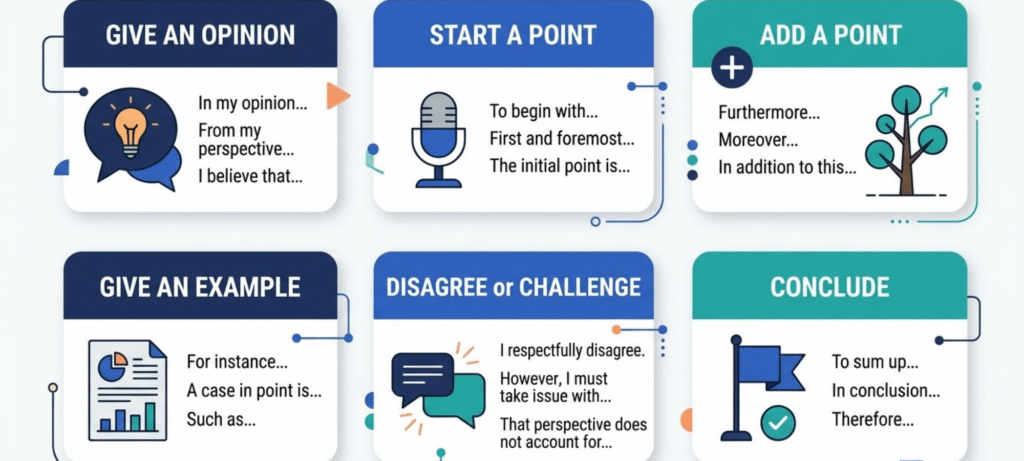
Use this quick debate vocabulary cheat sheet to find the right phrase for each part of your speech. From introducing an argument to disagreeing politely and reaching a conclusion, these expressions can help you speak more clearly and confidently.
| Purpose | Useful phrase |
|---|---|
| Give an opinion | In my opinion… |
| Start a point | To begin with… |
| Add a point | Furthermore… |
| Give an example | For instance… |
| Emphasize | It is important to note… |
| Agree | I agree with this point. |
| Partly agree | I agree to some extent, but… |
| Disagree | I respectfully disagree. |
| Challenge | I would challenge that claim. |
| Rebut | However, this overlooks… |
| Cite evidence | The evidence suggests… |
| Conclude | Therefore… |
| Summarise | To sum up… |
Screenshot this and keep it with your notes. For more phrase lists sorted by situation, My English Pages has free expression sheets for discussion and debate.
Frequently Asked Questions
What is vocabulary for a debate?
It’s whatever you pull out of your head when you need to make a point and shoot down someone else’s. Some of it is ordinary language. “I respectfully disagree” is a good example, and you’d say it in a normal conversation too. The rest is technical stuff like motion and burden of proof, which you mostly pick up once you start competing.
What are some useful words to use in a debate?
I’d begin with a short list: argument, claim, evidence, reasoning, rebuttal, counterargument, perspective and conclusion. Honestly, that’s enough for most rounds. After that, add a few linking words such as furthermore, therefore and for instance. Without them, your points tend to come across as a heap of unrelated facts.
What are strong debate words?
When you’re backing your own side, compelling, credible, substantial and convincing do the work. When you’re going after the other team’s case, reach for unsupported, misleading, inconsistent or questionable. Here’s the catch, though. If your reasoning is flimsy, no strong word is going to rescue it.
What are good phrases for starting a debate?
“Today we are debating…”, “Our position is…”, “To begin with…” and “The central question is…” all work well.
How do you politely disagree in a debate?
Go after the idea, not the person. Try “I respectfully disagree,” “I’d challenge that point,” or “That argument overlooks…”, then give your reason.
What vocabulary supports an argument?
Because, for instance, the evidence shows and this matters because. They link your claim to proof and explain why it counts.
What are some debate phrases in English?
“On the other hand,” “Even if we accept that point,” “The evidence suggests,” “I would question the assumption that,” and “To sum up.”
What are the most important debate terms for beginners?
Motion, proposition, opposition, claim, evidence, rebuttal, burden of proof and cross-examination. Skip the advanced terms until your format needs them.
What is the difference between a rebuttal and a counterargument?
A counterargument is a case for the opposite view. A rebuttal is your direct response to it.
What are some fancy words to use in a debate?
Substantial, inconsistent, far-reaching and unsubstantiated sound impressive without being awkward. Still, plain and accurate language usually persuades better than showy language.
What vocabulary can I use to conclude a debate?
“To sum up,” “Ultimately,” “For these reasons,” “Therefore” and “As we have shown” all signal a clean ending.
Final Thoughts
Good vocabulary for a debate comes down to a few habits. Know your core words. Keep a handful of polite disagreement phrases ready. Match your language to the people listening. Start with the cheat sheet, practise out loud with a friend, and add formal terms only when your format asks for them. Give a reason for every claim and say it clearly, and the vocabulary mostly takes care of itself.