
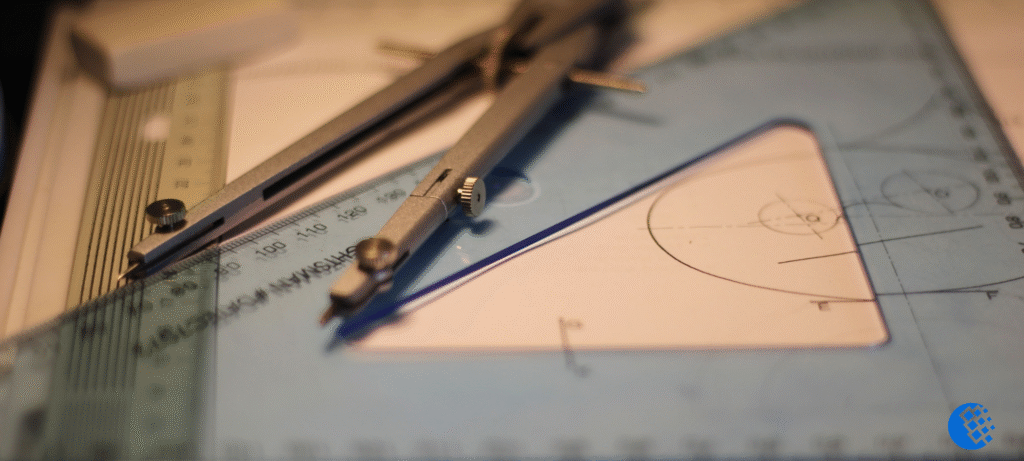
If you ask a room full of students who invented geometry, most of them will say Euclid, and honestly that’s a fair guess. It’s just not the whole story. Geometry started out as everyday know-how in Egypt, Babylon and India, where people needed to measure their fields and build things that wouldn’t collapse. The Greeks came along later and wanted proof that all of it worked, and Euclid gathered a lot of that into one famous book. Mathematicians then spent the next two thousand years or so adding to it.
I’ve always found the real history more interesting than the one-line answer, so let’s walk through it in order.
Who Invented Geometry? The Short Answer
Nobody can point to one person, because geometry grew out of ordinary life long before textbooks existed. Think of a farmer marking out a plot, a builder checking that a corner is square, or a priest following the stars. They were all using geometry without calling it that.
What the Greeks added was the habit of asking why. Earlier cultures were happy that a method worked. The Greeks wanted to show it had to work, and they started from plain definitions and assumptions to do it. Around 300 BCE, Euclid pulled a large part of this into the Elements, which then became the standard geometry textbook for centuries.
If you need something short for class, try this: geometry developed gradually in several civilizations, and Euclid organized it into a logical system.
When Was Geometry Invented?
No one knows the exact date. The written evidence, though, is seriously old. Look at the word itself: geometria, Greek for “earth measurement.” That’s where it all began, with somebody measuring a piece of land. And for ages, that’s all geometry was. A practical skill. You marked out a field, you planned a house, you worked out whether the storehouse would hold the grain, you watched the stars so the calendar didn’t drift. Proofs? Nobody was asking for them.
Herodotus, a Greek historian, tied it all to the Nile. Every year the river flooded and the boundary markers between fields disappeared, so officials had to come back and re-measure each plot before taxes could be collected. Historians now treat this as a good story and not the whole truth, since Egyptians were also putting geometry to work in construction and astronomy. Even so, the link to daily life is obvious.
Keep two things separate in your mind: practical geometry and proof-based geometry. The first is at least 4,000 years old. The second only took shape in Greece, about 2,500 years ago.
| Period | Development |
|---|---|
| c. 1800 BCE | Babylonian clay tablets show advanced geometric calculations |
| c. 1650 BCE | Rhind Papyrus records Egyptian area and volume problems |
| c. 800–500 BCE | Indian Sulba Sutras describe geometric constructions |
| c. 600 BCE | Greek mathematicians begin developing proof-based geometry |
| c. 300 BCE | Euclid compiles the Elements |
| 1637 CE | Descartes publishes La Géométrie |
| 19th century | Non-Euclidean geometry develops |
| 20th century | Modern and fractal geometry expands |
Why Was Geometry Invented?
Mostly because people had jobs to get done. They needed to divide land fairly, build houses, temples and canals, and work out areas and volumes. Farmers followed the sun and stars to know when to plant, and traders had to find their way over long distances. Nobody sat down hoping to discover elegant theorems. Shapes, angles and measurements were simply the tools that worked.
If you’re curious what those tools look like, our guide to the basic tools of geometry covers the compass, straightedge and protractor that students still use today. And if angles are your sticking point, have a look at types of angles.
How Did Ancient Egyptians Use Geometry?
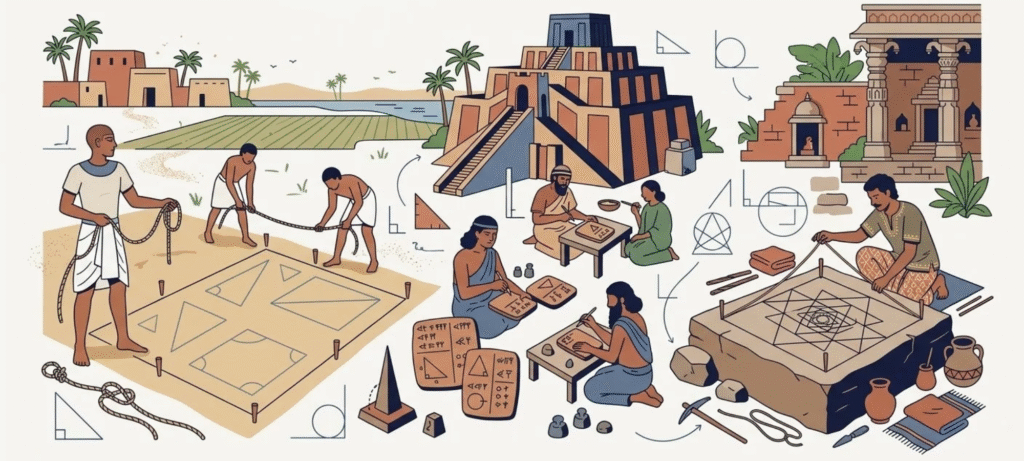
Egyptian geometry had one job: getting real things done. Rope-stretchers, the surveyors of the day, carried knotted cords to lay out right angles and mark where one plot ended and the next began. Builders used much the same tricks when they put up temples and pyramids.
Then there’s the Rhind Papyrus, copied around 1650 BCE. It’s full of worked examples: the areas of rectangles, triangles and circles, and ways to estimate how much grain a store could hold. Their rule for circles lands on a pi of about 3.16, which is closer than you’d expect (we cover the number properly in what is pi). Just don’t go looking for neat formulas with explanations attached. What they left us are procedures, step by step. And honestly, that was enough for them. They needed answers they could trust for fields, buildings and storage, not proofs.
How Did Babylonian Mathematics Contribute to Geometry?
Babylonian scribes pressed their writing into clay tablets, and they counted in base 60. That’s why an hour still has 60 minutes and a circle still has 360 degrees. The tablets are packed with multiplication tables, reciprocal tables and even square roots.
Take YBC 7289. Along the diagonal of a square, someone carved a very good estimate of the square root of 2. Then there’s Plimpton 322, a list of number sets that behave like Pythagorean triples. Put the two together and it looks like they knew their way around right triangles more than a thousand years before Pythagoras was born (our post on the Pythagorean theorem has more on that). The math was clearly advanced. But it comes to us as worked procedures. No step-by-step proofs, which is what the Greeks would later be famous for.
How Did Ancient India Contribute to Geometry?
India had its own geometric tradition and didn’t borrow its starting point from anyone else. The Sulba Sutras, written somewhere between about 800 and 500 BCE, explain how to build sacred altars with exact shapes and areas.
Because priests had to follow strict rules, the texts describe how to construct squares, rectangles and other figures using cords and stakes, how to turn one shape into another with the same area, and how to use diagonals. They also state a version of the right-triangle relationship we now link to Pythagoras. Geometry here was part of ritual architecture, so people had a very good reason to get their measurements right.
Did Ancient Greeks Invent Geometry?
Not really. “Invented” is the wrong word here, because the Greeks borrowed a lot from Egypt and Babylon. The change was in the question. A builder asks whether something works. A Greek mathematician asked why it works, and he didn’t stop until he’d shown it, starting from definitions and assumptions and moving one logical step at a time.
Around 600 BCE, Thales of Miletus supposedly gave us some of the first geometric proofs. His classic example: a diameter cuts a circle in half. Pythagoras and his followers looked at numbers and shapes together. People knew the famous theorem before them, sure. The Greeks were the ones who proved it.
Archimedes came later. He worked out the area of a circle, the volume of a sphere, and a very close estimate of pi. Apollonius of Perga, meanwhile, wrote the classic study of ellipses, parabolas and hyperbolas. So who invented geometry in ancient Greece? Nobody, strictly speaking. They took knowledge that already existed and gave it a system of reasoning.
Who Was Euclid, and Did He Invent Geometry?
Not much survives about Euclid the person. He was in Alexandria around 300 BCE, and he wrote the Elements, a set of thirteen books that cover plane geometry, solid geometry, number theory and ratios. For a quick look at his life and work, Britannica’s entry on Euclid is a good place to start.
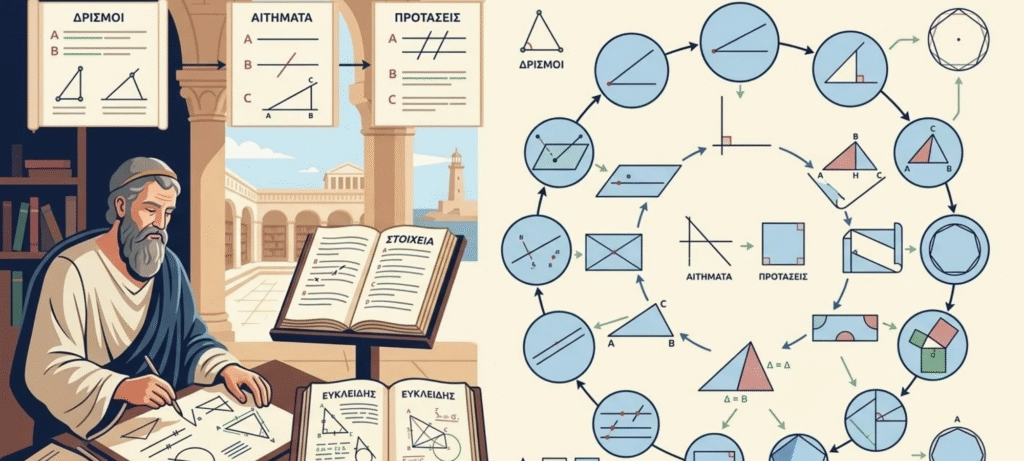
Where the book shines is in how it’s put together. Euclid opens with a handful of definitions, common notions and five postulates, nothing fancy. Everything after that, hundreds of propositions, rests on what came before it. Mathematicians borrowed the pattern, and so did people doing science. No wonder it stayed on classroom desks for so long. It was also clear, which is how you end up with scholars in Greek, Arabic and Latin copying it out, translating it and writing their own commentary.
Did he discover all of it himself? Probably not. Eudoxus and Theaetetus had already worked out some of it. His job, really, was sorting through the material, putting it in order and proving the whole lot inside a single framework. Which is a far better answer to who invented geometry than pointing at one name.
Who Is the Father of Geometry?
The usual answer is Euclid. He gets the title because of the Elements, a book that arranged a huge amount of knowledge around definitions, postulates and proofs. But it’s a title of respect, not a literal one. Egyptian and Babylonian mathematicians had been using geometric methods for centuries before him, and Thales and Pythagoras had already contributed major ideas. So why Euclid? His book gave geometry the form it held onto for so long.
Did Islamic Scholars Contribute to Geometry?
Yes, though they didn’t invent it. During the Islamic Golden Age, scholars in cities such as Baghdad translated the major Greek mathematical works into Arabic. They read them closely, questioned them and pushed the ideas further. Later, those Arabic texts became one of the routes by which mathematical knowledge reached medieval Europe.
Thabit ibn Qurra translated Greek texts and extended results on areas and curves. Ibn al-Haytham took geometry into the study of light and vision, and his work laid a foundation for optics. Omar Khayyam went deep into Euclid’s parallel postulate, and he also showed that certain cubic equations can be solved by intersecting conic sections. Then there’s al-Khwarizmi, the man behind the word algebra, who helped tie geometry to equations.
So who invented geometry in Islam? Nobody. By then the subject was already ancient. What Islamic mathematicians did was keep it alive, test it and build on it. For the wider picture, see our history of mathematics guide.
Who Developed Geometry After Euclid?
Several major branches grew out of Euclid’s work, and each one has its own story.
Who Invented Coordinate and Analytic Geometry?
Geometry used to describe shapes only through how points, lines and angles relate to each other. Then came coordinate geometry, also called analytic or Cartesian geometry. The idea was simple: give every point a pair of numbers, and suddenly a shape can be written as an equation.
René Descartes published his version in La Géométrie in 1637, and “Cartesian” is named after him. Pierre de Fermat was working on almost the same thing at the time, so the credit is shared. Ever graphed y = 2x + 1? That’s their idea at work, and our coordinate geometry guide goes deeper.
Who Invented Non-Euclidean Geometry?
For centuries, mathematicians were bothered by Euclid’s fifth postulate, the parallel postulate, because it seemed less obvious than the other four. Plenty of people tried to prove it from those four, and all of them failed.
In the early 1800s, Nikolai Lobachevsky and János Bolyai, working separately, built consistent geometries in which the postulate doesn’t hold, now called hyperbolic geometry. Carl Friedrich Gauss had reached similar ideas privately. Later, Bernhard Riemann gave a lecture in 1854 that opened the way to elliptic geometry and curved spaces.
These systems weren’t mistakes in Euclid’s work. They showed that if you change the starting assumptions, you get a different geometry that is just as consistent, which is another reason there’s no single inventor. Our non-Euclidean geometry explainer has more.
What About Differential and Fractal Geometry?
Differential geometry brings calculus to curves and surfaces. Its roots lie in the work of Gauss and Riemann. Fractal geometry is the newcomer. Benoit Mandelbrot coined the word “fractal” in 1975 for rough, repeating shapes such as coastlines, clouds and ferns (see fractals for examples). And if you’re wondering where Euclid sits in all of this, the MacTutor archive has a detailed biography of Euclid.
How Did Geometry Change Our Understanding of Space?
For ages, people took it for granted that Euclidean geometry described the space around us: flat planes, parallel lines that never meet. Non-Euclidean geometry broke that assumption. Space, it turned out, could curve. That was a huge shift.
Riemann’s work on curved spaces later handed Einstein the math for general relativity, where gravity appears as the bending of space and time. The same ideas matter closer to home too. Sailors and pilots plot routes across a round Earth. Astronomers map the sky. Architects and engineers rely on geometry so that structures can carry their loads safely.
Where Is Geometry Used Today?
Almost everywhere, once you start looking. Architects and engineers use it to design buildings, bridges and machines. GPS fixes your position from distances and angles. Computer graphics, 3D modeling and video games turn geometric shapes into what you see on screen, and robots use geometry to spot objects and move around them. Physicists and astronomers depend on it as well. All of these tools trace back to people measuring fields and building altars, which is a good reason to learn the history.
How Did Geometry Become Modern Mathematics?
Looking at the whole story, it follows a fairly clear path:
- Practical geometry in Egypt, Babylon and India, driven by building and land measurement
- Proof-based geometry in Greece, built on logic
- Euclidean geometry, organized in the Elements
- Analytic geometry, linking algebra and shapes in the 1600s
- Non-Euclidean geometry, which questioned old assumptions in the 1800s
- Modern geometry, including differential, fractal and computer-based forms
Each stage kept what came before it, and Euclidean geometry is still what most students learn in school. If you’d like to try some of that step-by-step reasoning yourself, take a look at our geometry challenge problems.
Frequently Asked Questions
Who actually invented geometry?
No single person did. Egyptians and Babylonians developed practical geometry thousands of years ago, Indian scholars added their own constructions, Greek mathematicians turned it into a system of proofs, and Euclid organized much of it in the Elements.
Who created geometry?
Nobody on their own. Its ideas grew gradually in several ancient civilizations, including Egypt, Babylon and India. Greek mathematicians later built a more formal, proof-based approach, and Euclid organized much of that earlier knowledge in the Elements.
Was Euclid the first person to use geometry?
No. Egyptian and Babylonian builders and surveyors were using geometric methods more than a thousand years before him. He became famous because he arranged existing knowledge into a clear, logical structure.
Why is Euclid called the father of geometry?
Because the Elements became the standard geometry textbook for centuries and set the model for mathematical proof. The title honors his influence, and it doesn’t claim he started the subject.
Did Egyptians or Greeks invent geometry?
Neither group did it alone. Egyptians used practical geometry early on for surveying and building, and Greeks developed the formal, proof-based version that grew out of it.
When did geometry become a formal mathematical system?
Greek mathematicians began building it around 600 BCE. Euclid’s Elements (around 300 BCE) then gave it a complete, organized structure based on definitions, postulates and proofs.
What is the oldest evidence of geometry?
Written examples go back at least 3,500 to 4,000 years, including Babylonian clay tablets and the Egyptian Rhind Papyrus. Practical geometry was probably in use even earlier.
What is the difference between Euclidean and non-Euclidean geometry?
Euclidean geometry follows Euclid’s postulates, including the parallel postulate, and describes flat space. Non-Euclidean geometry changes that postulate and describes curved spaces, like the surface of a sphere.
Who invented coordinate geometry?
René Descartes and Pierre de Fermat, working separately in the early 1600s. Descartes’ La Géométrie is the work that made the approach famous.
Conclusion
So, who invented geometry? People did, bit by bit, in many different places. Egyptian surveyors, Babylonian scribes, Indian altar builders and Greek thinkers each added a piece, and Euclid earned his famous title by joining those pieces into one clear system that students still use. The subject never stopped growing either, from ropes and clay tablets all the way to curved space and fractals. Once you know that history, the formulas in your textbook start to feel like the work of real people who had real problems to solve.