
Most families start looking into English VCE tutoring after a bad surprise, typically a SAC mark that doesn’t match how hard their kid worked. It makes sense. English is compulsory for every VCE student, and for nearly all of them the study score counts toward the ATAR. A weak English result can drag the whole number down, which is why parents tend to panic about it before any other subject.
But a tutor isn’t a cure-all. When the help matches the actual problem, it’s worth the money. When it doesn’t, you’re just paying for hours that change nothing. Below I go through what tutoring really does, how to choose a tutor, how online lessons compare with in-person ones, which providers operate in Melbourne and online, what they roughly charge, and when you can safely skip tutoring. I checked the provider details in October 2026, but prices move around a lot, so confirm them on each provider’s own site before booking.
English VCE Tutoring: What Does It Actually Help With?
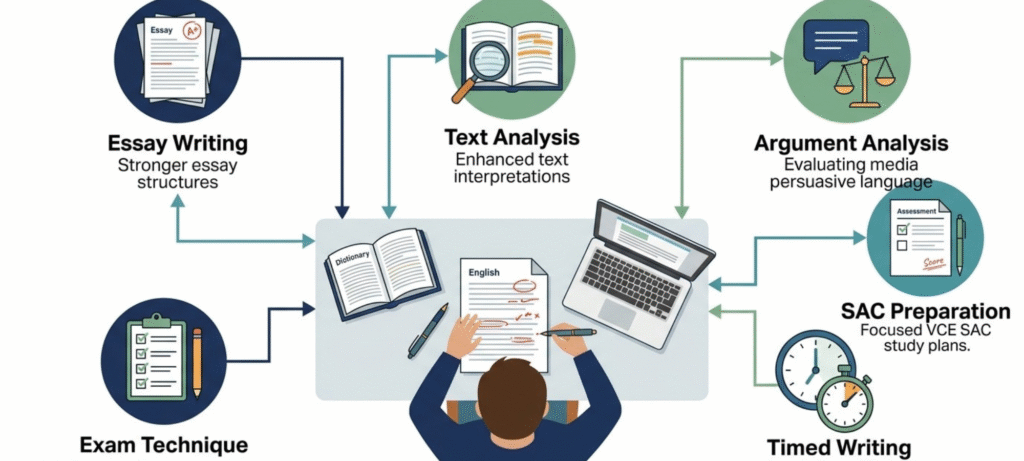
Tutoring covers essay writing, text analysis, argument analysis, SAC prep, timed writing and exam technique. Honestly, though, most of it comes down to having somebody read what you wrote and tell you what’s wrong with it.
Homework help is a different job. There’s no answer key in English. You can read a novel twice, love it, and still write a so-so essay about it. Knowing the book and arguing about the book aren’t the same skill.
Here’s how it usually goes. A student writes “the character changes.” Okay, but changes how? Why? What’s the author getting at? A tutor keeps asking until the sentence says something. Planning works the same way. Fifteen minutes on a plan when the whole essay has to be done in fifty is a real problem, but it shrinks with practice. Sometimes the feedback is one line, like “your evidence is fine, you never say why it matters”, and it sticks for the next few essays.
Then there are memorised essays. A student polishes one for one prompt, the SAC prompt comes in sideways, and it all falls apart. The fix is practising on prompts you haven’t seen, marked soon after, and that’s the flexibility VCAA assessors reward.
Where VCE English Students Usually Lose Marks
Hardly any student is weak across the board. It’s normally one or two spots that cause the damage, and tracking down which ones takes up half the tutor’s time.
Text response
Retelling the plot is the big one. A student gets a prompt about interpretation and writes out what happens in the book. Even those who understand a character well often drop marks in the same way, by placing a quotation in the paragraph without ever linking it back to the argument. In my experience, a single short quote with a proper explanation does more for a mark than a handful of quotes left to speak for themselves.
Argument and language analysis
The task is to read a media piece and explain how it persuades. Students who do well pick out the contention, think about who the audience is, describe the tone, and then connect the word choice, the techniques and any images to that overall purpose. Weaker ones just list things: “emotive language, statistics, rhetorical question”. Listing is where marks go missing, because the response never says what any of those techniques does to the reader. And metalanguage has to be used accurately. It isn’t there for decoration.
Essay writing underneath it all
Strip away the task names and it’s the same handful of skills every time. A clear contention. Topic sentences that actually move the argument along. Evidence that fits the point, not just a quote from the right page. Analysis that explains, where weaker essays only describe. And some link between one paragraph and the next. If one of these is shaky, it follows the student through every assessment that year, so it pays to sort out structure early.
Writing under the clock
A student can know the text inside out and still run out of time. Writing fast and writing well are two different skills, and both take repetition and review. It also helps to have a fallback for the moment a prompt looks strange and your mind goes blank. On the r/vce forum, the same advice keeps coming up: timed essays that get properly marked do more than rereading notes.
How to Choose a VCE English Tutor
A tutor can look impressive on paper and still be the wrong match. Picture a Year 12 student who understands the texts but keeps dropping marks for thin analysis. Now picture a student who hasn’t yet learned how to structure an essay. They need very different help, even though both would search for the same thing online. So start by working out what’s actually going wrong, then test tutors against that.
Some things are worth checking directly.
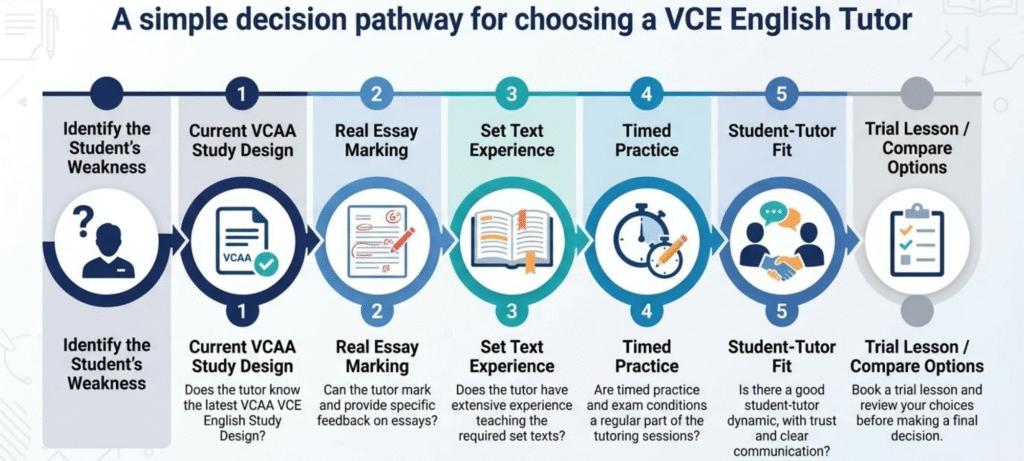
Current study design. The VCAA study design and assessment criteria decide what examiners reward. Someone who teaches to those criteria is more useful than someone repeating advice from an older format. The official requirements are on the Victorian Curriculum and Assessment Authority website, and it’s fair to ask any tutor how they use them.
Marking of real writing. This matters most. If the tutor mainly talks about technique and rarely marks an essay, that’s a warning sign. You want to hear what works, what doesn’t, why, and how to fix it.
Your set texts. Schools choose different texts. If a tutor has taught yours, lessons move faster, although a strong teacher can pick up a new text quickly.
Timed practice. Ask how SACs and exams are handled. If timed writing isn’t part of the plan from the start, it tends to get squeezed out.
Fit with the student. Some students want blunt correction. Others do better talking ideas through, or just need a weekly routine and someone checking in. A free or trial lesson is the easiest way to find out.
Online vs In-Person VCE English Tutoring
Format changes the experience more than most families expect.
| Option | Upside | Downside |
|---|---|---|
| Online one-on-one | Flexible, no travel | Needs a reliable connection and a quiet space |
| In-person one-on-one | Direct interaction, fewer distractions | Travel time, fixed locations |
| Small group | Peer discussion, lower cost per student | Less individual attention |
| Large class | Set program and resources | Feedback is less personal |
| Marketplace tutor | Wide choice of tutors and prices | Families have to vet the tutor |
Online lessons work well when the tutor marks up a shared document while the student watches, and they suit anyone juggling sport, work or a long commute. Students who drift on screens often do better face to face. Groups are great for hearing how other people read a text, though a quiet student can go a whole session without saying much.
The study habits that make online learning work apply in every format, and our guide to online learning tips that actually work covers them.
VCE English Tutoring Options in Melbourne and Online
All of these providers appear in current search results for the topic. This isn’t a ranking, and everything below reflects what each provider says about itself, not independent testing.
Start with the marketplaces, where you choose the tutor yourself. Learnmate connects students with private tutors, including recent high achievers and qualified teachers, and its listings start around $30 an hour. Superprof is far bigger, with independent tutors setting their own rates (VCE English listings from about $20 an hour). With either, the vetting is on you.
If you’d rather have someone matched for you, HZ Tutoring runs one-on-one VCE English lessons in Melbourne and online across Victoria. It publishes rates from $94 an hour, offers a free first 30 minutes, and lists student results, which are its own claims. Alchemy Tuition quotes about $89 an hour in-home and about $59 online, and says it’s available seven days a week. KIS Academics offers private tutoring with a focus on exam strategy.
Lindsey’s VCE Tutoring only covers VCE English. Along with one-on-one and small-group sessions, it offers essay marking, bootcamps and masterclasses, online or face to face in Melbourne.
For a more school-like setup, Matrix Education runs a Year 12 VCE English program online and on campus, built around theory books and weekly written homework with teacher feedback. Contour Education teaches small groups using VCE-specific resources for text response and argument analysis. Edu-Kingdom also runs a VCE English program covering essay writing and exam-style sessions.
| Provider | Format | Worth a look if you want |
|---|---|---|
| Learnmate | Online / in-person | A choice of tutors |
| Superprof | Directory | Lower-cost independent tutors |
| HZ Tutoring | One-on-one | Personalised support |
| Alchemy Tuition | Online / in-home | Flexible scheduling |
| KIS Academics | Private tutoring | Exam-focused individual help |
| Lindsey’s VCE Tutoring | One-on-one / small group | English-only focus |
| Matrix Education | Online / campus | A structured program |
| Contour Education | Small group | Class-based learning |
| Jason Huang | English Language | VCE English Language support |
VCE English Language is its own subject
English Language isn’t mainstream English with a different label. It studies how language works, using metalanguage, linguistic frameworks and real-world texts. Someone who only teaches essay structure for text response won’t cover it. Jason Huang VCE English Language Tutoring is one specialist provider here. Whoever you’re considering, ask straight out whether they’ve taught English Language specifically.
How Much Does VCE English Tutoring Cost?
Published rates currently run from about $30 an hour on tutor marketplaces to $90 or more an hour for premium one-on-one services. Group programs are usually priced per term.
Read those as examples from the time of checking, not a market standard. Rates move, and many tutors charge differently by year level or lesson length.
Several things push the price around:
- Experience. A uni student and a long-serving classroom teacher won’t charge the same.
- Format. One-on-one costs more per hour than a group seat, and online is often cheaper than in-person.
- Company or independent. Agencies carry overheads. Independents can be cheaper but offer less admin support.
- Packages and length. Longer blocks or term packages sometimes bring the hourly rate down.
- Extras. Essay marking, bootcamps and exam workshops are sometimes billed separately.
Ask what the rate includes. A higher hourly price that covers marked essays between lessons can be better value than a cheaper one where feedback only happens live.
Do You Actually Need VCE English Tutoring?
Not always, and it’s better to say so than to pretend every student needs lessons.
Extra help makes sense when the same feedback keeps appearing on every essay, when a student understands the text but can’t turn that into analysis, or when running out of time is a regular problem. It also makes sense when school feedback is too vague to act on, SAC preparation feels scattered, or unfamiliar prompts cause panic. Some students simply need a regular commitment to keep writing, and a weekly lesson provides it.
On the other hand, a student whose teacher gives useful feedback, whose writing is improving on its own and who finishes timed responses comfortably probably doesn’t need it. Lessons would mostly add cost.
There’s a middle path, too. A handful of sessions aimed at one weak spot, like language analysis, can achieve more than a year of weekly lessons. And if the real problem is general study habits, our post on the qualities of a good student is a better starting point than a tutor.
Getting More Out of Your Lessons
Lessons only help as much as the student uses them. The students who improve fastest tend to do the following:
- Bring their latest essay, so the session is about real writing.
- Bring teacher feedback and ask for it to be turned into specific fixes.
- Mention the next SAC or exam date up front.
- Ask pointed questions instead of “is this good?”
- Rewrite weak paragraphs soon after the lesson, while the advice is fresh.
- Practise prompts they haven’t planned for.
- Keep a log of repeat mistakes, like vague topic sentences or quotes dropped in without explanation.
- Do timed writing between sessions, so lesson time goes on review rather than first drafts.
- Reread the last round of feedback before the next lesson.
Improvement comes from writing, reviewing and rewriting. The lesson is where that process gets steered, not where it happens.
Faqs
What does a VCE English tutor help with?
Writing, mainly. Text response, language analysis, argument analysis, and the awkward business of finishing a SAC essay before the bell. A few tutors also teach English Language and Literature. Plenty don’t. Ask before you book, because finding out in lesson three is annoying.
Is online VCE English tutoring effective?
Yes, mostly. The test is simple: will the tutor mark your essay in a shared document while you watch? If so, the screen barely matters. If it’s just a chat about technique, you could get that from a YouTube video. Add a quiet room and a student who actually rewrites paragraphs afterwards, and online does the job fine.
How much does a VCE English tutor cost?
Anywhere from about $30 an hour on a marketplace up past $90 for a premium service. Big gap, and it comes down to who’s teaching, where, and whether it’s online. Rates change, so go to each provider’s own page.
When should I start VCE English tutoring?
Early. Year 11, or the start of Units 3/4. Writing habits take months to change, and one lesson won’t do it. Leaving it late isn’t a disaster, though. A few focused sessions before a SAC or the exam still help.
Can a tutor help with VCE English Language?
Only one who’s taught it. English Language is about metalanguage and linguistic analysis, so it’s a different subject from coaching a text response essay. Ask which study design they actually know.
Is one-on-one tutoring better than group tutoring?
Depends what’s going wrong. If it’s your own writing, one-on-one, since someone looks at exactly your paragraphs. If you mostly need structure and a push, a group is cheaper and you get to hear how other students read the text.
Can English VCE tutoring improve essay writing?
Yes, but only when somebody marks your real essays. Write, get corrected, rewrite. That loop is what you’re paying for. The rest is extras.
Final Thoughts
English VCE tutoring pays off when the tutor fits the student, and a slick website tells you almost nothing about that. So start with the boring question: where are the marks actually going? Analysis, structure, time, or going blank when the prompt isn’t the one you practised? Then compare tutors on how they teach, whether they know the current VCAA requirements, what feedback you get and what the fee covers.
Study-score stats and guaranteed results are the providers’ own claims. Check them yourself. And if you’re already looking ahead to the ATAR and course choices, the VTAC website explains how study scores are used when places are offered.