

Why is Latin a dead language? Simple: no community on Earth raises its kids in Latin anymore. A child in Madrid learns Spanish from mum and dad. A child in Cairo learns Arabic. Latin? Nobody picks it up at home. That’s all “dead” means here, and it’s way less dramatic than it sounds.
Dead language. Sounds final, doesn’t it? Most of us picture a language that just stopped one day, lights off, done. But that’s not how it went for Latin. Everyday Latin never sat still. It kept changing, century after century, region after region, until it had become Spanish, French, Italian, Portuguese and Romanian. Meanwhile the polished written stuff, the Latin of Cicero and Virgil, stayed put in churches, courts and universities. For a thousand years and more. People still read it. Some write in it. A few even talk in it.
So, is the label fair? Sort of. It’s just easy to read more into it than it actually means. Get clear on what “dead” really covers, and the rest of the Latin story falls into place.
Why Is Latin a Dead Language?
Short answer: Latin has no native speakers. Linguists call a language “living” when kids pick it up naturally from the people around them. Does that happen with Latin today? No. There’s no established community where children grow up with it. Everyone who speaks it learned it later, from a teacher, a book or a course. Curious how that early learning works in kids? This piece on how language grows from first reading to advanced understanding is worth a look.
It wasn’t always this way. Once, Latin was just everyday speech for millions of people across the Roman Empire. Markets, army camps, courtrooms, everywhere. Then the spoken version started drifting, region by region, until it had turned into new languages. What stayed behind was Classical Latin, a formal written standard. Schools and scribes kept copying it long after people had stopped talking like that at home.
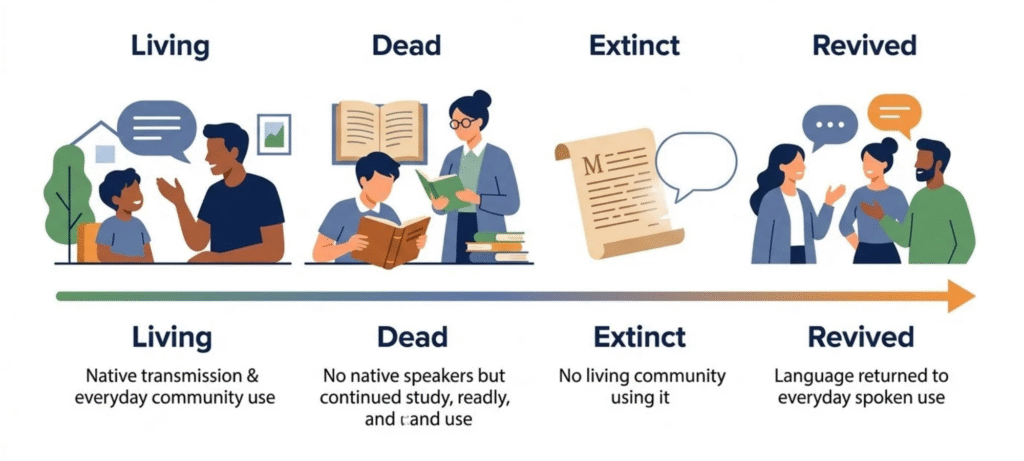
Two words get mixed up a lot, so quick note. Dead means a language has lost its native speakers, though people can still study, read and use it. Extinct usually means no living community speaks or uses it at all, but sources don’t always define it the same way. Latin is called dead, not extinct. Why? Because it never really left study, writing or religion.
What Does “Dead Language” Actually Mean?
Easiest way to get this is to imagine a sliding scale. Over on one side you’ve got the living languages, so English, Urdu, Spanish, Mandarin, anything that has native speakers and whole communities using it day in, day out. Way over on the other side are the extinct ones, which nobody speaks or uses any more. The Linguistic Society of America explains extinction like this: new generations stop learning the language, and once the last speakers die, that’s the end of it.
Dead languages sit awkwardly somewhere in the middle. Nobody’s growing up with them as a mother tongue, but they haven’t lost their importance, because religion, scholarship and literature still lean on them heavily. Sanskrit, Classical Hebrew and Latin all fit in this bucket, though each of them got there by its own route.
And then there’s a fourth group that catches a lot of people off guard: revived languages. Hebrew is the usual example. It spent centuries living mostly in prayer and writing, and then in the late 1800s and 1900s it found its way back into everyday speech. Which tells you something. A language can lose its home speakers and still be a big deal, sometimes for ages.
That’s where Latin is. Out of the home, but never out of the classroom, the library or the church.
How Did Latin Stop Being an Everyday Language?
Latin spread across the Roman Empire
Rome grew, and Latin went along with soldiers, officials, traders and settlers. It became the language of law, army life and public business across a massive area, from what’s now Portugal to what’s now Romania.
But think about who was speaking it. Plenty of these people grew up with other languages, like Gaulish or the tongues of Iberia. They lived hundreds of miles apart. Nobody was making sure they all sounded alike. So their speech drifted. Speech always does.
Spoken Latin changed over generations
The everyday speech of Roman soldiers, farmers and shopkeepers is called Vulgar Latin. Don’t let the word throw you. “Vulgar” just means “of the common people.” It doesn’t mean rude or wrong. It’s simply the ordinary spoken version, as opposed to the polished writing of educated authors.
And like any spoken language, it never sat still. Sounds shifted. Word endings wore down. Word order loosened up. New words crept in from local languages.
Regional varieties grew apart
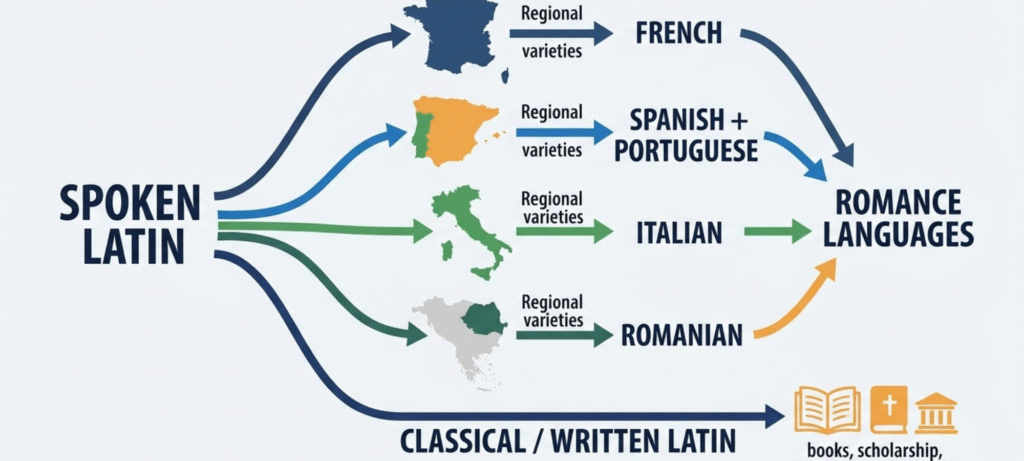
Over many centuries, small local differences stacked up. In Gaul, spoken Latin eventually became French. In Iberia it turned into Spanish and Portuguese, among other varieties. In Italy it became Italian and its regional relatives. Around the Balkans and the lower Danube it became Romanian.
Romanian is a great test case. Roman rule in Dacia, roughly modern Romania, lasted under two centuries. Even so, the language that grew there is Romance to its core.
None of this happened on a set date. Nobody woke up in Toledo one morning and said, “Well, we speak Spanish now.” Each generation understood its parents and neighbors fine, so hardly anyone noticed anything was changing.
Did Latin Really Die, or Did It Become Other Languages?
Some languages vanish when the last speaker dies and nothing carries on. Latin didn’t go that way. Its spoken forms kept going. They just stopped being called Latin. Wikipedia’s article on Latin even points out that, although Latin is often called a dead language, it didn’t go through language death in the strict sense, because natural change in speech produced the Romance languages. So yes, the terminology really does vary.
| Region | Romance languages that developed there |
|---|---|
| Gaul | French |
| Iberian Peninsula | Spanish, Portuguese |
| Italian Peninsula | Italian and related varieties |
| Balkans and lower Danube | Romanian |
Take that table as a rough map, not a tidy family tree. The Romance languages didn’t all come from one identical Latin. They grew out of lots of regional varieties that influenced each other, borrowed from local languages and changed at different speeds.
Meanwhile, Classical Latin lived its own life as a written, learned language. So you get two streams. Everyday speech turned into the Romance languages. Formal Latin carried on in books, institutions and schools. Which makes the question of why Latin is called a dead language a bit odd to answer. The speech survived. It’s the name that didn’t.
Classical Latin vs. Vulgar Latin
If you only take one thing from this article, take this.
Classical Latin is the formal, literary language of writers like Cicero and Virgil. Schooling, public speaking and a long written tradition shaped it, and it’s the Latin most students meet in textbooks. Vulgar Latin covers the everyday spoken varieties. They differed from place to place, changed naturally and became the base for the Romance languages. Britannica describes Classical Latin as “dead” in the sense that its form became fixed, while Vulgar Latin, the language most Romans actually used, kept evolving.
The two weren’t walled off from each other. They overlapped for centuries, and the gap probably widened slowly. But Classical Latin didn’t just “turn into” Spanish or French overnight. The spoken varieties did the changing, bit by bit, while the written standard stayed closer to its old form.
Think of formal written English next to how people actually talk at a pub or the kitchen table. Related, obviously. Not the same thing. Now stretch that gap over centuries and an entire empire.
When Did Latin Become a Dead Language?
There’s no single date. If anyone gives you one, they’re simplifying.
By the early medieval period, spoken varieties had moved a long way from Classical Latin, and eventually from each other too. Wikipedia’s Latin entry puts the natural change in the spoken language that produced the Romance languages roughly between the 6th and 9th centuries. Even that’s a loose window, not a switch somebody flipped. If you want the detail, Wikipedia’s article on Latin is worth skimming.
Two moments from the early ninth century show how far things had drifted. In 813, the Council of Tours told preachers to give sermons in the rustic Roman tongue or in German, so ordinary listeners could follow along. That hints that everyday speech and church Latin were already far apart. Then in 842, the Strasbourg Oaths were recorded partly in an early Romance variety that looks like an ancestor of French. It’s often cited as one of the earliest texts of its kind.
Written Latin never stopped, though. So if someone asks when Latin was spoken, the honest answer is a timeline. In ancient Rome it was a living, widely spoken language. In the classical period a polished literary standard grew up next to everyday speech. In late antiquity spoken varieties kept shifting and spreading. And by the medieval and early modern periods, Latin lived mostly as a learned language for scholarship, religion and law, while the Romance vernaculars took over daily life.
Can you point to a moment and say “that’s when it died”? Not really. The label came later, once scholars could see nobody was growing up with the language any more.
Why Did Latin Stop Being Spoken but Greek Survive?
It’s tempting to say, “Rome fell, so Latin died, but Greek made it.” Too neat.
For starters, Greek arrived in the Roman world with a big head start. It already had a deep literary and cultural tradition, and educated Romans respected it enough to learn it. Across the eastern Mediterranean, Greek had been the common language of trade and administration long before Rome turned up. The New Testament was written in Greek, for example.
Then there’s the fact that the empire’s two halves had very different histories. The west went through political upheaval that split Latin-speaking regions into separate kingdoms. The east, later called the Byzantine Empire, kept Greek going in daily life, government and the Church.
And Latin’s spoken varieties didn’t disappear anyway. They became the Romance languages.
People also forget that Greek changed too. Modern Greek isn’t Ancient Greek, just like Spanish isn’t Classical Latin. A modern Greek speaker can’t pick up Plato and read it without studying first. Greek didn’t dodge language change. It just kept its name and its unbroken chain of native speakers, while Latin’s chain ended up with new names.
Is Latin Really Dead Today?
In the traditional linguistic sense, yes. Latin is generally classed as a dead language because it has no community of native speakers.
Still, a lot is going on. People learn Latin in schools, universities and online courses. Scholars read and translate Latin texts every day. Some enthusiasts speak it, and there are conversation groups, podcasts and summer immersion programs. The Catholic Church continues to use Latin in liturgical and official contexts, and papal documents are still often named after their opening Latin words. Vatican City has a strong institutional link to Latin, but no community of native Latin speakers lives there. It doesn’t.
So why is Latin a dead language when it’s this visible? Because “dead” only measures one thing: whether a native-speaking community exists. It doesn’t say anything about whether people use or value the language.
Latin also keeps showing up in debates about schooling, usually as a way into grammar, logic and the roots of loads of modern words. If that interests you, we’ve got a good discussion of the benefits of classical education on the blog.
Can Anyone Speak Fluent Latin?
Yes. People can learn to speak Latin fluently, and there are teachers and communities who do exactly that.
But speaking Latin today isn’t the same as having native speakers of Latin. Mixing those two up causes most of the arguments online. A native speaker grows up with the language at home. A second-language speaker learns it later, often as an adult. Everyone who speaks Latin now is in the second group.
Modern spoken Latin is generally learned rather than picked up natively, and different communities use different pronunciation traditions. Some follow reconstructed Classical pronunciation. Others use the Italian-influenced style long linked to church Latin. And since no native speakers can give us a continuous record of how it sounded, scholars have pieced together ancient pronunciation from spelling, poetry, comments by ancient grammarians and the way the Romance languages developed.
So both statements can be true at once. Some people do speak Latin, and Latin is still classed as dead. They’re just answering different questions.
Is Latin an Extinct Language?
Calling Latin “extinct” can be misleading. After it stopped being a native vernacular, it carried on as a written, learned language, and it still does.
Dead means no native speakers, though people may still learn and use it. Extinct generally means no living community uses it at all. Latin still has readers, writers, teachers and even speakers, so “dead” fits better. One caution, though. Sources don’t always use these words the same way, and some writers treat them as nearly interchangeable. Check how a source defines them before you treat any single rule as universal.
Where Is Latin Still Used Today?
Latin hasn’t left the building. It runs through the Catholic Church and Vatican life, from liturgy to official documents. It anchors classics departments at universities and turns up in school classrooms. It fills historical records like treaties, charters, manuscripts and inscriptions. A small amount of new writing still gets produced in it, and the classical literature is still widely read.
In everyday life you’ll bump into it in law, where phrases like pro bono and habeas corpus are standard vocabulary. Medicine and science lean hard on Latin-based terms, and species names like Homo sapiens are Latin. You’ll even spot it on school crests, city seals and university banners, and on the national seal of the United States, which carries E pluribus unum.
Is Latin Still a Language?
Yes, Latin is still a language. Calling it “dead” describes its lack of native speakers, not the disappearance of its grammar, vocabulary or written tradition. People can still study it, read it, write it and speak it. What changed is its role. It’s no longer the everyday first language of a native-speaking community.
Its descendants, meanwhile, are doing great. Hundreds of millions of people speak Spanish, French, Italian, Portuguese and Romanian, and all of them grew out of the spoken Latin of the Roman world.
Common Questions About Latin
Why isn’t Latin a language anymore?
It still is a language. What it isn’t anymore is a native community language. Latin has full grammar, a big vocabulary and a huge body of literature. Nobody just grows up speaking it at home.
Is Latin hard to learn?
Depends on your background. Latin has a case system, verb forms that look scary at first, and pretty flexible word order. On the flip side, if you already know a Romance language, or you’ve studied English vocabulary, plenty of words will feel familiar. Most learners say grammar is the toughest part, not pronunciation.
Is Sanskrit a dead language?
Not in exactly the same way. Sanskrit is classical and liturgical like Latin, but its modern status is different. It still has ceremonial use, and a small number of people report it as their mother tongue in India’s census. The two cases are alike in some ways and different in others, so it’s better not to lump them together.
Is Pig Latin a dead language?
No. Pig Latin is a playful word game that shuffles English sounds around. It has nothing to do with the historical Latin language apart from the name.
Why is Latin a dead language if people still speak it?
Latin is considered a dead language because it no longer has a native-speaking community, not because nobody can speak it. People can still learn and use Latin as a second language, and plenty do. The “dead” label only tracks whether children grow up with it at home, and they don’t.
Final Thoughts
So, why is Latin a dead language? In the simplest linguistic sense, because it no longer has a native-speaking community that passes it from parents to children as a first language. But that answer leaves out the best part of the story.
Latin’s “death” was really a transformation. The speech of ordinary people slowly turned into Spanish, French, Italian, Portuguese and Romanian, while the older written tradition lived on in churches, courts, classrooms and libraries. It didn’t end with a bang, and it didn’t end on one particular day.