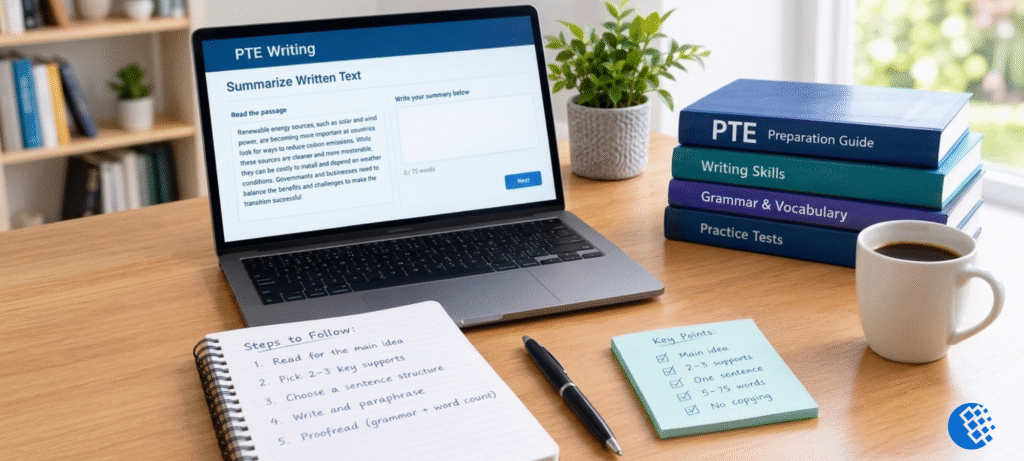
You get a passage, a blank box and ten minutes. Write one sentence. Sounds like the easiest question on the whole PTE, right? It isn’t. Lots of people follow the passage perfectly well and still lose marks, usually because of something small. The sentence has no real verb, there’s a second full stop hiding in the middle, or one detail got changed just enough to shift the writer’s meaning. That’s all it takes. PTE Summarize Written Text punishes tiny mistakes more than you’d expect.
Below, I’ll go through the format, a routine you can repeat on any passage, a few templates and worked examples (one of them deliberately bad), and the mistakes people keep making.
What Is PTE Writing Summarize Written Text?
The task itself is simple enough. Read the passage, then write a summary in your own words. It’s in the Speaking & Writing section, but here’s something people often miss: it also adds to your Reading score. So the time you spend on it helps two skills, not just one.
Before you start practising, make sure you know which test you’re sitting. PTE Academic and PTE Core have different rules for this task, and it’s very easy to mix them up when you’re jumping between blogs and YouTube videos. The safest move is to check the official Pearson PTE website close to your exam date, since Pearson does change small details from time to time.
| PTE Academic | PTE Core | |
|---|---|---|
| Passage length | Up to about 300 words | Up to about 200 words |
| Time | 10 minutes | 10 minutes |
| Response | One complete sentence | One or more complete sentences |
| Word range | 5 to 75 words | 25 to 50 words |
Pearson owns the test, and a number of countries accept it for study and migration. If you’d like the general background, the Wikipedia article on the Pearson Test of English is a fair place to start. One more thing worth knowing: Summarize Spoken Text has a similar name, but it’s a listening task with its own rules, so don’t mix the two up.
How to Summarize Written Text in PTE: The Five-Step Method
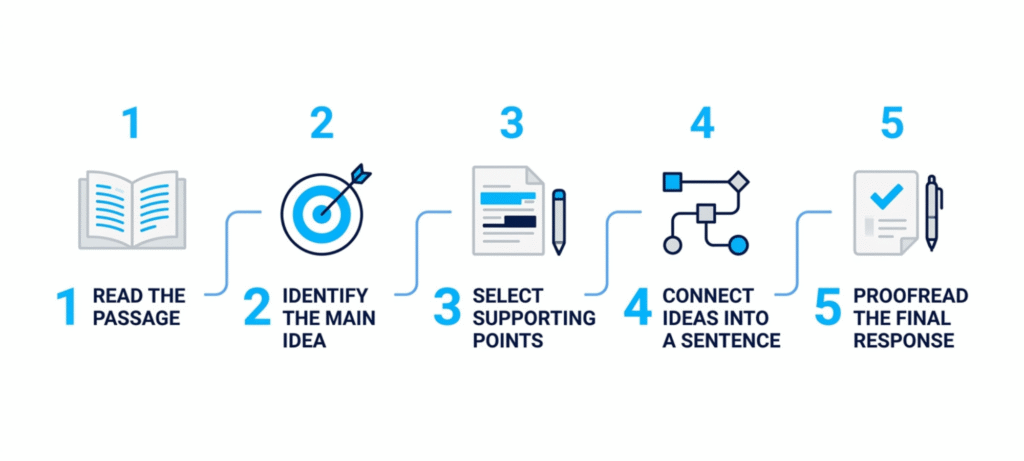
Honestly, long lists of tips don’t help much. You read thirty, you remember four, and then you panic anyway. What works better is doing the same things in the same order every time, until it feels boring.
Start by reading the whole passage before you type a single word. I know the clock makes you want to start early. Don’t. When you reach the end, try to say what the writer is really getting at in about ten words. Can’t do it? Read again. People often say the first and last sentences give you the answer, and that’s true a lot of the time, though not always, so keep your eyes open.
Next, find two or three supports. These are the points that explain, prove or limit the main idea. Think causes, results, contrasts, suggestions. Examples and numbers mostly drop out. A simple trick: pretend you’ve crossed a detail out. If the message still makes sense, you didn’t need it.
Then comes the step almost everyone skips, and it’s the one that makes writing easier. Work out how your ideas relate to each other. Is it a benefit and a problem? A cause and a result? Once you see the connection, the linking word (although, because, so, which) nearly picks itself.
After that, write it in your own words. Some words can’t really be swapped, so leave them. “Inflation” is still “inflation”. Build the rest of the sentence around it with different verbs, a different order and your own connectors.
Last, proofread. Pretend you’re a fussy teacher with a red pen. One sentence, one full stop at the end. A verb in each clause. Subjects and verbs agreeing. Articles in the right places. Spelling. Word count goes last. No contractions or slang, and keep your opinions out of it.
PTE Writing Summarize Written Text Template: Four Flexible Frames
Templates have a bad name, and honestly some of it is fair. If you memorise one whole sentence and just swap a few words, it sounds odd as soon as the topic doesn’t fit. Treat a template like a rough sketch instead. Here are four worth knowing.
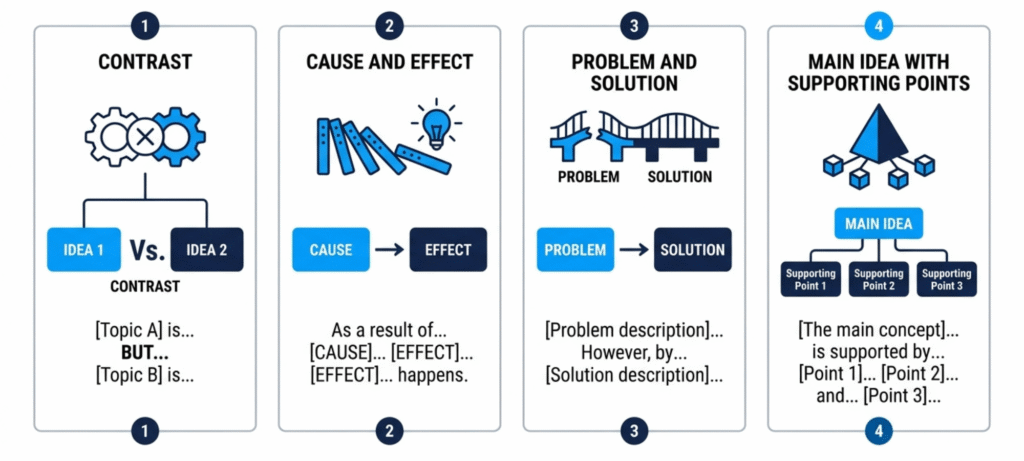
- Contrast: Although [good point], [problem] means that [result].
- Cause and effect: [Cause] has led to [effect], which [bigger consequence].
- Problem and solution: [Problem] is threatening [thing affected], so [people] are [doing something].
- Main idea plus supports: The passage argues that [main idea], highlighting [support] and [support].
Which frame should you pick? Let the passage tell you. Words like “however”, “but” or “yet” usually mean the writer is setting one thing against another, so the contrast frame fits well. If the text is mostly explaining why something happened, go for cause and effect. When the ending offers a solution, problem and solution is the natural choice. The main idea plus supports frame is the one I’d save for now and then. If every answer begins with “The passage argues”, it starts sounding robotic, and you’re left with nothing to fall back on when a passage doesn’t fit that mould.
A word on connectors. Each one does a different job. “Because” gives the reason behind something. “While” and “although” bring in a contrast. “Which” lets you add a bit of extra detail about the thing you just mentioned, and “so” points to a result. Two or three of these in one sentence is plenty. Squeeze in five clauses and the grammar often starts to wobble, particularly when you’re nervous and the clock is running.
PTE Writing Summarize Written Text Example 1: Contrast (Academic)
Here’s a practice passage I wrote myself, so it isn’t lifted from anyone’s sample set.
Passage: Public libraries have changed far more than most people realise. Once valued mainly for lending books, many now offer free internet access, job-search workshops, language classes and quiet places to study. This shift has helped people who cannot afford home broadband or private tutoring. However, funding cuts in several regions have forced libraries to shorten their opening hours, which limits the very services that communities have come to rely on.
So what’s the main idea? Libraries have turned into community centres, and funding cuts are now putting that at risk. For supports, I’d keep the new services and the damage from shorter hours. The list of workshops, plus the bit about broadband and tutoring, can go. They’re nice details, but the summary survives without them.
Model answer (33 words):
Public libraries have grown from book-lending spaces into community hubs offering internet access, classes and study space, yet funding cuts that shorten opening hours now threaten the services that many residents depend on.
Look at the order. The big change comes first, then the turn (“yet”), then the consequence. No long chunk is copied, and nothing from outside the passage sneaks in.
PTE Writing Summarize Written Text Example 2: Fixing a Weak Answer
This next one is trickier, and I’m starting with a bad attempt on purpose. Mistakes teach more than perfect answers do.
Let’s try a harder one. I’m going to start with a bad answer on purpose, because honestly, you learn faster from what went wrong.
Passage: Remote work has made a lot of companies rethink what an office is for. Plenty of firms found out that most jobs can be done from a kitchen table, and staff say they like getting their commute time back. But it isn’t all good news. Newcomers pick up less by watching and chatting with coworkers, and managers have a tougher time spotting who’s drowning in work. So more employers are moving to a hybrid setup, where people split the week between home and the office. The idea is to keep the freedom without losing the team spirit.
Weak answer (35 words):
Remote work has made companies rethink offices and many firms found that most jobs can be done from home, and new staff struggle to learn from colleagues, so employers are now moving to hybrid schedules.
What’s wrong with it? A few things. It borrows whole chunks of the passage, so the marker has barely any of your own wording to reward. It also skips the upside for staff (no commute) and never says why hybrid work appeals to employers. And there’s no comma after “offices”, so the first two ideas just run into each other.
Improved answer (37 words):
Remote work spares people the commute and proves most jobs can be done at home, but newcomers learn less and managers miss signs of overload, so more employers now choose hybrid schedules to keep flexibility and teamwork.
See how it follows the passage’s own order? Good point first, then the problem, then what people did about it. You’ll meet this shape again and again in this task.
PTE Writing Summarize Written Text Example 3: PTE Core
Core has its own rules. Here you’re allowed more than one sentence, but the window is narrower: 25 to 50 words. Let’s go back to the library passage for this one.
Core answer (36 words):
Libraries have moved well beyond lending books, now offering internet access, classes and quiet study space. But funding cuts have shortened opening hours, and that puts these services at risk for the communities relying on them.
Splitting it into two sentences keeps the “good news, then bad news” shift easy to follow, and 36 words is well inside the limit. Still, take a quick look at the current Core instructions before your exam, since Pearson can tweak the wording.
Try It Yourself: A Practice Passage With an Answer
Cover the answer and write your own first. Set a ten-minute timer so it feels like the real thing.
Passage: Bees are turning up in cities more and more. Rooftop hives on offices and hotels have become common lately, and a few batches of city honey have even won awards. Parks and gardens give bees a wide mix of flowers, and urban areas usually spray fewer farm chemicals than rural ones. Still, experts say too many hives can leave wild bees without enough food. Their advice is to plant more flowers instead of adding hives, so managed and wild bees both do well.
Model answer (33 words):
Rooftop hives are booming in cities because of varied flowers and fewer pesticides, but experts caution that too many can starve wild bees, so they recommend planting more flowers instead of adding hives.
Notice the pattern? It’s the contrast shape again, with a suggested fix at the end. If yours was built differently but still covered the upside, the warning and the advice, that works too. Good summaries don’t have to look alike.
How Is PTE Summarize Written Text Scored?
Pearson’s score guide marks this task on four traits, and each one gives partial credit.
| Trait | Marks | What it looks at |
|---|---|---|
| Content | Up to 4 | Main points captured, meaning unchanged |
| Form | Up to 1 | One sentence (Academic) within the word limit |
| Grammar | Up to 2 | Correct sentence structure |
| Vocabulary | Up to 2 | Accurate, fitting word choice |
Content is the big one. A sentence with perfect grammar that misunderstands the passage still loses most of its marks, and that catches a lot of people off guard. Form is strict in its own way: break the one-sentence rule or the word limit and that mark can disappear. The scoring is also automated, so the system only sees what you typed. It can’t guess what you were trying to say. That’s one more reason to keep your sentence structure simple, with a clear main clause and maybe one supporting clause.
After each practice run, ask yourself a few things. Did the main idea come first? Did I stop at two or three supports? Is there one sentence and one final full stop? Is the word count inside the limit? Did I copy any long phrases? Are the verbs, articles and commas right? If you missed the first two, your trouble is reading and selecting. If you missed the rest, it’s language control. They’re different skills, so train them separately.
PTE Summarize Written Text Tips and Tricks Worth Remembering
Short on time? Here’s what matters most. Give the first minute or two to understanding the passage. Typing can wait. Lead with the main idea, no exceptions. Examples and figures are nice to have, but you can leave them out. Stick to one or two connectors. Then keep your final two minutes free for a check, since small careless errors are the quickest marks to win back.
Another thing that helps: silently read your sentence as if you were saying it out loud. If you’d need a breath halfway through, it’s too long.
What’s the Right Word Count?
Academic lets you write anywhere from 5 to 75 words. Aiming for roughly 35 to 55 usually works best, since there’s space for the main idea and two supports, and your grammar stays safe. A few teachers say to push toward the upper limit to fit in more content. It can help, but only if your grammar is very reliable. Otherwise every extra clause is one more risk. Go with the length you can control under pressure.
Copying or Paraphrasing: Which One?
It’s the question everybody asks. The task says to use your own words, and when you copy a lot, the scoring system has almost nothing to assess for vocabulary or grammar. Aim for the middle. Hold on to the main topic words, rewrite whatever connects them, and don’t borrow more than a few words in a row. Don’t go overboard with synonyms either. One wrong swap can change the meaning, and meaning is worth more than anything else in the score.
Are Semicolons Allowed?
Also a common one. In everyday English, a semicolon joins two closely related clauses, and it still counts as one sentence. Here, though, a computer marks your answer and the one-sentence rule is strict, so semicolons are risky. If you have any doubt, use a comma with “and”, “while” or “which” instead. That’s the safer option.
How to Spend the Ten Minutes
You don’t need to plan every minute. A loose outline will do. Start with reading and finding the main idea. Spend the middle on choosing supports and drafting. Leave the last two or three minutes for proofreading and counting words. I’d guess most low scores come from starting to type too early, rewriting the same sentence three times, and then running out of time.
Common Mistakes and How to Fix Them
The most common slip is cramming in every detail. The sentence swells up and the message gets lost, so stick to the main idea plus two supports. Close behind it is opening with an example, which buries your central point. Lead with the big idea instead.
Then there’s the run-on. If you feel the sentence getting away from you, cut it down and rejoin the pieces with a single connector. Fancy synonyms cause trouble too, since an almost-right word can change the meaning. Keep the precise terms and rephrase around them.
Two smaller ones are easy to miss. In Academic, a second full stop breaks the one-sentence rule, so scan the end of each clause before you submit. And slipping in your own opinion costs you, because this is a summary, not a reaction. Finally, don’t forget the word counter. It takes two seconds, and the form mark depends on it.
How to Practise: A Simple Four-Part Cycle
Doing lots of passages builds speed, but not always skill. Try a loop for two or three weeks. Write one passage against a 10-minute timer. Compare it with a model answer. Work out which trait lost you marks: content, form, grammar or vocabulary. Then rewrite the answer once, fixing only that one problem.
An error log helps too. Nothing fancy, just short notes like “missed the contrast” or “forgot the article”. After twelve entries or so, the repeat offenders start to show up. And little and often beats a big weekend session. If you want a routine that sticks, these tips for online learning that actually works fit PTE prep nicely. Working on speaking as well? Take a look at this piece on PTE AI software for speaking and pronunciation.
Frequently Asked Questions
How do you write a PTE Summarize Written Text answer?
Find the main idea, choose two or three supports, and join them in one clear sentence with a connector like although or because. Paraphrase the wording, then proofread for grammar, punctuation and word count.
How many words count in Summarize Written Text PTE?
For PTE Academic it’s 5 to 75 words. For PTE Core it’s 25 to 50. Check the official rules close to your test date, since they can change.
How much time do you get?
Ten minutes per item. That covers reading, planning, writing and checking.
Can I use a template?
Yes, as a planning frame. Just don’t memorise a full sentence. The topic is different every time, and a forced template can twist the meaning.
Can I write more than one sentence?
Not in PTE Academic, where one complete sentence is required. PTE Core allows more than one, so read the instructions for your own test.
Can I use ChatGPT in the PTE exam?
No. The exam runs under secure conditions with no outside tools. AI is fine for practice feedback on your drafts, but on test day the answer has to be your own.
How do I get 85 or above in PTE writing?
There’s no shortcut, sadly. A high writing score comes from steady grammar, accurate vocabulary and clear organisation across every writing task. Use the four-part cycle above for this one, and carry the same habits into your essays.
What happens if I go over the word limit?
You risk losing the form mark, so check the counter before you submit.
Final Thoughts
PTE Summarize Written Text comes down to one habit: find the main idea, keep only the supports that matter, write one clean sentence, and check it twice. Templates and models are handy, but real progress comes from comparing each attempt against the scoring traits and fixing one weakness at a time. Stay with it for a couple of weeks and ten minutes will start to feel like plenty.