

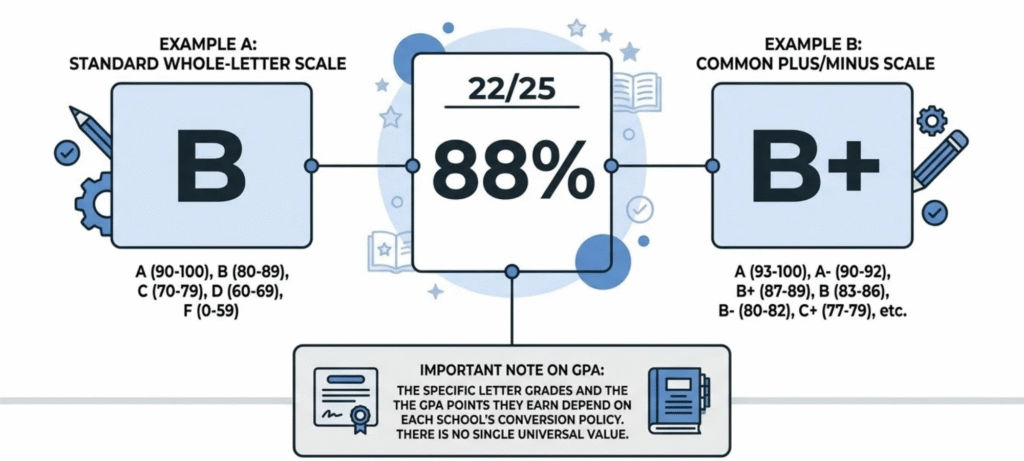
A 22/25 grade is 88%. Divide 22 by 25, multiply by 100, and you get exactly 88. No rounding, nothing messy. On the usual US scale, anything from 80 to 89 percent is a B, so that’s your letter. Does your school use plus and minus grades? Then it’s most likely a B+.
That’s the quick answer. But there’s more to it. The letter, the GPA, even whether the score counts as “good” shifts depending on your school and how much the assignment was worth. So here’s what this page covers: the math, the letter grade on a few different scales, what the GPA could be, how nearby scores compare, and how to win those three missing points back next time.
What Is 22 out of 25 as a Grade?
Getting 22 out of 25 means you earned 22 points from a possible 25, which works out to 88%. Three points slipped away somewhere along the line.
Lots of students hear that and think, “so I got three questions wrong.” Sometimes that’s exactly what happened. Other times it isn’t. Picture a quiz where every question is worth one point. Three wrong answers, three lost points, simple. Now picture a lab report where one section was worth five points and you only got two of them. You’ve lost three points on a single section, and you didn’t get “three questions” wrong at all. Partial credit, missing units and skipped steps can all take points off in small pieces. The score tells you how many points you dropped. It doesn’t tell you how many questions caused it.
Here’s the result at a glance:
| Points earned | Points lost | Total points | Percentage |
|---|---|---|---|
| 22 | 3 | 25 | 88% |
You’ll run into scores like this on short quizzes, homework sets, lab reports, class presentations and anything graded with a rubric. A 20-question vocabulary quiz graded at 1.25 points a question would give you 25 points total. So would a five-part project where each part is worth five points. Twenty-five is a popular total because it fits into 100 so neatly, which is why 22/25 shows up so often in gradebooks.
How to Calculate 22/25 as a Percentage
To convert 22 out of 25 into a percentage, divide 22 by 25 and multiply the result by 100. That’s the same method for every score you’ll ever need to convert.
Here it is step by step:
22 ÷ 25 = 0.88 0.88 × 100 = 88%
If you’d rather skip the calculator, there’s an easy trick for any test out of 25. Since 25 goes into 100 four times, each point is worth exactly 4 percentage points. Multiply your score by four and you’re done. 22 × 4 is 88. A 10 out of 25 is 40%. A 20 out of 25 is 80%.
You can also run it backward. Say you want to know what raw score gets you 92%. Divide 92 by 4 and you get 23. So 23 out of 25. This reverse trick is handy before a test, when you’re working out how many points you can afford to lose.
One more thing, because some websites get this wrong: the answer is 88%, not 88.9%. There’s no decimal hiding in there. As a decimal, 22/25 is 0.88. If you want to double-check any other score, a grade calculator does the same division for you. And if you’d like to see how raw scores turn into percentages and what that does to your overall standing in a class, this guide on how percentage scores affect student grades has more worked examples.
What Grade Is a 22/25?
On a standard US scale, 88% is a B. Most schools that use whole letters run something like this:
- 90 to 100% is an A
- 80 to 89% is a B
- 70 to 79% is a C
- 60 to 69% is a D
- Below 60% is an F
A lot of schools split those letters further with plus and minus grades. The common cutoffs look like this:
- 87 to 89% is a B+
- 83 to 86% is a B
- 80 to 82% is a B-
So 88% sits near the top of the B range. Under plus and minus grading you get a B+. Under whole letters you get a B. Both answers are right. They just come from two different rulers measuring the same score.
Here’s how the same 88% can read in different places:
| Grading approach | What 88% usually becomes |
|---|---|
| Standard whole-letter US scale | B |
| Plus/minus US scale | Usually B+ |
| School-specific or teacher-specific scale | Depends on that school’s cutoffs |
Treat that table as a guide, not a rule. Every school sets its own thresholds, and some teachers set theirs class by class.
Is 22/25 a B or a B+?
It comes down to one question: does your school use plus and minus grades?
If your syllabus only lists A, B, C, D and F, then your 88% is a B. If it lists A-, B+, B- and so on, you’re looking at a B+. Some teachers also make their own cutoffs. One might say a B+ starts at 89, which turns your 88% into a plain B. Another might start B+ at 87 and give you the plus.
The fastest way to find out is to open your syllabus or student handbook and look for the grading scale. It takes about thirty seconds and gives you the real answer for your class instead of a general one. If you want to see how different scales stack up, this breakdown of the high school grading scale lays out the common versions next to each other.
What GPA Is a 22/25?
You can’t turn a percentage straight into a GPA. The GPA comes from the letter grade your school gives you, and then from the number of points that school attaches to that letter.
On the common 4.0 scale with plus and minus grades, a B+ is worth 3.3 and a B is worth 3.0. So that same 88% could be a 3.3 at one school and a 3.0 at the next. Honors or AP class? Weighted systems can push it higher. Some colleges count whole letters only, and a few run on completely different scales.
You’ll see other sites claiming 22/25 equals a 3.5 or a 3.7. At a particular school, sure, that could be true. But it isn’t a universal rule, so don’t lean on it. Need an exact GPA for an application or scholarship form? Skip the guesswork and use the conversion chart from your own school. And if you just want some general background on how GPA works, this overview of grade point average is a decent place to start.
Is a 22/25 Grade Good?
For most people, yes. You earned 88 out of every 100 available points, and that means you handled most of the material well.
Still, “good” depends on who’s asking. A few things change the answer:
- How tough the test was. An 88% on an exam where the class average was 61% is a strong result. The same 88% on an easy review quiz tells you less.
- How it’s graded. Some classes use a curve, and others give almost no partial credit. The same 22/25 can feel very different in each.
- What you were aiming for. If you wanted an A, 88% is a little short. If you were nervous about passing, it’s comfortably above the line.
- How much it counts. A quiz worth 5% of your grade barely moves the needle. A big exam worth 30% matters a lot more.
Be a little careful with big claims like “this proves you’ve mastered the topic.” One score can’t prove that. What it does show is that you picked up most of the points, and what you do with that is up to you.
Weight is where this gets interesting, so let’s try two examples. Say your 22/25 counts for 20% of your final grade. At 88%, it adds 17.6 points toward that 20, so the three lost points cost you 2.4 points of your final grade. Now say the same score is only worth 10% of the course. Then it adds 8.8 points toward the final grade, and the rest of your grade will come from everything else you do in the class. That second number isn’t your whole grade, just one piece of it. The takeaway is simple: a single 88% rarely sinks a course, and it’s usually easy to make up with later work.
How Does 22/25 Compare With Other Scores?
Looking at nearby scores helps you see where 22/25 sits. Since every point is worth 4%, building the table is easy.
These letters follow a common US scale, so your school may use different cutoffs.
| Score | Percentage | Common letter (standard scale) |
|---|---|---|
| 25/25 | 100% | A |
| 24/25 | 96% | A |
| 23/25 | 92% | A |
| 22/25 | 88% | B (B+ with plus/minus) |
| 21/25 | 84% | B (B with plus/minus) |
| 20/25 | 80% | B (B- with plus/minus) |
| 19/25 | 76% | C |
| 18/25 | 72% | C |
| 17/25 | 68% | D |
| 16/25 | 64% | D |
A few things stand out. First, 22/25 is just under the A line. To hit 90% you’d need 22.5 points. Most teachers only award whole points, so in practice you’d need 23/25, which is 92%. If your teacher does allow half points, a 22.5/25 is possible and would land exactly on 90%.
Second, each point on a 25-point test is a big deal. Moving from 21/25 to 22/25 is a jump of four percentage points, which is far more than one point would mean on a 100-point test. That’s why short quizzes can feel so harsh. One careless slip can change your letter.
Third, those related scores people search for are covered too. A 21/25 is 84%, still a B. A 19/25 is 76%, which is usually a C, though a school with a C+ that starts at 77 would still call it a C.
What Is a 21/25 Grade?
A 21/25 grade is 84%. That’s a B on a standard US scale, and still a B with plus and minus grading, since most schools put the B range at 83 to 86%. You lost 4 points, one more than a 22/25. You’d need two more points, 23/25, to cross into A territory.
What Is a 19/25 Grade?
A 19/25 grade is 76%. On the usual cutoffs that’s a C, and it sits one percentage point below a C+ at schools where C+ starts at 77. You lost 6 points. Winning back just one, for 20/25, would lift you to 80%, which is a B.
If you’re planning ahead, here’s how many points you need on a 25-point assessment for common targets:
- For 80%, you need 20/25.
- For 88%, you need 22/25.
- For 90%, you need 22.5 points, so 23/25 with whole-point grading.
- For 92%, you need 23/25.
Put another way, you can lose at most 5 points and still hold an 80%. To stay at 90% or above, you can lose 2 points, or 2.5 if your teacher gives half points.
Here’s something worth checking: what is each question actually worth? A 25-question test gives you one point per question. Only 5 questions? Then every single one carries 5 points. With 10 questions, you’re looking at 2.5 each. The weight decides how badly one mistake hurts, so it’s worth knowing before you sit down.
How Can You Improve a 22/25 Score?
Happy with 88%? Then stop here, honestly. Not every good score needs fixing. But if an A is what you’re after next time, those three lost points are the best study guide you’ve got.
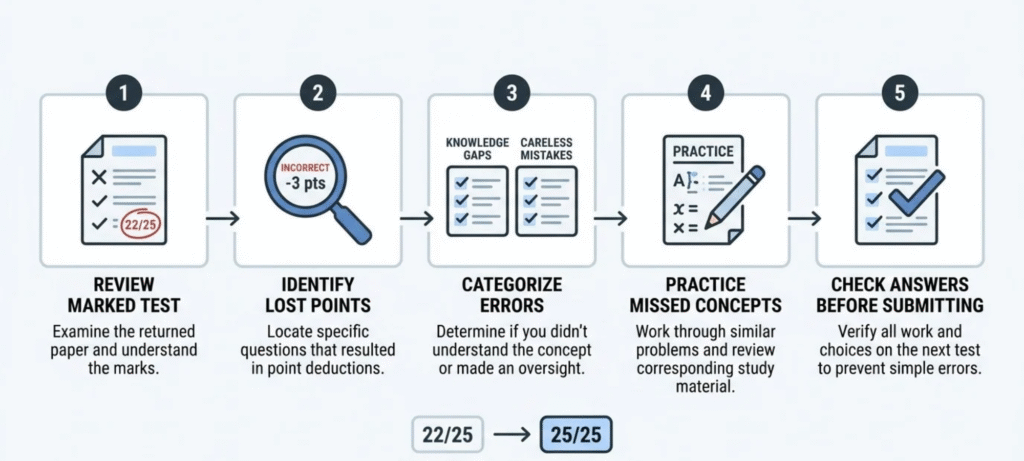
Find exactly where the points went. Grab the graded paper and mark every single deduction. Do they all sit in one topic? Then you know exactly what to review. Scattered all over the place? That usually means small slips.
Sort your mistakes into two piles. A lost point isn’t always lost for the same reason. Maybe you honestly didn’t know the material. Or maybe you knew it fine, but you rushed, misread the question, or skipped showing your work. Different problem, different fix. A gap in knowledge needs more study time, and there’s no way around that. Careless errors? The cure is a boring one: slow down and read everything once more before the test leaves your hands.
Read the feedback and the rubric. Did your teacher write comments or hand out a marking rubric? Then use it. Think of it as a map to full marks. So many points disappear because an answer was right but incomplete, and the rubric shows you exactly what a complete one looks like.
Redo the questions you missed. Close your notes. Try them again from scratch. Get them right this time? Great. Still stuck? Then you’ve just found the exact thing to ask your teacher.
Ask a specific question. “Why did I lose a point on question 4?” is far easier to answer than “how can I do better?” Teachers can work with the first one. The second one is just vague.
Practice a few similar problems. Once you’ve spotted the weak spot, do a short set of practice questions on it a few days before the next test. It works much better than cramming the night before.
To reach 25/25 next time, you’d have to win back all three points on a test of the same size. If the errors were small, that’s very doable. If they pointed to a real gap in understanding, it takes more work. Still, it’s a smaller job than it sounds.
If you’re thinking beyond a single test and want to lift your whole standing, this article on how to raise your GPA covers the longer game.
Frequently Asked Questions
What is a 22/25 grade?
It’s 22 points out of 25 possible points, which works out to 88%. The letter depends on your school’s scale, but it’s commonly a B or a B+.
What is 22/25 as a percentage?
Divide 22 by 25 to get 0.88, then multiply by 100. That gives you 88%.
What letter grade is 22/25?
On a standard US scale, it’s a B. At a school with plus and minus grades, it’s usually a B+.
Is 22/25 an A or a B?
It’s a B. An A usually starts at 90%, and you’d need 22.5 points out of 25 to get there, so 23/25 is the first whole-number score that makes it.
Is 22 out of 25 a good score?
You earned 88% of the available points, which is a strong result in most situations. Whether it meets your goal depends on how hard the test was and what grade you were hoping for.
What is 22/25 as a decimal?
It’s 0.88. Move the decimal two places to the right and you get 88%.
How many points can you lose and still get 90% on a 25-point test?
You can lose 2.5 points at most. With whole-point grading that means losing 2, so your score would be 23/25, or 92%.
How much is each question worth on a 25-point test?
That depends on how many questions there are. 25 questions at one point each are worth 1 point apiece, and 5 questions are worth 5 points apiece. Each point is worth 4 percentage points either way.
Can 22/25 affect your overall class grade?
Yes, but how much depends on the weight. If it counts for 10% of the course, it adds 8.8 points toward your final grade. If it counts for 20%, it adds 17.6.
What is 21/25 as a grade?
21 out of 25 is 84%, which is a B on both standard and plus/minus scales. You lost 4 points.
What is a 19/25 grade?
19 out of 25 is 76%, generally a C. You lost 6 points, and one more point (20/25) would make it a B. Check your school’s cutoffs, because they vary.
Does a 22/25 mean I got three questions wrong?
Not always. It means you lost three points. If each question was worth one point, then yes, three questions cost you marks. If questions had different values or you got partial credit, fewer questions may have caused the loss.
Final Thoughts
A 22/25 is 88%. Wherever you study, that number stays put. The label is the part that moves. Basic scale? It’s a B. School with plus and minus grades? Then you’re looking at a B+. And the GPA? That comes down to your school’s policy, nothing else. So think of it this way: the percentage is the fact, the letter is just the local translation. Want to push higher? Start with those three lost points. That’s where the improvement is waiting.