

So, what is vocational education? It’s job training built around doing the work. A trainee electrician wires a real circuit in a workshop while an instructor checks each connection. A care trainee practices on an actual patient with a supervisor close by. Books help, sure, but the hands-on part is the point. Some programs wrap up in a few weeks. Others take a couple of years. You’ll find them in schools, colleges, workplaces and even community centers.
This guide is for students sizing up their options, parents who want to help, and adults thinking about switching careers. Here’s what’s ahead: what vocational education means, the main types, real examples, the benefits, the downsides people rarely bring up, and how to choose a program that’s worth your time.
What Is Vocational Education?
Vocational education covers the knowledge, skills and work habits a person needs for one particular occupation. Everything is shaped around tasks you’ll actually face on the job, which is why so much of the day happens in a workshop, lab, kitchen, clinic or on a job site. Lecture halls take a back seat.
UNESCO frames it much the same way. For them, these programs exist to give learners the know-how and competencies tied to a specific trade or occupation. If you’d like to dig deeper, the UNESCO-UNEVOC site publishes research and definitions on technical and vocational training from around the world.
A few things set it apart from a typical academic route:
- It’s occupation-focused. You train for a job family, like automotive repair or dental assisting.
- It’s practice-heavy. Theory still matters, but it’s there to support the work.
- It often includes work-based learning. Apprenticeships, placements and supervised practice are common.
- It’s assessed by what you can do. Many programs test practical skills, not just written exams.
One thing to know early: the names vary by country. In the US you’ll hear Career and Technical Education, or CTE. Elsewhere it’s Technical and Vocational Education and Training (TVET) or Vocational Education and Training (VET). They overlap a lot, but they aren’t identical everywhere, so always check how your own country uses the term.
What Is the Meaning of Vocational Education?
Strip away the jargon and the meaning is simple: learning a trade or skill by doing it.
Picture someone training to be an electrician. Nobody in that program is going to stop at a lecture on how current flows. They learn electrical safety first. Then they spend hours in a workshop doing real wiring, studying circuit diagrams, and tracking down the fault when a circuit just won’t work. When the course ends, they can do the job, or at the very least begin as an apprentice with someone supervising.
You’ll hear “vocational training” and “vocational education” used for the same thing, and in daily conversation that’s usually fine. Strictly speaking, though, there’s a small gap. Training is the hands-on skill itself. Education is the bigger picture around it: safety rules, the math a trade needs, how to talk to clients and coworkers, and the professional standards you’re expected to meet. Want a quick look at how the term has been used over time and from country to country? The Wikipedia entry on vocational education is a decent starting point.
What Are the Types of Vocational Education?
There’s no single format. What’s on offer depends on where you live, but these are the routes you’ll see most often.
Vocational courses in high school
Many schools run career-focused classes alongside regular subjects. Students might take courses in construction, health science, culinary arts or computer support. I’ll say more on this below.
Certificates and diplomas
Plenty of people take one of these right after secondary school. A certificate usually covers a small, focused set of practical skills. A diploma tends to go broader, or further into a subject. Don’t assume the labels mean the same thing everywhere, though. Length, level and entry requirements shift between countries and between institutions. So ask one question before you pay a fee: will employers where I plan to work recognize this credential?
Apprenticeships
Apprentices learn on the job. They work in a real workplace, pick up the trade from people who’ve done it for years, and sit through formal instruction as part of the deal. Pay is not the same everywhere. Neither are the protections or training requirements, since those depend on the country, the employer and the program. Plumbing, electrical work and carpentry are the classic examples, and plenty of other trades work the same way.
Technical colleges and trade schools
These institutions specialize in job-focused programs. If you want to see what local trade school options can look like in practice, our roundup of trade schools in San Antonio worth enrolling in gives a real-world example of how programs get described and compared.
Employer-based training
Some employers train staff directly. It’s common in manufacturing, retail, hospitality and healthcare support. It’s fast and tied to a specific workplace, though the skills may not always transfer neatly to another employer.
Short courses and adult reskilling
Not everyone wants a long program. Short vocational courses, lasting anywhere from a few weeks to a few months, help people add a skill or switch fields. Food handling, basic IT support, digital tools and first aid are typical examples.
Which of these exist where you live, and how they’re recognized, changes by country. Treat this list as a map of possibilities, not a promise about any one system.
What Is Vocational Education in High School?
Some countries don’t make students wait for graduation. Vocational classes can start while they’re still in secondary school, right next to their regular subjects. In the US, the name for this is Career and Technical Education, or CTE.
Want the official numbers? NCES, the statistics agency of the U.S. Department of Education, puts out data and definitions on CTE at nces.ed.gov.
Which courses you get is up to your school. Construction, health science, culinary arts, IT. Those are common, but the menu changes from place to place. Not every course is built around one job, either. Some teach general workplace skills, and some fall under family and consumer sciences.
The school day gets split. Part of it is spent in a normal classroom, and part in a workshop, kitchen, medical lab or computer lab. Lots of programs also arrange job shadowing, industry visits or a work placement. Some students even earn a certification before they finish school.
It’s not a dead end, either. Some graduates go straight to work. Others head to a technical college or a university. Local rules and the program itself decide which of those are open.
What Are Some Vocational Education Examples?
Here’s where it gets concrete. These fields are commonly taught through vocational routes, along with the kind of practical skill each one builds.
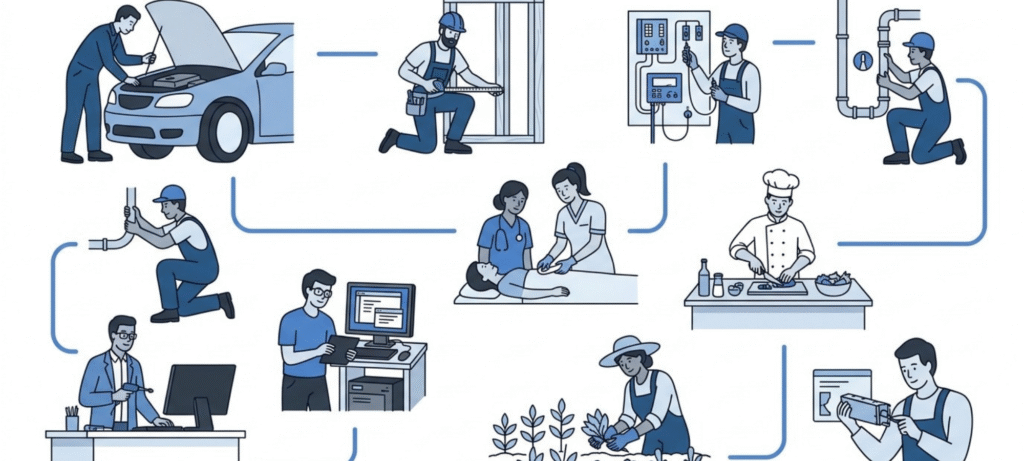
- Automotive technology. Engine diagnostics, brake and suspension work, routine maintenance. Jobs include mechanic and service technician.
- Construction and carpentry. Reading plans, measuring, framing, safe tool use. Jobs include carpenter and site worker.
- Electrical installation. Wiring, circuit testing, safety standards. Jobs include electrician’s apprentice and maintenance technician.
- Plumbing. Pipe fitting, leak repair, reading building layouts.
- Healthcare support. Patient care basics, hygiene, vital signs, working under supervision. Roles vary a lot by region and licensing rules, so don’t assume every healthcare course leads to a nursing license.
- Culinary arts and hospitality. Food prep, kitchen safety, service, event handling. Jobs include cook, caterer and hotel staff.
- Information technology support. Troubleshooting devices, networks and basic security. Jobs include help desk and IT support technician.
- Agriculture and food technology. Crop care, equipment, food processing.
- Manufacturing. Machine operation, quality checks, workplace safety.
Notice the pattern. Each one is a skill you can demonstrate. That’s what makes vocational examples different from broad degree subjects: you can usually point at the thing you’ve learned to do.
What Are the Benefits of Vocational Education?
You’ll see long lists of benefits online, and some of them are inflated. Here are five that hold up pretty well.
1. You build practical skills early. Practice is the main event, not an afterthought. For people who learn better by doing, that matters.
2. The training points at an occupation. Because programs are built around a trade, you usually know what you’re working toward from day one.
3. Work-based learning is common. Placements, apprenticeships and supervised practice give you a feel for the real job before you commit to it.
4. It offers an alternative route into work. A university degree isn’t the only way to a solid career. For many trades and technical roles, vocational training is the normal entry point.
5. It supports further learning and reskilling. Adults can add a skill without starting from scratch, and some qualifications can lead to further study.
What I’m leaving out on purpose: guaranteed jobs, guaranteed salaries and promises that it’s always cheaper or faster. Those depend on the country, the industry, the school and the local job market. Anyone promising otherwise is selling something.
What Are the Disadvantages or Limitations?
A fair guide has to cover the other side.
Quality varies. Some programs are excellent and some aren’t. Poor equipment, thin hands-on time and outdated content can waste your money.
Recognition isn’t always universal. A qualification that employers respect in one place might mean less in another. Check before you enroll.
Local demand matters. A course in a field with few local openings can leave you stuck. Do a quick check of the job market where you want to work.
Switching careers can cost you. If you train for one trade and later decide it’s not for you, you may need new training. That’s true of any specialized path, but it’s worth knowing.
Some paths have limits on advancement. Certain careers need further qualifications to move into senior or management roles. Often that’s possible, but it may take more study.
None of this means vocational education is a bad idea. It means you should pick with your eyes open.
Vocational Education vs. Traditional Education
People often treat this as a contest, and it really isn’t one. They do different jobs. Here’s a side-by-side look at the general differences.
| Aspect | Vocational education | Traditional academic education |
|---|---|---|
| Main purpose | Develop skills for a particular occupation or field | Develop broader academic knowledge and research skills |
| Learning method | Practical tasks, workshops and work placements where available | Lectures, reading, research and written assignments |
| Typical settings | Technical colleges, trade schools and workplaces | Universities and academic colleges |
| Qualifications | Certificates, diplomas and apprenticeship credentials, depending on the system | Degrees and other academic qualifications |
| Career pathways | Often focused on a trade or technical field; skills may transfer across related roles | Can support a wider range of career paths, depending on the subject |
| Further study | Progression or credit transfer may be possible | Further academic study may be available through established pathways |
Notice I haven’t said one is cheaper, shorter or better for getting hired. Cost and length depend on the program and country, and job outcomes depend on the field. Some careers need a degree. Others are best entered through a trade qualification. The right comparison is between a specific program and your specific goal.
How to Choose a Vocational Education Program
This is the part most basic definition articles skip, and it’s where people lose money. Before you sign up, check these things.
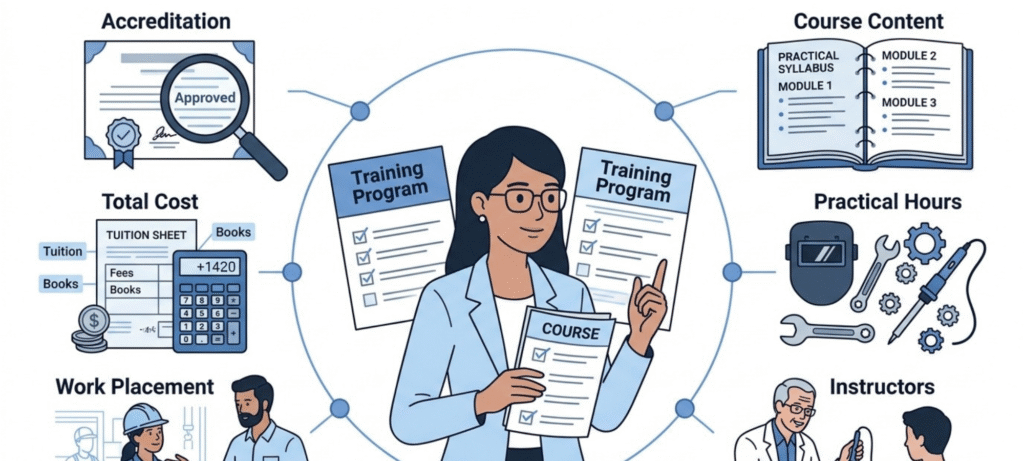
- Accreditation. Is the school approved by the relevant education authority? Ask for proof, and check it with the authority itself.
- Licensing and professional requirements. Some occupations require a professional licence, registration, supervised practice or additional examinations before you can work independently. This is especially important in regulated healthcare and certain electrical, plumbing and childcare roles. Confirm the requirements with the relevant authority in the country where you plan to work; completing a course does not automatically grant permission to practise.
- Course content. Does the syllabus match the job you want? Look for current tools and methods.
- Hands-on hours. How much of the course is practical? Ask for real numbers.
- Instructors. Have they worked in the field? Good teachers have usually done the job.
- Equipment. Will you train on modern, working equipment?
- Work placement. Does the program arrange apprenticeships or work experience?
- Total cost. Ask about tuition, tools, uniforms, exam fees and anything else you’ll pay for.
- Recognition. Will employers and professional bodies accept the qualification where you plan to work?
- Graduate outcomes. Ask what graduates actually do after finishing. Be wary of vague answers.
If you may want to continue studying later, ask whether the qualification can lead to an advanced course, transfer credits or recognition of prior learning. Some institutions assess skills and experience gained through previous study or work, but the rules vary. Check the available pathway before enrolling rather than assuming every vocational qualification will count toward a degree.
If you’re still narrowing down which direction to take, our guide on how to choose the right course for specialized careers can help you think it through.
And one more tip: talk to people who work in the trade. A short chat with a working electrician or chef tells you more than most brochures.
Who Should Consider Vocational Education?
It can be a good fit if you:
- learn better by doing than by reading
- want to train for a particular trade or technical job
- are a school student exploring career options
- are an adult changing careers or adding a skill
- want a route into work that doesn’t depend on a traditional degree
It may be less of a fit if your dream career requires a university degree, or if you haven’t yet figured out what interests you. In that case, exploring through a short course or a school-based CTE class can help you test the waters before committing.
The best choice depends on your interests, the quality of the program, the entry requirements and where you want to end up. There’s no universal right answer.
Frequently Asked Questions
What is vocational education?
It’s education and training that prepares you for a specific job or trade through practical, hands-on learning. You build the skills needed for an occupation instead of studying broad academic subjects.
What is vocational education and training (VET)?
VET is a common term, especially in Australia and parts of Europe, for the system of programs that teach occupational skills. It’s closely related to TVET and CTE, though the details differ by country.
What is vocational education in high school?
It means career-focused classes taken during secondary school, such as health science, construction or culinary arts. In the US, these are often called Career and Technical Education.
What are some vocational education examples?
Common examples include automotive technology, electrical installation, plumbing, carpentry, healthcare support, culinary arts and IT support.
What is the difference between vocational education and vocational training?
In everyday use they’re often interchangeable. If you split hairs, training focuses on the hands-on skill, while education can include the wider knowledge around the job.
What is a synonym for vocational education?
Common alternatives include career and technical education, technical education, trade education and TVET, although the exact meaning can vary by country.
How does vocational education differ from academic education?
Vocational education prepares you for a particular occupation through practical training. Academic education focuses on broad knowledge, theory and research.
Conclusion
So, what is vocational education? It’s a practical way to learn a trade or skill for a specific job, offered through schools, colleges, workplaces and apprenticeships. It isn’t a second-best option. It’s a different route, and for plenty of careers it’s the main one.
What decides whether it works for you isn’t the label. It’s the quality of the program, the demand for the skill where you live, and whether the work suits you. Start by looking at what your local schools and colleges offer, check their accreditation, and talk to someone who does the job you’re curious about. That small bit of homework can save you a lot of time and money.