

How many sentences are in an essay? Depends. For 500 words I’d say you’re looking at about 25 to 34, and for 1,000 words it’s more like 50 to 67, give or take. None of that is official though, and I’d be lying if I said it was. No style guide gives a number. Teachers? Most of them couldn’t tell you how many sentences were in the last essay they graded.
Why the spread? Sentence length, mostly. Take “I went home. It was late. I was tired.” That’s three sentences and nine words. Now squash it into one sentence with a comma and a “because” and you’re down to one. Do that for 500 words and the totals drift miles apart.
Somebody usually asks this around 11 pm. The assignment says 750 words, they’ve got 600, and they’re wondering if five more sentences will cover it. Might. Might not, if the sentences are short. What your teacher actually cares about is whether the ideas make sense and the evidence backs them up. The word limit’s just there so nobody hands in forty pages. Still, I like having a rough target while planning, since it keeps me from writing a body paragraph that’s three sentences long and kind of lazy, or one that’s fourteen and has lost its way by sentence nine.
Haven’t worked out your structure yet? Our informative essay outline is a good place to start, it shows how to lay out your sections before you write anything. After this you’ll get sentence estimates for common essay lengths, a formula you can use on any assignment, and quick answers on paragraphs, introductions, conclusions and argumentative essays.
How Many Sentences Are in an Essay?
No fixed rule here. Your total depends on a handful of things: word count, how long your sentences run, what kind of essay it is, and what your instructor is after. To get a number, just divide your word count by your average sentence length. That’s it.
Most academic writing averages somewhere between 15 and 20 words a sentence, so I’ve used that range for the table below:
Most academic writing sits around 15 to 20 words per sentence. Using that, here’s how it shakes out:
| Essay word count | Estimated sentences | Typical paragraphs |
|---|---|---|
| 250 words | 13 to 17 | 3 to 4 |
| 300 words | 15 to 20 | 3 to 5 |
| 500 words | 25 to 34 | 4 to 6 |
| 750 words | 38 to 50 | 5 to 8 |
| 1,000 words | 50 to 67 | 6 to 10 |
| 1,500 words | 75 to 100 | 8 to 12 |
| 2,000 words | 100 to 134 | 10 to 15 |
Don’t treat these as rules. The paragraph column is my rough guess, built on body paragraphs of about 5 to 8 sentences and a shorter intro and conclusion. Your essay can look different and be completely fine.
How Sentence Length Affects the Total Count
Say two students both hit exactly 500 words. One writes short, quick sentences. The other packs a lot into each one. They’ll end up with totals that are miles apart.
| Writing style | Average words per sentence | Sentences in 500 words |
|---|---|---|
| Short sentences | 10 | 50 |
| Moderate sentences | 15 | 34 |
| Longer sentences | 20 | 25 |
| Very long sentences | 25 | 20 |
So is one style better? Not really. Still, if every sentence in your draft is ten words or less, the whole thing starts reading like a grocery list. And when most of them run past 25, readers get lost somewhere in the middle. So mix it up. Throw in a short one. Then a longer one when there’s something that needs explaining.
The kind of essay changes the count too. A story usually goes short when stuff is happening, then stretches out when the writer stops to think. Research papers run long, mostly because they’re carrying citations and “however” clauses around. That’s why, when someone asks how many sentences are in an essay, the honest answer is a range. And it’s a wide one.
Does Every Essay Need the Same Number of Paragraphs?
Nope. Your points decide the paragraph count, not some formula. A 1,000-word essay doesn’t have to have six paragraphs, and a 500-word one doesn’t always get five.
Two strong points? Two body paragraphs could be plenty. Four points? Then you’re writing four. Figure out your ideas first, and the paragraph count usually sorts itself out.
How to Calculate How Many Sentences Your Essay Needs
The method is quick. Take your target word count and divide by your average sentence length.
Estimated sentences = word count ÷ average words per sentence
Say you’re writing 750 words and your sentences average 18. That’s 750 ÷ 18, so roughly 42 sentences. Shorten your style to 15 words and the same essay needs 50.
Three steps:
- Find the assignment’s word count.
- Work out your average sentence length from something you already wrote.
- Divide the first number by the second.
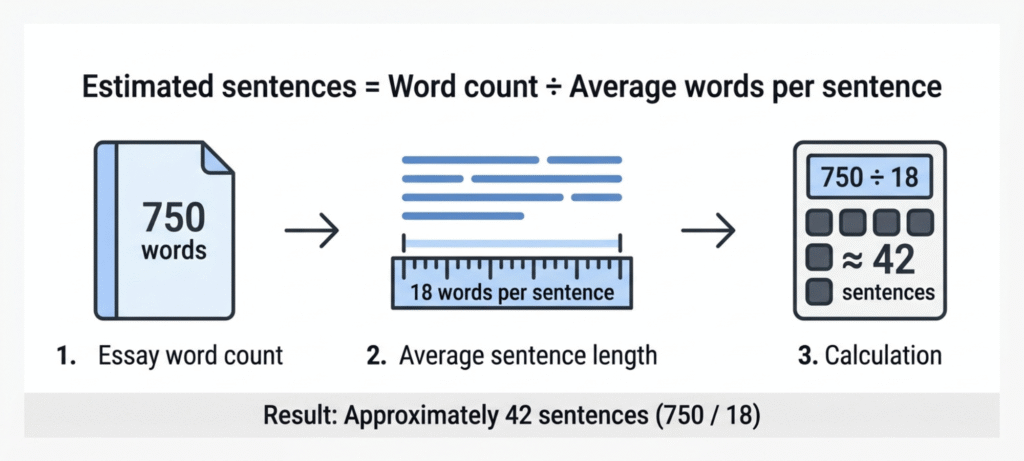
Try a real one. You’ve got a 1,000-word assignment and your last essay averaged 17 words per sentence. 1,000 ÷ 17 comes out near 59. That’s your starting estimate and nothing more.
To get your own average, open an old draft and check the word count in Microsoft Word or Google Docs. Then count the sentences in a few paragraphs by hand and scale it up. Or use the math:
Average sentence length = total words ÷ total sentences
One more thing before you go: don’t chase the number. Say you pad a paragraph just so you can land on exactly 59 sentences. All you’ve done is make the essay weaker, and teachers usually spot padding fast. Use the figure to plan. What you’ve actually got to say should decide the final count.
How Many Sentences Are in a Paragraph for an Essay?
This is usually the next thing students ask after the total. Most body paragraphs in academic essays end up somewhere between 4 and 8 sentences. For shorter school essays it’s often 4 to 6. Outside school, professional and creative writing can go all over the place, and plenty of paragraphs are one sentence long on purpose.
Truth is, the count matters less than what each sentence is doing. So if you’re stuck on how many sentences are in an essay paragraph for your own assignment, ask yourself one thing. Did this paragraph finish explaining its one idea? If yes, stop there. If it didn’t, write another sentence.
What Is the Ideal Number of Sentences in an Essay Paragraph?
Think of 4 to 8 as a loose guide, nothing stricter. Sometimes a simple point is done in three sentences. Other times an argument has a few moving parts and you end up at nine, and that’s fine too. What you really don’t want is a paragraph that stops before it’s explained anything, or one that starts on a second idea halfway through and never comes back.
What Should Each Sentence Do in a Body Paragraph?
Most good paragraphs use some of this list. Not always all of it:
- Topic sentence: tells the reader what the paragraph is about.
- Supporting sentence: a reason, or a bit of explanation for the claim.
- Evidence sentence: a fact, an example, maybe a quote.
- Analysis sentence: says why that evidence actually matters.
- Extra development: another example, more detail, or a small counterpoint.
- Closing sentence: brings the idea back around to your thesis.
You hardly ever need all six. Shorter paragraphs can skip the extra development, and a longer one might want a second piece of evidence. The one test that counts is whether each sentence is doing something.
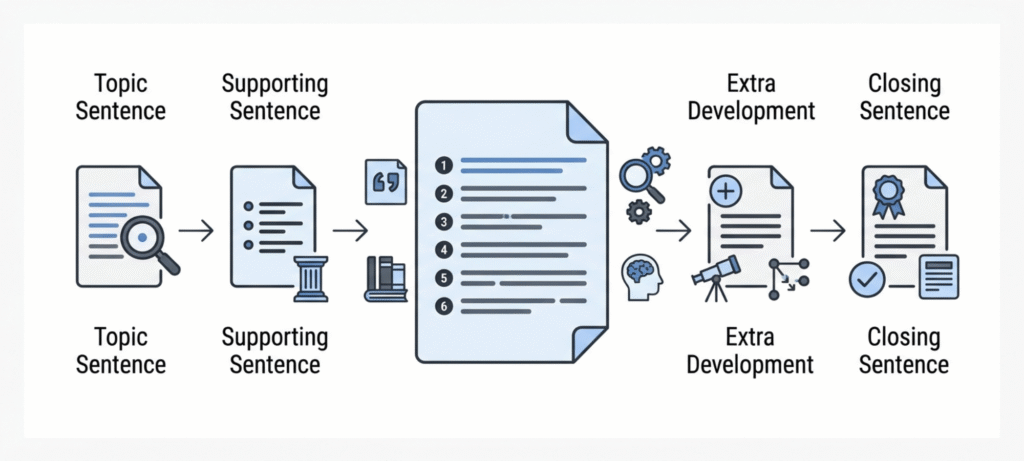
Nobody needs all six every single time. Short paragraphs can skip the extra development, and a longer one might want two pieces of evidence. The only real test is whether each sentence has a job.
Example of a Well-Developed Essay Paragraph
Here’s a paragraph on school start times. Each sentence has its job written next to it.
Teenagers might do better in class if school started later. (topic) Lots of them fall asleep late no matter what, so a 7:30 bell leaves plenty of them short on sleep. (support) Think of a kid who gets up at 5:45 a.m. and spends first period with their eyes half shut. (evidence, illustrative) That’s a problem, because tired students can’t focus well, forget what they just learned, and tend to be in a worse mood. (analysis) Start the day an hour later and they have a real chance of taking something in. (development) Districts really should look at pushing start times back. (closing)
Six sentences, one idea, and none of them is filler. The example is invented, by the way. In a real essay you’d swap in an actual source and cite it.
When Should You Write a Short or Long Paragraph?
It depends on how much the point needs.
| Paragraph situation | Possible sentence count |
|---|---|
| Simple supporting point | 3 to 4 |
| Standard academic explanation | 5 to 7 |
| Complex argument with several details | 7 to 9 |
| Short transition or opening paragraph | Can be shorter |
Don’t take those numbers as rules, they’re just examples. For something more solid to compare against, the Purdue Online Writing Lab has a clear walkthrough of paragraph structure and development.
Also worth knowing: whatever the subject, a paragraph should stick to one idea. But how long it runs does change. A history paper, a lab report and a lit essay all handle paragraphs a bit differently. If you’re not sure, follow your instructor’s guidelines or the style guide they gave you. MLA, APA and Chicago don’t ask for a particular number of sentences, by the way.
How Many Sentences Are in Different Parts of an Essay?
Pretty much every academic essay has an intro, a body and a conclusion. And each one tends to be a different size.
How Many Sentences Are in an Essay Introduction?
For a typical school essay the intro is 3 to 5 sentences. A short response can get away with 2 or 3. Longer research papers might give the intro a whole paragraph or more, usually because there’s background to cover.
You may have come across the rule that an intro is about 10 percent of the word count. It’s a handy shortcut, not something any teacher is required to enforce. At 500 words that’s around 50 words, so 2 to 3 sentences. At 1,000 words it’s about 100 words, or 5 to 6 sentences. That doesn’t line up perfectly with the 3 to 5 range, and that’s okay. They’re measuring different things and both are rough, so use whichever suits your essay.
What really matters is what the intro does. It grabs attention. It gives a little context. And it ends with a clear thesis, usually as the last sentence, so the reader knows what you’re arguing before the body starts. Short response? A quick setup is plenty. Research essay? You’ll need more background first, otherwise the thesis won’t make much sense.
Struggling to word yours? The UNC Writing Center put together a handy guide on writing thesis statements.
How Many Sentences Should Be in Body Paragraphs?
Body paragraphs carry most of the weight, so they’re the longest part. Figure on 5 to 8 sentences each. They’re built around a topic sentence, some evidence, an explanation and a link back to your thesis.
Quick example. Say your thesis is that cities should spend more on public transit. A body paragraph could start by claiming that buses and trains reduce traffic. After that you add evidence, maybe ridership numbers from a city report. Then you explain what those numbers mean for drivers and commuters. Finally, you tie it back to the thesis. Four jobs, and each takes a sentence or two.
As for how many body paragraphs you need, that depends on how many supporting points you’ve got. There’s no formula.
How Many Sentences Should Be in an Essay Conclusion?
For a short essay, 3 to 4 sentences is usually enough. A research paper can run longer. Whatever the length, a conclusion should:
- Say your main point again, but in new words, not just a copy of your thesis.
- Tie the big ideas together instead of going back over each one.
- Finish on a last thought, maybe why any of this matters.
Don’t sneak in a brand-new argument at this point. If it’s worth including, put it in the body where it belongs.
How Many Sentences Are in a Three-Paragraph and Five-Paragraph Essay?
Teachers like these two formats because they’re easy to follow and easy to mark. That doesn’t make them a rule, though. They’re just training formats, nothing more official than that.
When Is a Three-Paragraph Essay Appropriate?
It’s the smallest version of an essay: an intro, a single body paragraph and a conclusion. Quick responses, basic school work and simple topics are where it fits best. Aim for 3 or 4 sentences in the intro, 5 to 7 in the body, and 3 or 4 at the end. That’s roughly 11 to 15 sentences altogether, which suits a 200 to 300 word response.
When Should You Use a Five-Paragraph Essay?
Add two more body paragraphs and suddenly you have space for three separate supporting points. That’s enough to build a proper argument, and you won’t bury a short assignment doing it. Here’s one way a 500-word version could break down:
| Section | Paragraphs | Example sentences |
|---|---|---|
| Introduction | 1 | 4 |
| Body paragraph 1 | 1 | 6 |
| Body paragraph 2 | 1 | 6 |
| Body paragraph 3 | 1 | 6 |
| Conclusion | 1 | 4 |
| Total | 5 | 26 |
At 26 sentences and 500 words, that’s about 19 words per sentence, which sits comfortably in the normal range. It’s just one possible structure, so don’t copy it like it’s a standard. If planning is what trips you up, this guide on how to write an essay plan walks through it step by step.
Are Three-Paragraph and Five-Paragraph Essays Mandatory?
No. Longer or more advanced essays use as many paragraphs as the argument needs. If your teacher asks for five paragraphs, write five. If they only give a word count, organize it your way.
How Many Sentences Are in an Argumentative Essay?
No fixed count here either, but argumentative essays often run longer than other types. You’re not just explaining something. You’re making a claim, backing it up, walking through your reasoning and dealing with the other side.
A solid argumentative essay usually has a thesis, supporting claims, evidence, a counterargument and a rebuttal. Each one needs enough space to actually work.
| Section | Example sentence range |
|---|---|
| Introduction | 3 to 5 |
| Body paragraph 1 | 5 to 8 |
| Body paragraph 2 | 5 to 8 |
| Body paragraph 3 (counterargument and rebuttal) | 5 to 8 |
| Conclusion | 3 to 4 |
| Total | 21 to 33 |
Think of that table as a sample, not a goal. In a timed AP Language or AP English Literature essay you’ll probably write fewer sentences, simply because the clock is ticking. A college research argument can easily run way longer.
How Many Sentences Should an Argumentative Essay Introduction Have?
Most of the time it’s 3 to 5. Grab attention first, then explain the issue in a line or two. The last sentence is your thesis, and it should be something a reasonable person could push back on. If the reader can’t tell where you stand by then, something’s missing. Longer research arguments often need extra space for background.
How Many Sentences Should an Argumentative Body Paragraph Have?
Somewhere between 5 and 8. Make a claim, show your evidence, then say what it means. People forget that last bit. A claim with nothing behind it is just an opinion, and evidence with no explanation leaves the reader asking “so what?”
How Many Sentences Are Needed for a Counterargument and Rebuttal?
Lots of students skip this, and it shows in their grades. Start by describing the other side’s view in a way they’d actually agree with. Then answer it, using reasoning or evidence. A good starting point is two or three sentences for the counterargument and three or four for your rebuttal. And don’t make the opposing view sound dumb. Readers can tell, and they stop trusting you.
Example of an Argumentative Essay Sentence Structure
Let’s use the question “Should schools start later in the morning?” Here’s one way a 500-word argumentative essay could be split up:
- Introduction (4 sentences): open with a hook about early alarm clocks, explain how start times work now, mention that people disagree, then give your thesis that schools should start later.
- Body 1 (6 sentences): argue that sleep affects focus. Evidence, explanation, then back to the thesis.
- Body 2 (6 sentences): this one’s about attendance and alertness, built the same way.
- Body 3 (7 sentences): the counterargument comes in here, say bus schedules and sports practice, and then you answer it with fixes that could realistically work.
- Conclusion (3 sentences): say where you stand again, sum it up quickly, and end on a thought about student well-being.
Total is 26 sentences. Count after you’ve written the draft, not before.
How Many Sentences Should an Essay Have at Different Academic Levels?
No grade level has a fixed requirement, but a pattern shows up pretty reliably.
Elementary students usually write short paragraphs with simple sentences, sometimes 3 to 5 each. Middle school essays run a bit longer, with more evidence and clearer structure. High school essays expect fuller paragraphs, often 5 to 8 sentences, plus more analysis. University papers go deeper again. Paragraphs stretch, sentences get more complicated, and sources need more explaining.
So a 7th grader doesn’t need exactly 20 sentences and a college freshman doesn’t need exactly 60. What grows with the level is the amount of development. And always check the rubric first.
What Determines the Number of Sentences in an Essay?
Seven things shape your final count.
- Assignment word count. This sets the overall size. A 300-word response can’t hold 80 sentences.
- Topic complexity. A tricky subject needs more explaining, which means more sentences.
- Academic level. Younger students write shorter pieces. University papers go deeper.
- Essay type. Narrative, informative, persuasive and argumentative essays all use sentences differently.
- Evidence and detail. The more support a point needs, the more sentences it takes.
- Assignment format. A timed exam, a personal essay and a research paper come with very different expectations.
- Citation requirements. Research-heavy assignments often need extra sentences to introduce, explain and evaluate each source.
Your teacher’s instructions beat anything you read online, this article included. If the rubric asks for five paragraphs of at least five sentences each, do that. Outside the classroom, formats set their own limits. An IELTS Task 2 response has a 250-word minimum, and the Common App personal statement has a 650-word cap, so word count drives your sentence count in those cases. Check the official guidelines before you start, since requirements can change.
Common Sentence-Count Mistakes Students Make
Most problems come from chasing a number instead of writing for the reader. These show up the most.
Padding. Adding filler sentences just to reach a target. They almost always repeat something you already said.
Overly long sentences. Cramming three ideas into one sentence makes it hard to follow. Split it.
Fragments and run-ons. A fragment leaves a thought hanging. A run-on glues two complete thoughts together without proper punctuation. Both make writing feel sloppy.
One-sentence paragraphs by accident. A single sentence can work for emphasis. But if it’s there because you ran out of things to say, the point probably needs more development.
Paragraphs with unrelated ideas. If a paragraph jumps from one topic to another, split it, even if it’s only five sentences long.
How to Know If Your Essay Has Enough Sentences
Forget counting for a minute and run through these checks:
- Does each paragraph stick to one main idea?
- Is every claim backed by evidence or an example?
- Have you explained why the evidence matters?
- Did you cut repeated sentences and filler?
- Do your transitions make the order of ideas clear?
- Is each paragraph a sensible length for its point?
- Does the essay meet the word count and follow your instructor’s rules?
Adding sentences doesn’t automatically help, and here’s why. Compare these two versions of the same paragraph.
Weak: Homework is bad for kids. Homework is not good. Many kids do not like homework. Homework is a problem for students. It is bad.
Improved: Heavy homework loads can hurt students’ well-being. A teenager who spends three hours a night on assignments often cuts into sleep and family time. Over weeks, that kind of schedule can leave students more stressed and less interested in learning, which suggests that the quality of assignments matters more than the quantity.
The first has five sentences and says almost nothing. The second has three and makes a real point. Keep in mind the improved version is only an illustration, so if you use a claim like this in a real essay, back it up with a source you can cite.
How to Check Your Essay’s Sentence and Word Count
Word count is easy. In Microsoft Word, the count shows at the bottom left of the window, and you can highlight a section to check just that part. In Google Docs, open Tools and choose Word count, or press Ctrl+Shift+C on Windows (Cmd+Shift+C on a Mac).
Sentence count is trickier, because many word processors don’t show it by default. Some writing tools report sentence stats, but interfaces change, so I wouldn’t lean on one. A manual estimate works fine. Count the sentences in two or three typical paragraphs, find the average, then multiply by your paragraph count. It’s rough, but it’s close enough for planning.
Use the word count to meet your assignment requirement. Use the sentence estimate to check your balance. Two different jobs.
Frequently Asked Questions
How many sentences are in a 500-word essay?
About 25 to 34, assuming your sentences average 15 to 20 words. If you like shorter sentences, you could reach 40 or more.
How many sentences are in a 1,000-word essay?
Roughly 50 to 67. That usually spreads across 6 to 10 paragraphs, depending on your structure.
Is 12 sentences enough for an essay?
Twelve sentences could work as a very short three-paragraph response of around 200 words. For most school assignments, though, it’s too short. Check your word count and rubric first.
Is 7 sentences an essay?
Usually not. Seven sentences typically make one paragraph. A full essay needs an introduction, development and a conclusion, so you’re generally looking at three paragraphs at minimum.
Can a paragraph have only three sentences?
Yes, if the point is simple and fully made. Three precise sentences beat eight repetitive ones. Just make sure the paragraph has a main idea and some support.
Does every essay need five paragraphs?
No. The five-paragraph essay is a teaching format. Longer or more advanced essays use as many paragraphs as the argument needs.
How many sentences should an argumentative essay introduction have?
Three to five is typical. Open with a hook, add brief background, and finish with a clear, arguable thesis.
Final Thought
Sentence count is a result, not a goal. Work out a rough target from your word count, build each paragraph around one idea, and let your evidence decide how long it runs.
So, how many sentences are in an essay? Enough to introduce your idea, prove it and wrap it up. That’s usually 25 to 34 for 500 words and 50 to 67 for 1,000. Check your assignment guidelines first, then draft, then count.