

Walk into any university admissions office and you’ll hear the same complaint: too many leads, not enough time. Counselors are chasing cold inquiries while genuinely interested students sit waiting for a reply. That’s why lead scoring criteria in higher education has become essential for modern admissions teams trying to improve enrollment efficiency, prioritize high-intent students, and increase application conversions.
Lead scoring is the fix for that. Not a complicated one, either. You assign points to the things prospective students do — visiting certain pages, attending an open day, starting an application — and then you use those scores to decide who actually needs a call today versus who’s fine getting an automated email next week.
This guide is for admissions and enrollment teams who want a practical, working model. Not a theoretical overview. Real criteria, real scoring values, and a clear picture of how it connects to your CRM and daily workflow.
What Actually Is Lead Scoring in Higher Education?
At its core, lead scoring gives each prospective student a number. That number reflects two things: whether they’re a strong fit for your institution, and how much genuine interest they’ve shown through their behavior.
Think of it this way. You’ve got two students who both submitted an inquiry form last Tuesday. One of them visited your postgrad program page, checked the fees section twice, and watched the full 20-minute virtual open day. The other one hasn’t opened a single email since. Same starting point. Completely different level of intent.
Lead scoring captures that difference automatically. The first student might hit 80 points within a week. The second might still be sitting at 10. Your admissions team doesn’t have to guess which one to call first — the score tells them.
Why Admissions Teams Actually Need This

Most admissions counselors are managing 200 to 400 active leads at any given time. There’s no realistic way to give every single one proper attention without some kind of system for sorting them.
Without scoring, what usually happens is either a first-in-first-out queue (which ignores intent entirely) or counselors relying on gut feeling about which leads look promising. Neither of those works well at scale.
Speed matters more than most teams realise
There’s solid research behind the idea that the faster you contact a high-intent lead, the better your conversion odds. Waiting 24 hours instead of two hours can make a meaningful difference. A scored system makes it possible to route urgent leads to a counselor the moment they cross a threshold — no manual review needed.
Better conversations, not more calls
When a counselor calls someone who just started an application and visited the fees page three times, that’s a different conversation than cold-calling someone from a six-month-old inquiry list. Scoring means counselors spend their time on students who are actually close to making a decision.
Your marketing budget starts making more sense
Once you’re tracking which channels produce high-scoring leads versus which ones produce a lot of noise, you have real data to work with. A paid campaign generating 500 leads that all score under 15 is telling you something important.
You can personalise outreach properly
A student with a strong profile fit but no engagement needs urgency-building content. A highly engaged student who’s borderline on qualifications needs reassurance. Scoring lets you segment those two groups and communicate with each of them appropriately.
The Lead Scoring Criteria That Actually Move the Needle
There are two main buckets: explicit criteria (who the student is) and implicit criteria (what they’ve done). You need both. Relying only on demographics means missing students who are quietly doing all the right research. Relying only on clicks means you might prioritise someone who browses everything but has no intention of enrolling.
Demographic and Profile Fit
These tell you whether this person could realistically enroll, before you factor in any behavior at all.
- Location: A domestic student generally scores higher than an international one, not because they’re more valuable, but because the conversion path is shorter and simpler. That said, for programs with strong international intake, adjust your model accordingly.
- Study level interest: Postgrad inquiries often convert at different rates than undergrad ones. Continuing education students behave differently again. Your scoring model should reflect those differences.
- Whether they named a specific program: A vague ‘interested in studying at your university’ inquiry is worth less than ‘I want to apply for the MBA starting March.’ Specificity signals intent.
- How they found you: Students who arrive through organic search or word-of-mouth referrals tend to be more serious than those who clicked a paid social ad. Build that into your base score.
Academic Background
This saves your counselors from investing hours in students who’ll be screened out at the application stage anyway.
- Previous qualification level: Someone with a completed bachelor’s degree applying for a master’s program gets a higher base score than someone mid-degree or with a gap in their education history.
- GPA or equivalent grades: Not always available early on, but where students self-report or where data comes through a portal, it’s worth incorporating.
- Subject match: A student whose background lines up with the program they’re asking about is a better fit than someone pivoting from an unrelated field. The latter isn’t a bad lead — just one that needs different handling.
- Standardised test results: IELTS, GMAT, GRE, SAT — wherever these come up in your intake process, they’re worth scoring.
Behavioural Engagement – This Is Where Scoring Gets Powerful
Profile criteria give you the baseline. Behavioral data tells you whether this particular student is actually moving toward enrolling.
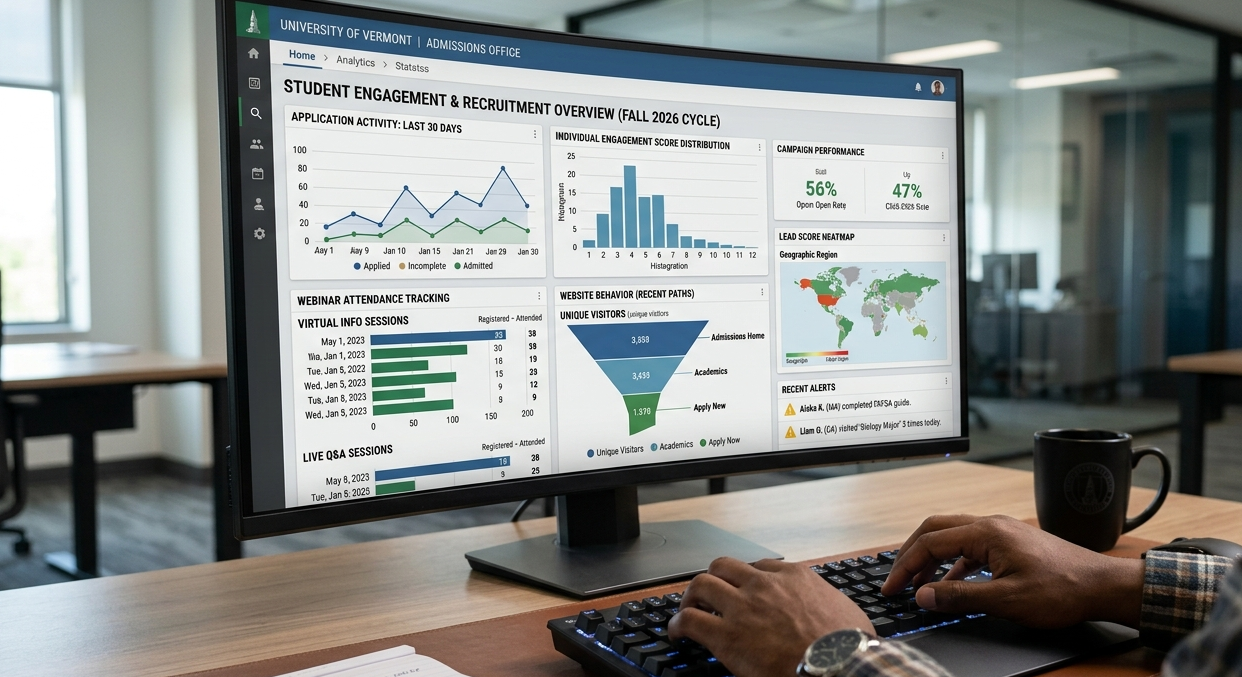
- Page visits: Not all page visits are equal. Someone reading your ‘About Us’ page is different from someone who just spent ten minutes on the program curriculum and then checked the application deadline.
- Email opens and clicks: An open is a small signal. Clicking through to a specific program page is a much stronger one. Clicking the Apply Now link is stronger still.
- Content downloads: Students downloading brochures and scholarship guides are actively researching. That’s a meaningful indicator they’re comparing options seriously.
- Webinar and event attendance: Registering for a webinar scores modestly. Actually showing up and staying for the full session scores considerably higher.
- Form activity: General inquiry = low points. Callback request = higher. Financial aid inquiry = even higher. Each form type tells you something different about where the student is in their decision.
- Application portal activity: Even if someone starts an application and abandons it halfway through, that’s a high-intent signal. That student needs an immediate, personal follow-up — not an automated email.
Intent Signals — The High-Value Ones
Some actions sit well above general engagement. These tell you the student isn’t just curious; they’re actively trying to move forward.
- Scheduling a call with a counselor or booking a campus visit
- Asking specific questions about entry requirements, credit recognition, or scholarship deadlines
- Returning to the application portal on multiple occasions without submitting
- Using a program comparison tool to stack two or three courses against each other
Weight these heavily. A student doing any of the above is telling you exactly what they need — a counselor who knows their situation and can help them across the line.
Negative Scoring — Don’t Skip This Part
This is the section most articles gloss over. It’s actually one of the most important parts of keeping your lead pipeline usable.
Without negative scoring, old leads accumulate. A student who was semi-interested 18 months ago and has done nothing since will still show up in your active pipeline with a score of 45. That’s noise, not signal.
- Unsubscribing from emails: This is explicit. They’re telling you they don’t want to hear from you. Pull significant points immediately.
- Extended inactivity: No email opens, no site visits, nothing for 60 to 90 days. Their score should decay over that window rather than staying frozen.
- Email bouncing: Bad contact details means they can’t be reached. Drop the score and flag for data cleaning.
- Explicit disinterest signals: If someone marks ‘not currently interested’ or ‘just browsing’ on any form, that should subtract meaningful points.
- Career page visits with no program interest: Often job-seekers who landed on your site by accident rather than students.
Negative scoring is what keeps your hot leads list actually hot.
A Working Scoring Model You Can Start With
The table below gives you a baseline. Treat it as a starting point — you’ll want to adjust the weights based on your own conversion data over the first couple of intake cycles.
| Student Action / Signal | Score |
| Opens a marketing email | +5 |
| Clicks a program link inside an email | +10 |
| Downloads a course brochure or guide | +15 |
| Visits the Apply Now page | +20 |
| Checks the tuition/fees page more than once | +20 |
| Submits an inquiry or callback request | +25 |
| Registers and attends a webinar or open day | +25 |
| Books and completes a campus visit | +30 |
| Begins an application but does not finish | +35 |
| Submits a full completed application | +50 |
| Uses the program comparison tool on-site | +15 |
| Asks about scholarships or financial aid | +20 |
| No email open or site visit in 60 days | -15 |
| Unsubscribes from all email marketing | -20 |
| Email address bounces back as invalid | -10 |
| Selects ‘not interested’ on any form | -25 |
With scores in hand, here’s how to segment your leads:
- 80 points and above — Hot lead. This student needs a real person calling them, ideally within a few minutes of hitting the threshold, certainly within the same business day.
- 50 to 79 — Warm lead. Good engagement but not yet urgent. Put them into a nurture sequence with event invites and personalised program content. Check back in a week or two.
- 20 to 49 — Cold lead. Still worth keeping. Monthly newsletter, occasional touchpoint, low frequency.
- Under 20 — Dormant. Either re-engage with a dedicated win-back campaign or archive after 12 months.
How Admissions Teams Actually Use Scores Day-to-Day
A number in a database means nothing without a process behind it. Here’s what it looks like when it’s working well.
Automated Routing Inside Your CRM
Tools like Slate, Salesforce Education Cloud, Element451, and HubSpot all let you set threshold-based rules. When a lead crosses 80 points, the system automatically reassigns them to an available counselor, creates a follow-up task, and logs the trigger. Nobody has to manually scan a spreadsheet at 8am to figure out who to call.
If your institution is still figuring out how to connect your CRM strategy with broader digital learning infrastructure, it’s worth reading up on e-learning consulting services — particularly useful if you’re pre-implementation and trying to figure out which platforms actually suit your enrollment workflow.
Drip Sequences for Warm Leads
Warm leads don’t need a phone call — not yet. They need relevant content that keeps your institution in their head while they’re still making up their mind. A student sitting at 60 points might get a sequence over three weeks: a faculty profile on day one, a student testimonial on day five, an open day invite on day ten.
The content changes depending on which program they’re interested in. That’s not hard to set up once your CRM is tagged properly. It just takes a bit of upfront configuration.
Smarter Counselor Assignments
Some universities route leads based on program interest plus score tier combined. A high-scoring inquiry for a specific nursing program goes straight to the nursing faculty liaison rather than the general admissions inbox. That counselor already knows the program cold and can have a genuinely useful conversation from the first call.
Re-engagement Automation
When a student’s score drops below a certain level — say, they haven’t opened anything in 45 days — the CRM can fire a re-engagement email automatically. Sometimes it’s just ‘we noticed you haven’t heard from us in a while, here’s what’s new.’ Sometimes it’s an invite to an upcoming event. Either way, it’s happening without anyone on your team having to manually identify that the lead has gone quiet.
Lead Scoring vs. Lead Qualification — They’re Not the Same Thing
Easy to confuse these, but they serve different purposes.
Lead scoring is ongoing and automated. Every action a student takes nudges the score up or down. The score is a live indicator of where they are right now, not where they were when they first submitted a form.
Lead qualification is a human judgment call. Once a lead scores high enough to reach a counselor, the counselor looks at the actual details and decides: can this student meet our entry requirements? Is their application likely to be approved? Do they need extra support with their submission?
You need both. Scoring gets the right student in front of the right person. Qualification makes sure the counselor’s time is spent on students who can actually proceed.
What Actually Works — Best Practices Worth Following
- Get your marketing team and admissions team in the same room before you build the model. They have different ideas of what a ‘good lead’ looks like, and those differences will create problems if you don’t address them upfront.
- Recalibrate after every intake cycle. Your thresholds from last year might be completely wrong this year if student inquiry behavior has shifted.
- Don’t let demographics carry too much weight. A domestic student who opened one email and never came back is not a better lead than an international student who’s visited your fees page five times.
- Build time decay into your model. A webinar attended eight months ago shouldn’t carry the same weight as one attended last week. Most CRM scoring tools support decay natively.
- Cross-reference your scoring model against actual enrolment data every six months. Look at where students who eventually enrolled were sitting in the funnel at various points. That tells you whether your thresholds are in the right place.
- Train your counselors on what the scores actually mean. A score is useless if the person receiving the lead doesn’t trust it or doesn’t understand what triggered it.
Mistakes That Come Up Repeatedly
- Weighting demographics too heavily. Geography and age tell you very little about whether someone is serious about applying.
- Skipping negative scoring completely. Pipelines without negative scoring get clogged fast. Old, cold leads stay at 40 points indefinitely and create a false picture of your funnel.
- Building the model and then never touching it again. This is probably the most common mistake. The model needs to evolve as student behaviour changes.
- No CRM integration. If counselors are manually exporting scores from a spreadsheet and then cross-referencing a contact list, the system will break down within a week. The scoring needs to live where the counselors work.
- Treating paid and organic leads identically. A student who searched specifically for your MBA program and landed on your site has different intent than someone who clicked a Facebook retargeting ad. Your model should reflect that.
Where Lead Scoring in Higher Education Is Heading
Rule-based scoring — where you manually set point values for each action — is still the foundation for most institutions. But the ceiling on that approach is fairly obvious. You’re only capturing what you thought to score for.
Predictive Scoring Using Historical Enrolment Data
A growing number of universities are feeding years of enrolment data into machine learning models to identify which combinations of signals most reliably predict that a student will complete an application. The model doesn’t need you to guess which behaviors matter most — it figures that out from the data.
The practical upside: scores become significantly more accurate over time. The model learns from every intake cycle.
Pulling Data from LMS and SIS Platforms
There’s a lot of intent data sitting in places that never make it into a traditional lead score. A student who’s been completing free preparatory modules on your platform for the past three weeks is signaling something specific and valuable. Institutions connecting their LMS and Student Information System data to their enrollment CRM are getting a much richer picture of student intent.
This kind of data-driven approach is especially relevant for career-focused programs like the Diploma of Associate Engineer, where students are often comparing multiple pathways and moving fast. Real-time scoring means you can reach them at exactly the right moment in that decision.
Real-Time Score Updates
Batch-updating scores overnight was fine a few years ago. Now, with students researching across multiple devices at odd hours, overnight batches mean you’re always working with stale data.
Modern CRM platforms can update scores in real time. If someone starts an application at 10pm on a Thursday, a flag goes up immediately. The counselor sees it first thing Friday morning rather than waiting until Monday when the next batch runs. That kind of speed matters, especially during peak enrolment windows.
Frequently Asked Questions
What exactly is lead scoring in higher education?
It’s a way of giving each prospective student a number that reflects both how well they fit your institution and how seriously they’re engaging. The score changes over time as students take actions — or go quiet. Admissions teams use it to work out who needs attention right now versus who can wait.
How do universities actually score student leads?
Most use a combination of profile data (location, prior qualifications, program interest) and behavioral data (page visits, email opens, event attendance, application activity). Each factor gets a point value. Some actions subtract points. The total score determines which bucket the student goes into and what kind of follow-up they receive.
Which factors have the biggest impact on a student’s score?
Application activity is the biggest single signal — even an incomplete application puts a student well ahead of someone who’s only ever opened an email. After that, it’s campus or virtual event attendance, financial aid inquiries, and repeated visits to high-intent pages like the fees breakdown or the application portal.
What’s predictive lead scoring and does it actually work?
Predictive scoring uses historical enrolment data to figure out which behaviors most reliably predict that a student will enroll. Rather than you guessing which actions should score 20 points versus 10, the model works it out from patterns in your own data. It does work, but it requires a decent volume of historical data to be useful — typically at least two or three full intake cycles worth.
What score should trigger an immediate counselor call?
Most institutions set the threshold somewhere between 70 and 85. There’s no universal right answer — it depends on your inquiry volume and how many counselors you have available. Start at 80, run it for one intake cycle, and see whether you’re routing too many leads for counselors to handle or too few. Adjust from there.
Does CRM integration actually make a big difference?
Yes, and it’s not really optional if you want the system to work. Without integration, someone has to manually check scores, manually identify hot leads, and manually assign them to counselors. That introduces delays and human error. CRM integration means the routing and follow-up tasks happen automatically the moment a threshold is crossed.
For a broader look at how CRM-based scoring works across different industries, the ActiveCampaign guide to lead scoring is worth a read — it covers scoring models and automation logic that translate well to higher education contexts.
If you’re specifically trying to configure scoring rules in a higher education CRM, Element451’s enrollment marketing blog has practical walkthroughs on setting up workflows for different score tiers.
Final Thoughts
Lead scoring in higher education does not need to be overly complex to deliver results. A simple model based on student behavior — like campus tour registrations, application starts, or repeated website visits -can help admissions teams identify high-intent prospects faster and prioritize follow-up more effectively.
The biggest advantage comes from timing. Students are more likely to enroll when admissions counselors reach out at the right moment, not weeks later. Start with a basic scoring system, refine it using real enrollment data over time, and focus on consistent, fast outreach rather than perfect automation from day one.