

My geometry teacher used to say circles are the most honest shape in math. Same formula, every single problem, no surprises. She was right — but that doesn’t mean working through homework 8 equations of circles answers in Unit 10 feels easy when you’re staring at a worksheet late at night trying to remember how circle equations actually work.
So let’s make it easier. Whether you’re stuck finding the center and radius, writing equations from scratch, or solving completing the square problems, this guide breaks down the most common Homework 8 circle questions step by step in a way that actually makes sense.
What Is the Equation of a Circle
The one formula you need:
(x − h)² + (y − k)² = r²
Write it on your hand if you have to. Seriously.
h = x-coordinate of the center k = y-coordinate of the center r = radius — but the formula uses r², so always square root the right side when you want the actual radius
Now the sign flip — pay attention here because this is where most people go wrong. Whatever you see inside the parentheses, the center coordinate is the opposite sign.
See (x − 3)? Center x-value is +3. See (x + 5)? Center x-value is −5.
Read that again if you need to. It trips up even students who understand everything else.
One more easy case: if the center is at (0, 0), the whole formula simplifies to x² + y² = r² because subtracting zero doesn’t do anything.
Solving Each Problem Type on Homework 8
There are really four kinds of problems on this worksheet. Learn to spot which type you’re dealing with before you start writing anything.
Reading Center and Radius Out of an Equation
Example: Find center and radius of (x − 4)² + (y + 1)² = 36
x-part says (x − 4), so h = 4. y-part says (y + 1), which is (y − (−1)), so k = −1. Right side is 36, so r = √36 = 6.
Center: (4, −1) — Radius: 6
Flip the signs. Square root the right side. Every single time, same two moves.
Building an Equation From Center and Radius
Example: Center (−2, 5), radius 7.
r² = 49. Plug straight into the formula:
(x − (−2))² + (y − 5)² = 49
Clean it up: (x + 2)² + (y − 5)² = 49
The negative center value becomes a plus sign in the equation. Students write (x − 2)² constantly when the center is negative 2. Write (x − h) first, substitute second. Let the sign handle itself.
Finding the Equation When You Have a Point Instead of Radius
They give you the center and a point on the circle. You have to figure out the radius yourself first using the distance formula.
Example: Center (3, −2), point on circle (7, 1).
r = √[(7−3)² + (1−(−2))²] r = √[4² + 3²] r = √[16 + 9] r = √25 = 5
Now write the equation: (x − 3)² + (y + 2)² = 25
Once you have the radius, it’s identical to any other problem. The distance formula is just the extra first step.
Center at the Origin
Example: Center (0, 0), radius 9.
x² + y² = 81
That’s it. No parentheses with signs. No flipping. Both coordinates are zero so they vanish.
Practice Problems With Full Working
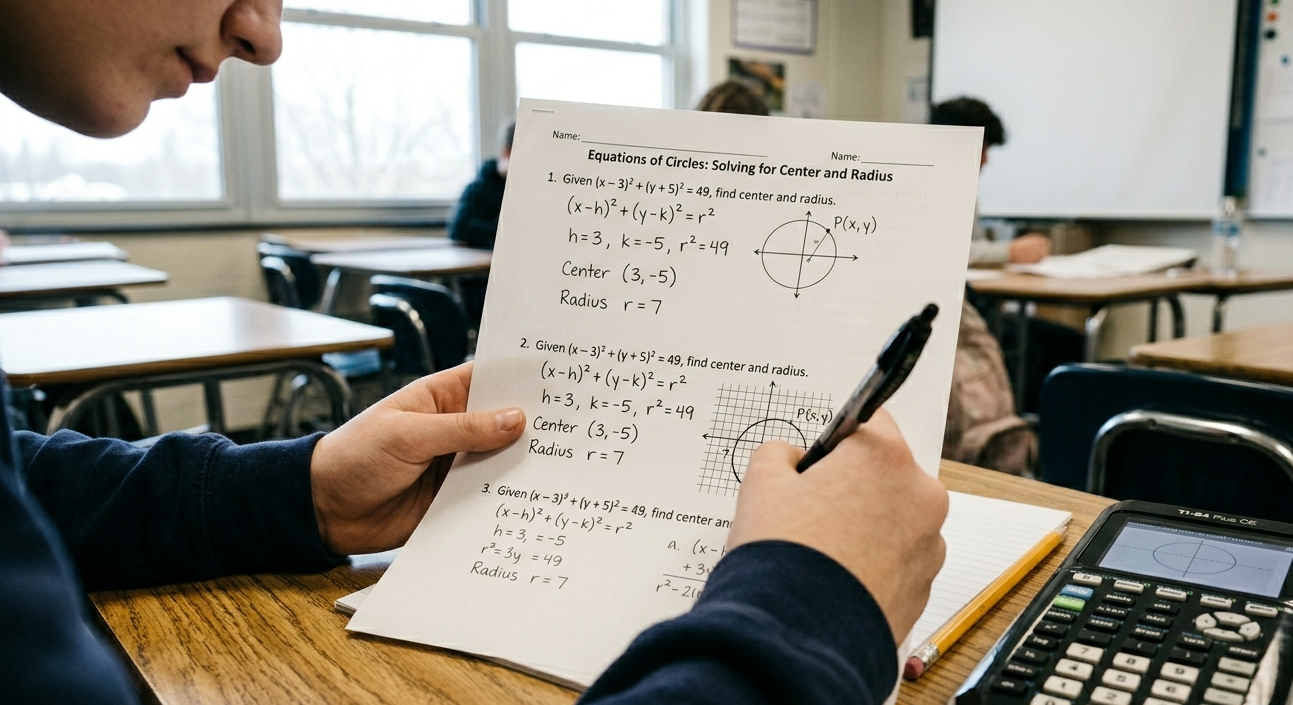
Go through these yourself before reading the answers. Check each step, not just the final number.
Problem 1 — Center (6, −3), radius 4. → (x − 6)² + (y + 3)² = 16
Problem 2 — Center and radius of (x + 7)² + (y − 2)² = 100. → Center: (−7, 2) — Radius: 10
Problem 3 — Center (0, −5), radius 3. → x² + (y + 5)² = 9
Problem 4 — Center (1, 4), passes through point (4, 8). r = √[(4−1)² + (8−4)²] = √[9+16] = √25 = 5 → (x − 1)² + (y − 4)² = 25
Problem 5 — Center and radius of x² + y² = 49. → Center: (0, 0) — Radius: 7
Problem 6 — Center (−4, −9), diameter 12. Radius = 6, r² = 36 → (x + 4)² + (y + 9)² = 36
That last problem — note the word diameter. When a problem gives you diameter, your first move is always to halve it. Students who square 12 instead of 6 get a completely wrong equation. Divide first. Then square.
Graphing Circle Equations
Honestly, graphing is the fun part of this unit. The equation literally tells you everything you need.
You get the center from (h, k). You get the radius from the right side. That’s enough.
Plot the center first — it’s your anchor point. Then move exactly r units in each of the four directions: right, left, up, down. Mark each spot. Connect them smoothly. Done.
Example: (x − 2)² + (y − 3)² = 16
Center: (2, 3). Radius: 4.
Go right 4 → (6, 3) Go left 4 → (−2, 3) Go up 4 → (2, 7) Go down 4 → (2, −1)
Your circle passes through all four of those points. If it looks lopsided when you draw it, recheck your points. A circle has the same radius in every direction — that’s literally the definition.
Completing the Square — the Hard Version
Some problems throw you a messy equation like:
x² + y² − 6x + 4y − 12 = 0
That’s called general form. You can’t read the center and radius from it directly. You have to convert it first.
Step by step:
Group x-terms together and y-terms together, move the number to the right: (x² − 6x) + (y² + 4y) = 12
Complete the square for x — half of −6 is −3, squared is 9. Add 9 to both sides: (x² − 6x + 9) + (y² + 4y) = 21
Complete the square for y — half of 4 is 2, squared is 4. Add 4 to both sides: (x² − 6x + 9) + (y² + 4y + 4) = 25
Factor both trinomials: (x − 3)² + (y + 2)² = 25
Center: (3, −2) — Radius: 5
The rule that breaks everything if you forget it: add to BOTH sides. Left side gets the number to complete the square. Right side gets that same number. Skipping this gives you a wrong answer that looks right until you check the center.
Mistakes That Show Up on Almost Every Paper
These aren’t rare edge cases. These are the errors that drop marks on probably half of all Homework 8 submissions.
Calling r² the radius. The equation shows r-squared on the right side. If it says 64, your radius is 8. Square root it.
Backwards signs on the center. (x + 4)² doesn’t mean h = 4. It means h = −4. Opposite. Every time.
Squaring the diameter. If the problem says diameter 10, your radius is 5, and r² = 25. Not 100. Halve the diameter first.
Forgetting to balance completing the square. Both sides. No exceptions.
Subtracting coordinates to find radius. When you have a center and a point, the distance formula uses both x-difference and y-difference. Ignoring the y part completely changes the radius.
Recognising your own error patterns before you submit is the most underrated skill in any subject. The same idea — spotting logical gaps in your own reasoning — is exactly what this argumentative essay guide covers for writing, and it applies just as much to math.
Why Unit 10 Spends So Long on This
Circle equations sit at the crossroads of algebra and geometry. You’re taking something visual — a round shape on a grid — and describing it with an equation. That skill of translating between visual and algebraic representations is one of the core things geometry courses are actually trying to build.
It also shows up again in trig. The unit circle, the one that underpins all of sine and cosine, runs on the same formula. Students who understand the structure now don’t have to relearn it later. That’s not something you get from memorising answers. Understanding the pattern travels forward with you. It’s the same reason strong students in any discipline — math, history, writing — build transferable reasoning skills rather than just answer banks, which is what competitions like the World Historian Student Essay Competition actually test.
FAQs
What is the standard equation of a circle?
(x − h)² + (y − k)² = r² — where (h, k) is the center and r is the radius.
How do you find the center from an equation?
Look at the values inside each set of parentheses and flip their signs. (x − 3)² + (y + 7)² gives center (3, −7).
How do you find the radius?
Take the right side of the equation — that number is r². Square root it.
What is Homework 8 equations of circles?
A Unit 10 geometry assignment where students write, identify, and graph circle equations using standard form.
How do you convert general form to standard form?
Complete the square for x and y separately — group terms, move constants to the right, add completing values to both sides, then factor.
What if the center is at the origin?
The equation becomes x² + y² = r². H and k are both zero so they disappear.
What if they give you diameter?
Divide by 2 to get radius. Then square it for the equation.
Can the radius be irrational?
Yes — something like √11 or √13 is a perfectly valid radius.
One More Thing Before You Go
This whole worksheet runs on the same formula repeated in different arrangements. Once you can spot h, k, and r² no matter how the equation is written, the problems stop being a source of panic and start being something you can move through confidently.
If anything above still doesn’t feel solid, work five more problems by hand — not to get answers but to check each individual step. That’s where the real understanding builds.
Khan Academy’s equations of circles section has free interactive practice with instant feedback.
Go slowly. Check your signs. You’ll get there.