

My cousin failed her first college essay. Not because her ideas were bad, not because they were actually pretty solid. She lost marks entirely on what her professor called “convention errors.” Capitalization missing in random places, sentences bleeding into each other, verb tenses switching halfway through paragraphs without warning.
She called me frustrated, asking what even is a writing convention and why does it matter so much.
Honestly, fair question. Most schools teach these rules without ever explaining the logic behind them. So let me actually break it down, what writing conventions are, how they’re grouped, where people go wrong, and why fixing them makes a bigger difference than most writers expect.
What is a Writing Convention?
Writing conventions are the agreed upon patterns that make written language readable. Not laws. Not grammar jail. Just shared habits that developed because they helped readers understand writers without extra effort.
Every language has them. English has spelling standards, capitalization rules, punctuation systems, sentence structure expectations, all of it built up over centuries because communication works better when both sides follow the same code.
Here’s the practical version, when you write “the dog barked loudly” instead of “teh dog barked loudley,” you’re following spelling conventions. When you start that sentence with a capital T, you’re following capitalization conventions. When you put a period at the end, punctuation conventions. Do all three consistently and your reader never has to stop and decode, they just read.
Drop them and suddenly reading takes work. Most people won’t bother doing that extra work.
Main Types of Writing Conventions
Language teachers, writing coaches, and academic rubrics all organize writing conventions the same basic way, three categories, each covering a different layer of the written language system.
Mechanics: The Visual Layer of Writing
Mechanics are what you see on the page. If you read a piece of writing out loud, you don’t say the mechanics, you don’t announce “capital letter” or “comma,” but your eyes need them there to make sense of the text.
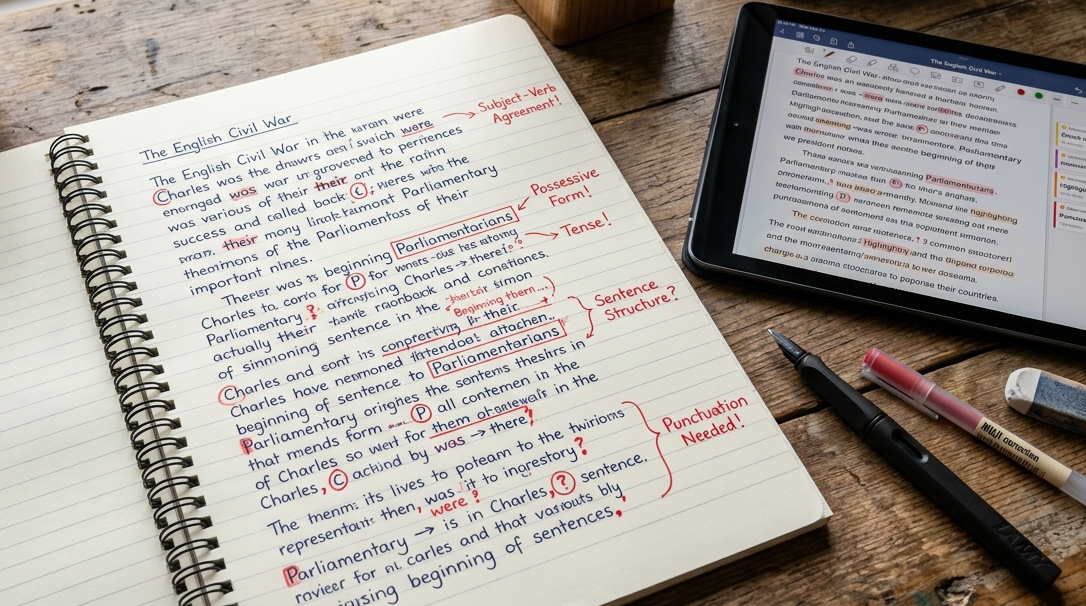
Spelling sits here. Standard English spelling exists because readers have trained their brains to recognize specific letter patterns. “Necessary” lands instantly. “Neccessary” forces a pause. That half second pause happens thousands of times across a long document and it wears the reader down.
Capitalization follows consistent, learnable patterns. New sentence, capital letter. Someone’s actual name, capital letter. A specific country, city, month, day, capital letter. These aren’t random. They signal importance and new starts. Miss them repeatedly and the writing looks unfinished.
Punctuation is probably the most powerful mechanical tool a writer has. A period ends a thought completely. A comma creates a brief pause inside a thought. A question mark changes the entire emotional tone of a sentence. An apostrophe shows ownership or contraction. Each mark gives the reader a precise instruction. Pull them out and everything becomes one long blur.
Grammar and Usage: How Words Work Together
If mechanics are the visual surface of writing, grammar and usage are the internal logic underneath. This is about whether your words actually cooperate with each other to build clear meaning.
Subject verb agreement is where a lot of writers slip. Singular subjects need singular verbs, plural subjects need plural verbs, simple in theory, trickier in long sentences where the subject and verb end up far apart. “The list of requirements is ready” not “the list of requirements are ready.” The subject is “list,” not “requirements.” Getting these right consistently signals genuine language command.
Verb tense consistency matters most in longer pieces. Academic writing, blog articles, short stories, anything over a few paragraphs. Pick your tense and stay in it. Past tense for something that already happened, present tense for something ongoing. Randomly hopping between them mid paragraph scrambles the reader’s timeline and makes the whole thing harder to follow than it needs to be.
Sentence Structure: Complete, Independent Thoughts
Every sentence should stand on its own. That’s the basic requirement. Two structural problems wreck this constantly.
Run on sentences happen when two or three separate complete thoughts get pushed together without proper separation. The reader chases the meaning across the sentence, loses track somewhere in the middle, and has to start over. Writing convention errors like this are especially common in first drafts when the writer is just trying to get ideas out fast.
Fragments are the opposite issue. Half a thought, presented as a full sentence. “Because the deadline passed.” Okay, what happened because the deadline passed? The thought never finishes. By itself it just hangs there and the reader waits for a resolution that doesn’t come.
Both problems are fixable once you train yourself to spot them. Reading your work out loud helps enormously, your voice naturally pauses at complete thoughts, and you’ll hear when a sentence keeps going too long or stops too early.
What is a Convention in Writing for Grammar?
People mix up “grammar” and “writing conventions” constantly, and it makes sense, they genuinely overlap. But they’re not quite the same thing.
Grammar is the larger system. The underlying architecture of how English works. A convention in writing for grammar is more specific, it’s the standardized application of that system in actual writing situations. The practical choices that formal written English expects you to make.
Knowing when “who” is correct versus “whom,” that’s a grammatical convention. Avoiding double negatives like “I didn’t see nothing,” grammatical convention. Choosing “fewer” for countable things and “less” for uncountable ones, same category. Using consistent parallel structure in a list so everything matches grammatically, also a grammatical convention.
None of these are about sounding fancy. They’re about precision. When you get them right, your reader follows your meaning cleanly. When you miss them across a whole piece, even a sympathetic reader starts to hesitate and second guess.
What is a Genre Convention in Writing?
Here’s the part that genuinely surprises a lot of students, the rules shift depending on what type of writing you’re doing.
A genre convention in writing is the set of style, tone, format, and structural expectations that belongs specifically to one category of writing. Academic writing, fiction, journalism, business writing, each has its own distinct convention system, and writing that works perfectly in one genre can completely fail in another.
Take academic writing versus casual blogging. If you’re working through TOK Essay Topics for an IB assignment, the genre conventions are strict, formal tone, third person or carefully hedged first person, cited sources, no contractions, no slang, organized arguments with clear transitions. The reader, your teacher or examiner, expects that specific format. Deviate from it and the content gets penalized regardless of how good the actual thinking is.
Now flip to a casual platform. If you want to Write an Essay Tumblr Style for a personal blog or creative outlet, those same formal rules would feel completely wrong. Lowercase letters, conversational tangents, sentence fragments used deliberately for rhythm, these are actual genre conventions on that platform. The audience expects casual, personal, and immediate.
Same English language. Completely different convention sets. Context determines the rules.
Fiction writing has its own layer again. Spoken dialogue goes inside quotation marks. Scene setting descriptions need enough sensory detail for the reader to picture the space. Plot structure, even experimental, non linear plot structure, still needs an internal logic the reader can follow.
Business writing strips everything back to function. Short paragraphs. Direct headings. No unnecessary preamble. Someone reading a work email on their phone during a meeting isn’t looking for narrative, they want the core information in the first three lines.
Understanding which genre you’re working in, and applying the right conventions for that genre, is a genuine writing skill. It’s what separates writers who can adapt from writers who have exactly one mode.
What is a Convention Error in Writing?
A convention error in writing is simply a place where one of these established rules gets broken, whether the writer knew it or not.
Minor errors are normal. A misplaced comma, a homophone swap, one sentence that runs a bit long, none of these end careers. But errors compound. Three or four scattered through a paragraph shift the reader’s experience from smooth to effortful. A full page of them signals either serious rushing or a genuine gap in language knowledge. Neither creates a good impression.
The most common ones, confusing there, their, and they’re. Mixing up its and it’s. Dropping apostrophes from contractions. Capitalizing random mid sentence words. Starting multiple consecutive sentences with the same word. Shifting from past to present tense without reason.
One reason convention errors are so hard to self catch, your brain reads what you meant to write, not what’s actually on the page. You’ve got context and intent in your head that the reader doesn’t have. Reading slowly, sentence by sentence, or reading out loud forces your brain to process the actual text rather than the intended text. This catches significantly more errors than a normal proofread.
Why Writing Conventions Actually Matter
The real reason conventions matter isn’t academic compliance or impressing a teacher. It’s friction.
Clean conventions create frictionless reading. The reader moves through the content, the ideas land, the meaning transfers, and none of it required conscious effort. Bad conventions create friction at every stumbling block. The reader has to stop, decode, re read, and figure out what you actually meant. Each interruption chips away at trust and patience.
For students, this hits assessment scores directly. Marking rubrics at secondary and university level allocate significant weight to mechanics, language usage, and sentence structure. A strong argument poorly expressed loses marks that a weaker argument expressed cleanly might hold.
For working professionals, writing quality affects professional perception. Sloppy emails and reports suggest sloppy thinking, even when the underlying ideas are solid. Clients, managers, and colleagues form opinions based on the surface quality of written communication whether they consciously intend to or not.
For content creators, bloggers, and anyone building authority online, convention quality affects trust. Readers are measurably less likely to act on information from a source that looks unpolished. SEO aside, convention quality affects how long visitors stay and whether they share or return.
The Ultimate Writing Conventions Checklist
Before publishing anything or handing in any written work, run through this list:
[ ] Every sentence opens with a capital letter
[ ] All proper nouns, names, specific places, titles, dates, are capitalized
[ ] Spelling has been checked manually, not just through autocorrect
[ ] Every sentence closes with appropriate punctuation
[ ] Verb tense stays consistent throughout the entire piece
[ ] Subject verb agreement holds in every sentence
[ ] Sentence structure is complete, no unfinished fragments, no unterminated run ons
[ ] Format and style match the specific genre being written in
Frequently Asked Questions
What is a writing convention in simple words?
A writing convention is a shared rule that writers follow so readers can understand their work without extra effort. Spelling words correctly, capitalizing where expected, using punctuation properly, these are all writing conventions.
What are examples of writing conventions?
Capital letters at sentence starts. Periods ending statements. Commas between list items. Apostrophes in contractions. Quotation marks around spoken dialogue. Subject verb agreement within sentences.
Why are writing conventions important?
They reduce reading friction. When conventions are consistent, readers absorb ideas cleanly. When conventions break down repeatedly, readers spend mental energy decoding rather than understanding.
What is a grammar convention?
A specific rule about how words work together in standard written English, subject verb agreement, consistent verb tenses, parallel structure in lists, correct pronoun usage. These rules keep sentences logical and meaning precise.
What is the difference between mechanics and conventions?
Conventions is the broader category, it covers grammar, sentence structure, style, and formatting. Mechanics is one subset within conventions, referring specifically to the visual elements, spelling, punctuation, and capitalization.
Summary: What Good Conventions Actually Do For Your Writing
Getting writing conventions right does one thing more than anything else, it gets out of the reader’s way. When the mechanics are clean, the grammar holds, and the format fits the genre, your actual ideas get the full attention they deserve. Nothing is distracting the reader from what you’re trying to say.
It doesn’t require a massive vocabulary or complex sentence constructions. It just requires consistency and attention, to spelling, punctuation, agreement, tense, and format.
For thorough guidance on grammar rules, citation standards, and academic writing conventions, the Purdue Online Writing Lab is one of the most reliable free resources available. For international English communication standards and usage guidelines, the British Council Learning English platform covers everything from basic mechanics to advanced style questions. Use both, proofread carefully, and your writing will hold up in any context.