Some students read the same page three times and still remember nothing. Then someone hands them a block, a tray of sand, or a lump of clay — and suddenly the concept clicks in under five minutes.
That gap isn’t about intelligence. It’s about learning style.
Tactile learners make up a big portion of students in every classroom, but they’re often the ones quietly falling behind while lessons move on without them. They don’t need simpler content. They need a different way in. This article breaks down real examples of tactile learning — what they look like in everyday life, in classrooms, and across different subjects — so teachers and parents can actually do something with the information.
What Is Tactile Learning, Really?
Tactile learning is a style where understanding comes through physical touch and interaction. Not watching someone else do it. Not reading a description of it. Actually doing it — with the hands involved.
You’ll hear it called the tactile-kinesthetic learning style too, because touch and movement tend to show up together. The most obvious real-world version of this? Learning to ride a bike. Nobody learns that from a book. You get on, you wobble, you fall, you try again — and somewhere in that physical process, your body figures it out in a way your brain never could from just reading instructions.
In the VARK learning model, tactile learning sits alongside visual and auditory as one of the three main ways people absorb information. Most people use a mix of all three. But for tactile learners, the physical experience isn’t optional — it’s the whole thing.
Examples of Tactile Learning in Everyday Life
Before diving into classroom strategies, it’s worth recognizing how much tactile learning already happens outside of school. Most people just don’t label it.
Cooking is probably the most common example of tactile learning in real life. You can read a recipe perfectly and still produce something wrong. It takes actual practice — measuring by feel, learning what properly kneaded dough feels like, adjusting heat when something starts to smell off — to truly understand cooking. The hands are doing the teaching.
Tying shoelaces is another one every parent knows. You can demonstrate it twenty times. You can explain the bunny ears method in three different ways. The child still won’t get it until they physically take the laces in their own hands and fumble through it themselves. That’s tactile learning at its most straightforward.
Beyond those, think about learning to play guitar, assembling flat-pack furniture, fixing a leaky tap, or learning to drive. All of these rely heavily on hands-on experience. Reading helps a little. Watching helps more. But doing it yourself is where the real learning happens.
Examples of Tactile Learning in the Classroom
This is where things get more structured. Tactile learning in schools doesn’t require a complete overhaul — sometimes small additions make the biggest difference.
Math: Moving Objects Instead of Just Staring at Numbers
Abstract numbers on a page are genuinely difficult for tactile learners. The concept of “five minus three” makes much more sense when a child physically moves three beads away from a group of five and sees two remaining.
Common tactile math tools include:
- Counting blocks and beads for basic addition and subtraction
- Fraction tiles that let students feel the physical size difference between 1/2 and 1/4
- Abacuses, where moving beads creates a sensory memory tied to number concepts
- Foam or wooden number tiles that children can pick up, sequence, and rearrange
The key difference here is that students aren’t copying numbers — they’re physically manipulating them. That physical action creates a memory that a written exercise often doesn’t.
Reading and Writing: Touch Before the Pencil
Letter formation is a surprisingly difficult concept for many young children to grasp from visual instruction alone. When you add touch to the process, retention improves noticeably.
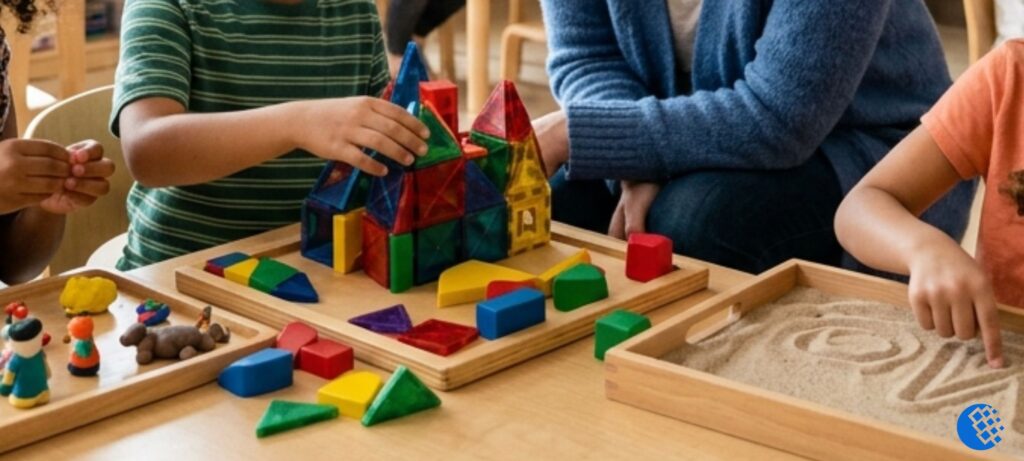
Sand tray writing is a simple but effective example of tactile learning in literacy. Students use a finger to trace letter shapes through a thin layer of sand in a tray. The texture provides sensory feedback that reinforces the visual memory of the shape. You can make one at home with a baking tray and a handful of sand or salt.
Sandpaper letters, used widely in Montessori classrooms, work on the same idea. Children run their fingers over raised, textured letter shapes — building the muscle memory of each letter before they ever pick up a pencil. The Montessori approach uses these almost universally in early literacy for exactly this reason.
Clay or playdough letters are useful for younger children. Shaping a letter with their hands gives the brain a three-dimensional reference point that flat writing on paper doesn’t provide.
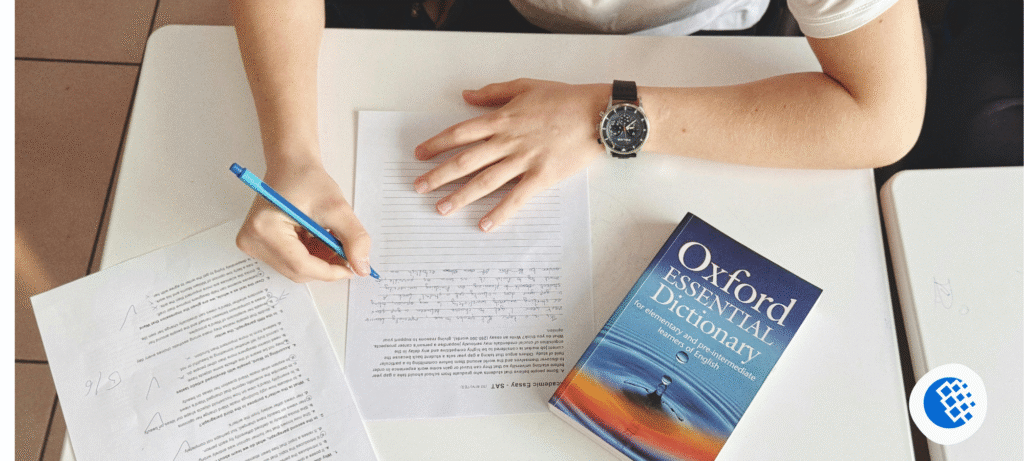
For older students, handwriting rather than typing is itself a form of tactile reinforcement. The physical act of writing a word by hand engages memory in a different way than staring at a screen.
Science: Doing the Experiment, Not Just Watching It
Science is the subject that probably has the most natural overlap with tactile learning — and yet a lot of science instruction still happens passively, through videos and textbook diagrams rather than actual hands-on work.
The baking soda and vinegar volcano is a classroom classic because it works. Students mix the substances themselves, watch the reaction they caused, and connect the chemistry to something they physically made happen. That’s very different from watching a YouTube video of the same experiment.
Other strong tactile science examples:
- Examining real rocks, leaves, and soil samples by touch rather than just looking at photographs
- Growing plants from seed and tracking growth through physical measurement
- Building simple circuits with actual wires and components — not simulations
- Dissection activities at secondary level, which engage multiple senses simultaneously
The physical interaction is what creates lasting memory. A student who has held a pumice stone understands its texture and structure in a way that reading “porous volcanic rock” simply doesn’t produce.
History and Social Studies: Building the Past
History is one of the harder subjects to make tangible — it’s all events that happened somewhere else, to people who are long gone. Tactile learning methods pull it closer.
Dioramas — miniature scenes representing historical moments — require students to make decisions about what the scene looked like, what materials to use, how to position elements. That process of building forces them to think about the content in detail that just reading about it doesn’t demand.
Scale models of historical buildings or monuments work similarly. Building a rough model of the Colosseum with cardboard and clay requires understanding its structure. Textured maps, where different terrain types are represented by different materials, give students a physical relationship with geography.
These activities take longer, and some teachers resist them for that reason. But for tactile learners, the time investment usually shows up in retention and understanding.
Art: Creating to Understand
Art class is tactile by default — but the principles transfer to other subjects.
Using clay to model a cell structure or heart anatomy is a strong cross-subject example. Students can’t just memorize the parts — they have to physically build them, which forces a different kind of understanding. Where does the nucleus sit? What size is the mitochondria relative to the cell wall? The hands figure that out in ways the eyes often don’t.
Sensory Play: Tactile Learning for Young Children
For children under six or seven, sensory play activities are among the most effective examples of tactile learning, even when they don’t look anything like formal education from the outside.
Mystery texture bags — where children reach in and try to identify objects using touch alone — build sensory discrimination and vocabulary at the same time. Rice bins and water tables engage fine motor development and early scientific thinking. Sorting activities with objects of different weights, sizes, and textures develop the foundations of classification and reasoning.
These activities look like play. They are play. And they’re also some of the most developmentally valuable examples of tactile-kinesthetic learning available for young children.
Tactile Learning Styles: Not All the Same
It’s worth noting that tactile-kinesthetic learning style examples don’t look identical in every person.
Some tactile learners need to physically hold and handle materials to understand them. Others learn through building — putting pieces together step by step. Some retain information significantly better when they write it down by hand rather than type it. Others need role-play or simulation — physically acting something out — to make it stick.
Lumping all of these together as “just be hands-on” misses the specificity. A student who learns best by writing things repeatedly by hand needs something different from a student who needs to build a model. Understanding the particular kind of tactile engagement that works for a specific learner matters more than a broad label.
Auditory, Visual, and Tactile Learning: How They Compare
For context, it helps to see the three main learning styles side by side.
Auditory learners absorb information most effectively through listening — lectures, discussions, spoken explanations. They often remember things they’ve heard better than things they’ve read, and they tend to talk through problems.
Visual learners process information best through images, diagrams, charts, and spatial organization. They think in pictures and benefit from seeing information laid out clearly.
Tactile learners retain information most effectively when they physically interact with it. Reading and listening are less sticky for them. The hands-on experience is what makes concepts real.
Most people have a dominant style but use all three. Good teaching naturally incorporates all three rather than defaulting to one mode. Understanding how learning styles connect to output — like writing — can also help. If you’re exploring how different learning approaches affect academic work, checking out resources on different essay writing styles gives useful perspective on matching your learning style to your output style.
Tactile Learning in Montessori and Special Education
Montessori education is essentially built around tactile learning principles. The entire classroom material set is designed to give children physical, sensory access to abstract ideas. Children understand number quantity by physically holding and stacking golden bead materials long before they work with written numerals. The sandpaper letters, the pink tower, the fraction circles — all of it is about making the abstract concrete through touch.
In special education settings, tactile methods are frequently used as an accommodation for students with dyslexia, ADHD, and various processing differences. Multi-sensory reading programs like Orton-Gillingham are built specifically on the principle that combining touch with vision and hearing creates stronger memory pathways for students who struggle with standard reading instruction.
For a broader grounding in the research behind tactile and hands-on learning, Understood.org provides well-sourced practical guidance for both parents and educators navigating different learning styles.
Why Tactile Learning Works
The basic reason tactile learning is effective isn’t complicated. When you physically interact with something, your brain stores the experience across multiple memory systems at once — motor memory and semantic memory both get engaged. That creates two retrieval pathways instead of one, which makes the information more accessible later.
Physical interaction also increases attention. Students who are actively building something stay focused in a way that passive reading doesn’t require — partly because it’s more engaging, and partly because the task itself demands present attention.
Research in educational psychology has consistently supported multi-sensory approaches over single-channel delivery. It’s one of the reasons hands-on learning in early childhood has been gaining ground in curriculum frameworks internationally over the past two decades.
Frequently Asked Questions
What is an example of tactile learning?
Writing letters in a sand tray, building a model volcano, or using counting blocks for math — these are all clear examples where the learning happens through physical touch and hands-on action rather than reading or listening.
What are examples of tactile learning styles?
Tactile learning styles show up as a preference for hands-on experiments, building and constructing things, writing by hand rather than typing, and physically acting out concepts rather than just reading about them.
How do tactile learners learn best?
They retain information most effectively when they can physically interact with it — handling materials, building things, writing by hand, or working through a process step by step with their hands involved.
What are good tactile learning activities for classrooms?
Sand tray writing, math manipulatives, clay modeling, science experiments, diorama building, sensory sorting games, and hands-on art projects are all effective options.
What is the difference between tactile and kinesthetic learning? Tactile learning specifically involves touch and physical handling of objects. Kinesthetic learning is broader and includes whole-body movement and physical activity. The two overlap significantly, which is why they’re often grouped as the tactile-kinesthetic learning style.
What are examples of tactile learning in real life?
Cooking, tying shoelaces, learning to drive, playing an instrument, gardening, and assembling furniture are all everyday examples where learning happens through physical doing rather than reading or watching.
Final Thoughts
The examples of tactile learning that work best all share one thing: the hands are doing something that matters, not just going through motions for the sake of it.
Whether it’s a six-year-old tracing letters in sand, a secondary student building a historical diorama, or an adult learning to cook by actually making the dish — the physical engagement is what creates the memory. That’s not a philosophy. It’s just how tactile learners process the world.
For teachers and parents, the shift doesn’t have to be dramatic. A set of counting tiles, a sand tray, a model-building component added to a unit — small additions like these can make a genuine difference for students who’ve been struggling through lessons designed for how other people learn.