
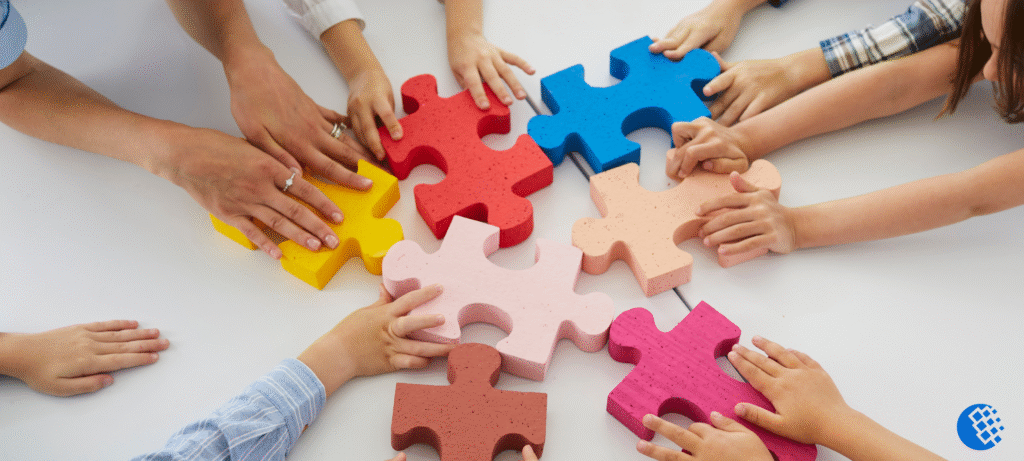
I learned something interesting during a summer camp a few years ago. We gave a group of children a simple challenge: build the tallest tower they could using paper cups.
Nobody cared about the cups at first. They were goofing off, knocking things over, and competing for attention. Within five minutes, though, the room had completely changed. One girl started sketching layout ideas on a scrap piece of paper. Another was testing how many cups a base could hold before it buckled. A quieter boy who rarely spoke started pointing out why every design kept falling over. Before long, the entire group was working together.
That’s what makes children’s team building games so powerful.
They look like simple activities on the surface, but underneath, kids are learning how to communicate, solve problems, share ideas, handle frustration, and trust one another. Those are skills they’ll use long after the game ends. Whether you’re a teacher, parent, camp counselor, coach, or church leader, the right team-building activity can turn a group of individuals into a genuine team.
Quick Answer: What are the best children’s team building games?
The most effective children’s team building games focus on low-prep, cooperative play over individual elimination. Popular options include The Human Knot, The Marshmallow Challenge, Blindfolded Obstacle Course, and Hula-Hoop Pass. These activities require children to slow down, listen to alternative perspectives, and establish collective strategies to achieve a shared objective.
Why Team Building Games Matter (The Child Development Angle)
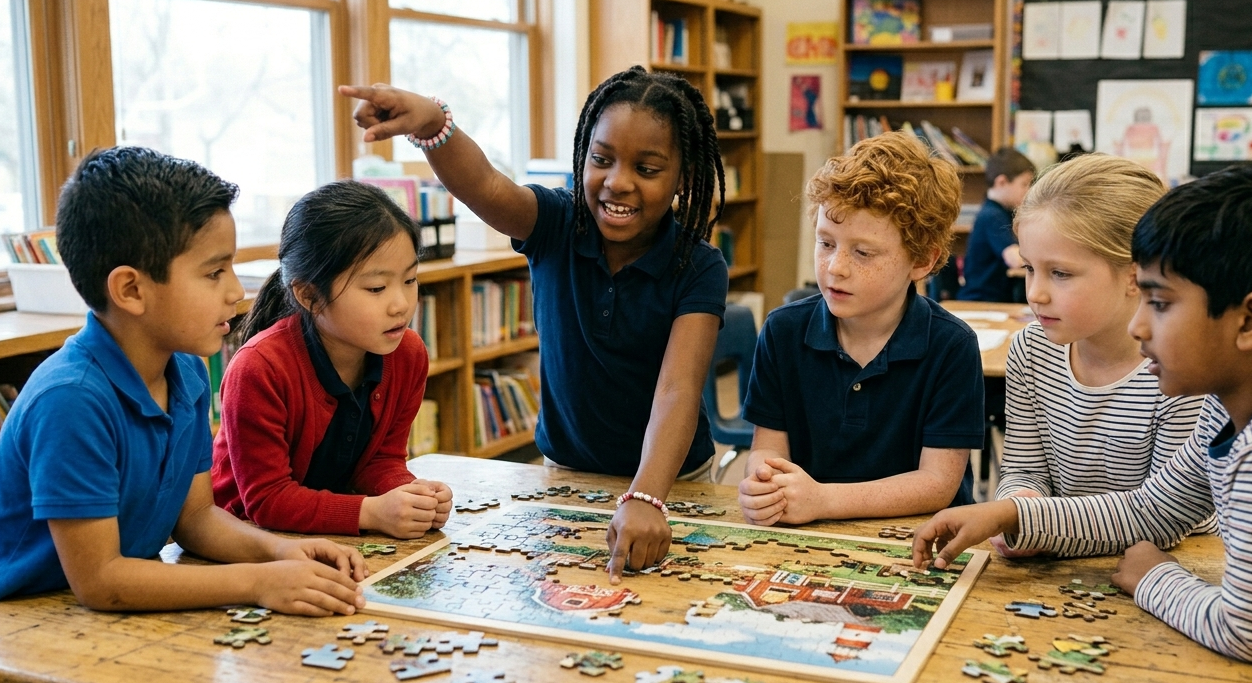
If you read typical lesson plan guides, they frame team building as a magical, instant fix for behavioral issues. In reality, putting kids into cooperative games for kids creates immediate, messy friction.
According to Swiss psychologist Jean Piaget’s stages of development, younger children naturally view situations from an egocentric perspective. Moving from “me” to “we” is a monumental cognitive shift. When kids take part in team building children’s games, they are forced into what Lev Vygotsky called the Zone of Proximal Development—learning social skills dynamically through peer interaction.
This hands-on, collaborative problem-solving is foundational to modern pedagogy. As noted in our comprehensive framework on the Best Modern Teaching Methods in 2026, shifting the classroom from passive listening to active, team-based exploration drastically improves retention and social-emotional growth.
Core Benefits for Children
- Decentralized Communication: Instead of waiting for an adult to call on them, children must learn to negotiate with their peers directly.
- Resilience Through Failure: When a structure collapses, kids learn to process collective frustration without immediately assigning blame to a specific teammate.
- Adaptive Leadership: These exercises give reserved children a low-stakes environment to offer niche ideas that might otherwise get drowned out in a standard academic setting.
10 Best Indoor Team Building Games
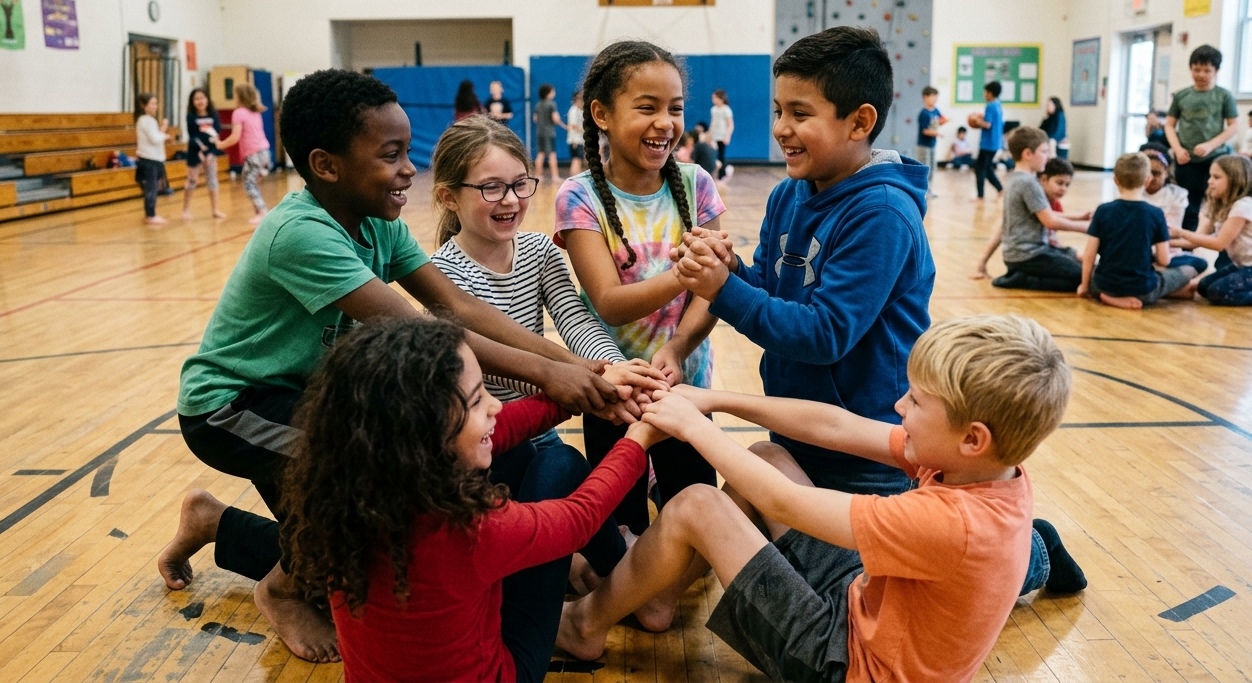
Indoor games require clear, physical boundaries to manage energy levels, but they offer the best environment for focused communication activities for children.
1. The Human Knot
I still use this activity at the start of almost every camp session because it reveals group dynamics in under five minutes. Have 6 to 10 children stand in a tight circle, reach across, and grab the hands of two different people (excluding the kids directly next to them). They must untangle themselves into a clean loop without breaking their grip.
The first few minutes are always chaotic. Kids pull in opposite directions, laugh, complain, and usually make the knot twice as tight. Eventually, the physical discomfort forces them to pause. Someone will say, “Wait, nobody move for a second.” That’s the exact moment teamwork begins. One voice takes the lead, and the others learn to follow specific, sequential movements.
- Ages: 7–14
- Gear: None
- Key Focus: Patience and listening under physical pressure.
2. The Marshmallow Challenge
This is a standard engineering drill that frequently stumps adults because people tend to plan too much and test too little. Give your teams of four twenty sticks of dry spaghetti, one yard of tape, one yard of string, and a single marshmallow. They have 18 minutes to construct the tallest freestanding structure that can support the marshmallow on top.
Most kids spend 17 minutes building a massive, flimsy tower out of spaghetti. At the last second, they place the marshmallow on the peak, and the structural load immediately snaps the thin sticks. The winning teams are consistently those who put the marshmallow on early and continuously reinforce their base as they build upward.
- Ages: 8–14
- Gear: Spaghetti, tape, string, marshmallows
- Key Focus: Rapid prototyping and handling unexpected structural failure.
3. Sneak a Peek
Build a small, asymmetrical hidden structure out of LEGO blocks behind a cardboard divider before the session begins. Give each team an identical set of loose blocks. One “scout” from each team gets 10 seconds to stare at your model before running back to their table to explain how to replicate it. They are not allowed to touch the blocks themselves; they can only give verbal directions.
The real joy of this game is watching kids discover that what makes perfect sense in their own mind doesn’t translate instantly to someone else. A scout will scream, “Put the blue brick on the side!” and get completely bewildered when their teammate snaps it onto the wrong side. It forces them to adopt highly precise language.
- Ages: 6–12
- Gear: Two matching sets of building blocks
- Key Focus: Structural translation and descriptive precision.
4. Balloon Keep-Up
Perfect for younger groups where attention spans are short and motor skills are still developing. The group must keep a single inflated balloon aloft without letting it touch the carpet. The main restriction: the same child cannot touch the balloon twice in a row.
With early elementary kids, the entire group will blindly chase the balloon in a chaotic pack, leading to head bumps and collisions. After a quick reset, ask them how they can protect their designated zones. They quickly learn to spread out, hold their positions, and call out names to delegate responsibility. For older groups, inject a second or third balloon to test their peripheral awareness.
- Ages: 4–9
- Gear: Inflated balloons
- Key Focus: Spatial awareness and proactive vocal tracking.
5. Back-to-Back Drawing

Pair your students up and sit them on the floor back-to-back. Give Partner A a simple geometric line drawing (e.g., a square inside a triangle with a circle on top). Give Partner B a blank sheet of paper and a marker. Partner A must instruct Partner B how to draw the image perfectly without naming the shapes directly.
When they turn around to compare the original with the interpretation, the results are usually hilarious. It’s a brilliant way to visually demonstrate how easily information gets distorted when assumptions take the place of clear instructions.
- Ages: 8–14
- Gear: Paper, clip-art cards, markers
- Key Focus: Eliminating conversational assumptions.
6. Cup Stack Relay
Tie four or five long strings to a single central rubber band. Each team member takes hold of the end of one string. By pulling in unison, they can stretch the rubber band wide enough to fit over a plastic solo cup; by easing off, the rubber band grips the plastic. The goal is to stack six cups into a pyramid without touching the cups with their hands.
- Ages: 6–12
- Gear: Solo cups, rubber bands, string
- Quick Tip: If one person moves too aggressively or pulls too hard, the entire apparatus tilts. It demands mechanical synchronization.
7. Group Story Building
Sit the children in a circle and introduce a simple opening line: “The school bus turned down the wrong street and drove straight into a hidden cave.” Moving clockwise, each child must add exactly three words to the narrative. This exercise completely eliminates the “dominant planner” trait; kids cannot script their answer ahead of time because the story shifts constantly based on the inputs immediately preceding theirs.
- Ages: 6–14
- Gear: None
- Key Focus: Improvisation and intensive active listening.
8. The Memory Relay
Place 15 miscellaneous items on a central tray covered by a towel. Teams wait across the room. One runner at a time sprints up, lifts the towel for 15 seconds to study the contents, covers it back up, and runs back to contribute to a master list. Smart groups quickly figure out how to divide the mental labor (“You look for toys, I’ll memorize colors, you look for metal objects”).
- Ages: 7–12
- Gear: 15 random objects, a towel, paper
- Key Focus: Tactical division of labor.
9. Blind Formations
Blindfold a group of 8 to 10 players and place a closed loop of rope in their hands. Instruct them to work together to lay the rope out on the ground in the shape of a perfect geometric figure, like an equilateral triangle or a square, without removing their blindfolds. Without visual reference points, leadership must become orderly, sequential, and entirely vocal.
- Ages: 9–14
- Gear: Blindfolds, rope
- Key Focus: Navigating ambiguity through verbal systems.
10. Paper Tower Challenge
Give a small group 20 sheets of standard printer paper and one roll of masking tape. They have 10 minutes to build the tallest freestanding tower possible. They cannot tape the structure to the floor or the table surface. This challenge rewards spatial intuition and helps kids see that fragile individual components can gain immense strength when folded into stable shapes like cylinders or triangles.
- Ages: 8–14
- Gear: Printer paper, masking tape
- Key Focus: Creative engineering and structural resource limits.
10 Best Outdoor Team Building Games
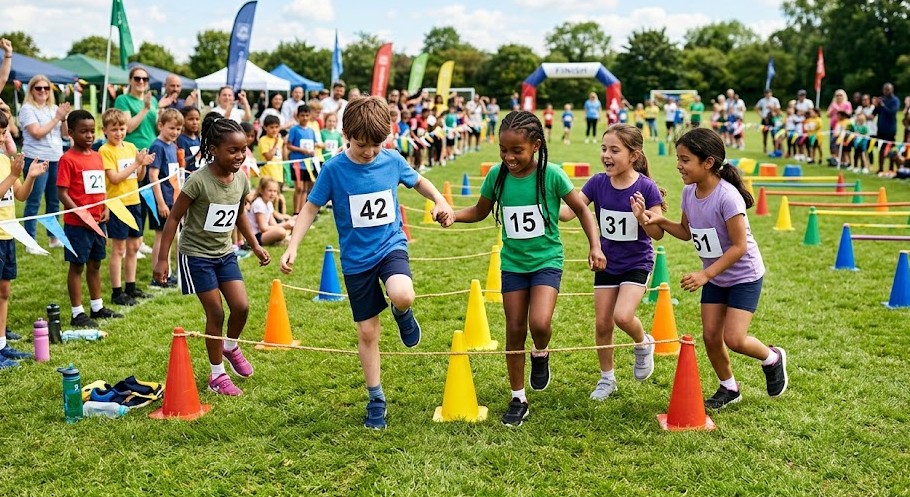
Outdoor settings provide the physical space needed for high-energy, large-scale outdoor teamwork challenges that get kids moving.
11. Blindfolded Obstacle Course
Set up a simple course using cones, hula hoops, and plastic chairs across a lawn. In pairs, one child is blindfolded while their partner stands at the boundary line, calling out specific directional commands to steer them safely to the exit.
- The Reality: If you let every pair run simultaneously, the cross-talk is deafening and the blindfolded kids panic. Space out the starts. The guides must use concrete measurements (“Take three baby steps straight forward, freeze, then turn your body toward my voice”). It builds profound peer reliance.
- Ages: 8–14
- Gear: Cones, chairs, blindfolds
12. Hula-Hoop Pass
Have your entire group form a large circle and hold hands firmly. Break the link between two players just long enough to drop a hula hoop onto one child’s arm, then re-lock hands. The team must maneuver the hoop completely around the circle without breaking the hand-holding chain.
- Why it works: This game is beautifully inclusive. If a child lacks flexibility or struggles with coordination, the peers on either side cannot leave them behind—they must physically bend down, lower their arms, and coordinate their movements to slide the hoop over their teammate’s feet.
- Ages: 6–12
- Gear: 1 Hula-hoop
13. Team Scavenger Hunt
Give groups a list of environmental riddles to solve or specific items to collect (“Find a leaf with jagged edges,” “Find a rock smoother than a coin”). Add one strict constraint to enforce teamwork: the entire group must hold onto a single length of rope or stay within arm’s reach at all times. If anyone separates, the team must freeze for 30 seconds.
- Ages: 7–14 | Gear: Prepared list, collection bags | Focus: Collective pace and compromise.
14. The Lava Crossing
Tell the kids the field has turned into molten lava. Give a team of six players four small carpet squares or foam mats. They must transport their entire group across the zone using only those mats as safe islands. If a mat is left unattended on the floor without a foot or hand touching it, the leader removes it.
- Ages: 6–12 | Gear: Foam mats or carpet remnants | Focus: Balance and physical resource sharing.
15. Blindfolded Tug-of-War
A standard pull is just a raw test of muscle. To completely reset the metric, blindfold both teams and forbid them from speaking during the pull. Designate one sighted captain for each team who stands safely to the side and directs their line using pre-arranged signals or specific vocal rhythms.
- Ages: 9–14 | Gear: Heavy rope, blindfolds | Focus: Synchronization over raw strength.
16. Water Delivery Relay
Line your teams up in straight rows. The child at the front fills a plastic cup with water from a bucket and must pass it backward over their head, blind, to pour it into the cup of the teammate behind them. The trick? Every cup has five pinholes poked in the bottom.
- Ages: 6–12 | Gear: Buckets, cups with holes | Focus: Speed, precision, and physical alignment.
17. The Minefield
Scatter soft objects across a defined grass grid. One partner sits on the sidelines and uses verbal cues to guide their blindfolded teammate through the maze. To increase the difficulty for teenagers, ban the words left, right, forward, and backward, forcing them to invent a new navigational language.
- Ages: 8–14 | Gear: Miscellaneous toys, blindfolds | Focus: Coding and decoding instructions clearly.
18. Nature Canvas
Give teams 15 minutes to collect fallen natural items like twigs, pinecones, and colorful leaves. They must work together within a designated square on the ground to create a detailed mosaic image of an animal or building.
- Ages: 5–11 | Gear: None | Focus: Artistic collaboration and self-directed task delegation.
19. Dragon Tail Chase
Kids line up in chains of six, holding firmly onto the waist of the person in front of them to form a “dragon.” The final player tucks a cloth bandana into their back pocket. The front player tries to sprint around and snatch the bandana off a rival dragon’s tail while keeping their own line completely unbroken.
- Ages: 6–12 | Gear: Bandanas | Focus: Pacing a group so the rear can keep up with the front.
20. The Tarp Flip
Have 8 to 10 kids stand together on top of an open tarp on the grass. Without any team member stepping off the fabric onto the grass, the group must figure out how to completely flip the tarp over so they are standing on the opposite side.
- Ages: 9–14 | Gear: A small tarp or old bedsheet | Focus: Collaborative spatial problem solving.
5 Team Building Games for Children’s Church
Church youth activities and Sunday school settings require unique group dynamics. These trust building activities combine physical problem-solving with foundational spiritual themes.
21. Noah’s Ark Animal Match
Hand every child a card with an animal name, ensuring exactly two of each animal are distributed. The kids must locate their matching partner across a crowded fellowship hall without speaking or writing. They can only use physical gestures and accurate animal noises. Once matched, they must help other lonely animals find their partners.
- Why it works: It instantly breaks the ice for new or quiet kids who feel intimidated by large church youth groups, setting up excellent discussions on inclusion, welcoming newcomers, and community care.
- Ages: 4–9
- Gear: Animal index cards
22. Scripture Verse Relay
Hide individual words of a key Bible verse on index cards around your youth room or church courtyard. Divide the kids into teams. On the whistle, runners take turns retrieving one card at a time. Once all cards are collected, the team must assemble the puzzle on their table and read the complete scripture aloud together to stop the clock.
- Ages: 7–13 | Gear: Index cards, marker | Focus: Merging physical energy with literacy tracking.
23. The Wall of Jericho (Cup Build)
Give each group a bulk stack of plastic cups to build a massive wall within five minutes. Every 60 seconds, call out an unexpected rule change representing life’s trials: “A dust storm hits, you can only use your left hand,” or “A blackout occurs, the team leader must close their eyes while the group directs their hands.”
- Ages: 6–12 | Gear: Plastic solo cups | Focus: Handling unexpected change and operational resilience.
24. The Good Samaritan Lifeline
Mark a wide “raging river” across the hall floor with tape. Place a volunteer on the far side acting as an injured traveler. The kids must cross the river to help them, but they are given zero tools. They must create a literal lifeline by tying their own sweaters, jackets, or belts together to form a safe rope line to cross.
- Ages: 8–14 | Gear: None | Focus: Sacrificing personal comfort (giving up a hoodie) for a shared goal.
25. The Whispered Faith Walk
One child is blindfolded to represent walking through challenging moments in life. Their partner must stand at the boundary lines and guide them through a cluttered room using only a calm, steady whisper. To simulate real-world distractions, play music or have other leaders converse nearby so the child must actively filter out the noise.
- Ages: 9–14 | Gear: Blindfolds | Focus: Tuning out cultural noise to focus on trusted guidance.
For children who require explicit structural or behavioral modifications during high-stimulus group play, setting up clear parameters using our structured EasyIEP Guide helps ensure every child is included safely without feeling singled out.
Games By Age Group
A major mistake adults make is picking an activity that doesn’t match the developmental capabilities of their group. If a game is too complex, kids get frustrated; if it’s too simple, they get bored and act out.
Preschool to Kindergarten (Ages 4–6)
At this stage, children are still developing basic social play mechanics. Avoid complex logic games or strict strategy constraints. Stick to high-movement, reactive games like Balloon Keep-Up or Noah’s Ark Animal Match. Keep descriptions brief and focus on basic turn-taking and physical space awareness.
Elementary School (Ages 7–10)
This is the sweet spot for cooperative games for kids. Children at this stage love rules and can handle detailed instructions. Activities like The Cup Stack Relay, Sneak a Peek, and Hula-Hoop Pass work beautifully because they introduce a light puzzle element without causing overwhelming frustration.
Middle School & Early Teens (Ages 11–14)
Adolescents need high-stakes challenges that test their critical thinking and peer trust. Focus on activities with clear engineering goals or sensory limits, such as The Marshmallow Challenge, Blind Formations, or The Tarp Flip. These youth group games provide a constructive outlet for natural leadership development and social bonding.
Games With No Equipment Needed
If you find yourself stuck on a rainy day, at a camp site with no supplies, or running an unexpected indoor recess, you can still run top-tier youth group games. Use these three zero-gear options from our master list:
- The Human Knot: Requires only a group of 6 to 12 kids willing to stand close and talk things through.
- Group Story Building: Perfect for quiet circles or long bus rides; requires zero materials, just active listening.
- Dragon Tail Chase: All you need is an open patch of grass or a clear room. If you don’t have a bandana for the tail, a simple piece of paper or a sleeve tucked into a pocket works perfectly.
How to Run Team Building Activities Successfully
According to research insights from the American Camp Association, the success of a recreational group activity depends almost entirely on how it is introduced and managed by the adult facilitator.
- The 3-Minute Rule: Never lecture kids on rules for longer than three minutes. If you spend ten minutes explaining every edge-case scenario, you will lose their attention completely. State the primary objective, demonstrate it visually, and start playing.
- Embrace the Silence: When a group faces a problem, don’t step in immediately to offer advice. Let them sit in the uncomfortable silence for a minute while they figure out who is going to speak first. That minor social discomfort is exactly where leadership development occurs.
- The Post-Game Wrap-Up: The true developmental value of a game happens during the debrief. Gather the group in a circle immediately after the game ends and ask two open-ended questions: “What was the exact moment your team felt stuck?” and “What did your partner do that made your job easier?”
Common Mistakes Adults Make During Group Play
Many well-meaning parents and educators accidentally sabotage their own team challenges by setting up the wrong expectations.
- Prioritizing Speed Over System: If you only praise the team that crosses the finish line first, you are rewarding raw speed or luck rather than cooperation. Make a conscious effort to publicly praise the group that slowed down, listened to each other, and executed a clean plan.
- Allowing Teams to Grow Too Large: If you put twelve kids on a single team, the three most assertive personalities will dominate the entire game. The other nine will stand around completely unengaged. Keep your teams small—ideally between 4 and 6 players—so it is physically impossible for any child to hide or feel excluded.
- Intervening Too Early: It is hard to watch a tower collapse or a group argue about a strategy. But if you step in and solve the puzzle for them, you teach them that they need an adult to bail them out of tough situations. Step back unless there is a clear safety concern.
Expert Tips for Managing Difficult Group Dynamics
After running youth programs for several years, I’ve noticed that the biggest variable isn’t the environment—it’s managing specific personality types during high-energy play.
The Controlling Leader: If you have a child who dominates every conversation and refuses to listen to their peers, don’t reprimand them. Instead, give them an explicit structural constraint in the next round: “You are now the quiet observer. You can see everything, but you can only speak three words total during this challenge.” This forces them to select their interventions carefully while giving others room to speak.
For more passive or anxious children who lock up during fast-paced competitive situations, shifting the focus from speed to quality can ease their anxiety entirely. Rather than running a race, frame the activity as a collaborative art project or a structural puzzle where precision beats speed every time.
Frequently Asked Questions
What are the best children’s team building games for large groups?
Games like The Hula-Hoop Pass and Dragon Tail Chase scale beautifully for large numbers. You can easily chain multiple hula hoops together or run three separate “dragons” simultaneously in an open field without needing extra supervision.
How do you encourage an anxious or quiet child to participate?
Never force a resistant child into the middle of a high-stimulus game. Instead, assign them an official management role. Say, “I need an official timekeeper to run the stopwatch,” or “I need a line referee to track the safety boundaries.” Most of the time, once they see their peers laughing and playing from a safe distance, they will naturally ask to join the game in the next round.
How often should you run team building exercises in a classroom setting?
Consistency beats intensity. Running a massive two-hour team building day once a year doesn’t build lasting social skills. Instead, integrate a simple 10-minute game like Group Story Building or Balloon Keep-Up every Tuesday morning. Regular, low-stakes practice is what turns a group into a community over time.
Why do some competitive kids ruin cooperative games?
Highly competitive children are often conditioned to believe that winning is the only metric that earns praise. When placed in a cooperative game, they can get easily frustrated with slower peers. You can redirect this energy by making the goal performance-based rather than head-to-head (“Our goal isn’t to beat Team B; our goal is to beat our own time from yesterday”).
Conclusion & Final Verdict
At the end of the day, children’s team building games aren’t about creating perfect towers, flawless drawings, or immaculate geometric shapes out of a rope. They are about providing a low-risk environment where children can experience small conflicts, test out ideas, and learn that a group working in harmony can consistently achieve more than an individual acting alone.
The next time you see a group of kids struggling, arguing, or failing to complete a challenge, take a deep breath and resist the urge to step in. Sit back, watch closely, and let the play do the teaching.