

So you got a 16 out of 20 on something — a quiz, a homework set, maybe a short test — and now you’re staring at it trying to figure out what it actually means. Fair question. In plain percentage terms, what is 16 out of 20? It works out to 80%. That part’s easy. What’s less obvious is whether 80% is actually a good grade, what letter it turns into on your report card, and how it nudges your GPA one way or the other. That’s the stuff most students (and honestly, most parents too) are really trying to figure out. So let’s walk through it properly.
Quick Answer
| Score | Result |
|---|---|
| Score | 16/20 |
| Percentage | 80% |
| Decimal | 0.80 |
| Fraction | 4/5 |
| Letter Grade | B- (varies by scale) |
| GPA (US 4.0 scale) | Roughly 2.7–3.0 |
What Is 16 Out of 20?
Put simply, 16 out of 20 means you earned 16 points out of a possible 20 — doesn’t matter if it was a quiz, a graded assignment, or a short exam, the math behind it stays the same. Divide it out and you land on 80%, which is a solid, comfortably-above-average result on the 10-point grading scales most US schools use.
Here’s the thing nobody tells you upfront: not every teacher scores 80% the same way. Some schools run a strict plus/minus system and mark it as a B-. Others round it up to a plain B. That distinction is exactly what a bare “16/20 = 80%” answer leaves out, and it’s honestly the part worth knowing.
How to Calculate 16 Out of 20
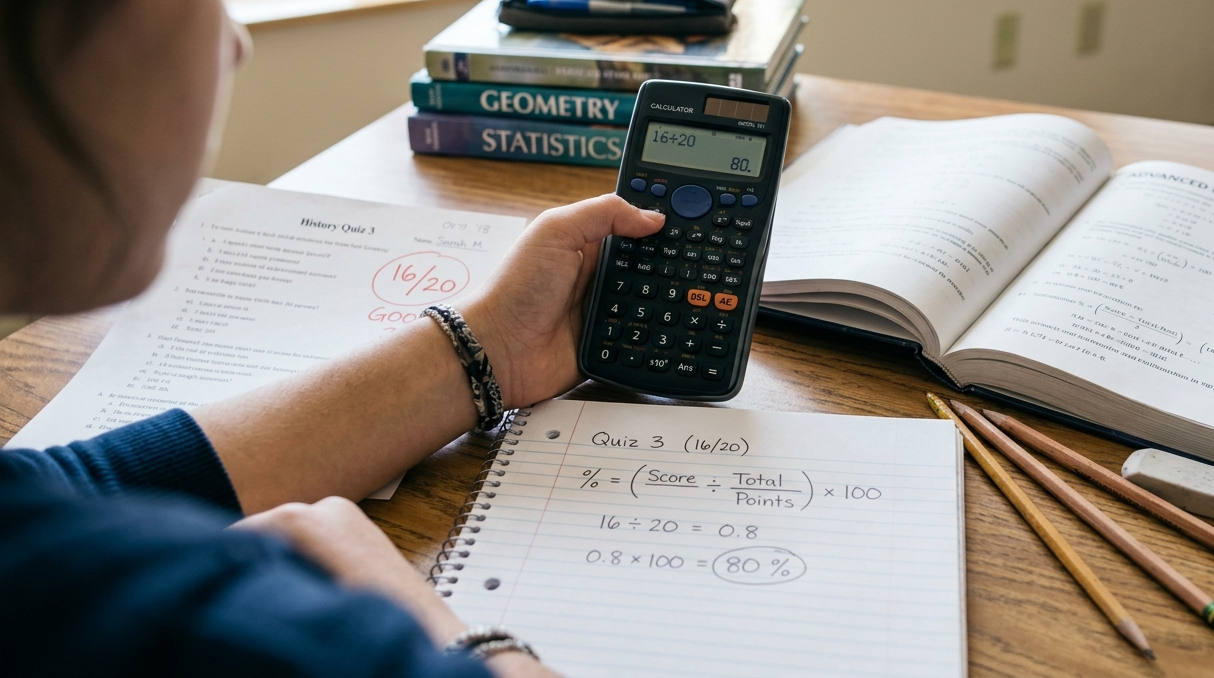
The formula is nothing new — it’s the same one used for converting any test score into a percentage:
Percentage = (Score ÷ Total Points) × 100
Here, that looks like:
16 ÷ 20 = 0.80, then 0.80 × 100 = 80%
Obtained marks divided by total marks, times 100 — that’s really all a percentage formula is. If you’re doing this kind of division over and over across a stack of quizzes and assignments, it gets tedious fast. That’s basically why our final grade calculator exists — punch in your scores and it handles the conversion instantly instead of you redoing the same division by hand each time.
One mistake I see a lot: dividing 16 by 100 instead of by 20. It’s an easy slip, but it throws the whole answer off. Always divide by the total possible points — not by 100.
What Grade Is 16 Out of 20?
This is where the answer starts depending on where you go to school. On the standard US 10-point scale:
| Percentage | Letter Grade |
|---|---|
| 90–100% | A |
| 80–89% | B |
| 70–79% | C |
| 60–69% | D |
| Below 60% | F |
At 80%, a 16/20 sits right at the bottom edge of the B bracket. That’s why some schools using a plus/minus system will log it as a B-, while others just call it a straight B. High schools, community colleges, and universities aren’t all running the same grading policy, so if the exact letter actually matters — say, for a transcript or a scholarship cutoff — check your syllabus instead of guessing.
Grading isn’t identical everywhere outside the US either. In the UK, a score like this often maps to a Merit or upper-second-class band depending on the course. Canadian schools frequently report it directly as 80%, sometimes alongside a B+ on a 9-point scale. Australian institutions tend to call an 80% a Distinction, and in India’s 10-point CGPA system, it typically lands around an 8.0. The number stays the same — 80% — but what it’s called changes depending on where you are.
Is 16 Out of 20 a Good Score?
Generally, yeah. An 80% clears the passing bar at nearly every school, college, and standardized test out there, and it’s high enough to keep a GPA looking healthy. For a weekly quiz, a homework check, or a short essay grade, 16 out of 20 counts as a solid, above-average result — nothing to stress over.
That said, context matters. A driving theory test or a certification exam with a strict pass mark — 85% or 90%, say — could still mean a retake even with an 80%. And if you’re chasing a scholarship GPA minimum or applying somewhere competitive, a run of scores stuck in the low 80s is worth keeping an eye on rather than brushing off.
Quick tip: if you’re averaging several scores together — quizzes, homework, a couple of tests — don’t just average the percentages directly. Add up the total points earned across everything, divide by the total points possible, and then convert to a percentage. It’s a small difference, but it gives you a more accurate final grade, especially when assignments carry different point values.
16 Out of 20 in Different Formats
| Format | Value |
|---|---|
| Percentage | 80% |
| Fraction | 16/20 (simplified: 4/5) |
| Decimal | 0.80 |
| Ratio | 4:5 |
That simplified fraction, 4/5, is just the same value written a different way — handy if your teacher or textbook wants the answer as a fraction instead of a percentage.
16 Out of 20 GPA Equivalent

On the standard US 4.0 GPA scale, an 80% usually lands somewhere between 2.7 and 3.0, depending on whether your school treats it as a straight B (3.0) or a B- (2.7). This is always going to be an estimate — GPA conversion charts differ by school, state, and country, and your institution’s official chart is the only place to get the exact number that shows up on your transcript. As Wikipedia’s rundown of US academic grading points out, there’s no national standard for converting letter grades to GPA points, which is exactly why two schools can hand out completely different GPAs for the same 80%.
If you’re looking at a full semester rather than one assignment, a single 16/20 barely moves your overall grade on its own — it’s the average across everything graded that decides your final GPA. Running your full list of scores through a weighted grade calculator gives you a much clearer picture than eyeballing one score by itself, especially once some assignments start counting more than others.
Common Examples
- Math quiz: 16/20 correct on a 20-question quiz — a solid B-range result.
- Science exam: 16 marks out of 20 on a short-answer section.
- Homework set: 16 out of 20 assigned problems completed correctly.
- Driving theory test: 16/20 passed — may or may not clear the bar depending on the testing authority.
- Online course quiz: 16/20 on an auto-graded module, converting instantly to 80% on most platforms.
Related Percentage Conversions
Scores like this rarely show up alone, so here’s how the nearby ones stack up, letter grade included:
| Score | Percentage | Letter Grade |
|---|---|---|
| 12/20 | 60% | D |
| 13/20 | 65% | D |
| 14/20 | 70% | C |
| 15/20 | 75% | C |
| 16/20 | 80% | B |
| 17/20 | 85% | B |
| 18/20 | 90% | A |
| 19/20 | 95% | A |
| 20/20 | 100% | A |
Frequently Asked Questions
What is 16 out of 20?
16 out of 20 equals 80%, or 4/5 as a simplified fraction.
What percent is 16 out of 20?
80% — calculated as (16 ÷ 20) × 100.
What grade is 16 out of 20?
On most US 10-point scales, that’s a B or B-, depending on the school’s plus/minus policy.
Is 16 out of 20 good?
Yes. 80% is generally a solid, above-average score in school and college.
Is 16 out of 20 a passing grade?
Yes — it clears the typical 60% passing mark comfortably.
Is 80% an A?
No, 80% is usually a B, not an A, on the standard 10-point scale.
Is 16/20 good in college? It’s decent, but competitive programs often expect scores closer to 90%+, so it depends on the course.
What GPA is 16 out of 20?
Roughly 2.7 to 3.0 on a standard 4.0 GPA scale, depending on the institution.
What fraction is 16 out of 20?
It simplifies to 4/5.
What decimal is 16 out of 20?
0.80.
Is 80% a B?
In most US grading scales, yes — it sits at the low end of the B range.
How many questions can you miss out of 20 and still get 80%?
Missing 4 out of 20 gets you exactly 80%.
Conclusion
So, what is 16 out of 20 when you put it all together? An 80%, a B-range grade, and a GPA somewhere around 2.7–3.0 — a genuinely solid score, even if the exact letter shifts a bit from one school to the next. If you want to see how a score like this fits into your overall average, our ez grade calculator handles the full conversion — percentage, letter grade, and GPA — in one go. And for the official plus/minus cutoffs at your specific school, your published grading policy always has the final say.