
Ask ten students what they find hardest about newspaper writing, and most will give you some version of the same answer: they know the event they want to cover, but they’re not sure how to turn it into an actual news story. That’s usually why teachers hand out a newspaper article example for students before asking anyone to write one — seeing a finished piece makes it much easier to understand how headlines, leads, quotes, and facts are supposed to fit together.
That’s the gap this guide is trying to close. Not just one sample article, but the format, several examples at different levels, and enough writing tips that the next assignment doesn’t start with twenty minutes of staring at a blank page.
What Is a Newspaper Article?
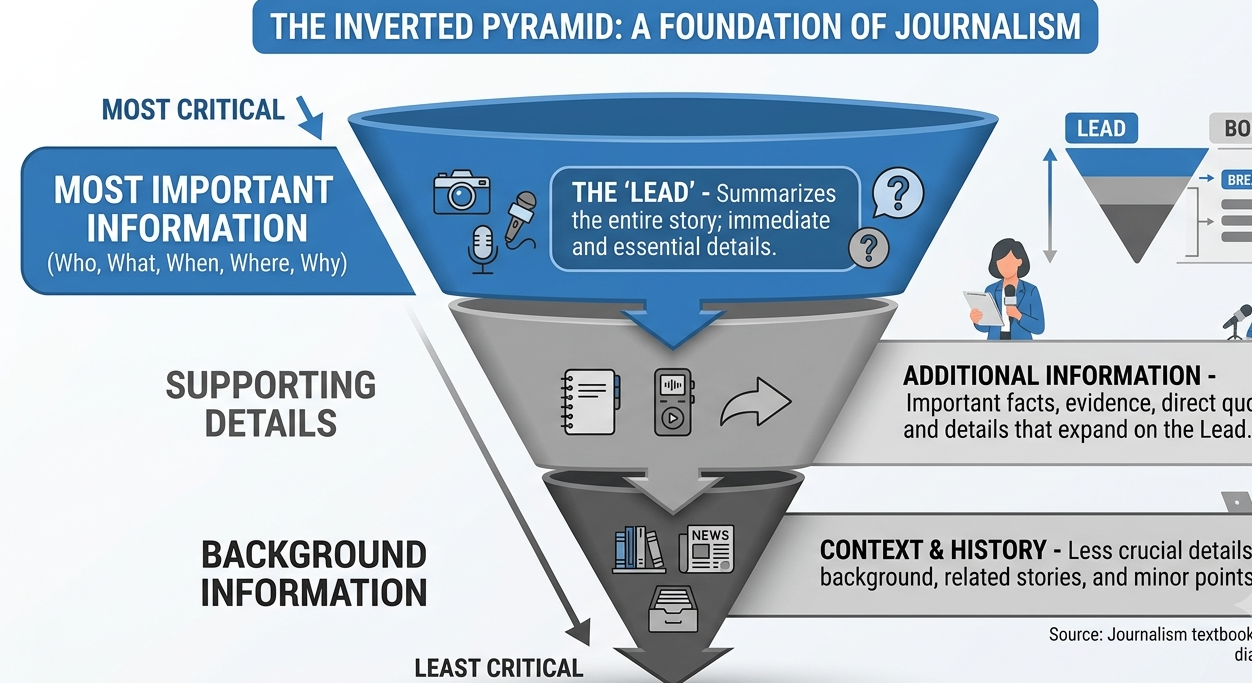
Open almost any local newspaper and you’ll notice something. The first paragraph usually tells you nearly everything you need to know before you’ve even reached the middle of the page. That’s not an accident — news writing is built to deliver the biggest facts first, which is why students get taught the inverted pyramid early on. Picture a triangle balanced on its point: the most important information sits at the top, and smaller supporting details trail off toward the bottom.
Most newspaper articles follow the same basic structure, although some school assignments simplify it a bit. In general, though, you’re looking at a headline that grabs attention, a byline naming the writer, a lead paragraph that answers the essential questions right away, a body that fills in the details, and usually at least one direct quote from someone connected to the story. Skip most of these and the piece starts reading more like a diary entry than actual news.
Newspaper Article Format for Students
Here’s roughly the order things go in:
Headline — short, and it should sum up the whole story in a handful of words. Interestingly, a lot of students spend twenty minutes writing the article and maybe two minutes on the headline, even though it’s usually the very first thing a teacher reads.
Byline — “By [Your Name],” typically right under the headline.
Dateline — location, sometimes the date too, often in capital letters right before the story starts (“HYDERABAD —” or “NEW YORK —”).
Lead paragraph. Answers who, what, when, where, and why, all within the first two or three sentences. This is where students tend to drag things out way too long, and it’s honestly the biggest thing separating a strong article from a weak one.
Body paragraphs — details, background, and at least one or two quotes from people connected to the story.
Ending. A closing line, sometimes a quote, sometimes a look at what happens next. Not a summary. Newspapers rarely circle back and repeat themselves the way school essays do.
Newspaper Article Example for Students
A teacher I heard about once said students only really understand newspaper writing after they’ve seen a full, complete example — not just a definition and a diagram. So here’s one, built around a fairly typical school story: a student-led recycling initiative.
Headline: Lincoln High’s Student-Run Recycling Program Hits One-Ton Milestone
Byline: By Sarah Ahmed, Staff Writer
HYDERABAD — Lincoln High School’s student-led Green Earth Club has collected and recycled one full metric ton of paper and plastic since launching the sustainability initiative in August, marking a major milestone just ahead of the school’s Earth Week celebration.
The program, organized entirely by students to cut down on campus waste, involved daily recyclable pickups from every classroom and weekly sorting sessions run by club members.
“We started this as a small project to clean up our lunchroom, but seeing the whole student body get involved has been incredible,” said Ali Raza, a junior and president of the Green Earth Club.
The initiative has the backing of the school’s science department, and Principal Ayesha Khan praised the students’ commitment. “They’ve proven that small, consistent actions can lead to massive environmental benefits for our community,” Khan said.
The Green Earth Club now plans to expand the program to include electronic waste and old textbooks, with a goal of doubling its current collection rate by the end of the academic year.
Read the opening paragraph again. Within a few seconds, you already know who did it, what they did, and roughly why it matters — and that’s exactly why journalists spend so much time polishing that first paragraph before touching anything else.
Short Newspaper Article Example for Students
Not every teacher asks for a full 400-word report. In a lot of middle school classrooms, the assignment is much shorter. Here’s what that version tends to look like, in under 150 words.
Headline: Grade 7 Wins Regional Science Fair
Byline: By Daniel Osei
RIVERSIDE — Grade 7 student Maya Chen took first place at the Riverside Regional Science Fair on Saturday for her project on solar-powered water filtration, beating out entries from twelve other schools.
Chen’s design used a small solar panel to power a basic filtration pump, aiming to provide clean drinking water in areas without reliable electricity.
“I wanted to build something that could actually help people, not just win a ribbon,” Chen said after the ceremony.
Her teacher, Mr. Patel, said the win reflected months of after-school work. Chen will now represent Riverside Middle School at the state competition next month.
Shorter doesn’t mean cutting corners. This version still has a headline, byline, dateline, lead, and a quote — it’s just tighter on the details.
Newspaper Article Examples for Students About School
Most classroom assignments circle back to a handful of the same topics — sports day, science fairs, tree plantation drives, debate competitions, annual functions — and that’s actually a good thing, because it means the pattern only needs to click once. Same format every time. Only the topic and the quotes change. Stuck on what to write about? Pick one of these and plug in real details from your own school.
Beginner Newspaper Article Example for Students
For younger students, roughly grades 4 through 6, the goal is simpler words and shorter sentences without dropping any part of the structure.
Headline: Class 5 Plants 50 Trees for Earth Day
RIVERTOWN — Students in Class 5 planted 50 trees at Rivertown Park on Friday to celebrate Earth Day.
The students worked with their teacher, Ms. Lopez, and park staff to dig holes and plant young oak and maple trees.
“I liked getting my hands dirty and helping the earth,” said student Ben Carter.
The class plans to check on the trees every month to see how much they’ve grown.
Same bones as the longer version. Headline, dateline, quote, simple ending. Just built with plainer words.
Advanced Newspaper Article Example for Students
Grades 9 through 12 usually lean into more statistics, multiple quotes, and a bit more background — closer to what an actual local paper might run.
Headline: School Board Approves $2.4 Million Renovation for Aging Gymnasium
Byline: By Priya Nair, Editor-in-Chief
CENTERVILLE — The Centerville School Board voted 5–2 on Tuesday to approve a $2.4 million renovation of the district’s forty-year-old gymnasium, citing safety concerns raised in a structural review completed last spring.
The renovation, expected to begin next summer, will include a new roof, updated electrical systems, and expanded seating capacity from 800 to 1,100. District officials say the project will be funded through a combination of state grants and a bond measure approved by voters last November.
“This building has served generations of students, but it simply isn’t safe to keep patching it year after year,” said Board President Robert Klein.
Not everyone on the board was fully on board with the price tag. Member Denise Ford voted against the measure, arguing the district should have sought additional bids before committing to a contractor. “I support the renovation. I just don’t think we did our due diligence on cost,” Ford said.
Construction is expected to take approximately fourteen months, with the gymnasium remaining closed to student athletics during that period.
How to Write a Newspaper Article
Start with something specific. “The science fair” works fine as a topic, but “how one student’s project won first place” actually gives you a lead to build around.
From there, research the facts before writing anything. If you’re covering a real school event, keep a notebook handy or use your phone to jot down quotes while people are still talking — trying to remember exact wording later almost never works out the way you’d hope. Figure out the five Ws and the H (who, what, when, where, why, how) before you write a single sentence of the actual article.
Draft the headline last, even though it runs first. It’s much easier to summarize a story you’ve already written than to write toward a headline you invented before knowing any of the details.
Write the lead to answer as many of the 5Ws as you reasonably can in two or three sentences. Build the body around supporting details, roughly in order of importance, and use quotes to back up facts rather than replace them. Edit for length before anything else — student drafts almost always start too long. Proofread out loud if you can. Reading aloud catches the awkward phrasing that spell-check tends to miss completely.
Good Article vs. Weak Article
| Good Article | Weak Article |
|---|---|
| Strong, specific headline | Generic or vague title |
| Answers the 5Ws right away | Buries key details deep in the article |
| Includes real quotes | No quotes, or quotes that add nothing |
| Stays objective | Slips into the writer’s own opinions |
| Ends with a forward-looking detail | Just repeats the introduction |
Pre-Submission Checklist
Before turning anything in, run through this:
- Headline that summarizes the story
- Byline with your name
- Dateline (location, and date if required)
- Lead paragraph answering the 5Ws
- At least one direct quote
- Facts checked and specific — numbers, names, correct spelling
- No first-person opinions, unless it’s specifically a feature or opinion piece
- Proofread for grammar and length
Common Mistakes Students Make
Writing in the first person is probably the single most common slip. “I think this was a great event” belongs in an opinion piece, not a news article. Close behind that: an overlong lead that takes four or five sentences to say what should fit in two. A missing headline shows up more often than you’d expect, along with articles that skip the location entirely or never quote anyone at all. And a fair number of students end their piece the way they’d end an essay — with a summary. Real newspaper articles almost never do that, mostly because the important stuff already got covered near the top.
Journalism teachers tend to repeat one thing more than anything else: accuracy matters more than fancy vocabulary. A short, accurate article beats a long one built on guesswork, every time.
Grade-level expectations shift what “good” actually looks like at each stage, which is worth keeping in mind if you’re also working through vocabulary-heavy subjects — our guide on AP Spanish Language Vocabulary covers a similar idea of building from simple blocks toward exam-ready material, the same way a beginner news article eventually grows into an advanced one.
Practice Exercises
Reading examples only gets you so far. If you want to actually practice, try a short article on one of these:
- Your school’s sports day results
- A local flood or weather event
- A student council election
- Your school’s Independence Day celebration
- A science exhibition
- Environment Day activities at your school
Each one works with the exact format above — plug in your own quotes, facts, and details, and follow the same headline-byline-lead-body-quote-ending shape.
For a deeper look at professional news-writing standards, the Purdue Online Writing Lab’s guide to journalism and news writing is a solid academic reference, and the Poynter Institute — a well-known journalism training organization — publishes material on reporting fundamentals that goes well beyond what any classroom assignment usually covers.
Frequently Asked Questions
What is a newspaper article?
It’s a piece of factual writing that reports on a real event, organized with the most important information first, typically including a headline, byline, lead paragraph, body, and at least one quote.
How do students write newspaper articles?
By researching the facts first, answering the 5Ws in a short lead paragraph, then building the body around supporting details and direct quotes, all while avoiding personal opinions.
What are the 5Ws? Who, what, when, where, and why — the essential questions a strong lead paragraph should answer as early as possible, sometimes paired with “how” as a sixth question.
How long should a newspaper article be?
It depends on the assignment, but student articles typically run somewhere between 150 and 500 words, with shorter versions common in middle school and longer ones expected in high school.
Can students use first person?
Generally, no — standard news articles stay in the third person and skip personal opinions, unless the assignment is specifically a feature or opinion piece.
What is a byline?
The line naming the writer, usually formatted as “By [Name]” and placed just below the headline.
What is the format?
Headline, byline, dateline, lead paragraph, body paragraphs with quotes, and a closing line — generally organized using the inverted pyramid, with the most important facts first.
What is the difference between a news article and an essay?
A news article reports facts objectively and leads with the most important information, while an essay usually builds an argument or narrative and often saves key points for the end rather than the opening.
Final Thoughts
Once you’ve written one or two of these, the format stops feeling intimidating pretty fast. You’ll spend less time wondering where the byline goes and more time hunting for better quotes and sharper facts — which is really the whole point of working through a newspaper article example for students in the first place. It hands you a structure you can confidently reuse for almost any school assignment, whether that’s a 150-word update or something closer to the advanced version above. Pick a real event, get the facts straight, write the lead first, and the rest tends to follow on its own.
If you’re working through a whole semester of writing assignments across different subjects, our piece on the Hall of Graduate Studies shows the same research-first, fact-driven approach applied to a completely different topic — the discipline of checking sources and writing clearly carries over no matter what you’re covering.