

If you ask any student what wrecked their day on the AP Spanish exam, they rarely blame the grammar. It’s the vocabulary. You’re halfway through a reading passage, and suddenly, you’ve slowed to a crawl. You’re listening to an audio track, the speaker is moving fast, and one missed word throws off the whole sentence. Then, when you sit down to write your essay, you find yourself circling back to the same five basic words because nothing sharper comes to mind fast enough.
The College Board isn’t grading your ability to have a casual coffee-shop chat. They want to see you weigh in on global crises, break down cultural values, and defend opinions on the fly—all in Spanish that hits that B2 or C1 fluency level. Grammar is your frame, sure, but a strong AP Spanish Language Vocabulary is usually what pushes a solid “3” into a “5.”
Many students get stuck in a rut. They study like they’re still in ninth grade, flipping through flashcards for el perro or la mesa. That won’t save you when the prompt asks about renewable energy or global economic gaps. The exam runs on a totally different frequency, and this guide is built around the actual themes, lists, and phrases that show up in real reading passages, listening tracks, and free-response tasks.
What Is AP Spanish Language Vocabulary?
Basically, AP Spanish Language Vocabulary is a collection of formal, academic terms tied to the six themes set by the College Board. It’s designed for cultural analysis and formal writing, not just getting by in a conversation.
Think about how you learned in earlier classes. Those focused on “survival Spanish”—ordering food, describing clothes, or talking about your weekend. That’s fine for a beginner, but it isn’t what this test is looking for.
- Standard High School Track: Survival Spanish (food, clothing, immediate hobbies).
- AP Spanish Language Track: Academic Spanish (global issues, identity, ethics, abstract analysis).
Here is the difference in practice:
- Basic: El problema es grande. (The problem is big.)
- AP: La situación actual plantea un desafío verdaderamente formidable. (The current situation poses a truly formidable challenge.)
See the shift? The first is a simple observation. The second version actually argues a point. That shift in tone is exactly what the graders want to see.
Why Is Vocabulary Important for the AP Spanish Language and Culture Exam?
The exam tests four areas: listening, speaking, reading, and writing. A thin vocabulary trips you up differently in each one.
The Interpretive Sections (Reading & Listening)
You’ll get real-world material here: newspaper editorials, science segments, and radio clips recorded at a natural pace. Miss a high-frequency academic verb and you might misinterpret the entire argument. Even one skipped transition word, like sin embargo (however), can flip the meaning of a whole clip, causing you to lose easy points.
The Interpersonal Sections (Email Reply & Conversation)
Graders notice your tone immediately. If you write a formal email using slang, it sounds off, even if your grammar is perfect. You need language that sounds professional. In the timed conversation, having a bank of words ready is your safety net when the right term is on the tip of your tongue.
The Presentational Sections (Persuasive Essay & Cultural Comparison)
For the essay, you’ll be reading three sources and picking a side. You need analytical verbs—like sostener (to argue) or fomentar (to promote)—to make your writing sound like an argument, not a summary. For the cultural comparison, you need variety so you aren’t just repeating más and menos for two minutes.
Truth be told, hitting that top tier score starts way before you ever crack open a prep book. The Importance of Choosing the Right School is huge when you look at how a student actually picks up a language over time. When a school has a well-thought-out, step-by-step curriculum, it keeps you from constantly feeling like you’re drowning or playing catch-up the second the material gets tough.
On top of that, the Importance of Choosing the Right School means you actually get the resources and faculty that make a difference. Having teachers who are native speakers or getting to use specialized language labs makes making the leap from Spanish 3 to AP feel like a natural next step instead of a total shock. If you’re sitting in Spanish 3 right now, make it your mission to lock down your core grammar this year. That way, you can put all your energy into mastering that advanced academic vocabulary when the time comes.
AP Spanish Language Study Guide: How to Use This Vocabulary List
Whatever you do, don’t just stare at a giant block of words and hope for the best. The students who actually remember this stuff are the ones who chunk words together by theme, simply because it gives the brain an actual concept to anchor onto.
Try this for a daily routine: Pick just one theme, and physically write the words out with a pen—seriously, typing them just doesn’t build the same muscle memory. Once you’ve got them down, challenge yourself to write two or three quick sentences based on an old exam prompt. Spending just 15 minutes doing this day in and day out is going to do wonders for you, miles ahead of trying to suffer through a chaotic one-hour cram session once a week.
AP Spanish Language and Culture Vocabulary Themes
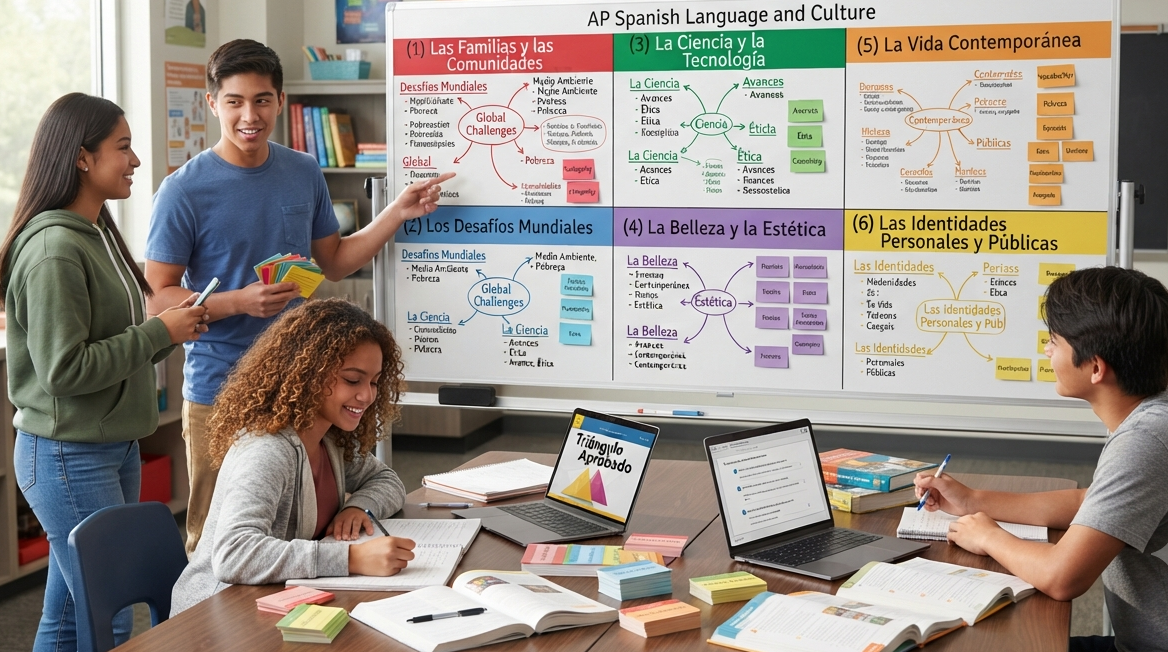
The course runs on six global themes. Studying these is the most reliable way to prep.
1. Las Familias y las Comunidades (Families and Communities)
This covers family dynamics, community identity, and how society is changing. This is huge for the cultural comparison section.
| Spanish Word | English Meaning | Real Exam Context |
| La convivencia | Coexistence | La convivencia armónica requiere respeto. |
| El lazo familiar | Family bond | Los lazos familiares son el núcleo. |
| El ciudadano | Citizen | Cada ciudadano debe contribuir al bienestar. |
| Inculcar | To instill | Los padres buscan inculcar valores éticos. |
| El entorno | Environment | El entorno social influye en los jóvenes. |
2. Las Identidades Personales y Públicas (Personal and Public Identities)
This is about how history, language, and your experiences shape who you are.
| Spanish Word | English Meaning | Real Exam Context |
| La autoimagen | Self-image | Las redes sociales afectan la autoimagen. |
| La enajenación | Alienation | El inmigrante a menudo siente enajenación. |
| Asimilarse | To assimilate | Es un desafío asimilarse a una nueva cultura. |
| La herencia | Heritage | Debemos preservar nuestra herencia. |
| La autoestima | Self-esteem | El éxito depende de la autoestima. |
Quick warning: La herencia (heritage), la herida (wound), and la herramienta (tool) get mixed up constantly because they look similar. Say them out loud to help your brain distinguish them.
3. La Vida Contemporánea (Contemporary Life)
Think of this as the “mechanics” of daily life: work, school, and money.
| Spanish Word | English Meaning | Real Exam Context |
| El sector laboral | Job market | El sector laboral exige tecnología. |
| El voluntariado | Volunteering | El voluntariado fomenta la empatía. |
| El presupuesto | Budget | Debes diseñar un presupuesto. |
| La formación | Background | La formación académica abre puertas. |
| El ocio | Leisure time | El equilibrio entre trabajo y ocio es vital. |
4. Los Desafíos Mundiales (Global Challenges)
Environmental issues, rights, and inequality. This is massive for your persuasive essay.
| Spanish Word | English Meaning | Real Exam Context |
| Calentamiento global | Global warming | Amenaza la biodiversidad. |
| La escasez | Scarcity | La escasez de agua es un desafío. |
| La desigualdad | Inequality | Es urgente erradicar la desigualdad. |
| Sustentable | Sustainable | Debemos usar energía sustentable. |
| Perjudicar | To harm | La contaminación perjudica la salud. |
5. La Ciencia y la Tecnología (Science and Technology)
Move past “new gadgets.” Focus on ethics, AI, and social media.
| Spanish Word | English Meaning | Real Exam Context |
| Avance científico | Breakthrough | Los avances han erradicado enfermedades. |
| La herramienta | Tool | El internet es una herramienta necesaria. |
| La ética | Ethics | Considera la ética en la ciencia. |
| Inalámbrico | Wireless | Facilita la comunicación instantánea. |
| Predecir | To predict | Es difícil predecir el impacto de la IA. |
6. La Belleza y la Estética (Beauty and Aesthetics)
It’s not just looks. It’s art, literature, and architecture across cultures.
| Spanish Word | English Meaning | Real Exam Context |
| Canon de belleza | Standard of beauty | Los cánones varían según la época. |
| La obra maestra | Masterpiece | Don Quijote es una obra maestra. |
| Plasmar | To portray | El pintor logró plasmar la angustia. |
| La moda | Fashion | La moda refleja estilos variados. |
| Apreciar | To appreciate | Debemos apreciar el arte. |
Essential Advanced Connectors
Transitions are the road signs for your grader. They stop your writing from looking like a list of random sentences.
- Contrasting: Sin embargo (however), No obstante (nevertheless), A pesar de (despite).
- Adding Evidence: Además (furthermore), Asimismo (likewise), Por lo tanto (therefore).
- Concluding: En resumen (in summary), En última instancia (ultimately), A fin de cuentas (at the end of the day).
Study and Official Resources
To keep leveling up, check out resources from experts. For official exam details and rubrics, the AP Central (College Board) site is your go-to authority. Also, for a deeper look at language proficiency standards, ACTFL (American Council on the Teaching of Foreign Languages) offers great insights into how language skills develop.
How to Memorize Vocabulary Faster
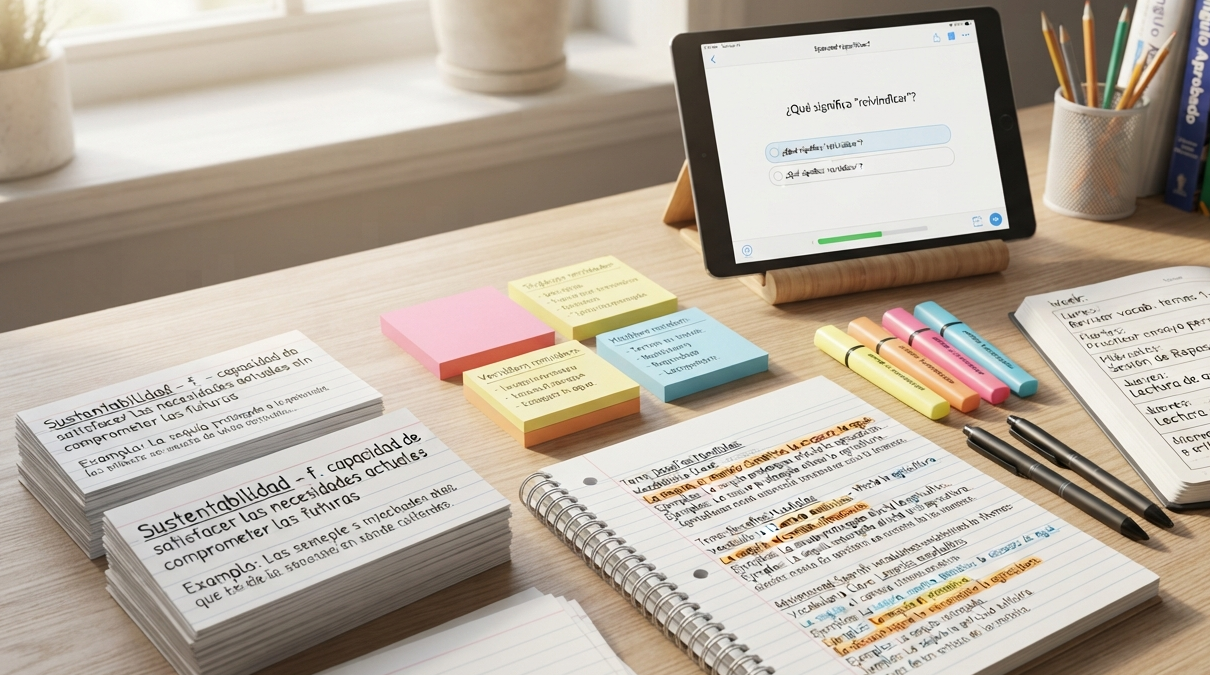
- Spaced Repetition: Use tools like Quizlet, but keep it active.
- Word Families: If you learn a verb, look up the noun and adjective forms. That’s three words for the price of one.
- Talk it Out: Before writing a word, say it in a full sentence. You need to be able to say it naturally, not just recognize it on a screen.
Common Vocabulary Mistakes to Avoid
- False Cognates: Don’t use realizar for “realize” (it means “to carry out”). Use me di cuenta de instead. Also, actualmente means “currently,” not “actually.”
- Bland Phrasing: Avoid repeating bueno, cosa, or problema. Use beneficioso, aspecto, or desafío to sound more sophisticated.
Frequently Asked Questions
- What is AP Spanish Language vocabulary? It’s formal academic language tied to the College Board’s six themes, meant for analysis rather than casual chat.
- How many words should I know? Aim for around 1,500 to 2,000 advanced terms to feel confident.
- Is Quizlet enough? It’s a great start, but you must use the words in practice essays to truly own them.
- What are the best resources? Official AP Central prompts and real media like Radio Ambulante or El País.
Final Thought
Ultimately, doing well on the AP exam really depends on the steady, daily study habits you build over time, rather than trying to cram everything in at the last minute. It’s definitely tempting to use automated tools to gauge your progress, but don’t lose sight of the bigger picture—your main goal is to develop an authentic, natural voice in Spanish. Think of these vocabulary lists as a scaffold to help you articulate your own ideas more clearly, rather than a quick fix to get around the real work of learning. If you stick with your routine and make a point of practicing out loud, you’ll walk into that exam feeling genuinely ready and confident in your own abilities.