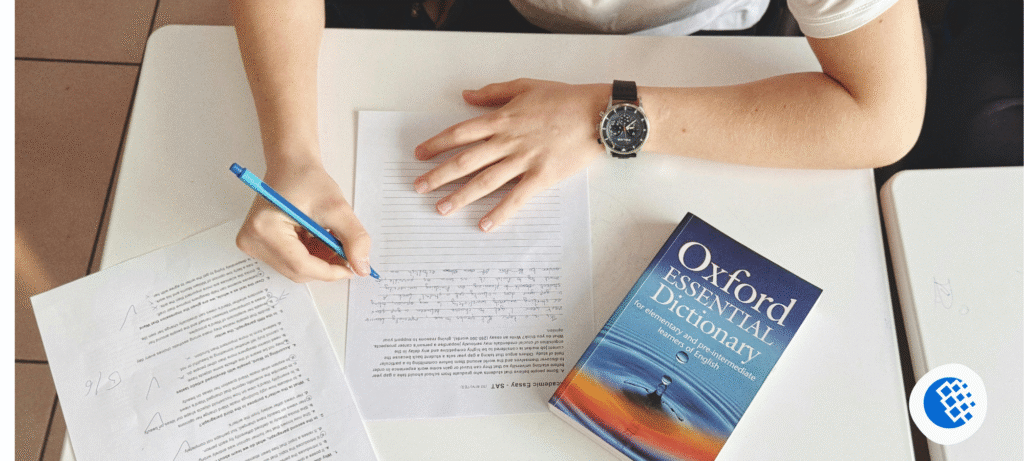

Teaching competencies of teachers are the combined knowledge, skills, and attitudes that let a teacher run an effective classroom – subject mastery, lesson planning, classroom management, communication, fair assessment, and increasingly, digital literacy. A teacher can know a subject inside and out and still fail to reach students without these; competency is really what turns knowledge into learning.
Two teachers can hand the same class the exact same textbook, the exact same lesson plan, even the exact same worksheet, and end up with completely different results. One leaves the room and half the students are still confused about what just happened. The other leaves and somehow the same material felt almost easy. It’s rarely a difference in intelligence. It’s teaching competence – and it’s a lot more specific, and a lot more learnable, than people usually assume.
What Are Teaching Competencies?
Teaching competencies are the practical abilities a teacher brings into the classroom – not just what they know, but what they can actually do with it. That distinction matters more than it sounds like it should. A teacher might have a graduate degree in chemistry and still struggle to explain the periodic table to a room of bored fifteen-year-olds. The knowledge is there. The competency to transmit it clearly isn’t automatically there too.
Most education researchers break competencies into three overlapping layers: knowledge (what a teacher understands about their subject and how students learn), skills (what they can do – plan a lesson, manage a room, give feedback), and attitudes (how they approach the work – patience, fairness, a willingness to keep adjusting). None of the three does much on its own. A teacher with great subject knowledge but poor classroom management loses the room before the lesson even starts. A teacher with excellent classroom management but weak content knowledge keeps order in a room where nobody’s actually learning much.
That first layer, knowledge, is really about more than facts a teacher can recite. It’s closer to what a lot of educators mean when they talk about what is theory of knowledge – understanding not just a subject, but how that knowledge was arrived at and how it connects to other ideas, which is exactly what lets a teacher answer the question a textbook never anticipated.
Why Teaching Competencies Actually Matter
It’s tempting to treat the teaching competencies of teachers as an academic distinction, but they show up in real, measurable ways. Students in classrooms run by more competent teachers tend to stay more engaged, ask more questions, and retain more of what’s covered – not because the material was easier, but because it was delivered in a way that matched how they actually process information. Weak assessment competency, in particular, is one of the quieter problems in a lot of classrooms: a teacher can move through an entire unit without ever really knowing which students understood it and which just nodded along.
There’s also a classroom-climate effect that’s harder to measure but easy to notice if you’ve ever sat in on a class. A competent teacher’s room tends to feel calmer, even when it’s loud – there’s a sense that the teacher knows where things are going. A less competent one can have a quiet room that still feels chaotic underneath, because nobody, including the teacher, is quite sure what’s supposed to happen next.
Core Teaching Competencies of Teachers
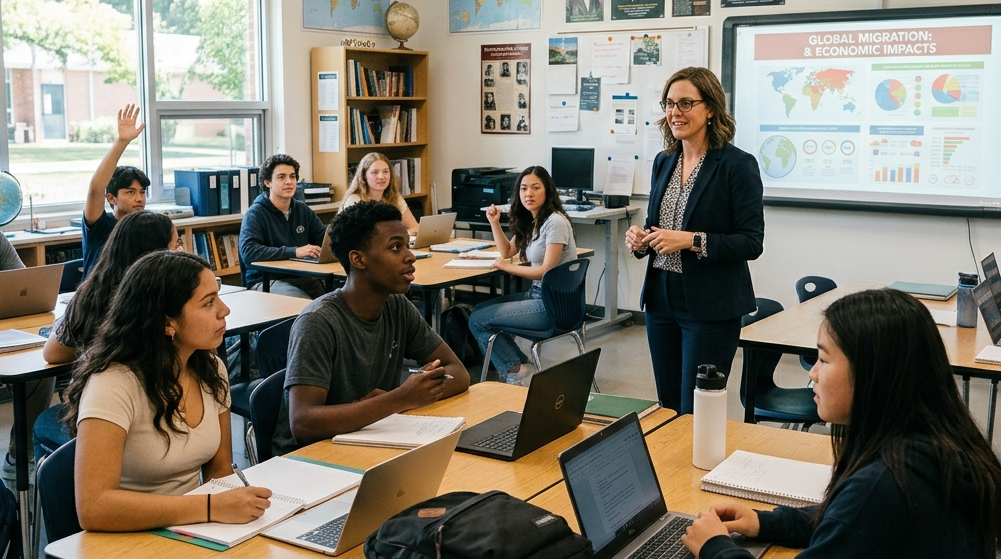
This is really the heart of it – the specific abilities that get grouped under “teaching competencies of teachers” in most frameworks, from OECD guidance to individual school district hiring standards.
Subject Knowledge. This is the baseline, and it’s more than memorizing facts. A teacher needs to understand a subject deeply enough to answer the question that comes out of nowhere – the one that isn’t in the lesson plan – without freezing up or giving a vague non-answer. Deep knowledge also lets a teacher connect one topic to another, which is often what makes abstract material click for a student who was otherwise lost.
Lesson Planning. Good lesson planning isn’t about writing an elaborate document nobody reads twice. It’s about sequencing – figuring out what needs to come before what, building in checkpoints to see if students are keeping up, and leaving enough flexibility that the plan can bend when a class clearly isn’t getting something. Rigid lesson plans tend to fall apart the moment reality doesn’t match the script.
Classroom Management. Probably the competency new teachers underestimate the most before they actually start teaching. It’s not about being strict or loud – it’s about setting a tone early, being consistent, and handling small disruptions before they become big ones. A teacher who’s constantly stopping the lesson to deal with behavior has, whether they realize it or not, lost a chunk of the class’s actual learning time.
Communication Skills. This cuts in more directions than people expect – explaining a concept clearly, yes, but also listening to a confused question and figuring out what’s actually confusing about it, and communicating with parents in a way that’s honest without being alarming. A teacher who can’t read the room – who keeps explaining the same way even when it’s clearly not landing – runs into a wall a lot faster than one who can adjust mid-sentence.
Assessment Skills. Testing is only part of this. Real assessment competency means noticing, in real time, that a student’s blank stare means they’re lost, not bored, and doing something about it before the unit test confirms what was already obvious three weeks earlier. Good assessment also means fair grading – consistent standards that don’t shift based on which student is sitting in front of the teacher.
Critical Thinking. Teachers who model their own thinking process – working through a problem out loud, including the wrong turns – tend to produce students who do the same. This is one of those competencies that’s hard to fake; students pick up fast on whether a teacher actually understands something or is just reciting it.
Technology Skills. This has shifted from a nice-to-have to something close to essential, especially after the pandemic normalized hybrid and online instruction almost everywhere. It’s not about using every available tool – it’s knowing which digital resource actually helps a specific lesson and which one is just a distraction with a login screen.
Inclusive Teaching. The ability to adjust instruction for students with different learning needs, language backgrounds, or disabilities, without singling anyone out or watering down the material for the rest of the class. This has become one of the fastest-growing areas of teacher training, and for good reason – classrooms are more diverse than the standard lesson-plan template usually assumes.
Student Motivation. Some students walk in curious. A lot don’t, and a teacher’s ability to spark interest in material a student didn’t ask to learn is a competency in its own right, separate from how well they know the content itself.
Professional Ethics. Fairness, confidentiality, treating students consistently regardless of personal opinion of them – these sound obvious until you watch a classroom where they’re missing, and it’s usually obvious there too.
Continuous Learning. Teaching methods, curriculum standards, and student needs all keep shifting. Teachers who stopped updating their approach a decade ago tend to be easy to spot, and not in a good way.
| Competency | Why It Matters |
|---|---|
| Subject Knowledge | Builds credibility and lets a teacher answer unexpected questions confidently |
| Lesson Planning | Keeps instruction sequenced and gives students a clear sense of direction |
| Classroom Management | Protects actual learning time from constant disruption |
| Communication | Lets a teacher adjust explanations in real time based on what students actually need |
| Assessment | Reveals gaps in understanding before they compound |
| Technology Skills | Supports modern, hybrid, and differentiated instruction |
| Inclusive Teaching | Ensures every student, not just the average one, can access the material |
Professional Competencies of a Teacher
Beyond what happens inside a single classroom, there’s a broader layer of professional competencies that shape how a teacher functions within a school. This includes ethical decision-making under pressure – what a teacher does when a student discloses something difficult, or when a parent pushes back on a grade. It includes collaboration with colleagues, since very few teachers actually work in total isolation; department meetings, shared curriculum planning, and mentoring newer staff all draw on a different skill set than classroom teaching itself. And it includes a genuine commitment to lifelong learning – not just attending the mandatory training sessions, but actually applying what comes out of them.
Frameworks that try to capture this bigger picture, like the 5 dimensions of teaching and learning, are useful precisely because they push past the single-lesson view of competency and look at how purpose, student engagement, curriculum, instruction, and classroom environment all work together over an entire school year, not just one class period.
21st Century Teaching Competencies
Modern classrooms ask for a layer of competencies that simply weren’t part of teacher training a generation ago. Digital literacy now sits alongside subject knowledge as something close to non-negotiable – not just using a projector, but understanding learning management systems, adaptive software, and how to run a lesson that works whether half the class is in the room or logging in remotely.
Beyond the digital piece, there’s a stronger emphasis now on teaching critical thinking directly rather than assuming it develops on its own, on designing genuinely collaborative learning activities instead of just group seatwork, and on social-emotional awareness – recognizing when a student’s disengagement is really about something happening outside the classroom, not the lesson itself. Creativity and problem-solving have also moved from “nice extras” to something closer to core expectations, largely because the jobs students are eventually training for look nothing like the ones that existed when a lot of current curricula were first written.
Teaching Competencies in Different Subjects
The core competencies stay the same across subjects, but the way they show up shifts quite a bit depending on what’s being taught.
Science teachers lean heavily on lab safety management and inquiry-based teaching – guiding students through experiments where the “answer” isn’t handed over up front, which requires a very different kind of classroom control than a straight lecture.
Math teachers need an unusually strong grip on scaffolding, since math tends to build sequentially in a way other subjects don’t always – miss one foundational concept and the next three lessons can collapse for a student.
Language teachers rely more on communication modeling and patience with mistakes, since language learning is uniquely tied to a student’s willingness to sound wrong in front of peers.
Primary school teachers need broader competencies across nearly every subject at once, plus a heavier dose of behavior management, since younger students haven’t yet built the self-regulation older students have.
Special education teachers need everything above, plus deep fluency in individualized education plans, differentiation, and often, specialized communication strategies for students with a wide range of needs.
Teaching Competencies in Inclusive Education
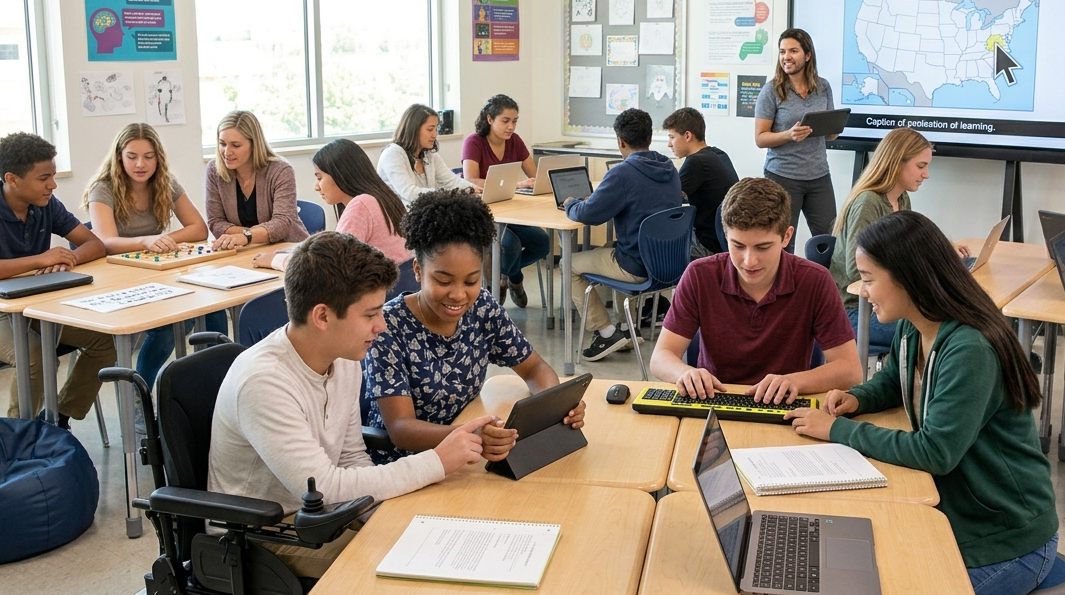
Inclusive classrooms have become the norm rather than the exception in most school systems, and that’s put real pressure on teacher training to catch up. Competency here usually centers on a few practical skills: understanding and implementing Individualized Education Plans (IEPs) without treating them as paperwork to file away, genuinely differentiating instruction rather than just slowing the whole class down, and applying Universal Design for Learning principles – building lessons that are accessible from the start instead of retrofitted after the fact for one or two students. Accessibility matters here too, and not just for visible disabilities; a teacher competent in inclusive education is also watching for the quieter signs of a student who’s struggling to access material for reasons that aren’t obvious from the back of the room.
Teaching Competencies for Pre-Service Teachers
Student teachers – the ones still in their training programs – build these competencies gradually, usually through a mix of coursework and, more importantly, an actual teaching practicum. Research on student teacher competency consistently points to the practicum as the part that matters most; reading about classroom management in a textbook and actually standing in front of twenty-five distracted teenagers are two very different experiences, and most of the real learning happens in the second one.
Perception of student teachers about teaching competencies tends to shift noticeably over the course of a practicum too. Many start out overestimating how much subject knowledge alone will carry them, and finish with a much sharper sense of how much classroom management, communication, and on-the-fly adjustment actually matter day to day. Reflection – sitting down after a lesson and honestly assessing what worked – and structured lesson observation from a mentor teacher are usually what turns that early-practicum humbling into real competency growth rather than just discouragement.
Assessment of Teachers’ Teaching Competencies
Measuring whether a teacher actually has strong competencies is its own challenge, and most schools use a blend of methods rather than relying on any single one.
| Assessment Method | Purpose |
|---|---|
| Classroom observation | Direct look at instructional and management skills in action |
| Student feedback | Reveals how instruction is actually landing, not just how it looks on paper |
| Peer review | Colleagues often catch blind spots a teacher can’t see in their own teaching |
| Lesson plan review | Shows planning quality, sequencing, and alignment to curriculum goals |
| Portfolios | A broader record of growth over time, not just a single observed lesson |
| Self-assessment | Encourages honest, ongoing reflection tied to professional goals |
None of these methods is perfect alone. Classroom observation can capture a good day or a bad one that isn’t representative. Student feedback can be shaped by how likable a teacher is rather than how effective. That’s exactly why most competency assessment frameworks combine several sources rather than trusting any single snapshot.
Examples of Teaching Competencies in Practice
It’s easier to recognize competency in action than to define it abstractly. Picture a teacher partway through a lesson who notices a cluster of students have gone quiet in a way that doesn’t feel like focus – it feels like confusion. A competent teacher catches that shift, pauses, switches to a visual explanation instead of continuing verbally, checks in with a quick question, and only moves on once the confusion has actually cleared. That entire sequence – noticing, adjusting, checking, confirming – is teaching competency happening in real time, and it usually takes only a few seconds.
Another example: a teacher grading a stack of essays notices the same specific mistake showing up across a third of the class. Instead of just marking it wrong on each paper and moving on, they build a five-minute mini-lesson addressing that exact mistake before the next assignment. That’s assessment competency feeding directly back into instruction, which is really the whole point of assessing in the first place.
Challenges Teachers Face in Building These Competencies
None of this develops in ideal conditions. Large class sizes make individualized attention genuinely difficult, no matter how skilled the teacher is. Technology keeps shifting faster than training programs can keep up with it. Inclusive classrooms demand differentiation that takes real planning time most teachers don’t have enough of. Behavior management gets harder in classrooms carrying more students with unaddressed needs than a single teacher can reasonably manage alone. And burnout – the quiet kind, not the dramatic kind – erodes competency over time in ways that rarely get talked about, since a exhausted teacher is working with less patience and less flexibility than the same teacher had five years earlier, even if their knowledge hasn’t changed at all.
How Teachers Can Improve Their Competencies
Improving the teaching competencies of teachers over a career tends to come from a handful of things done consistently rather than any single big fix. Ongoing professional development matters, but only when it’s actually applied afterward rather than filed away. Peer observation – watching a colleague teach, or being watched – tends to surface blind spots faster than almost anything else, mostly because it’s hard to see your own habits from the inside. Taking student feedback seriously, even when it’s uncomfortable to read, closes a gap that self-assessment alone usually misses. And keeping a simple reflective habit – even just five minutes after a lesson, jotting down what worked and what didn’t – compounds over a career in a way that’s easy to underestimate in any single week.
| Traditional Approach | Competency-Focused Approach |
|---|---|
| Teaches the same way regardless of who’s in the room | Adjusts methods based on how students are actually responding |
| Treats testing as the only form of assessment | Uses ongoing, informal checks throughout a lesson |
| Avoids new technology out of habit | Adopts tools selectively, based on whether they genuinely help |
| Sees feedback as criticism | Treats feedback as information to act on |
| Repeats the same lesson plans indefinitely | Revises lessons based on what worked and what didn’t |
Common Mistakes That Undermine Teaching Competency
A few patterns show up again and again, even among experienced teachers. Sticking rigidly to the textbook regardless of whether it’s working for this particular group of students. Ignoring feedback – from students, from peer observations, from test results – because it’s uncomfortable to sit with. Relying on one teaching style for every unit and every class, as if all students learn the same way. Avoiding technology entirely out of discomfort rather than genuine pedagogical judgment. And moving through material without checking, in any real way, whether it’s actually being understood until the test reveals it wasn’t.
Who Benefits When Teaching Competencies Improve
The obvious answer is students – better engagement, better understanding, and a classroom environment where confusion gets caught early instead of compounding for weeks. But it extends further than that. Teachers themselves tend to experience less daily frustration and burnout when their classroom runs smoothly, since so much teacher exhaustion comes from managing chaos rather than from the actual teaching. Schools benefit through stronger overall outcomes and often lower staff turnover, since competent, supported teachers tend to stay longer. And there’s a broader, slower benefit to society as a whole – students who were genuinely taught well tend to carry forward stronger critical thinking and communication skills well beyond the classroom they learned them in.
Independent research groups like the Learning Policy Institute have tracked this connection for years, consistently finding that investment in teacher effectiveness pays off in student outcomes far more reliably than most other school-level interventions.
Frequently Asked Questions
What are teaching competencies?
They’re the combination of knowledge, skills, and attitudes a teacher needs to run an effective classroom – things like subject mastery, lesson planning, classroom management, communication, and the ability to assess whether students are actually learning.
What are the competencies of a teacher?
Most frameworks group them into a few core areas: content knowledge, teaching methods, classroom management, assessment skills, communication, and increasingly, digital literacy and inclusive teaching practices.
What is teaching competency?
It’s a single measurable ability a teacher demonstrates in the classroom – for example, the ability to differentiate instruction for students at different levels, or the ability to manage behavior without disrupting the flow of a lesson.
Why are teaching competencies important?
Because they directly affect how much students actually learn. A teacher can know a subject deeply and still struggle to reach students if they lack classroom management or communication skills – competencies are what turn knowledge into learning.
What are professional competencies of a teacher?
These go beyond the classroom – professional ethics, collaboration with colleagues, decision-making, and a genuine commitment to ongoing learning throughout a teaching career.
What are the teaching competencies of science teachers?
Beyond the general competencies every teacher needs, science teachers need strong lab safety management, the ability to teach through inquiry and experimentation, and comfort explaining abstract concepts using concrete, hands-on examples.
What are digital teaching competencies?
The ability to use technology purposefully in the classroom – learning management systems, interactive tools, adapting lessons for online or hybrid formats, and knowing when digital tools genuinely help versus when they’re just a distraction.
How are teaching competencies assessed?
Usually through a mix of classroom observation, student feedback, peer review, portfolios of lesson plans and materials, and increasingly, self-assessment tied to professional development goals.
What are 21st century teaching competencies?
These add digital literacy, critical thinking instruction, collaborative learning design, and social-emotional awareness on top of the traditional competencies, reflecting how much classrooms and student needs have changed.
How can teachers improve their competencies?
Through ongoing professional development, peer observation, honestly reviewing student feedback, and reflective practice – regularly looking back at what worked in a lesson and what didn’t, then actually adjusting.
Final Thoughts
Great teaching isn’t really defined by how much a teacher knows – it’s defined by how effectively that knowledge gets shared, adapted, and put to use so that every student in the room actually walks away understanding something they didn’t before. The teaching competencies of teachers are what make that transfer possible. Subject expertise matters, but it’s the communication, the assessment, the patience, and the willingness to keep adjusting that turn a well-informed person into an actual teacher.
For educators who want to keep building on this, resources like Edutopia offer ongoing, practitioner-tested strategies that go well beyond any single article – a useful next stop for anyone serious about developing these skills further.