

Walk into two classrooms teaching the exact same math lesson and you can usually tell within five minutes which one is actually working. One has kids quietly copying problems off a board. The other has them arguing over which method got the right answer faster. The 5 dimensions of teaching and learning framework is basically an attempt to explain that difference — to break down, piece by piece, what separates instruction that genuinely sticks from instruction that just fills class time.
If you’ve ever sat in the back of a classroom for an hour, watching quietly instead of teaching, you notice this gap fast. Two teachers can cover the exact same standard using nearly identical materials, and somehow one room is buzzing while the other is dead silent in a bad way. That gap is exactly what this framework was built to help teachers name and work on.
Quick Answer: The 5 Dimensions of Teaching and Learning is an instructional framework from the University of Washington’s Center for Educational Leadership. It includes Purpose, Student Engagement, Curriculum and Pedagogy, Assessment for Student Learning, and Classroom Environment and Culture. Schools use it for lesson planning, instructional coaching, and teacher evaluation, most often through the 5D+™ Rubric.
Table of Contents
- What Are the 5 Dimensions of Teaching and Learning?
- A Real Classroom Walkthrough
- Understanding the 5 Dimensions of Teaching and Learning Instructional Framework
- Purpose: Why Am I Learning This?
- Student Engagement: Doing the Thinking, Not Just Watching It Happen
- Curriculum and Pedagogy: What’s Actually Being Taught, and How
- Assessment for Student Learning: Finding Out What Actually Landed
- Classroom Environment and Culture: The Part Everything Else Depends On
- Comparing the Five Dimensions at a Glance
- The 5D+™ Rubric Explained
- What About “5 Dimensions of Teaching and Learning 4.0”?
- Where to Find the Official PDF and PowerPoint Materials
- How Teachers Actually Apply the Framework Tomorrow
- Teacher Self-Reflection Checklist
- Common Mistakes When Using the 5D Framework
- 5D Framework vs. Danielson, Marzano, and Bloom’s Taxonomy
- Key Takeaways
- Frequently Asked Questions
The framework itself comes out of the University of Washington’s Center for Educational Leadership, and the group that maintains it is genuinely the most reliable source if you want the current, official version of any of this rather than a secondhand summary — including the one you’re reading right now. According to the Center’s own published materials, the framework was built to give coaches and teachers a shared language for talking about instruction, so feedback stops being vague (“good job,” “needs work”) and starts pointing at something specific enough to actually act on.
The five dimensions themselves are Purpose, Student Engagement, Curriculum and Pedagogy, Assessment for Student Learning, and Classroom Environment and Culture — and honestly, once you see them laid out, they read less like jargon and more like common sense that finally got written down properly. Some people call this the 5D instructional framework or the 5D model of education, and both terms point to the same thing.
What Are the 5 Dimensions of Teaching and Learning?
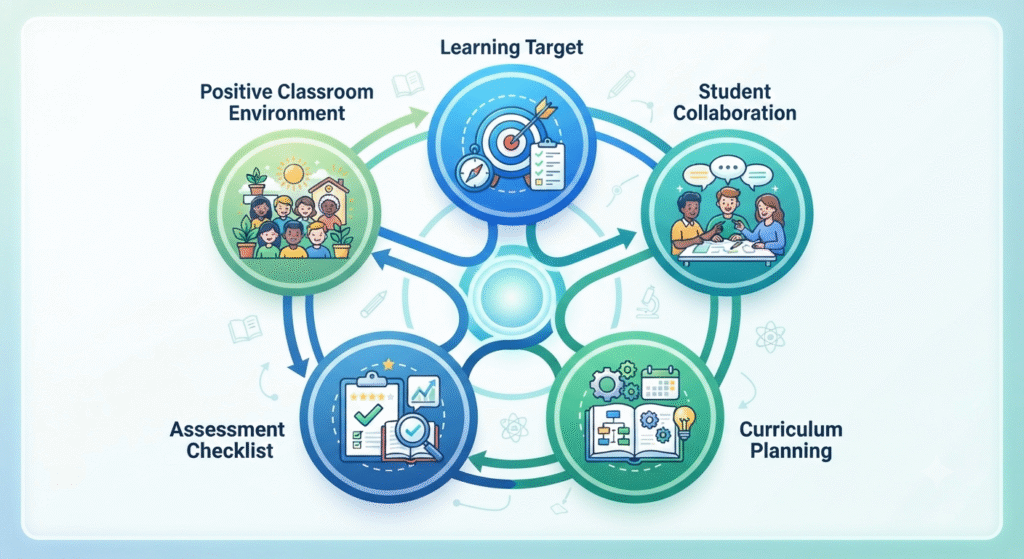
Short version, in list form since this is the part people usually just want a quick answer to:
- Purpose — do students know why they’re learning this?
- Student Engagement — are they doing the actual thinking, or just watching someone else do it?
- Curriculum and Pedagogy — is the material itself challenging, relevant, and well-structured?
- Assessment for Student Learning — how does the teacher know what’s landing and what isn’t?
- Classroom Environment and Culture — does the room feel safe enough for students to take risks?
None of these work in isolation. A brilliant lesson plan (strong curriculum and pedagogy) falls flat in a classroom where kids don’t feel safe raising their hand (weak environment and culture). A teacher can hit every assessment checkpoint on paper and still lose the room if students never understood the purpose behind the work to begin with.
A Real Classroom Walkthrough
It helps to see all five dimensions show up in one actual lesson rather than five separate examples.
Picture a fifth-grade math teacher — call her Mrs. Garcia — starting a lesson on equivalent fractions. She opens by telling students exactly what they’ll be able to do by the end of class and why it matters for the pizza-splitting problem she’s about to hand out. That’s Purpose. Students then work in pairs, arguing over which fraction actually represents more pizza, defending their reasoning to each other before she steps in. That’s Student Engagement. The task itself is built around a real scenario instead of a bare worksheet — that’s Curriculum and Pedagogy doing its job quietly in the background.

Near the end of class, she runs a quick exit ticket. Reading through the responses that evening, she notices about half the class still mixed up numerator and denominator when comparing fractions. That’s Assessment for Student Learning working exactly as intended — catching the gap before it snowballs into next week’s lesson. The next morning, she reteaches that specific piece to a small group while the rest of the class moves on. And throughout all of this, students felt comfortable enough to be wrong out loud in front of their pairs, which is Classroom Environment and Culture holding everything else together.
One lesson. All five dimensions, working at once, mostly invisible unless you know to look for them.
Understanding the 5 Dimensions of Teaching and Learning Instructional Framework
It’s called an “instructional framework” rather than a checklist for a reason. A checklist implies you tick boxes and you’re done. A framework is more like a lens — something you hold up against your own teaching, again and again, in different contexts, and keep learning from.
Schools that adopt this formally usually build it into three layers. First, individual teachers use it for self-reflection, walking through their own lessons against the five dimensions to spot where things broke down. Second, instructional coaches use it during observation cycles — watching a lesson, then sitting down with the teacher afterward to talk through which dimension needs the most attention next. Third, administrators fold it into formal evaluation, using the 5D+™ Rubric as shared language so feedback isn’t just a gut reaction, but something specific enough to actually act on.
Professional development around the framework tends to roll out slowly and deliberately, which surprises new staff who expect a single training day to cover it. In practice, most schools spend a full year or more helping teachers get comfortable with even one or two dimensions before layering in the rest. That’s not inefficiency — it’s just how deep behavior change in a classroom actually happens.
Purpose: Why Am I Learning This?
This dimension is deceptively simple. It’s just about whether a teacher clearly communicates the daily learning target and connects it to something bigger than the worksheet in front of a student. Kids are remarkably good at sniffing out busywork, and a lesson that never explains its own point tends to get treated like exactly that.
Here’s what the difference actually sounds like in a real classroom. A weak version of this dimension is a teacher opening class with “turn to page 47” and nothing else — no context, no reason given. A stronger version sounds more like, “Today we’re learning fractions because they show up every time you split a bill, follow a recipe, or figure out a discount at the store.” Same content, completely different level of buy-in from the room.
What strong Purpose looks like:
- A clear learning target stated in plain language
- A connection to something students already care about
- A moment for students to restate the goal in their own words
Student Engagement: Doing the Thinking, Not Just Watching It Happen
Engagement, in this framework, isn’t about kids smiling or looking busy. It’s about who’s actually doing the cognitive heavy lifting in the room. A classroom can look calm and orderly while the teacher does 90% of the thinking out loud and students just absorb it passively. That’s not engagement, even if it looks like a well-run class from the doorway.
Real engagement looks messier. Students debating which approach solves a problem, defending an answer to a peer, building on someone else’s half-formed idea instead of waiting for the teacher to confirm it. That kind of classroom is noisier and harder to manage, which is partly why this dimension is one of the trickiest for new teachers to build confidence in.
A few practical structures show up again and again in classrooms that do this well. Think-pair-share gives students a moment to form their own idea before it gets tested against a partner’s. Inquiry-based tasks hand students a question before handing them the answer, which forces actual reasoning instead of pattern-matching. Project-based learning stretches engagement across days instead of a single period, letting students own something bigger than one worksheet. And structured academic discussion — where students respond to each other rather than only to the teacher — tends to surface far more genuine thinking than a raised-hand Q&A ever does. None of these require fancy technology or a complete curriculum overhaul; they mostly require a teacher willing to talk less.
Curriculum and Pedagogy: What’s Actually Being Taught, and How
This dimension covers the material itself — is it appropriately challenging, culturally relevant, and structured to build real understanding rather than surface-level recall? A worksheet full of repetitive drills might keep a class quiet, but it rarely builds the kind of deep conceptual grasp this dimension is looking for.
A lot of strong curriculum design leans on real-world materials rather than generic textbook passages, because students engage more with content that feels connected to the actual world. A social studies teacher building a media literacy unit, for instance, might pull from a Newspaper Article Example for Students to teach students how to identify bias, structure, and credible sourcing — something a fabricated textbook excerpt rarely manages to do as convincingly.
Differentiated instruction fits here too. Not every student in a room is starting from the same place, and strong curriculum design accounts for that without watering down the material for everyone else.
Assessment for Student Learning: Finding Out What Actually Landed
This is where formative, summative, and diagnostic assessment all come into play, and it’s worth being specific about how each one functions differently. Diagnostic assessment happens before instruction even starts — a quick check to see what students already know or where their misconceptions sit. Formative assessment happens during learning — exit tickets, quick quizzes, peer feedback, thumbs-up checks — and its whole purpose is catching problems while there’s still time to fix them. Summative assessment is the more formal end-of-unit test, measuring what actually stuck once instruction is done.
The point isn’t just collecting scores. It’s using that evidence in real time to adjust what happens next in the classroom, rather than plowing ahead through a curriculum map regardless of whether half the room is lost. A teacher who notices, mid-lesson, that most students are stuck on the same concept and pivots to reteach it right then is applying this dimension well. One who waits until the unit test to discover the same gap is applying it poorly, even with identical content knowledge.
Classroom Environment and Culture: The Part Everything Else Depends On
This dimension is easy to underrate because it’s less visible than a lesson plan or a test score. It’s about whether the room feels physically and emotionally safe, whether diversity among students is genuinely valued rather than just acknowledged, and whether the day-to-day routines actually support learning instead of eating into it.
Did you know? Research on classroom climate consistently finds that students in emotionally safer classrooms take more academic risks — raising a hand with an unsure answer, attempting a hard problem out loud — specifically because the social cost of being wrong feels lower.
A classroom with strong culture tends to recover faster from a rough lesson than one without it — students trust the teacher enough to stay engaged even when the material gets hard. Without that trust, the other four dimensions have a much harder time functioning at all.
Comparing the Five Dimensions at a Glance
| Dimension | Main Focus | Teacher Action | Student Outcome |
|---|---|---|---|
| Purpose | Clarity of learning goals | Explains why the lesson matters | Understands the point of the work |
| Student Engagement | Active participation | Facilitates discussion and debate | Deeper, more durable thinking |
| Curriculum and Pedagogy | Quality of instruction | Differentiates and contextualizes lessons | Builds real conceptual understanding |
| Assessment for Student Learning | Evidence of learning | Uses formative checks, adjusts in real time | Continuous, visible improvement |
| Classroom Environment and Culture | Safety and trust | Builds relationships and routines | Confidence to take academic risks |

The 5D+™ Rubric Explained
The rubric itself breaks each of the five dimensions down further into sub-indicators — smaller, more observable behaviors that a coach or evaluator can actually watch for during a lesson. Rather than rating a teacher as simply “strong” or “weak” on Purpose, for example, the rubric describes specific levels of practice, from a teacher who states a target vaguely to one who connects it clearly to prior learning and future application.
Observations built around the rubric usually follow a cycle: a coach watches a lesson, takes notes tied to specific indicators rather than general impressions, and then meets with the teacher to reflect together. The goal isn’t a score for its own sake — it’s identifying one or two concrete next steps a teacher can act on before the next observation.
What About “5 Dimensions of Teaching and Learning 4.0”?
People occasionally search for a “4.0” version, and it’s worth being straightforward here rather than guessing: framework versions do get revised over time, and rather than assume a specific numbered release is the current standard, the safest move is checking directly with the University of Washington’s Center for Educational Leadership for whatever version they’re currently publishing. Rubrics like this evolve as research and classroom practice shift, so a version number you read about somewhere might already be out of date by the time you find it.
Where to Find the Official PDF and PowerPoint Materials
The official rubric and supporting materials — including the full breakdown of indicators, observation guidance, and scoring criteria for each dimension — are published directly by the Center for Educational Leadership, both as downloadable PDF documents and, for many districts running internal training, PowerPoint-based presentation materials for staff sessions. That’s the reliable place to go rather than a random reupload, partly because the framework does get updated periodically, and an old copy floating around the internet may not reflect the current version teachers are actually being evaluated against.
How Teachers Actually Apply the Framework Tomorrow
In practice, most educators don’t try to nail all five dimensions perfectly in every single lesson — that’s not really the point. It’s more of a lens for reflection, and it tends to work best as a simple sequence rather than an abstract idea.
Start by defining the learning target clearly enough that a student could restate it in their own words. From there, plan specifically for engagement — what will students actually be doing, not just listening to. Choose an assessment method before the lesson starts, not as an afterthought once it’s already over. Review classroom culture honestly, asking whether the room actually felt safe enough for students to take a risk today. And finally, reflect — walk back through the five dimensions and identify which one needs attention next time, rather than trying to fix everything at once.
That kind of gradual, one-dimension-at-a-time approach lines up with how a lot of modern instructional coaching works today. If you’re curious about broader shifts happening in classrooms generally, Best Modern Teaching Methods in 2026 covers several approaches that pair naturally with this kind of reflective framework, particularly around student-centered and technology-supported instruction.
Teacher Self-Reflection Checklist

- Learning target was clearly explained, not just assigned
- Students could restate why the lesson mattered
- Genuine student discussion or debate occurred, not just teacher-led talk
- A formative assessment was used to check understanding mid-lesson
- Instruction was adjusted based on what that check revealed
- The classroom felt respectful and safe enough for students to take risks
- At least one specific next step was identified for the following lesson
Common Mistakes When Using the 5D Framework
A few patterns show up repeatedly when schools first adopt this framework. Some coaches focus almost entirely on student behavior — attention, hands raised, quiet compliance — while missing whether real thinking is actually happening underneath. Others treat engagement as if it just means fun or entertainment, when the framework is really asking whether students are doing intellectual work, not whether they’re enjoying themselves.
It’s also common to lean on assessment purely for grading purposes, missing the whole point of using it to adjust instruction in real time. And Classroom Environment and Culture gets skipped over more than any other dimension, mostly because it’s harder to observe in a single 20-minute walkthrough than something concrete like a posted learning target.
5D Framework vs. Danielson, Marzano, and Bloom’s Taxonomy
Educators comparing frameworks often want to know how this one differs from the others they’ve encountered in training.
| Framework | Primary Focus | Best Used For |
|---|---|---|
| 5D Framework | Observable teaching practice across five areas | Coaching, reflection, teacher evaluation |
| Danielson Framework | Broader domains of professional practice | Formal teacher evaluation systems |
| Marzano’s Dimensions of Learning | Cognitive processes involved in learning itself | Instructional design, lesson planning |
| Bloom’s Taxonomy | Levels of cognitive complexity in tasks | Writing learning objectives and questions |
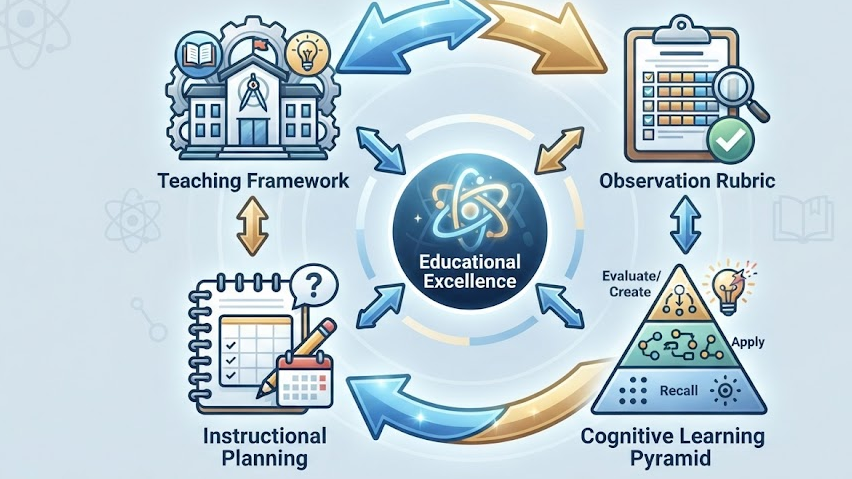
None of these frameworks are really competing with each other — many schools actually blend elements from more than one, using Bloom’s Taxonomy to write learning objectives, for instance, while using the 5D framework as the lens for classroom observation and coaching conversations. The Danielson Group’s own published framework is worth a look if you want to see how a domain-based evaluation model compares directly against this one.
Key Takeaways
- The framework covers five connected dimensions: Purpose, Student Engagement, Curriculum and Pedagogy, Assessment for Student Learning, and Classroom Environment and Culture.
- It’s meant to be used as a lens for reflection, not a rigid daily checklist.
- The 5D+™ Rubric builds directly on the framework and is the tool most schools use for formal observation.
- Schools typically roll it out gradually, focusing on one or two dimensions at a time.
- Strong teaching requires all five dimensions working together — none of them function well in isolation.
Frequently Asked Questions
What are the five dimensions of teaching and learning?
The five dimensions are Purpose, Student Engagement, Curriculum and Pedagogy, Assessment for Student Learning, and Classroom Environment and Culture — together forming the 5D instructional framework used to evaluate and improve teaching practice.
What is the 5D instructional framework?
It’s an approach developed by the University of Washington’s Center for Educational Leadership that breaks effective teaching into five interconnected areas, used for both teacher growth and formal evaluation.
What is the 5D+ rubric?
The 5D+™ Rubric is the formal evaluation tool built around this framework, used by schools and instructional coaches to assess and support teacher development against each of the five dimensions.
Who created the 5D framework?
The framework was developed by the University of Washington’s Center for Educational Leadership as part of their broader work supporting instructional coaching and school leadership.
Is the 5D framework only for K–12 teachers?
It’s most commonly applied in K–12 settings, though the underlying ideas — clear purpose, genuine engagement, sound curriculum, real assessment, and safe classroom culture — apply reasonably well to any instructional setting.
Can beginning teachers use this framework?
Yes, and many find it useful precisely because it’s specific enough to act on. New teachers often start with one or two dimensions, like Purpose and Assessment, before layering in the more nuanced ones like Classroom Environment and Culture.
Is the 5D framework used for teacher evaluation?
Yes, it’s commonly used in that context, though many teachers also apply it informally for lesson planning and self-reflection outside of formal observation cycles.
How often should teachers use the framework?
There’s no fixed schedule — some use it for every lesson reflection, others revisit it weekly or after each formal observation. The point is consistent use, not constant use.
Is the 5D+ rubric free to access?
Access and licensing details are managed directly by the Center for Educational Leadership, so checking with them is the most accurate way to find current availability.
How is the 5D framework different from other models like Marzano’s Dimensions of Learning?
Marzano’s model focuses more on the cognitive processes involved in learning itself, while the 5D framework centers more directly on observable teaching practice across purpose, engagement, curriculum, assessment, and classroom culture.
Where can I find the official 5 dimensions of teaching and learning PDF?
The Center for Educational Leadership at the University of Washington publishes the official rubric and supporting materials directly, and that’s the most reliable source for the current version rather than third-party reproductions.
Final Thoughts
The 5 dimensions of teaching and learning framework holds up because it doesn’t try to reduce good teaching to one metric. Purpose without engagement falls flat. Assessment without a safe classroom culture rarely surfaces honest results. Taken together, the five dimensions give teachers a genuinely useful way to diagnose what’s working in a classroom and what still needs attention — which, in the end, is a lot more practical than another abstract theory of good teaching.