

Admissions offices are drowning in spreadsheets. Advisors are chasing students across three different systems that don’t talk to each other. And somewhere in the middle of all that, a prospective student who emailed twice and never got a reply just enrolled somewhere else. This is the daily reality for a lot of campuses right now, and it’s exactly why the benefits of CRM in higher education have become such a common topic in provost meetings and admissions retreats alike.
A CRM — Customer Relationship Management software — isn’t new to the corporate world. Sales teams have used it for decades to track leads and close deals. What’s changed is how directly that same logic now applies to universities and colleges trying to manage an increasingly complicated student lifecycle, from that first inquiry email all the way to alumni donations twenty years later.
Before diving into the specifics, it helps to see how other institutions have tackled recruitment funnels — this piece on Lead Generation for Online Education covers a lot of the same groundwork that makes CRM adoption worthwhile in the first place.
What CRM Actually Means on a Campus
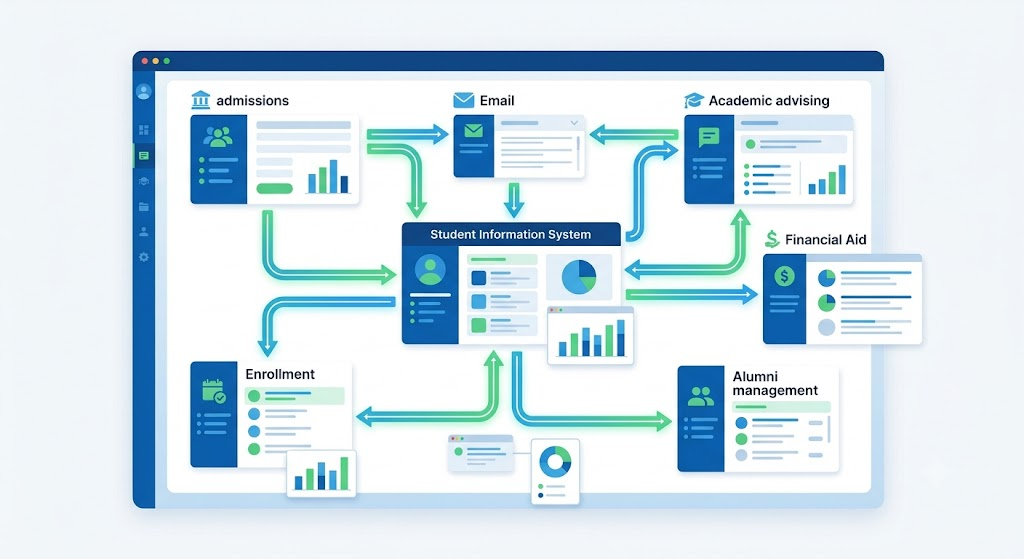
So what does a CRM actually do on a campus? Think of it as one central hub where every interaction with a person — a prospective student, a current one, a parent, a donor, even an alum — gets logged and tracked. That’s not the same job an SIS does. A Student Information System (SIS) is built for the academic and administrative side of things: grades, transcripts, enrollment status, that kind of record-keeping. A CRM works differently. It’s not really about which class a student is sitting in right now — it’s about the relationship itself. When did someone last reach out to this student? What was said? And what’s the next step supposed to be?
Plenty of schools already run an SIS. Fewer have layered a proper CRM on top of it, which is often where the real gaps show up — a student inquires about a program, nobody follows up for two weeks, and by the time someone does, that student has already committed elsewhere.
Why This Has Become Urgent, Not Optional
In a lot of regions, enrollment numbers just aren’t holding up the way they used to. Schools are competing harder for the same shrinking pool of students, and those students have gotten used to fast, personal responses — from food delivery apps, from streaming services, from pretty much every retailer they deal with online. So when a university takes ten days to answer a simple application question, it’s not just being slow — it’s up against institutions that reply in ten minutes. That’s a bigger problem than most administrators want to admit.
The Real Benefits of CRM in Higher Education
Faster, smarter recruitment. CRM platforms track every touchpoint a prospect has with the institution — website visits, event registrations, email opens — and use that data to prioritize follow-up. Admissions counselors stop guessing who’s actually interested and start working from evidence.
Quicker admissions decisions. Automated workflows can flag incomplete applications, send reminder emails, and route files to the right reviewer without a staff member manually tracking every step. That alone can shave days off the decision timeline.
Better student retention. This is where CRM tools start overlapping with advising. By tracking attendance patterns, grade trends, and engagement signals, institutions can flag at-risk students early — sometimes weeks before a traditional advising check-in would have caught the problem.
Genuinely personalized communication. Instead of blasting the same email to every prospect, a CRM lets staff segment audiences — first-generation students, transfer applicants, out-of-state families — and tailor messaging accordingly. It sounds small, but response rates tend to shift noticeably once messages stop feeling generic.
Less manual busywork. Deadline reminders, document requests, welcome sequences — all of it can run on autopilot, freeing staff to spend time on the conversations that actually need a human.
Stronger alumni and donor relationships. The same system that tracked a student from their first campus visit can keep tracking them after graduation, which makes fundraising and event outreach far less disjointed.
For a deeper look at how CRM data ties into the classroom side of retention, Salesforce’s higher education overview breaks down how institutions connect engagement data to academic outcomes.
The Student Journey, Mapped Against CRM Support
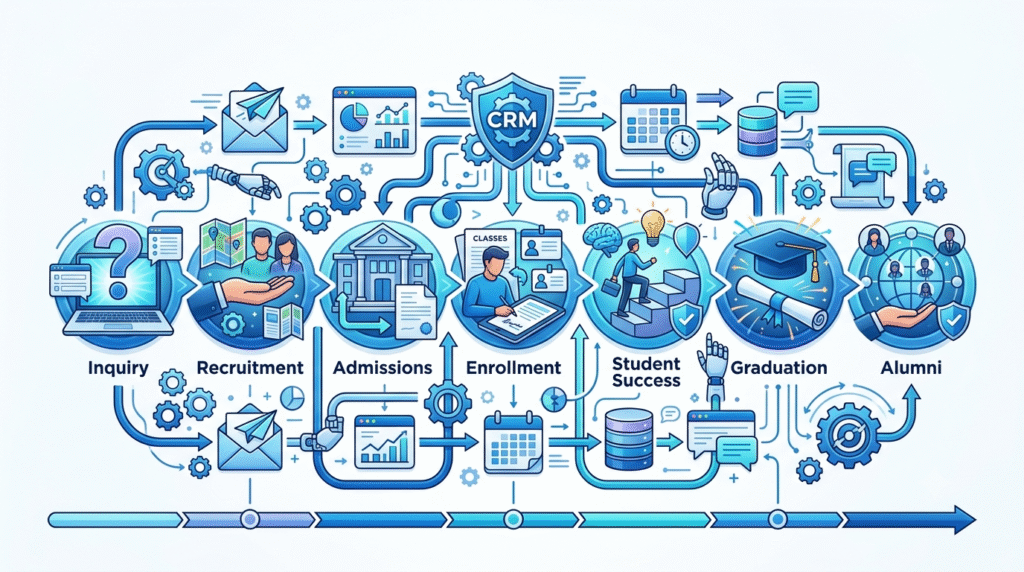
| Stage | How CRM Helps |
|---|---|
| Inquiry | Captures and scores leads automatically |
| Recruitment | Powers personalized outreach campaigns |
| Admissions | Tracks application status and missing documents |
| Enrollment | Automates confirmation and onboarding communication |
| Student Success | Flags academic risk, supports advising |
| Graduation | Tracks degree progress and milestones |
| Alumni | Manages events, giving campaigns, and outreach |
CRM vs. the Old Way of Doing Things
Spreadsheets and shared inboxes worked fine when class sizes were smaller and competition was lower. They don’t scale well now. Paper records get lost. Email threads get buried. A CRM doesn’t just digitize the process — it connects every department (admissions, advising, financial aid, alumni relations) to the same student record, so nobody is working off outdated information.
That said, this shift doesn’t happen without friction, and it’s worth being honest about that instead of pretending CRM adoption is effortless.
Common Roadblocks Worth Planning For
Staff adoption is usually the biggest one — people who’ve used the same spreadsheet for fifteen years don’t switch overnight just because leadership bought new software. Data migration from legacy systems can be messy and time-consuming. Integration with an existing SIS or LMS sometimes requires vendor support that takes months to sort out. Training takes real time away from day-to-day work, and budget constraints can stall rollout entirely at smaller institutions.
None of these are reasons to avoid a CRM — they’re just the realistic cost of doing it properly, and pretending otherwise sets projects up to fail.
Best Practices for a Rollout That Actually Sticks
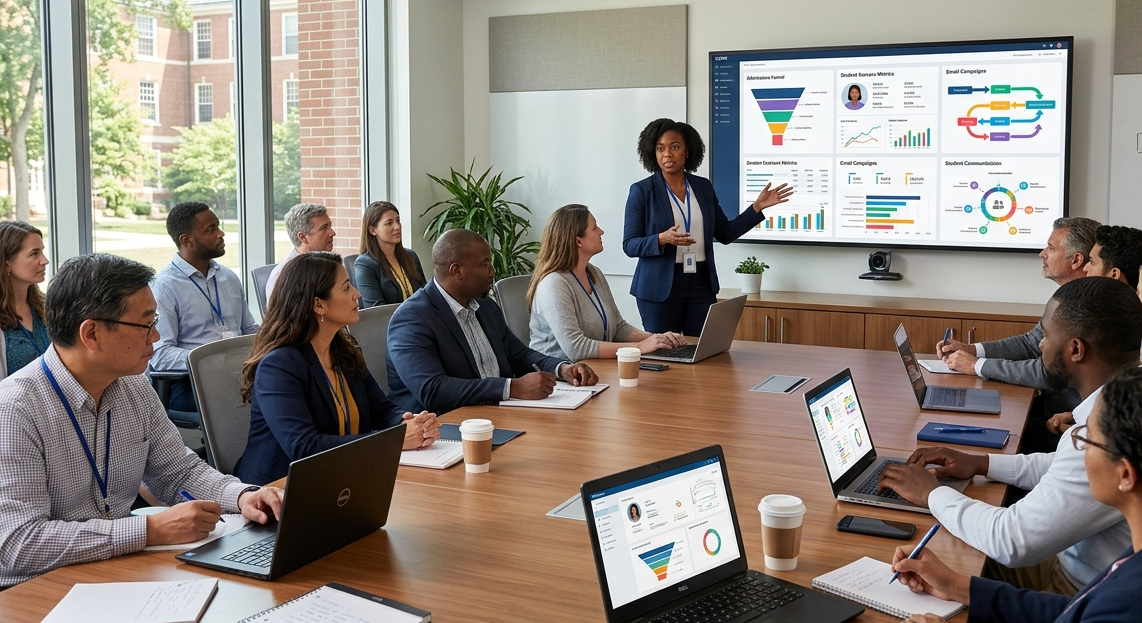
Start with clear goals instead of buying software first and figuring out the “why” later. Clean up existing data before migrating it — garbage in, garbage out applies here more than almost anywhere else. Train staff in stages rather than one overwhelming session. Make sure the CRM actually integrates with the SIS and LMS already in use. And set a handful of KPIs — response time, conversion rate, retention rate — to measure whether the investment is paying off, then actually revisit those numbers every semester instead of filing them away.
Teams that skip that last step tend to lose momentum fastest, and it’s worth building a repeatable review process — something covered in more depth in this piece on Teaching Competencies of Teachers, which touches on how ongoing staff development keeps new systems from stalling out after the initial rollout.
Frequently Asked Questions
What are the benefits of CRM in higher education?
Faster admissions processing, better retention through early risk detection, personalized communication at scale, and a single connected record across departments that used to work in isolation.
How is a CRM different from a Student Information System?
An SIS manages academic records — grades, transcripts, course registration. A CRM manages relationships and communication history across the full student lifecycle, including before someone is even enrolled.
Is CRM useful beyond admissions?
Yes. Advising, financial aid, student services, and alumni relations all benefit from the same centralized data, not just the recruitment funnel.
What are the benefits of CRM integration in the higher education admissions process specifically?
Integration means application status, communication history, and financial aid data all live in one place, which cuts down on the back-and-forth between departments that usually slows decisions down.
Do smaller colleges see the same benefits as large universities?
Generally, yes — sometimes more, since smaller teams feel the impact of manual, disconnected processes even faster than larger staffed offices do.
For more general context on how education-focused CRM tools compare to standard sales CRMs, EDUCAUSE’s research library is a solid starting point for administrators still evaluating vendors.
Where This Leaves Institutions
The benefits of CRM in higher education aren’t theoretical anymore — they show up in faster admissions cycles, students who get caught before they drop out instead of after, and departments that finally work from the same information. The rollout isn’t painless, and any school considering it should go in expecting some friction along the way. But for institutions competing for a shrinking pool of prospective students, the alternative — sticking with disconnected spreadsheets and hoping nothing falls through the cracks — is a much harder bet to make.