

Somebody says “novel study” and suddenly you’re not sure what it actually means, or what is a novel study supposed to look like in a real classroom. Simplest way to put it: it’s a structured approach to working through a full-length book together, instead of just handing a novel to students and telling them to read it cover to cover on their own. The book gets broken into sections. Each one comes with its own comprehension work, vocabulary practice, discussion, maybe some writing tied to it. Some teachers run the whole thing as one class; others split kids into small groups, or even let individuals move through it at their own pace. Whichever way it’s done, reading stops being a quiet, solitary task and turns into something students are actively doing together.
And here’s the part that trips people up. “Novel study” doesn’t mean the same thing everywhere. Say it in a classroom and everyone assumes fiction — chapters, characters, discussion questions. Say it in an academic context and it means something else entirely: a study that’s “novel” just means the research itself is new, original, not a repeat of something already done. Nothing to do with books. So this guide walks through both sides of it — what a novel study looks like in practice, how it changes for younger students, some real activity ideas, and how you’d actually put one together from scratch.
What Is a Novel Study?
A novel study isn’t just about getting to the last page. It’s a planned unit, built around a single text, where the teacher takes the story apart into manageable pieces and attaches comprehension questions, vocabulary work, and discussion to each one.
Picture the difference between reading a novel on the bus and reading that same book because it’s your book club pick this month. On the bus, you’re just moving through pages. In the book club, you actually stop you think about why a character did what they did, you start catching patterns you’d have missed otherwise, and you show up wanting to talk it through with someone. That’s basically the energy a novel study brings into a classroom.
Worth clearing up early: a novel study doesn’t have one fixed format. It can run whole-class, in small groups, or even one-on-one — and which version works best really comes down to the book itself, the class you’re teaching, and how much time you actually have to give it. There’s also a distinction worth making here, because people mix this up a lot. A novel study isn’t the same thing as a book club, and it isn’t a literature circle either. In those, students are usually the ones steering — picking the direction, deciding what to focus on. A novel study runs the other way. The teacher’s guiding it start to finish, even though there’s still plenty of room for discussion along the way.
Here’s a quick way to picture the difference between reading solo and doing a proper study:
| Reading a novel on your own | Doing a novel study |
|---|---|
| Mainly about finishing the book | About understanding and analyzing the book |
| Little to no discussion | Regular discussion and questions |
| Vocabulary learned incidentally | Vocabulary taught intentionally |
| No fixed structure | Planned activities and checkpoints |
| Usually independent | Usually guided or collaborative |
What Is the Purpose of a Novel Study?
The idea, at its core, is simple: use one book to build a whole stack of literacy skills at the same time. Comprehension, vocabulary, inference, writing — none of it happens in isolation. It’s all practiced through the same shared text, instead of getting scattered across a pile of worksheets that don’t connect to anything.
Done well, a novel study doesn’t let kids stop at “here’s what happened.” They’re pushed further than that — explaining why a character reacted the way they did, backing up an opinion with actual evidence pulled from the text, making a guess about what’s coming next based on clues they’ve already noticed. That’s the kind of thinking that actually builds comprehension. Just getting through the chapters doesn’t.
Novel studies also build reading stamina. Working through a full length book over several weeks trains students to stay focused and follow a longer story arc, something short passages and one-off worksheets just don’t ask of them.
What Does a Novel Study Include?
A solid novel study usually touches on a handful of core areas, even if the specific activities change depending on the book.
Reading and Comprehension
This is the foundation. Students summarize chapters, make predictions, pick out the main idea, and practice backing up their answers with evidence pulled straight from the text.
Vocabulary
New or tricky words from the book turn into a built-in vocabulary lesson. Students learn to use context clues, keep a running word journal, and practice using new words in their own sentences.
Our word study guide goes deeper into how this kind of vocabulary instruction ties into overall reading growth, if you want more on that specifically.
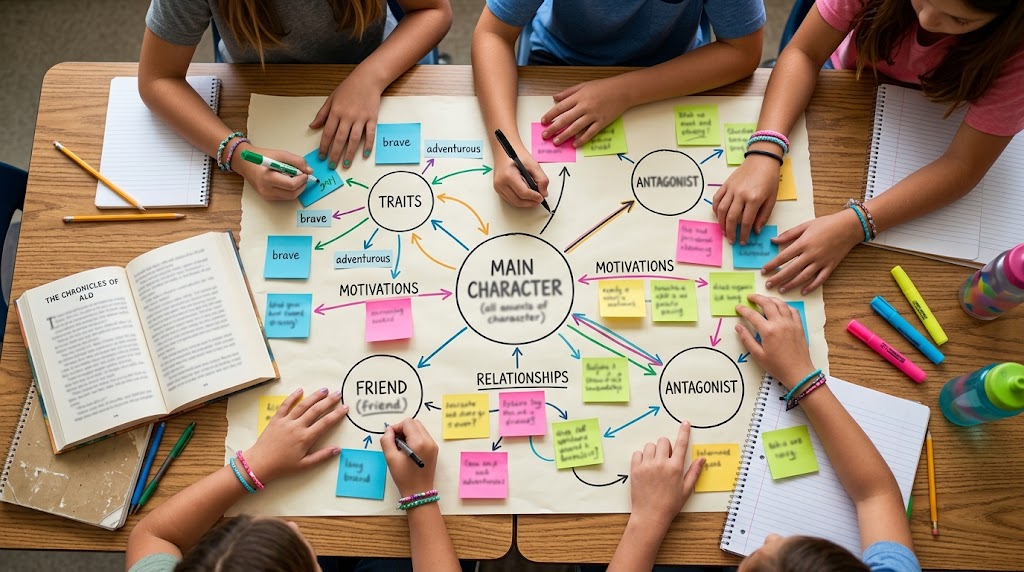
Character and Plot
Students track how characters change over the course of the story, what’s actually driving their decisions, and how the plot builds through setting, conflict, and resolution.
Themes and Critical Thinking
Beyond what happens on the page, students look at the bigger ideas a novel is exploring, morals, life lessons, the author’s message, and connect those back to their own lives.
Teacher Modeling During a Novel Study
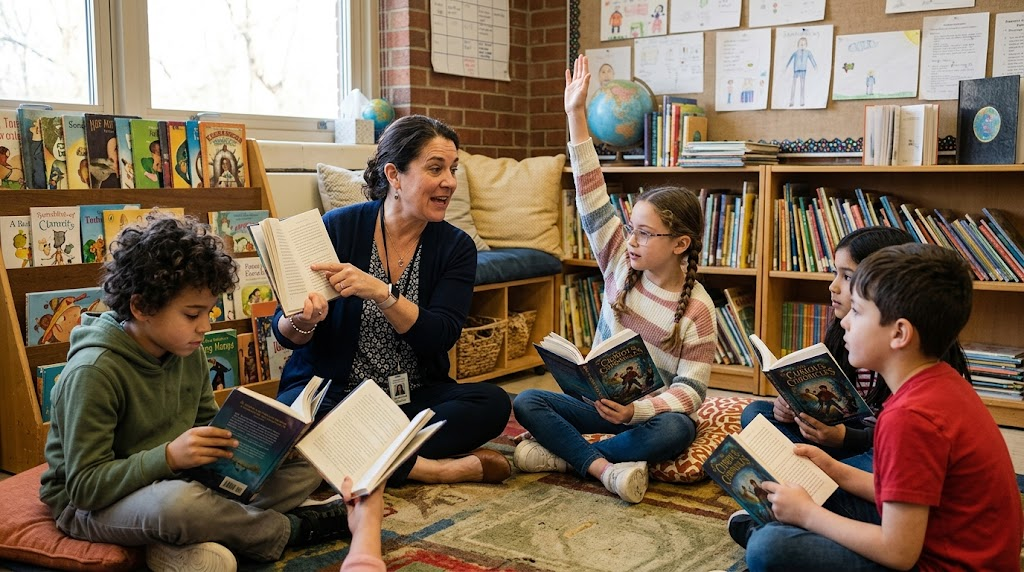
Part of why a novel study works so well: the teacher isn’t just assigning tasks and stepping back. They’re actually showing students what’s going on inside a skilled reader’s head. Reading aloud gives them the chance to do that in real time — pausing to predict what happens next, asking a question out loud, making an inference, summarizing what just went down, tying the story back to something real, flagging a new word, working through out loud why a character made the choice they did. Students pick up on that thought process just by watching it happen. And that’s a big reason a guided novel study tends to land better than just sending kids off to read on their own.
Writing, Speaking and Listening
Almost every novel study ends with some kind of response — could be a journal entry, a short essay, a group discussion, maybe a creative piece written from inside a character’s head. But writing isn’t really where most of the learning happens. A lot of it’s happening in conversation instead: waiting your turn, actually responding to what a classmate just said instead of just waiting to talk, explaining how you read the story, asking a follow-up question, sitting with a perspective that’s different from your own. Those speaking and listening muscles get worked just as hard through a novel study as the writing does.
How to Do a Novel Study: Step-by-Step
Running a novel study tends to follow a fairly predictable process, even though every teacher tweaks the details to fit their own class.
- Choose a novel that fits the reading level, age, and interests of the group.
- Set clear learning goals, whether that’s vocabulary growth, character analysis, theme identification, or something else entirely.
- Break the book into sections, often by chapter or by week.
- Prepare questions and activities for each section before reading starts.
- Read and discuss each section together or in small groups.
- Practice vocabulary and comprehension checks as you go.
- Assign written or creative responses tied to what was just read.
- Wrap up with a final assessment or project that pulls the whole book together.
This structure flexes depending on which format you’re using. A three-week unit built around a short middle-grade novel looks pretty different from a full-semester study of a longer classic, but the underlying steps stay basically the same whether you’re running it whole-class, in small groups, or with an individual student.
What Is a Novel Study in Primary Schools?
Primary school novel studies work the same way in concept, but they look pretty different in practice. Younger students usually need shorter chapters, more read-alouds, and a lot more scaffolding for vocabulary and comprehension.
Common features of a primary novel study:
- Read-alouds led by the teacher instead of independent reading
- Picture support and simple visuals tied to the story
- Oral discussion instead of long written responses
- Basic character maps and sequencing activities
- Short written or drawn responses instead of essays
Teacher Read-Alouds and Modeling
Read-alouds are especially useful in primary classrooms. The teacher reads out loud while students follow along, listen for key details, talk through predictions, and answer questions as they go. This lets younger students engage with richer, more complex texts than they could tackle alone, while the teacher openly models fluent reading and comprehension strategies in real time.
Speaking and Listening Practice
Most of a primary novel study happens out loud, not on paper. Kids are practicing taking turns, actually responding to what a classmate just said, sitting with an idea that’s different from their own. That matters a lot for reluctant or struggling readers especially — reading the book independently might be way out of reach, but they can still be part of the story through listening and talking it through with the class. A teacher reading aloud opens up books that would otherwise sit well above what these students could handle on their own.
Here’s roughly what a four-week structure might look like for a primary novel study: week one settles into characters and setting, week two shifts toward vocabulary and prediction work, week three gets into the main conflict along with comprehension checks, and week four closes things out with theme discussion and a short final response.
A Novel Study Example
Here’s what a mini novel study might look like for a grade four adventure novel, focused on character development.

| Activity | Student task |
|---|---|
| Before reading | Predict what the story’s about from the title and cover |
| During reading | Track the main character’s decisions |
| Vocabulary | Find and define five unfamiliar words |
| Discussion | Explain why the character made the choices they did |
| Writing | Describe how the character changed |
| Final task | Support an opinion using evidence from the text |
Common Novel Study Activities
Once the structure’s in place, activities are where a novel study actually comes to life. A few that consistently work well:
- Character maps: Track traits, motivations, relationships, and how a character changes.
- Vocabulary journals: Record unfamiliar words, definitions, context clues, and original sentences.
- Prediction charts: Students write down what they think will happen, then check whether it actually did.
- Chapter summaries: Students pick out the most important events instead of retelling everything.
- Discussion questions: Push students to explain their interpretation and back it up with evidence.
- Quote collection: Students pick out important passages and explain why they matter.
- Character diaries: Students write journal entries from a character’s point of view.
- Story timelines: Students lay out the major events in the order they happened.
- Theme tracking: Students collect evidence showing how a central idea builds through the novel.
- Creative responses: An alternative ending, a letter from a character, an illustration, or a short presentation.
One activity worth calling out on its own is teaching students to make connections beyond the page. There are really three types worth practicing: text-to-self, where a student links the story to something in their own life; text-to-text, where they compare the novel to another book or story they know; and text-to-world, where they connect it to something happening in the wider world. This kind of connection-making is also where inference comes in. A simple way to explain inference to students is that it’s what’s actually written in the text, combined with what the reader already knows, put together to reach a conclusion.
Reading circles are another solid option here, and ReadWriteThink has detailed, teacher-tested formats for running them, including assigned roles and discussion prompts.
For younger grades, our comprehension strategies for third grade post pairs really well with a primary novel study, since a lot of the same strategies apply directly to reading a shared class novel.
What Is a Novel Study in Research?
This is where things genuinely get confusing if you’re not paying attention, because outside a classroom, “novel study” stops meaning what you’d expect.
In academic or scientific research, calling something a “novel” study has nothing to do with fiction at all. It just means the research is contributing something new — that could be a new question nobody’s asked quite that way, a new method, a population that hasn’t really been studied before, or just a fresh angle on a problem people have already been chipping away at. In that context, “novel study” is really just shorthand for research that adds original value to a field instead of covering ground that’s already been covered.
This distinction matters because if someone’s searching “what is a novel study in research,” they’re almost certainly not asking about classroom reading instruction. They want to know what actually makes a piece of academic work original.
What Does It Mean When a Study Is Novel?
In plain English, novel just means new or meaningfully different, not necessarily something nobody’s ever come close to before. A study can be novel because it looks at an existing question from a new angle, uses a new dataset, applies an established method to a new population, or combines ideas from two fields in a way that hasn’t really been done before.
So a novel study in research doesn’t require reinventing an entire field. It just needs to move the conversation forward in some genuine way, even a fairly modest one.
Novel Study vs Simply Reading a Novel
Reading a novel on your own is usually about enjoyment, or just getting an assignment done. A novel study pairs that reading with structured investigation: discussion, vocabulary work, written analysis, and some form of assessment. Both have their place, but only one is actually built to develop measurable literacy skills over time.
Benefits of Novel Studies
Instead of teaching skills in separate, disconnected lessons, a novel study builds several at once. Comprehension goes deeper because students actually have to explain and defend their thinking, not just recall what happened. Vocabulary grows on its own, more or less, since new words keep showing up in context instead of sitting on some random list to memorize. Reading stamina builds too — sustaining attention across a full-length text asks a lot more of students than a short passage ever would. Discussion skills get sharper as well, since students are constantly explaining their read on things and pushing back on each other’s interpretations. And writing improves for a simple reason: students are writing about something they’ve genuinely thought through, not just answering a prompt that could’ve been dropped into any assignment.
Exposure to New Books and Perspectives
A shared novel can introduce students to authors, genres, settings, and perspectives they’d probably never pick up on their own. That matters a lot in elementary classrooms especially, where a teacher can use a shared reading experience to stretch students beyond the books they’d normally reach for.
Support for Reluctant Readers
Novel studies can be a real lifeline for reluctant readers. Even when independent reading feels like a struggle, students can still take part through listening, discussion, vocabulary work, and group activities. A teacher read-aloud gives them access to books that might otherwise be out of reach on their own, so they’re not left out of the shared experience just because reading solo is hard for them.
The National Reading Panel found strong support for teaching several comprehension strategies directly, including summarizing, questioning, and using graphic organizers. These strategies can be incorporated naturally into a novel study.
You can read more in the National Reading Panel’s report if you want the full research background behind this.
How to Create a Novel Study Guide
If you’re building one from scratch, a simple template beats an overly complicated one. Knowing what is a novel study supposed to accomplish before you start planning can make the whole process easier. The goal isn’t to turn every chapter into a worksheet, but to use the book as a starting point for comprehension, vocabulary, discussion, and deeper thinking.
That structure works for almost any book, at almost any grade level, with just small tweaks for age and reading level.
What Is a Novel Study Book?
A novel study book is the full-length book chosen as the central text for a novel study. Teachers typically choose one based on students’ age, reading level, interests, curriculum goals, and the literacy skills they want to develop.
Frequently Asked Questions
What is a novel study?
A novel study is a structured classroom approach to reading a full length novel, combining comprehension work, vocabulary building, discussion, and writing rather than just reading the book start to finish.
What is the purpose of a novel study?
The purpose is to build reading comprehension, vocabulary, critical thinking, and writing skills using one shared text as the anchor for all of it.
What is a novel study in primary schools?
In primary school, a novel study usually means shorter chapters, teacher-led read-alouds, oral discussion, and simpler written or drawn responses compared to what older grades do.
What is a novel study in research?
In research, a novel study is one that adds original value to a field, whether through a new question, method, dataset, or angle on an existing problem. It has nothing to do with reading fiction.
What does it mean when a study is novel?
In research, novel means new or original, a new question, method, dataset, or angle on an existing problem. It doesn’t require an entirely untouched topic.
Is a novel study the same as a book club?
They’re similar in spirit but different in structure. A book club tends to be more casual and choice-driven, while a novel study follows planned lessons, set goals, and formal assessment.
Is a novel study the same as a literature circle?
Not quite. A literature circle usually puts students in charge of discussion roles and direction, while a novel study is more teacher-guided from start to finish, even with plenty of discussion built in.
How long does a novel study usually take?
Most novel studies run somewhere between three and six weeks, depending on the length of the book and how many activities are built around it.
What activities are included in a novel study?
Common activities include character maps, vocabulary journals, prediction charts, discussion questions, chapter summaries, and a final written or creative response tied to the whole book.
What format can a novel study follow?
A novel study can run as a whole-class activity, in small groups, or one-on-one with an individual student, depending on the class size, the book, and the time available.
What’s the difference between text-to-self, text-to-text, and text-to-world connections?
Text-to-self links the story to something in the student’s own life, text-to-text compares it to another book or story, and text-to-world connects it to something happening in the wider world.
Do novel studies help struggling or reluctant readers?
Yes. Read-alouds and group discussion let reluctant readers take part through listening and conversation, even when reading independently feels difficult, so they’re not shut out of the shared experience.
Final Takeaway
What is a novel study? At its simplest, it’s a structured way of turning a full-length book into an active learning experience, with comprehension, vocabulary, discussion, writing, and critical thinking built around the story. The exact format can change depending on the grade level, group size, and book, but the basic idea stays the same. In research, the word “novel” has a completely different meaning and refers to something new or original. Understanding that distinction, and knowing which meaning applies to your situation, gives you a much clearer picture of the term.