Key Highlights
- Look for activities that develop basic motor skills and coordination.
- Expect a strong focus on language acquisition, speaking, and listening skills.
- Learn how social skills and emotional development are guided through group play.
- Understand the role of sensory activities in encouraging curiosity and discovery.
Introduction
The pre-nursery stage, typically for children aged two to three years, is a period of rapid development. At this age, toddlers transition from parallel play to active social engagement. A well-designed curriculum helps support this growth by offering structured, age-appropriate learning experiences. Guided activities during this stage encourage language expansion and early problem-solving skills. Consistent routines also help toddlers feel secure as they explore new environments and interactions.
When looking at a preschool in Singapore, understanding their approach to this age group is key. A high-quality pre-nursery curriculum focuses on sensory, social, physical, and cognitive development. Here are five key elements you should expect from a comprehensive program. Clear communication between teachers and parents should also form part of the programme’s framework. This partnership ensures that developmental progress is reinforced both at school and at home.
1. Active Language and Communication Development
At the pre-nursery stage, building language skills is a key developmental focus. A high-quality pre-nursery curriculum encourages communication through interactive story sessions, songs, rhymes, and daily conversations. These structured interactions create repeated opportunities for children to listen, respond, and experiment with new words. Consistent exposure to meaningful dialogue lays the groundwork for stronger comprehension and verbal fluency.
Educators guide children to express their needs, share ideas, and follow simple instructions. This immersion in a language-rich environment helps toddlers expand their vocabulary and build the communication skills they need to express themselves confidently. Positive reinforcement further motivates children to participate without fear of making mistakes. Over time, this confidence strengthens social interaction and early literacy readiness.
2. Structured Opportunities for Social and Emotional Growth
Learning to interact with peers is an important milestone for toddlers. In a supportive preschool setting, children learn to take turns, share toys, and work together on simple group activities. These guided interactions help them understand boundaries and respect for others. Over time, regular peer engagement strengthens communication skills and cooperation.
Teachers help children identify and manage their emotions, fostering empathy and resilience. These early social experiences teach children how to build positive relationships and adapt to group dynamics outside the home. By modelling constructive behaviour, educators reinforce problem-solving and conflict resolution skills. This foundation supports smoother transitions into more structured academic environments later on.
3. Focus on Sensory-Based and Hands-On Learning
Toddlers learn best by exploring the world around them using all their senses. A good curriculum includes plenty of hands-on activities, such as playing with clay, water, sand, and finger paints. These varied experiences allow children to experiment freely in a safe and guided setting. Repetition through play also reinforces neural connections that support long-term learning.
These sensory experiences stimulate brain development and encourage natural curiosity. By touching, sorting, and observing different materials, children build early mathematical and scientific concepts like size, shape, and texture. They also strengthen fine motor skills that are essential for writing and self-care tasks. Over time, this foundation supports smoother transitions into more structured academic activities.
4. Development of Fine and Gross Motor Skills
Physical development is crucial for building independence in young children. Pre-nursery activities are designed to develop both large muscle groups (gross motor) and small hand muscles (fine motor).
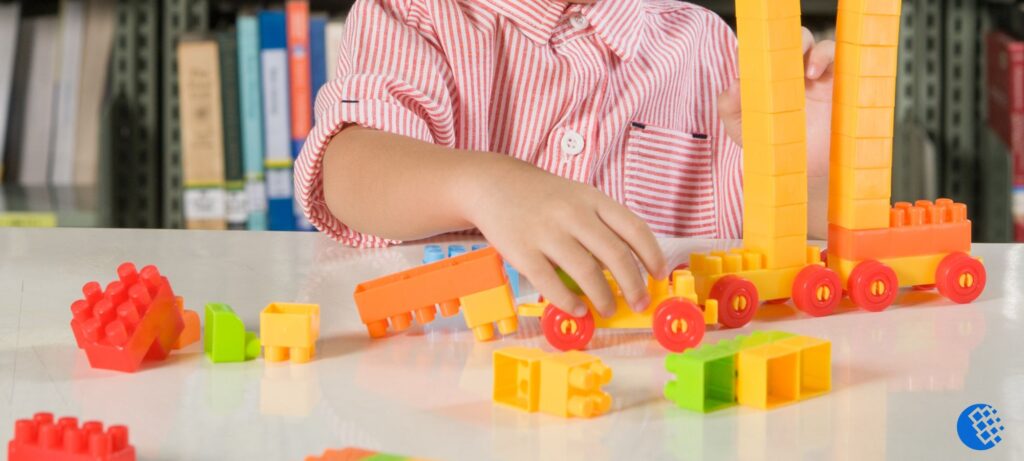
Gross motor activities include running, jumping, balancing, and climbing during outdoor play. Fine motor activities focus on holding crayons, threading large beads, using child-safe scissors, and building with blocks, which helps prepare children for writing later on.
Conclusion
A high-quality pre-nursery curriculum provides a balanced foundation of play, social interaction, and early learning. By focusing on holistic development, it helps toddlers build the confidence, physical coordination, and social skills they need for future nursery and kindergarten levels.
Choosing an established preschool ensures your child enjoys a nurturing, structured environment that encourages a lifelong love of learning.
To discover how our pre-nursery programme can support your child’s early development, contact E-Bridge Pre-School today to speak with our educators.