

For most organizations, utility bills are treated as unavoidable fixed costs—monthly invoices that get approved and paid with very little attention. But this passive approach to energy spending often hides a bigger problem: relying on default utility rates or renewing contracts without proper review can slowly increase your operating expenses over time. Electricity and natural gas prices constantly shift, and how a business chooses to source its energy can directly impact profit margins and financial stability.
This is why business energy procurement is becoming such an important part of modern corporate strategy. When companies actively manage their energy contracts instead of simply accepting standard renewals, they gain more control over costs, reduce exposure to market volatility, and create a more predictable long-term budgeting structure.markets.
What Is Business Energy Procurement?
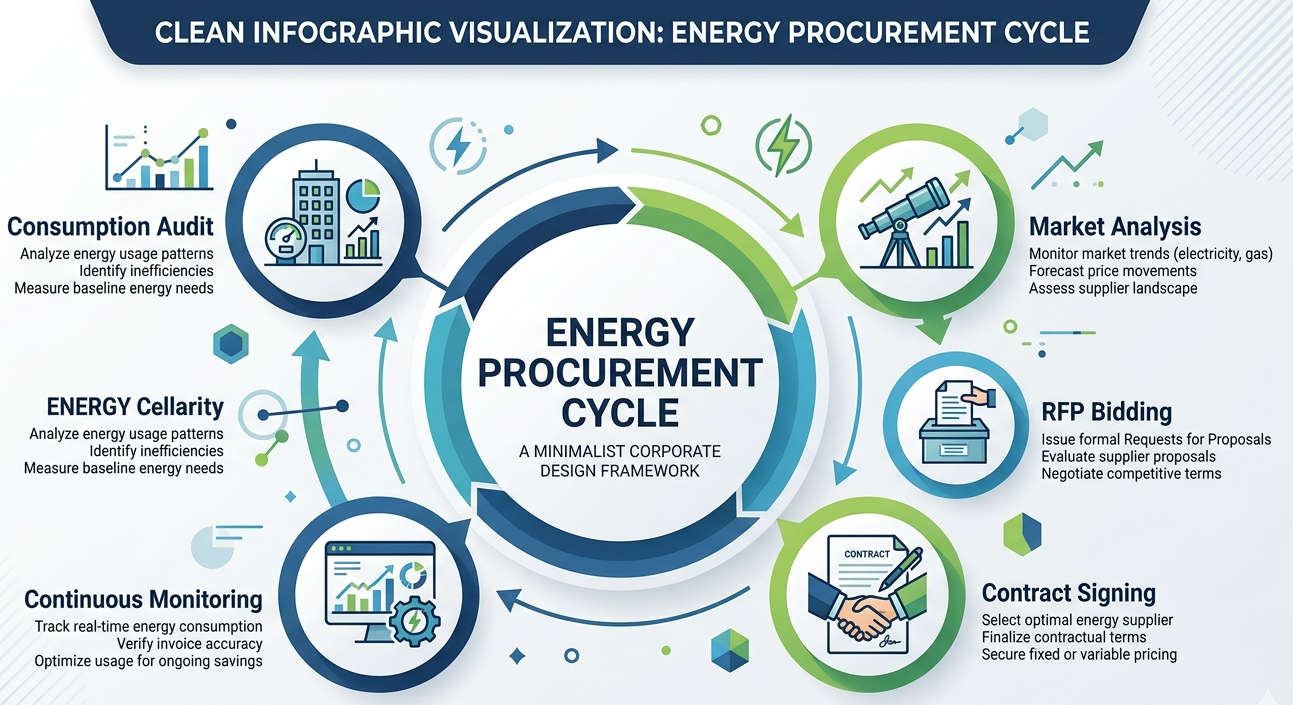
Business energy procurement is the strategic process businesses use to source, negotiate, and manage electricity and natural gas contracts while controlling costs, reducing risk, and meeting sustainability goals. Rather than simply accepting default utility rates, companies actively evaluate the retail energy market to secure favorable terms, mitigate pricing risks, and fulfill environmental or sustainability mandates.
+-----------------------------------------------------------------+
|                    THE PROCUREMENT CYCLE                        |
|                                                                 |
|  [1. Consumption Audit]  -->  [2. Market Risk Assessment]       |
|                                         |                       |
|  [4. Continuous Monitoring] <--  [3. Tender & RFPs]             |
+-----------------------------------------------------------------+
While residential users are largely bound to standard, regulated utility tariffs, commercial entities have the opportunity to leverage their consumption volume. By entering the wholesale energy market through retail energy providers, businesses can customize how and when they purchase their power.
Why Energy Procurement Matters for Businesses
A passive approach to utilities exposes an organization to unnecessary market volatility. Implementing a formal process for business energy procurement provides several distinct operational advantages. Optimizing commercial utilities functions similarly to general capital management. For instance, just as tracking corporate cash flow requires deliberate oversight—similar to deploying Smart Budget Intelligence Strategies—managing utility portfolios requires structured oversight to prevent waste.
Benefits of Energy Procurement for Businesses
Taking a structured approach to your utility contracts yields measurable improvements across financial and operational benchmarks. When launching a competitive sourcing initiative, organizations unlock several distinct advantages:
- Lower Utility Costs: Active negotiations and competitive bidding force energy suppliers to offer sharper pricing than their standard renewal rates, directly cutting overall utility expense and contributing to long-term utility expense reduction.
- Better Forecasting: Locking in fixed pricing or structured blocks gives financial teams accurate data for demand forecasting, removing the guesswork from quarterly budgeting.
- Supplier Competition: Running a formal Request for Proposal (RFP) forces retail energy providers to compete for your load profile, ensuring you receive the most aggressive commercial energy contracts available.
- Sustainability: A formal procurement strategy allows companies to source verifiable green energy, assisting corporate sustainability teams in hitting carbon-reduction and net-zero goals.
- Risk Reduction: Customized corporate energy management structures insulate your bottom line from unexpected pricing spikes in volatile wholesale commodity markets.
Types of Energy Procurement Contracts
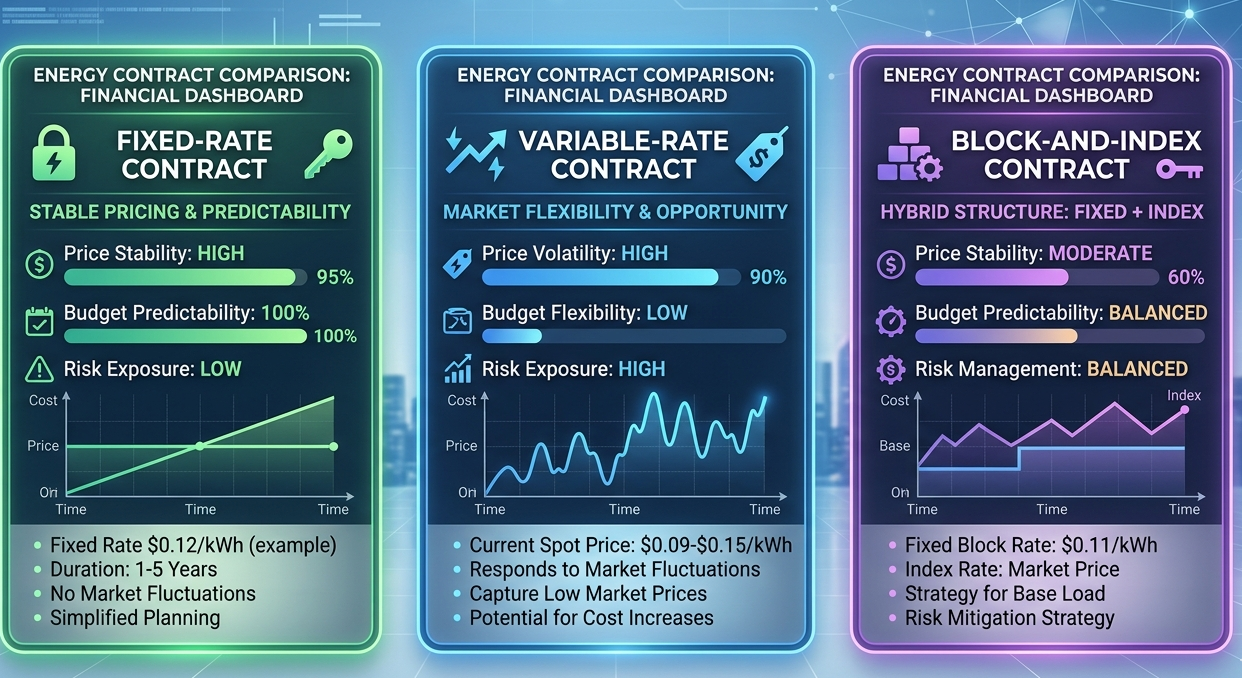
There is no universal energy contract that fits every enterprise. Suppliers structure their agreements into different risk-allocation models, and selecting the right structure depends entirely on your corporate budget flexibility and operational goals.
Fixed-Rate Contracts
Under a fixed-rate structure, you lock in a set price per kilowatt-hour (kWh) or therm for a defined duration, typically ranging from 12 to 48 months.
- Advantages: Complete budget stability and maximum price certainty. Your electricity pricing remains entirely unaffected by geopolitical events, supply constraints, or seasonal grid spikes.
- Disadvantages: If wholesale energy prices drop significantly during your contract term, you cannot capitalize on those lower rates.
Variable Contracts
Variable or index-linked contracts pass market fluctuations directly to the consumer. Your monthly rate moves in tandem with prevailing wholesale market indexes and natural gas pricing.
- Advantages: This model allows companies to take immediate advantage of market drops without being tied to a premium fixed rate during a down-market cycle.
- Disadvantages: Exposure to extreme price spikes during periods of peak grid stress or fuel shortages can lead to budget overruns.
Block and Index Contracts
A hybrid approach often favored by high-volume consumers. A business purchases a predetermined, fixed baseline “block” of energy to secure its core operational hours, while any supplemental power required during peak surges is bought at variable index rates. This method balances baseline price protection with the flexibility to manage variable demand shifts.
Sourcing Contract Comparison
| Contract Type | Price Certainty | Market Flexibility | Best Fit For |
| Fixed-Rate | Maximum | None | Strict, predictable budgets; risk-averse organizations. |
| Variable (Index) | Minimum | Maximum | Flexible operating budgets; low wholesale market peaks. |
| Block & Index | Moderate | Moderate | Large-scale industrial and commercial consumers. |
Business Energy Procurement Process
Securing a commercial utility contract requires clear operational steps to ensure you gain maximum leverage during supplier negotiations.
- Historical Usage Analysis: Before reviewing open market rates, gather at least 12 to 24 months of consecutive utility statements. You need to analyze your baseline consumption, peak demand hours, and seasonal load shapes. Suppliers require this specific data to price your risk profile accurately.
- Market Timing and Risk Assessment: Wholesale energy markets fluctuate daily based on weather forecasts, fuel inventory levels, and macroeconomic trends. Professional strategic sourcing teams track these forward curves to issue tenders when macro market conditions are favorable, rather than waiting until an existing contract is days away from expiration.
- Managing the Competitive Tender: Create a formal Request for Proposal (RFP) specifying your volumetric requirements, preferred contract lengths, and specific terms. Distribute this tender to multiple vetted retail suppliers to drive competitive pricing.
- Contract Analysis and Final Execution: When reviewing bids, look past the initial headline rate. Carefully audit the contract terms for hidden costs, such as capacity charges, bandwidth clauses (penalties applied if your business consumes significantly more or less energy than forecasted), and pass-through charges.
- Continuous Optimization: The procurement lifecycle does not conclude when a contract is executed. Organizations must consistently track their bills for billing errors, verify that contract terms are being met, monitor ongoing market developments for future extension windows, and optimize overall supply chain management.
Business Energy Procurement Services
Navigating complex wholesale markets requires specialized data, advanced utility management tools, and deep industry experience. Many companies partner with outside experts to execute an effective energy purchasing strategy:
- Consultants: Procurement consultants provide holistic, ongoing strategic support. Beyond simply running utility tenders, they handle complex services like long-term market risk modeling, detailed bill auditing, regulatory compliance tracking, and carbon accounting. They usually operate via an independent fee-for-service model or a monthly management retainer.
- Brokers: Primarily act as transactional intermediaries. They collect quote sheets from various suppliers and present them to your team. Brokers are typically paid through a small commission fee embedded directly into the final per-kWh or per-therm rate you sign.
- Procurement Firms & Managed Services: These specialized energy sourcing solutions take over the entire utility lifecycle. They deploy end-to-end management frameworks that handle vendor evaluation, contract negotiation, and continuous portfolio performance monitoring, allowing internal teams to focus on core operations.
Partnering with an independent consultant helps ensure your sourcing strategy adapts naturally as your operations grow. Taking advantage of these specialized external services allows a business to stay nimble and efficient—much like a modern company transitions to digital financial ecosystems, as discussed in our look at the operational Benefits of Online Banking: Advantages.
Renewable Energy Procurement for Businesses
Environmental, Social, and Governance (ESG) frameworks have shifted renewable energy procurement for businesses from an optional corporate PR initiative into a core operational requirement. Implementing a clean energy sourcing strategy reduces scope 2 emissions and helps organizations insulate themselves from future carbon taxation while hitting net-zero goals.
+-------------------------------------------------------------------+
|                    RENEWABLE SOURCING OPTIONS                     |
|                                                                 |
|  [Green Tariffs]          [On-Site Generation]      [PPAs & RECs]  |
|  Premium utility plans    Solar arrays/microgrids   Long-term off- |
|  for clean power.         for direct control.       site assets.   |
+-------------------------------------------------------------------+
Organizations pursuing this avenue frequently integrate several core renewable entities into their utility management mix. This includes purchasing Renewable Energy Certificates (RECs) to offset conventional usage, utilizing solar energy and wind energy through direct on-site infrastructure, or entering into off-site supply agreements. For larger enterprises, matching these options with overall Cost Reduction Strategies for Businesses ensures that sustainability initiatives remain fundamentally profitable.
How to Procure Renewable Energy for My Business
Transitioning a commercial portfolio to renewable power requires a structured, multi-step implementation framework to avoid overpaying for green premiums.
Step 1: Audit Consumption
Begin by gathering historical utility contracts and load profiles to establish a clear baseline of your annual megawatt-hour (MWh) consumption.
Step 2: Set Sustainability Goals
Define clear organizational benchmarks, specifying what percentage of your power must come from clean sources and aligning those targets with your corporate ESG reporting timelines.
Step 3: Compare Suppliers
Evaluate retail energy providers based on their green power mix, verification methods, and potential premium charges over conventional electricity procurement options.
Step 4: Consider RECs
For locations where direct green generation is unavailable, purchase Renewable Energy Certificates (RECs) to legally substantiate your environmental claims.
Step 5: Evaluate PPAs
Explore entering into Power Purchase Agreements (PPAs) with developers. These long-term commitments fund new wind energy or solar installations off-site, giving you fixed price protection and direct carbon emissions reductions. According to guidance from the U.S. Department of Energy, utilizing structured PPAs can protect large organizations from long-term electricity price volatility while adding new renewable power directly onto the regional grid.
Step 6: Monitor Performance
Continuously audit your monthly statements against green contract clauses to ensure all carbon credits and renewable generation allocations are properly credited to your account.
Who Provides Energy Procurement for Commercial Real Estate Businesses?
Sourcing utilities for multi-tenant commercial real estate requires specialized business energy procurement services capable of balancing landlord infrastructure costs with complex tenant sub-billing.
Asset managers frequently turn to enterprise utility management consultants and specialized energy procurement firms to consolidate accounts across disparate geographic regions. These specialists aggregate total portfolio demand to maximize bargaining leverage with national suppliers, establish unified utility contracts, and ensure that all building-level data integrates smoothly into annual investor ESG reporting metrics.
Who Provides Energy Procurement for Private Equity Businesses?
For private equity operations, managing energy expenses across an entire family of portfolio companies offers an excellent opportunity to capture hidden value.
Rather than allowing individual mid-market businesses to run an independent energy purchasing strategy, private equity firms utilize centralized energy procurement consultants to aggregate total energy spend across the entire fund. Tendering the total combined demand of dozens of corporate entities simultaneously gives them immense bargaining power with regional suppliers. This centralized approach drives down overhead costs and systematically boosts earnings before interest, taxes, depreciation, and amortization (EBITDA) across the entire portfolio.
Expert Insider Insights on Commercial Utility Contracts
Author Experience Section: Having worked alongside organizations evaluating complex commercial utility contracts, one recurring challenge I see is that businesses focus almost solely on headline unit rates while completely ignoring pass-through charges, bandwidth penalties, and renewal clauses. These hidden contractual elements frequently outweigh the superficial savings promised on the cover page. True energy cost management requires analyzing the structural terms of the entire contract, not just the initial cost per kilowatt-hour.
Common Mistakes to Avoid
- Waiting Until Contract Expiration: Delaying your market search until your current utility contracts are days away from expiring strips away your bargaining leverage and forces you into unfavorable default renewal rates.
- Ignoring Bandwidth Clauses: Many buyers fail to check volumetric flexibility clauses. If your operational volumes swing significantly during the year, a strict bandwidth clause can trigger heavy financial penalties for under-consumption or over-consumption.
- Failing to Audit Bills: Assuming that utility bills are always accurate is a costly mistake. Monthly bills often contain regulatory errors, incorrect pass-through calculations, or mistaken capacity charges that go unnoticed without consistent auditing.
Business Energy Procurement Checklist
Use this checklist to keep your sourcing strategy aligned with institutional best practices:
- [ ] Analyze usage: Compile 12 to 24 months of utility data, load profiles, and demand forecasting metrics.
- [ ] Review contract expiry: Identify renewal windows at least six to nine months in advance of expiration dates.
- [ ] Monitor markets: Track wholesale energy market forward curves to time your tender effectively.
- [ ] Compare suppliers: Issue a comprehensive RFP to multiple retail energy providers to spark competition.
- [ ] Negotiate pricing: Assess fixed, variable, and block contract options against corporate risk thresholds.
- [ ] Review contract terms: Inspect the fine print for bandwidth tolerances, pass-through charges, and termination clauses.
- [ ] Track performance: Implement continuous bill auditing and vendor evaluation via supplier scorecards.
Commercial Sourcing FAQS
How Businesses Access Supplier Performance Data During Energy Procurement
To properly assess supplier performance, organizations should implement standardized vendor scorecards during contract reviews. This performance data is gathered by tracking historical billing accuracy, evaluating the responsiveness of account management teams, and checking supplier financial credit ratings through market intelligence platforms. Many enterprises also work alongside independent utility consultants who maintain comprehensive databases detailing regional supplier performance, dispute resolution speeds, and contract compliance histories.
How Energy Tender Affects Your Business Procurement
An energy tender completely changes negotiation dynamics by shifting leverage back to the corporate buyer. When multiple energy suppliers are forced to openly bid for a business’s consolidated utility load, they must trim their profit margins to remain competitive. This structured competition creates complete pricing transparency, uncovers hidden pass-through variances, and encourages suppliers to offer more flexible contract terms—such as relaxed volume consumption requirements—that they rarely include in standard, non-competitive contract extensions.
Strategic Summary for Corporate Buyers
Executing a successful commercial energy program requires shifting away from short-term, reactive purchasing and focusing instead on a proactive, data-driven strategy. To maximize your market leverage, remember to audit early, understand your specific risk threshold, and carefully read the operational fine print.
By treating utility sourcing as a core financial priority rather than an automated facility expense, your organization can protect itself from volatile energy markets, unlock valuable operational savings, and build a sustainable framework for long-term growth. For deeper frameworks on aligning commercial operations with broader resource efficiency goals, consult the global market insights provided by the International Energy Agency as well as clean energy compliance frameworks mapped out by the Environmental Protection Agency.