
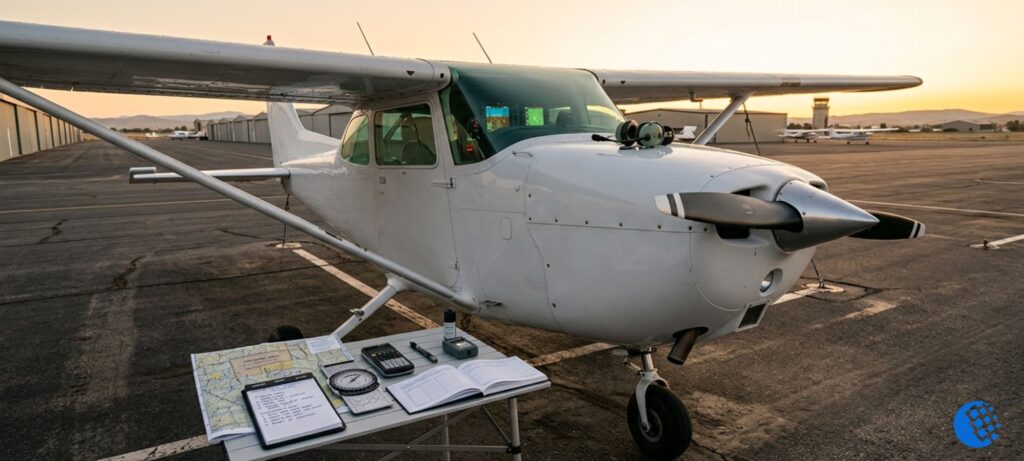
If you’re staring down your commercial checkride and wondering where to even start, this commercial pilot study guide is built to answer that one question: what do you actually need to know, and in what order should you learn it? Between the FAA knowledge test, the oral exam, and the practical test, it’s easy to end up with ten browser tabs open and no real plan. This guide pulls it into one place the written test, the Airman Certification Standards, checkride prep, and a study schedule you can actually follow.
Whether you’re calling it a commercial pilot study guide or a commercial pilot license study guide, you’re looking for the same thing a clear path through the FAA written exam, the oral exam, and the checkride, without wasting weeks on material that isn’t actually tested.
Note: This guide is focused on the U.S. FAA commercial pilot certificate for the airplane category. Requirements and testing standards differ in other countries, so if you’re training under a different civil aviation authority, treat the general study approach as useful but check your own regulator’s material for specifics.
What Is a Commercial Pilot Study Guide?
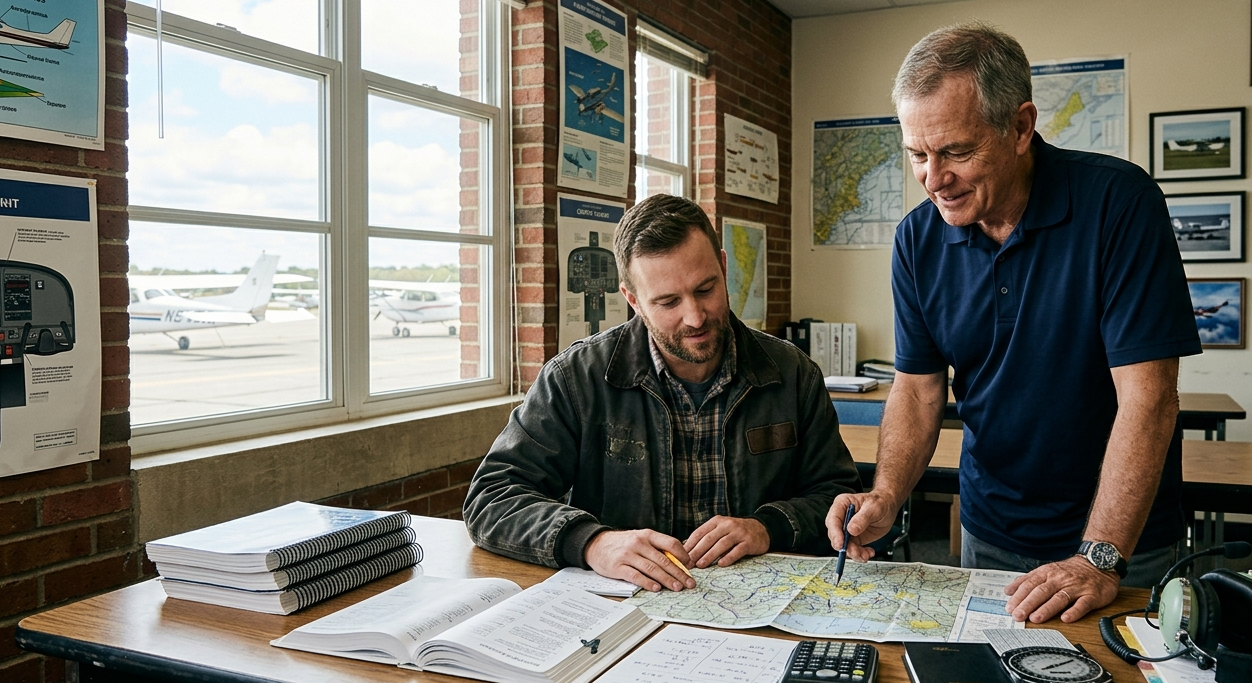
A commercial pilot study guide isn’t a replacement for your ground school or your flight instructor it’s a map of what to study and when. The FAA’s Commercial Pilot – Airplane Airman Certification Standards (ACS) is the official document your examiner, sometimes called a DPE (Designated Pilot Examiner), works from but it’s written as a testing standard, not a textbook. It tells you what you need to know and how well you need to know it, without necessarily explaining the material itself. That’s where a commercial pilot license study guide earns its keep it takes those ACS Areas of Operation and turns them into an actual study plan, pointing you toward the FAA handbooks and regulations that cover each topic in depth.
Commercial Pilot License Study Guide: What You Need to Study
A commercial pilot license study guide really comes down to seven knowledge areas. You’ll see all of these show up again in the ACS Areas of Operation, so treat this as your syllabus.
Aerodynamics
Lift, drag, thrust, and weight, plus how they interact during stalls, steep turns, and slow flight. Commercial-level flying asks you to understand why an airplane behaves a certain way, not just how to react to it so spend real time on stability and control, load factors, and the aerodynamics behind the commercial maneuvers you’ll fly on the checkride.
Aircraft Systems
Engine operation, fuel systems, electrical and hydraulic systems, flight controls, landing gear, propellers, and instruments. If you’re training in a complex or technically advanced airplane (TAA) often one with a G1000 or similar glass-panel avionics suite this section gets a lot bigger. Know your systems well enough to explain them to an examiner without a diagram in front of you.
Weather
This is where a lot of applicants lose points they didn’t need to lose, mostly because METARs and TAFs look like a wall of code the first few times you see one. They’re not they’re just abbreviated the same way every time.
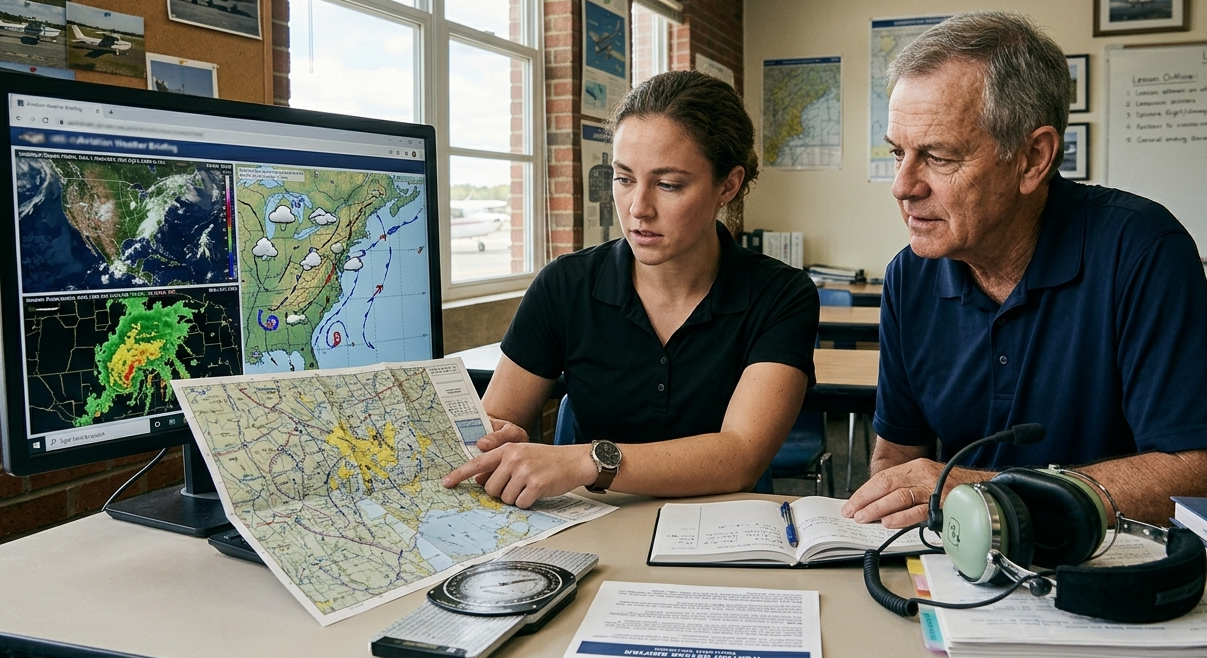
Take a typical METAR: KATL 171652Z 31013KT 1 1/2SM -RA BR BKN006 BKN012 OVC024 13/12 A2991 RMK A02 SFC VIS 3 SLP127 CIG 004V008 P0003 T01280117. Broken down, that’s Atlanta’s airport reporting on the 17th at 1652 Zulu: wind out of 310° at 13 knots, 1½ statute miles of visibility, light rain and mist, three cloud layers (broken at 600 and 1,200 feet, overcast at 2,400 feet), 13°C with a 12°C dew point, and an altimeter setting of 29.91. The remarks section adds detail an automated station with a precipitation sensor, a slightly different surface visibility reading, a variable ceiling, sea-level pressure, hourly precipitation, and temperature to a tenth of a degree.
TAFs work the same way but forecast conditions instead of reporting them, using FM (from), TEMPO (temporary), and BECMG-style change groups to show how conditions are expected to shift over the valid period. Once you can read one line of either report fluently, the rest is just repetition memorize the descriptor and precipitation codes (RA for rain, BR for mist, TS for thunderstorm, and so on) and the reports stop feeling like a foreign language.
Beyond decoding reports, know the mechanics behind thunderstorms the cumulus, mature, and dissipating stages along with wind shear and microbursts, since these show up constantly in both the knowledge test and the oral exam.
Navigation
Sectional charts, airspace classes, VOR and GPS navigation, pilotage, dead reckoning, and cross-country planning. Commercial applicants are expected to plan and explain a cross-country with real fuel, weight, and performance numbers, not just draw a line on a chart.
Performance
Weight and balance, density altitude, and takeoff/landing performance calculations using your specific aircraft’s charts. Be ready to work these by hand examiners routinely ask you to prove a number, not just state it.
Regulations
Commercial applicants need to know 14 CFR Part 61 (certification of pilots) and Part 91 (general operating rules) well beyond the level a private pilot does, especially the sections that define what a commercial certificate actually lets you do. §61.129 lays out the aeronautical experience requirements to even sit for the certificate, and §61.133 is the one examiners lean on hardest in the oral it spells out both the privileges and the limitations attached to your certificate.
Human Factors and Aeronautical Decision-Making
Risk management, hazardous attitudes, fatigue, and situational awareness. This is a growing part of the oral exam examiners like scenario-based questions that force you to talk through a decision process rather than recite a definition.
Commercial Pilot Privileges and Limitations
This is one of the areas where applicants sound the least prepared, mostly because they’ve memorized that a commercial certificate means “getting paid to fly” without knowing where the actual line sits.
Common Carriage vs. Private Carriage
Common carriage means holding yourself out to the public as willing to transport persons or property think a charter service. That level of operation requires Part 119 certification (usually tied to Part 135), not just a commercial certificate on its own. Private carriage is narrower and doesn’t require that additional certification, which is why most new commercial pilots start in private-carriage-style jobs banner towing, aerial survey, ferry flights rather than jumping straight into charter work.
Compensation or Hire
Under §61.133, a commercial certificate lets you act as pilot in command of an aircraft carrying persons or property for compensation or hire, provided you’re otherwise qualified for the specific operation under the applicable parts of the regulations. That last clause matters the certificate alone doesn’t clear every operation; the operating rules for that specific flight still apply.
Commercial Pilot Restrictions
The restriction examiners ask about most often: without an instrument rating, §61.133(b) prohibits carrying passengers for hire at night or on cross-country flights beyond 50 nautical miles in a single-engine airplane. That limitation gets removed once you add the instrument rating which is exactly why so many commercial pilots go straight into instrument training right after the checkride.
Commercial Maneuvers Worth Knowing Cold
The practical test standards get specific about commercial maneuvers, and each one has a shape you need to know before you’re in the airplane fighting to remember it mid-turn. The numbers below are the general pattern of each maneuver to help you study the concept your current Commercial Pilot – Airplane ACS is the actual authority on tolerances, and your instructor will fine-tune these to your specific aircraft.

- Chandelles generally entered around a 30° bank, with smooth, coordinated back pressure applied through a constant-rate rollout, arriving at the 180° point just above stall speed with the rollout complete.
- Lazy eights a gradual climbing turn toward roughly a 30° bank and your slowest pitch attitude near the 90° point, then a slow roll-out while descending back toward the 135° and 180° points, ending straight and level at your original heading, altitude, and airspeed.
- Steep spirals power idle, best glide airspeed, three complete 360° turns around a ground reference point with wind-drift correction to hold a constant radius, rolling out on a specified heading.
- Eights on pylons flown around your pivotal altitude, using roughly a 30–40° bank to hold a wingtip reference on each pylon as you cross a downwind 45° line between them.
All of these have a hard floor under the current ACS most commercial maneuvers must be completed no lower than 1,500 feet AGL so treat your altitude minimums as seriously as the maneuver’s shape, and always confirm exact tolerances against the current ACS revision rather than any secondhand summary, including this one. The math behind these maneuvers bank angles, load factors, pivotal altitude is exactly why pilots lean on strong math skills well before they ever sit a checkride.
Commercial Pilot Study Guide PDF: Free FAA Resources to Download
A lot of searches for an FAA commercial pilot study guide PDF end with someone downloading a random, possibly outdated file, or a “commercial pilot cheat sheet” that’s a few revisions behind. Skip that and go straight to the source the FAA publishes everything you need, for free, in current editions.
| Resource | What It’s Useful For |
|---|---|
| Commercial Pilot – Airplane ACS (FAA-S-ACS-7B) | The certification standards your examiner tests you against |
| ACS Companion Guide (FAA-G-ACS-2) | Testing procedures and how to interpret the ACS |
| Pilot’s Handbook of Aeronautical Knowledge | Core aeronautical knowledge, chapter by chapter |
| Airplane Flying Handbook | Flight techniques and commercial maneuvers |
| FAR/AIM | Regulations and operating procedures |
| Airman Knowledge Testing Supplement | The charts and figures used on the actual knowledge test |
Downloading straight from the FAA also means you’re never studying from an outdated repost editions get revised, and third-party PDFs floating around forums rarely get updated.
Commercial Pilot ACS Study Guide: How to Actually Use the ACS
The ACS is the single most useful document you own for this checkride, but only if you use it as a checklist rather than a reference you skim once. Here’s a workable process:
- Download the current Commercial Pilot – Airplane ACS (FAA-S-ACS-7B) directly from the FAA.
- Go Area of Operation by Area of Operation don’t skip around.
- Read every Task inside each Area, including the knowledge, risk management, and skill elements.
- Cross-reference each Task with the FAA handbook chapter it points to.
- Write your own notes in plain language if you can’t explain a Task without your notes, you don’t know it yet.
- Practice saying the answer out loud, the way you would to an examiner.
- Connect each Task to a real flight scenario you’ve actually experienced.
- Go back through your weak Areas of Operation in the week before your checkride.
The current standard is FAA-S-ACS-7B, effective since May 2024, and it supersedes the older 7A revision worth double-checking you’re not studying from an outdated PDF someone reposted years ago.
Commercial Pilot Checkride Study Guide
Split your checkride prep into three stages, because each one tests something different.
Before the checkride: get your logbook, aircraft records, endorsements, medical, and knowledge test results organized well before your test date. Examiners have ended checkrides before they started over missing paperwork don’t be that story.
Oral exam: think of this less as a commercial pilot oral exam guide with fixed questions and more as a conversation an examiner steers using the ACS. Expect questions across regulations, weather, aircraft systems, performance, navigation, risk management, and commercial pilot privileges and limitations, usually framed as scenarios rather than dry recall (“you’re dispatched on this flight walk me through your decision-making”). There’s no fixed question bank, since the actual oral exam depends on your aircraft, your rating, and your examiner which is exactly why working through the ACS Task by Task matters more for checkride preparation than memorizing a list someone posted online.
Practical test: preflight, the commercial maneuvers above, navigation, emergency procedures, takeoffs and landings, and performance-based decisions, all evaluated against the ACS standards for your specific Tasks.
Commercial Pilot Written Test: How to Prepare
The knowledge test rewards understanding over memorization question banks change, but the underlying concepts don’t. A solid approach:
- Study by knowledge area, not by practice-question topic
- Use the ACS as your framework for what’s actually testable
- Work performance and weight-and-balance problems by hand until they’re automatic
- Review every missed practice question until you know why it was wrong
- Get comfortable with charts and figures from the Airman Knowledge Testing Supplement they’re where a lot of avoidable points get lost
A 30-Day Commercial Pilot Study Plan
If your checkride is a month out, this pacing keeps you from cramming everything into the last week.
- Week 1: Aerodynamics and aircraft systems
- Week 2: Weather (including METAR/TAF fluency) and navigation
- Week 3: Regulations, performance calculations, and human factors/ADM
- Week 4: Practice questions, full ACS review, and oral exam rehearsal
- Final 3–5 days: Target your weak areas specifically, practice explaining concepts out loud, review your aircraft’s performance charts, and resist the urge to start new material the night before
How to Study for the Commercial Pilot Exam
If you only remember one framework, make it this one: Read → Understand → Practice → Explain → Apply. Read the handbook chapter, make sure you actually understand it rather than recognize it, practice with real questions, explain it out loud without notes, then apply it to an actual flight scenario. That last step is what separates commercial-level knowledge from private-pilot recall, and it’s exactly what your examiner is listening for.
Commercial Pilot Study Resources at a Glance
| Resource | Main Purpose |
|---|---|
| FAA ACS | Certification standards |
| ACS Companion Guide | Testing and ACS guidance |
| PHAK | Core aeronautical knowledge |
| Airplane Flying Handbook | Flight techniques and maneuvers |
| FAR/AIM | Regulations and procedures |
| Practice questions | Knowledge retention |
| Flight instructor | Oral and practical prep |
If your written-exam prep needs a better system than loose notes and a stack of practice tests, a few of these general study tools work just as well for FAA knowledge-test prep as they do for any other exam.
FAQ
What is the best commercial pilot study guide?
The most reliable one is built directly around the current FAA Commercial Pilot – Airplane ACS, paired with the Pilot’s Handbook of Aeronautical Knowledge and the Airplane Flying Handbook everything else is supplementary.
Is there a commercial pilot study guide PDF I can download?
Yes the FAA publishes the ACS, ACS Companion Guide, and both core handbooks as free PDFs on its official handbooks and manuals page, and they’re updated whenever a new edition is released.
What is the commercial pilot ACS, and is it a study guide by itself?
The ACS is a certification standard, not a study guide. It tells you exactly what an examiner can test and to what standard, but it points you toward other FAA material mainly the PHAK and Airplane Flying Handbook to actually learn the content.
How long should I study for the commercial pilot checkride? Most applicants do well with a focused 3–4 week study block covering aerodynamics, systems, weather, navigation, regulations, and performance, followed by a dedicated review week for the ACS and oral exam practice.
What FAA books do I need for the commercial pilot test?
At minimum: the current Commercial Pilot – Airplane ACS, the Pilot’s Handbook of Aeronautical Knowledge, the Airplane Flying Handbook, and the FAR/AIM.
Final Thought
There’s no shortcut around knowing the material, but there is a shortcut around wasting time and that’s studying in the order the ACS actually tests it, using the FAA’s own documents instead of guessing which third-party PDF is current. Work through this commercial pilot study guide a section at a time, lean on your instructor for the maneuvers that don’t click from reading alone, and by the time you’re sitting across from your examiner, none of it should feel unfamiliar.