

Let’s be honest: the days of sitting in a stiff wooden chair at a fixed time to learn something are mostly over. If you take a quick look around you on a train, in a coffee shop, or even just sitting on the couch late at night, you’ll see people staring at their phones—and they aren’t just scrolling through social media. They are learning. This massive shift in how we consume knowledge is exactly why e learning mobile app development has become such a hot topic in the tech world. It is no longer just about taking a textbook and slapping it onto a screen. It is about creating a sticky, engaging experience that actually makes people want to come back and finish their courses.
When you look at building a successful platform in 2026, you have to move past the code and think about the human on the other side of the screen. Most educational apps fail because, frankly, they are boring. To win, you need a “mobile-first” brain. People today have zero patience and very short attention spans. If your app feels slow or takes more than a few seconds to load a video, your users are gone. To avoid that, e learning mobile app development needs to focus on speed, simplicity, and a little bit of fun.
Table of Contents
- Why Custom EdTech Apps are Winning
- Core Features of a High-Performance Learning App
- The Technical Road to Launch
- Breaking Down Development Costs
- Future Trends: AI and Beyond
- Maximizing Your ROI
- Final Thoughts
Why Custom EdTech Apps are Winning

Moving Away from Generic Templates
In the early days of online learning, you could just buy a cheap template, upload a few videos, and call it a day. Those days are long gone. Today, Custom EdTech Apps are the only real way to build a brand that people trust.
Customization lets you build a “learning flow” that actually makes sense for your specific audience. If you are building a tool for corporate compliance, it shouldn’t look or feel like an app designed to teach five-year-olds their ABCs. The UI (User Interface) needs to feel like it was hand-crafted for the specific task at hand.
The Importance of Strategic Planning
Building an app without a solid roadmap is a great way to set fire to your budget. This is where E Learning Consulting comes into play. A good consultant doesn’t just talk about servers and databases; they look at the psychology of education. They help you figure out how to structure lessons so that people actually remember what they learned. More importantly, they help you decide which features are “must-haves” and which ones are just expensive distractions.
Core Features of a High-Performance Learning App
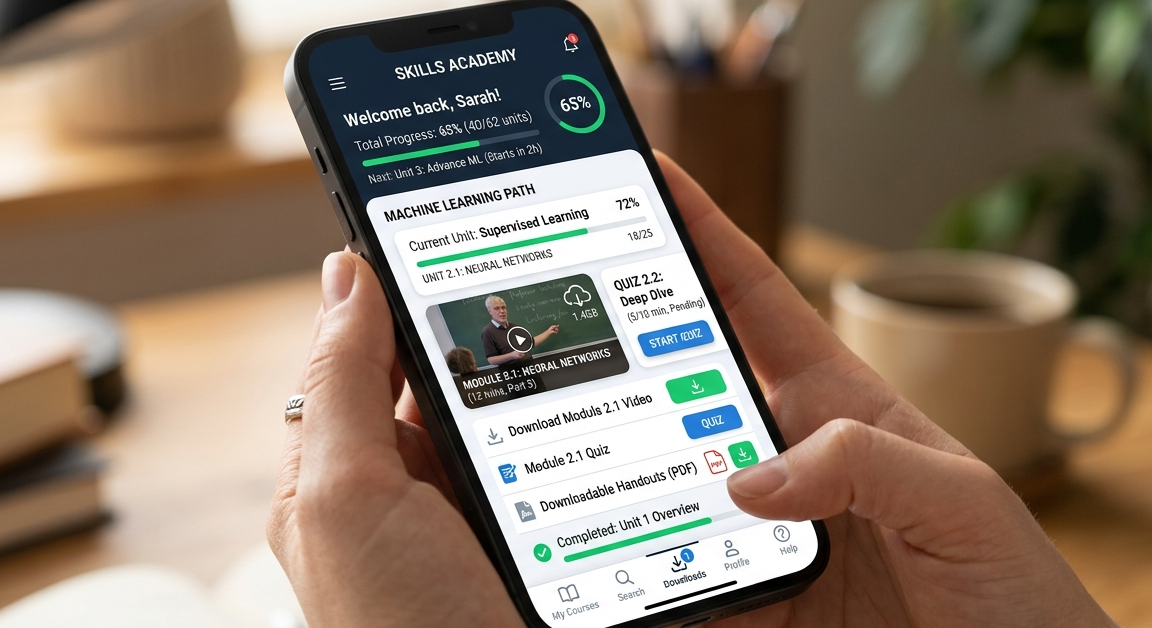
Personalized User Dashboards
Every student learns at a different pace, so a “one-size-fits-all” approach is a massive mistake. Modern apps use smart logic to show students exactly what matters to them:
- “Pick up right where you left off.”
- “Based on your last lesson, you might like this.”
- “You are 80% of the way to your certificate.”
This kind of personalization makes the app feel like a private tutor rather than just a cold, static database.
Multimedia and High-Speed Video Streaming
We live in a world where video is king. Your e learning mobile app development project has to prioritize a video player that works flawlessly, even when the user has a spotty 4G connection. But don’t stop at video. High-quality audio for “podcast-style” learning on the go and interactive PDFs for deep study are essential. The more ways people can consume your content, the more likely they are to stay in your app.
Offline Mode: The Silent Hero
One of the most requested features in 2026 is the ability to learn without an internet connection. Whether someone is on a plane, a subway, or just has a bad data plan, they should be able to download lessons. An offline mode ensures the learning never stops, which is a huge win for user satisfaction and long-term retention.
The Technical Road to Launch
Choosing the Right Technology Stack
This is probably the biggest technical crossroads you’ll hit. Do you build two separate apps (Native) or one app that works on both (Cross-Platform)?
| Feature | Native (iOS/Android) | Cross-Platform (Flutter/React Native) |
| Performance | Top Tier | Very Good |
| Development Time | Longer | Faster |
| Cost | Higher | More Affordable |
| Maintenance | Higher (Two codebases) | Easier (One codebase) |
For most startups, using Flutter for e learning mobile app development is the smartest move. It lets you launch on both the Apple App Store and Google Play Store at the same time, saving you a fortune in initial costs.
UI/UX Design for Different Ages
Design isn’t just about pretty colors; it’s about how the app “breathes.” If you’re building for kids, you want big, chunky buttons and fun sounds. If it’s for corporate professionals, you want a clean, minimalist look that feels efficient. If a user has to stop and think about “how” to navigate your app, you’ve already lost the battle.
Breaking Down Development Costs
From MVP to Full Scale
You don’t need to build a “Swiss Army Knife” app on day one. In fact, you shouldn’t. Start with a Minimum Viable Product (MVP). An MVP covers the basics: user registration, a few core courses, and a simple quiz. This usually costs between $15,000 and $40,000 depending on the details. Once you have a real user base giving you feedback, you can start adding the “fancy” stuff like AI tutoring or live-streamed classes.
Finding the Right Partner
Picking an e learning mobile app development company is like choosing a business partner. You don’t just want “code monkeys.” You want a team that understands the education market, knows how to secure user data, and has a track record of successful launches.
Future Trends: AI and Beyond
AI as a Personal Tutor
By the middle of 2026, AI won’t just be a buzzword; it’ll be the engine under the hood. Smart AI can track a student’s performance and notice if they are struggling with a specific concept. Instead of letting them fail, the app can automatically offer extra practice or show a different video that explains things better. This is called “Adaptive Learning,” and it is the future of the industry.
Gamification: Making Learning Addictive
We usually think of games as a distraction, but in EdTech, they are a superpower. Things like learning streaks, leaderboards, and digital badges give users a small hit of dopamine every time they finish a task. When you make learning feel like a game, users stay in the app longer, which leads to better reviews and higher revenue.
Maximizing Your ROI
Subscription Models and Monetization
How does the app pay for itself? Most developers are moving away from one-time fees and toward subscriptions. This gives you a steady, predictable income so you can keep updating and improving the app. You can also try a “Freemium” model—the basics are free, but the “Advanced Masterclass” or the “Professional Certificate” requires a monthly fee.
Global Standards and Compliance
Don’t ignore accessibility. Making sure your app works for people with disabilities—following standards like those from the U.S. Department of Education—is not just the right thing to do; it saves you from massive legal headaches later. Additionally, checking market data on Statista can help you figure out which global markets are ripe for your content.
Common Questions About Mobile Learning Apps
How much does it cost to develop an e-learning app?
A basic MVP typically starts around $15,000 to $40,000. A full-featured platform with AI and live streaming can easily go over $100,000.
Which is better, Flutter or Native development?
For most educational startups, Flutter is better because it reduces costs and speeds up the time to market while still providing a great user experience.
What is the most important feature for a learning app?
While content is king, “Offline Mode” is often the most requested feature because it allows learning to happen anywhere, regardless of internet access.
Final Thoughts
The path of e learning mobile app development is a long one, but it is incredibly rewarding. You aren’t just building software; you are building a gateway that gives people access to knowledge they might not have had otherwise. If you focus on high-quality content, a smooth user experience, and a tech stack that can grow with you, your app can become a leader in the digital classrooms of tomorrow.