

Advertising has changed. If you look at how we engage with brands today, we aren’t just hunting for products; we are looking for stories that click with us. This shift is exactly where the concept of what is creatives in marketing? becomes so important. It’s the most vital part of any campaign because, at the end of the day, it’s the only part your customer actually interacts with.
By 2026, you could have the smartest data tracking and a massive budget, but if your “creatives” are dull, your campaign will tank. People have become pros at ignoring ads. To break through that constant digital noise, you need assets that feel human, relevant, and visually impossible to ignore.
Table of Contents
- Defining Creatives in the Modern Marketing Era
- Creative vs. Creatives: Clearing the Confusion
- The Essential Types of Marketing Assets
- Why Creativity is the Engine of 2026 Marketing
- The Secret to a Perfect Creative Brief
- Measuring What Matters: Data Behind the Art
- Overcoming Creative Fatigue and Production Gaps
- Final Thoughts: Building a Brand that Sticks
Defining Creatives in the Modern Marketing Era

When we ask what is creatives in marketing?, we are really talking about the heart and soul of an ad. Think of strategy as the skeleton—it gives you the structure—but the creative is the skin, the face, and the personality. It’s the real, tangible stuff: that 15-second video that makes you laugh, the headline that hits home, or that Instagram graphic so clean you just have to click it.
In a professional agency setting, “creatives” are the finished files a team delivers. They are the “deliverables.” Without them, your strategy is just a collection of numbers on a spreadsheet. In today’s world, what is creative in marketing has evolved from basic images into complex, interactive experiences that have to look great across dozens of different apps and devices.
Creative vs. Creatives: Clearing the Confusion
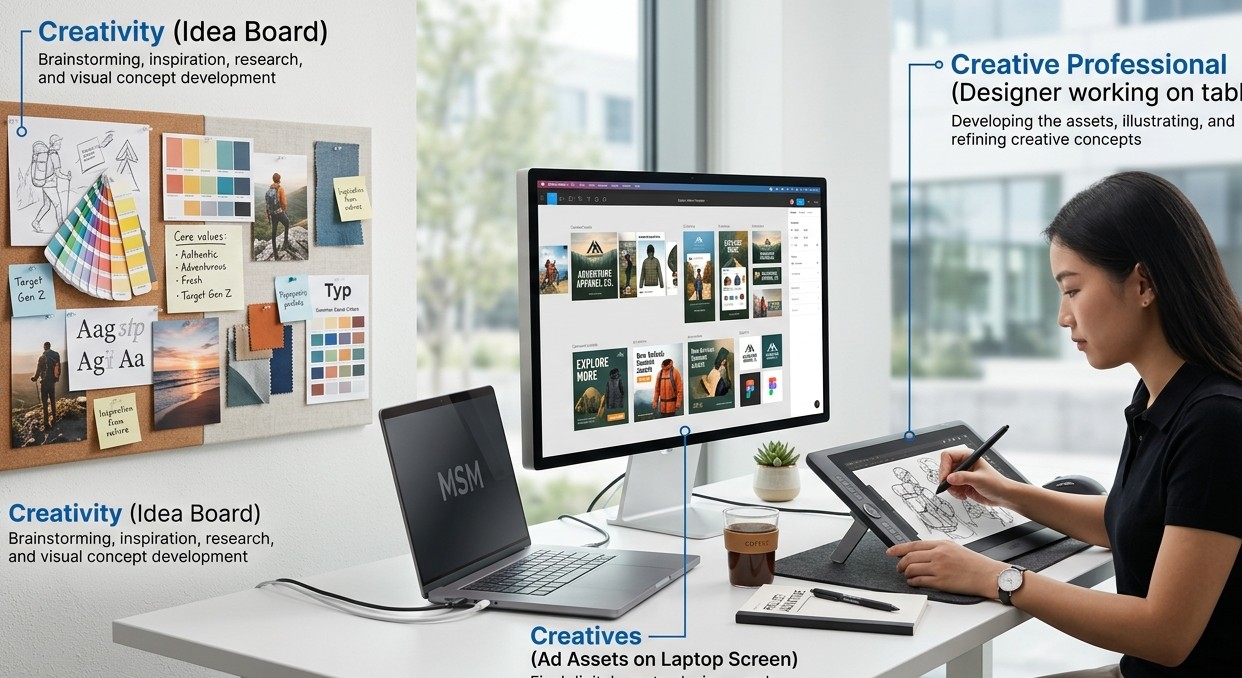
This industry loves its jargon, which can be a bit a headache for newcomers. Let’s break down these terms so you can talk like an insider:
- Creativity in Marketing: This is the “Big Idea.” It’s the high-level thinking used to solve a brand’s problem in a way nobody else thought of.
- Creatives (The Assets): This is the plural term for your actual ad files. If your manager asks for “the creatives,” they want the images, videos, and copy docs ready to go live.
- A Creative (The Professional): This is the person doing the heavy lifting—the designer, the writer, or the video editor.
Getting these small differences right helps a lot in E Learning Consulting and general project management. It ensures everyone, from the CEO to the intern, knows exactly what’s being discussed.
The Essential Types of Marketing Assets
To really win on social feeds and search results, you can’t just stick to one format. You need a mix to reach different people.
Visual Imagery and Graphics
Static images are still the backbone of the web. Whether it’s a sharp product shot or an infographic, our brains process visuals 60,000 times faster than text. If your image doesn’t grab someone in less than a second, they’ve already scrolled past you.
Video: The King of Engagement
Short-form video is easily the most powerful tool we have in 2026. Platforms like TikTok and YouTube Shorts have totally changed how what is a creative in marketing is seen. Video lets you use music, pacing, and storytelling to build an emotional bond that a still photo just can’t match.
Written Copy and Headlines
Don’t believe people when they say “nobody reads anymore.” They do—if the headline is good enough. Copy is the “brain” of the creative. While the image grabs their eye, the copy is what actually closes the deal and provides that vital “Call to Action” (CTA).
Why Creativity is the Engine of 2026 Marketing
We are living in an “Attention Economy.” Attention is the most expensive currency on earth right now. Because every brand is fighting for it, boring, generic ads just don’t cut it.
Solid creatives give you three huge advantages:
- The Pattern Interrupt: They break the habit of mindless scrolling.
- Information Retention: People remember 80% of what they see, but only 20% of what they read.
- Brand Authority: Sharp, high-quality assets make you look like a pro who can be trusted.
Look at it this way: e learning mobile app development requires a perfect interface to keep students from quitting. In the same way, your marketing needs top-tier creatives to keep your customers from jumping to a competitor.
The Secret to a Perfect Creative Brief
You wouldn’t build a house without a blueprint, so don’t build an ad without a brief. What is a creative brief in marketing? It’s the document that bridges the gap between a client’s vision and a creator’s work.
A professional, “rankable” brief needs to answer four things:
- Who is this for? (Define your persona).
- What problem are we solving? (The pain point).
- What is the one thing they should remember? (The core message).
- What do we want them to do? (The CTA).
Without a clear brief, you get “Creative Drift,” where the final ad looks nothing like what you actually needed.
Measuring What Matters: Data Behind the Art
We don’t just “hope” an ad works anymore; we use data. When checking the success of what is creative in marketing, we look at:
- CTR (Click-Through Rate): Did the creative make them take action?
- VTR (View-Through Rate): For videos, did they watch until the end?
- ROAS (Return on Ad Spend): Did the ad make more money than it cost to run?
Many pros use data from Statista to see how their work stacks up globally. This ensures you aren’t just making “art,” but building assets that grow the business.
Overcoming Creative Fatigue and Production Gaps
A major hurdle today is “Creative Fatigue.” This happens when your audience sees your ad so many times they become “blind” to it. Their brain just filters it out.
To fight this, you need a high volume of fresh assets. The secret? “Content Repurposing.” Take one long video and chop it into 10 clips, turn the transcript into a blog, and use the screenshots for Instagram. As the Harvard Business Review says, the best companies view their creative team as a driver of innovation, not just a cost.
Final Thoughts: Building a Brand that Sticks
Ultimately, what is creatives in marketing? It’s the bridge between a solution and the person who needs it. It’s the art of persuasion in a digital world.
If you focus on being helpful, clear, and honest, your creatives will do the heavy lifting for you. Don’t just try to “sell”—try to be the most interesting thing on your customer’s screen today. Whether it’s a complex app or a simple post, that human connection is what drives the highest ROI.