
Writing an ad for a school project feels like a breeze until you’re staring at the blank page. You know you have a decent idea, but turning that into something that actually makes a peer stop, look, and listen? That’s a completely different story.
We walk past posters and scroll through hundreds of ads every single day, and honestly, most of them are invisible. The example advertisements for students that actually work aren’t the ones that sound like some giant, soul-less corporate machine. They’re the ones written by someone who gets it—someone who understands the chaos of balancing classes, a tight budget, and actually having a life. If you want to write something that other students will actually read, stop trying to sound like a professional marketer. Let’s do it this way instead.
What Makes a Good Advertisement for Students?
Forget the textbook rules. Your student audience is smart. They have a massive internal filter for anything that feels like a fake sales pitch. If you want your promotional content to stick, keep these five points in mind:
- The Headline: This is your hook. If it doesn’t immediately call out a problem they have or a topic they actually care about, they’re going to keep scrolling.
- Real Benefits: Stop listing features. Tell them how their life gets better. Are they saving money? Getting an extra hour of sleep? Actually having fun?
- Keep it Human: If you wouldn’t say the words to your roommate while waiting in line for coffee, don’t write them in your ad.
- Visual Design: Whether it’s a poster advertisement or a digital graphic, use images that feel real. If you’re using Canva, keep it simple. Busy, cluttered designs are just distracting.
- A Direct Call to Action: Don’t leave them guessing. Tell them exactly where to go or what to click.
Advertisement Format for Students
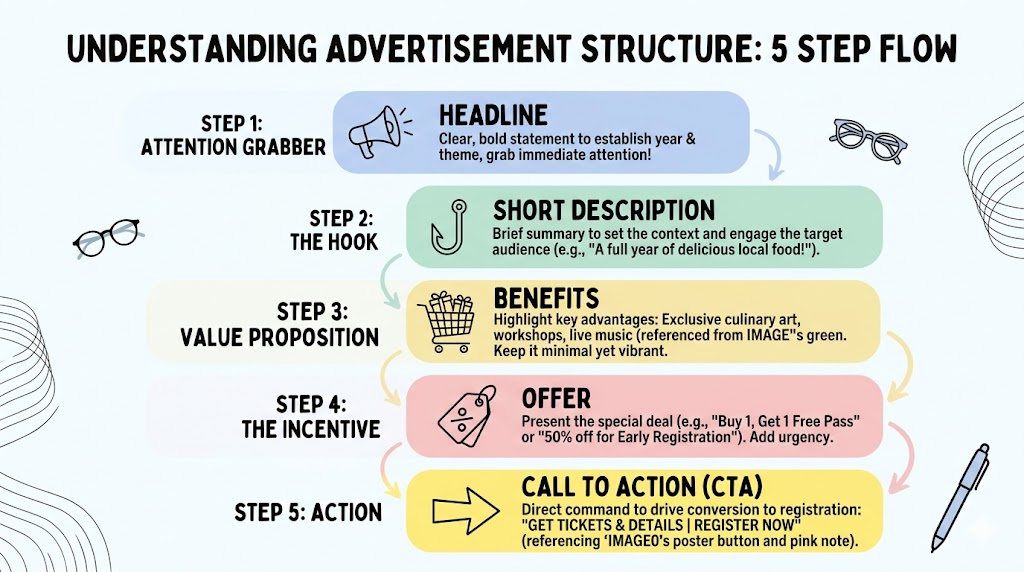
If you’re stuck, don’t overthink the structure. Most successful advertisement writing examples for students follow this simple flow:
- Headline: A bold line that hits the problem or the hook.
- Short Description: A quick sentence explaining the product, service, or event.
- Benefit: One or two points on why the student should care.
- Offer: A clear incentive, like a discount or a “first-timer” perk.
- CTA: A direct command, like “Sign up here” or “Find us at room 302.”
20 Example Advertisements for Students
Here are some school advertisement examples broken down by category. Each uses a slightly different advertising technique depending on your goal.
Educational & Tutoring Ads
- Exam Cram Session: “Stop Panic-Studying at 2 AM. Our 3-hour weekend cram sessions cover exactly what’s on the final. Sign up at the front desk.” (Why students like this: It calls out the exact time of night they feel most stressed.)
- Language Tutor: “Speak French before Spring Break. Learn the basics in 4 weeks. First class is on us.” (Why this works: It promises a quick, achievable win.)
- Essay Writing Help: “Stuck on your thesis statement? Get peer-reviewed feedback that clears your roadblocks. DM for a free consultation.” (Why this works: It targets the ‘writer’s block’ pain point.)
- Math Shortcut Series: “Stop spending 3 hours on one homework problem. Learn 5 shortcuts that cut your study time in half.” (The psychology behind it: It promises more free time.)
Student Discount & Tech Ads
- Laptop Deal: “Your laptop shouldn’t cost a fortune. Get professional software for 60% less than the standard price. Verify your ID to claim.” (Why this works: It connects an expensive ‘need’ with a budget solution.)
- Bookstore Sale: “End-of-semester clear-out! Grab all your pens, notebooks, and gear for 50% off.” (The psychology behind it: It triggers FOMO—the fear of missing out on a deal.)
- Study App Promo: “Tired of missing deadlines? Download the app that syncs all your classes in one place.” (Why this works: It solves a common organizational problem.)
- Tech Trade-in: “Is your laptop older than your favorite hoodie? Trade it in for $200 off a new model.” (Why this works: It acknowledges their current reality.)
Campus Life & Part-Time Job Ads
- Campus Café Job: “Earn money between lectures. We actually work around your class schedule.” (The psychology behind it: It hits the biggest pain point for student workers—rigid hours.)
- Gaming Club: “Love gaming? Join the University Gaming League. We host weekly tournaments and pizza nights. First entry is free.” (Why students like this: It promises community and pizza.)
- Lost & Found: “Have you seen my green notebook? It’s full of coffee stains and my entire history thesis. $20 reward—no questions asked.” (Why this works: It’s honest and relatable.)
- Fitness Session: “Burn off that exam stress. Free yoga every Tuesday at the Student Union. Just bring your mat.” (The psychology behind it: It frames exercise as stress relief.)
Print & Social Media Samples
- Flyer Design (Club): “Debate Club: We argue, we learn, we eat pizza. See you Thursday at 5 PM in Room 302.” (Why this works: It’s short, punchy, and promises pizza.)
- Instagram Story Ad: “Don’t pay for textbooks. Join our swap group and save $500 this semester.” (Why this works: It focuses on a high-value benefit.)
- Library Bookmark: “Don’t just read it, master it. Check out our new research portal—available now with your login.” (Why this works: It hits the audience where they are studying.)
- Scholarship Ad: “Your hard work deserves a reward. Apply for the 2026 Student Grant—it takes 10 minutes.” (The psychology behind it: It frames ‘work’ as a quick task.)
Persuasive Advertising Examples
- Volunteer Outreach: “Build your resume while helping the community. Join our weekend mentorship program.” (Why students respond: It links to their future goals.)
- Travel Opportunity: “Classroom walls are too small. Spend your summer studying in London. Applications close Friday!” (Why this works: It creates genuine urgency.)
- Food Deal: “Show your student ID, get a free side of fries. The perfect fuel for your all-nighter.” (The psychology behind it: It promises ‘fuel’ for a relatable struggle.)
- Workshop Ad: “Write like you mean it. Peer-led writing workshop. Free editing tips to make your paper shine.” (Why this works: It frames ‘work’ as a collaborative project.)
How to Write Persuasive Advertisements for Students
If you want persuasive advertising examples for students, remember that persuasion is about empathy, not force.
- Emotional Connection: Use words that describe the student experience—think “stressed,” “deadline,” “broke,” or “fun.”
- Urgency: If an offer is ending, say so. If spots are limited, mention it.
- Social Proof: If you are promoting a club, say how many students have already joined.
- Student Problems: Always start by identifying a problem they actually have. If you aren’t solving a problem, you’re just making noise.
Common Mistakes Students Make
Even if you have a killer idea, it’s easy to trip up on the execution. Watch out for these traps:
- Cluttering the page: Nobody will read a paragraph of tiny text on a flyer design. If they can’t get the point in three seconds, simplify it.
- Weak CTAs: Don’t just say “contact us.” Say “text us” or “click this link.” Be specific.
- Ignoring the visual: You might have the best catchy headline, but if the font is unreadable or the image is blurry, your message is lost.
Helpful => How to Design Flyers
FAQs
What is an advertisement example for students?
It’s a piece of communication—like a poster advertisement, flyer design, or social post—designed to get a message across to other students for a club, product, or event.
How do students write advertisements?
Identify one clear problem, offer a simple solution, and give the reader a direct way to respond. Keep the tone conversational and avoid corporate jargon.
What are persuasive advertising examples?
These are ads that use emotional triggers—like the fear of missing out or the promise of saving time—to convince a student to take action, such as signing up for a campus promotion or joining a study group.
How do you create a print advertisement?
Prioritize a clean, high-impact visual design and a strong headline. If you’re designing a flyer for a campus bulletin board, ensure the most important info is readable from a few feet away.
You can find us here: Easygrader