

Catholic school tuition has climbed steadily for years, and for a lot of families in Brooklyn and Queens, that rising cost is the difference between staying at a school their kids love and having to pull them out mid-year. That’s the gap Futures in Education Angel Wings was built to close. It’s a monthly giving program run by the nonprofit Futures in Education, and it exists for one fairly simple reason: to keep Catholic education within reach for lower-income families across the Diocese of Brooklyn.
This guide walks through what the program actually is, how the money moves from donor to student, who qualifies for help, and how the Angel Wings model compares to the organization’s other sponsorship option. If you’re weighing whether to donate, apply for assistance, or just trying to understand what you keep seeing referenced on the Futures in Education website, this should cover it.
What Is Futures in Education Angel Wings?

Futures in Education Angel Wings is a monthly donation program that pools contributions from individual donors to fund tuition assistance for lower-income students attending Catholic elementary schools in Brooklyn and Queens. Donations of any size are accepted, and the combined funds go toward keeping tuition affordable for families who would otherwise struggle to cover it.
The organization behind it, Futures in Education, is a nonprofit foundation connected to the Diocese of Brooklyn. Its broader mission is fairly straightforward — make sure a Catholic education stays financially possible for families in the diocese, regardless of income. Angel Wings is one piece of that mission, built specifically around recurring, smaller-scale giving rather than a single large gift.
One detail worth knowing: the suggested monthly contribution has historically been framed around $167 a month, or roughly $5.50 a day — a number the organization uses to help donors picture what a manageable monthly commitment actually looks like, even though donations at any amount are welcome.
How the Angel Wings Program Works
At a basic level, it’s a pooled-funding model. Donors sign up for recurring monthly contributions rather than a single one-time gift, and those contributions are combined with everyone else’s to fund tuition assistance across participating schools.
That structure matters for a specific reason — it spreads support across many students rather than tying one donor’s contribution to one specific child. For someone who wants to help without committing to a larger annual sponsorship, it’s a lower-friction way to get involved. A modest monthly amount, given consistently, adds up over a school year in a way a single donation sometimes doesn’t.
Families apply for assistance through the school or directly through Futures in Education, and awards are generally based on financial need. The organization has noted that financial aid applications for a given school year typically open in mid-January, so families hoping to apply for the following academic year should watch for that window.
Who Can Benefit From the Program?
The assistance is aimed at lower-income families with children enrolled in, or seeking to enroll in, Catholic elementary schools within Brooklyn and Queens. It’s not limited to families already struggling in a crisis sense — plenty of working families who simply can’t absorb the full cost of tuition on top of everything else qualify too.
From the donor side, the program is open to essentially anyone. There’s no minimum required to sign up, and no requirement that a donor have any prior connection to a specific school. Some donors are alumni of Catholic schools themselves, some are current parents wanting to support other families, and some just believe in keeping the option available for kids whose families couldn’t otherwise afford it.
Angel Wings vs. “Be an Angel to a Student”
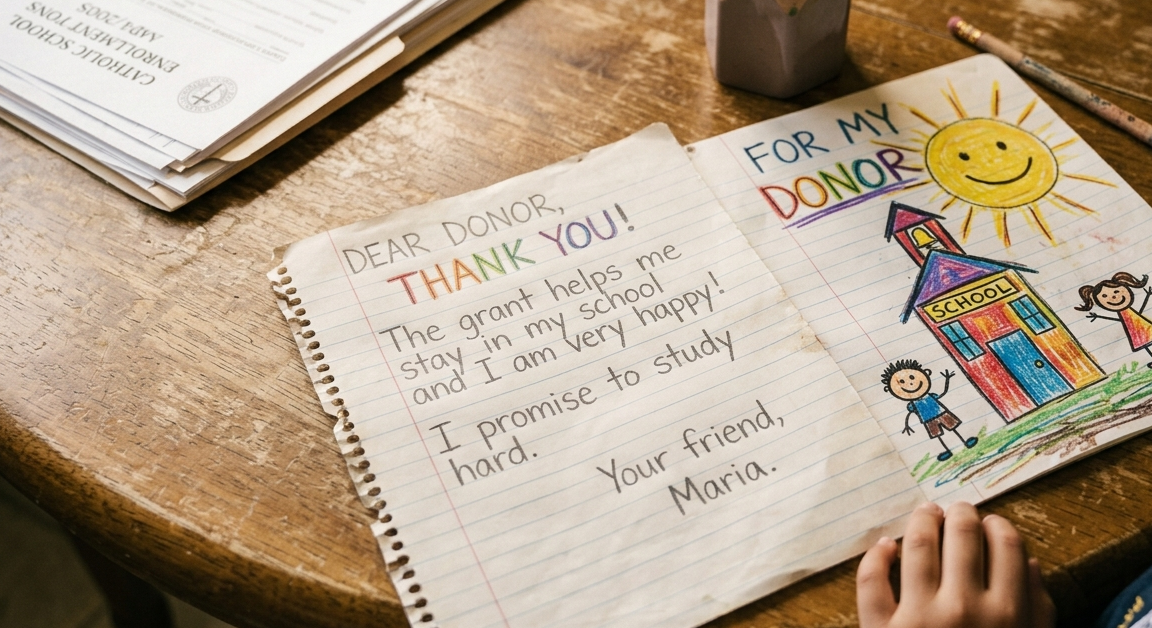
Futures in Education actually runs two related but distinct giving programs, and it’s easy to mix them up.
| Feature | Angel Wings | Be an Angel to a Student |
|---|---|---|
| Giving Style | Monthly recurring donation | Annual sponsorship |
| Minimum Commitment | Any amount, suggested ~$167/month | Starting at $2,500/year |
| Support Structure | Pooled across many students | Tied to one specific student |
| Donor Connection | General, program-wide | Personal — donors exchange letters, drawings, and progress updates with their sponsored student |
| Best Fit For | Donors wanting flexible, lower-commitment giving | Donors wanting a direct, ongoing relationship with one student |
Angel Wings is the better fit if you want to give consistently without a large upfront commitment. Be an Angel to a Student is the better fit if the personal connection — actually hearing from the student you’re helping — matters more to you than the amount.
Why Tuition Assistance Programs Like This Matter
Private and Catholic school tuition hasn’t exactly stayed flat over the past decade, and for families already stretched thin, even a partial gap in tuition can force a switch to public school mid-year, which is disruptive for a kid regardless of how good the reasoning behind it is.
Programs like Futures in Education Angel Wings exist because that gap is real and fairly common. They’re not a scholarship in the traditional “merit-based, one-time award” sense — they’re closer to an ongoing bridge that keeps a family enrolled year over year, provided the need continues and the funding holds up. That distinction matters if you’re trying to understand what the program actually promises versus what it can’t guarantee.
Schools with strong community and donor support tend to have more flexibility to keep tuition assistance flowing consistently, which is part of why programs like this lean so heavily on recurring monthly donors rather than one-off gifts. If your own school or organization is thinking through how to build that kind of consistent community support, our piece on Strategic Marketing for Schools covers a lot of the same groundwork — building trust and long-term relationships rather than one-time transactions.
How to Donate or Apply
Donors can sign up for Angel Wings monthly giving directly through the Futures in Education website, where recurring donation amounts can be set up in just a few steps. For families interested in the “Be an Angel to a Student” sponsorship, the process typically starts the same way, through the organization’s programs page.
Families seeking tuition assistance generally apply either through their child’s school directly or through the Futures in Education financial aid application, which the organization has indicated opens for a given school year around mid-January. Since exact dates and requirements can shift year to year, checking directly with the organization or the school’s admissions office before assuming a deadline is worth the extra step.
For specific questions — donation tiers, sponsorship matching, or general inquiries — the organization’s development office has been reachable at (718) 965-7308 ext. 1612.
Frequently Asked Questions
What is Futures in Education Angel Wings?
It’s a monthly donation program run by the nonprofit Futures in Education that pools contributions from donors to help fund tuition assistance for lower-income students attending Catholic elementary schools in Brooklyn and Queens.
Who can receive Angel Wings assistance?
Lower-income families with children attending, or applying to attend, participating Catholic elementary schools in the Diocese of Brooklyn are generally eligible, with awards based on demonstrated financial need.
How do I become an Angel donor?
Sign-up happens directly through the Futures in Education website, where donors can set up recurring monthly contributions at any amount they’re comfortable with.
What is the difference between Angel Wings and the Angel Program (Be an Angel to a Student)?
Angel Wings is a flexible, pooled monthly giving program, while Be an Angel to a Student is an annual sponsorship, starting at $2,500 a year, that pairs a donor directly with one specific student for ongoing correspondence.
Is my donation tax-deductible?
Futures in Education operates as a nonprofit foundation, and contributions to nonprofit organizations are generally tax-deductible, though donors should confirm the specifics with the organization directly or a tax professional given individual circumstances can vary.
How much should I donate?
The organization suggests around $167 a month as a benchmark for the Angel Wings program, but donations of any amount are accepted and combined with other contributions.
Who manages Futures in Education?
Futures in Education is a nonprofit foundation affiliated with the Diocese of Brooklyn, established to support the affordability of Catholic education for families in Brooklyn and Queens.
How does tuition assistance get awarded?
Assistance is generally awarded based on financial need, determined through an application process that families complete either through their school or directly with Futures in Education.
Final Thoughts
Programs like Futures in Education Angel Wings work because they turn something that sounds abstract — “tuition affordability” — into something concrete: a monthly amount, a specific set of schools, a real family that stays enrolled because the gap got covered. Whether you’re weighing becoming a monthly donor, considering the more personal “Be an Angel to a Student” sponsorship, or trying to understand what assistance might be available for your own child, the structure of the futures in education Angel Wings program is built to be flexible enough for most people to find their way in.
Programs that track outcomes carefully tend to build more donor trust over time, and organizations thinking about how they measure and communicate that impact might find our piece on Student Success Definition useful for framing what “success” actually looks like beyond enrollment numbers alone.
For the most current details on donation tiers, financial aid deadlines, and program updates, the official Futures in Education Angel Wings page is the most reliable source, and general guidance on charitable giving and tax deductibility is available through the IRS’s overview of charitable contribution deductions.