

Geometry challenge problems aren’t really about remembering formulas. They want you to spot a hidden relationship, choose the right theorem, and now and then glare at a diagram for ten minutes before anything clicks. Stuck? That’s normal. It’s kind of the point.
Fifteen problems follow, and each has a hint, a full solution and a final answer. Cover the working and give every one a proper try first, even if it’s only a minute. That’s usually enough to make the solution stick.
What Makes a Geometry Problem Challenging?
You usually can’t just drop numbers into one formula. The problem might hide a useful relationship, or need two theorems working together, or only open up once you redraw the figure. So the difficulty is in the noticing. The arithmetic isn’t any harder.
How to Solve Challenging Problems in Geometry
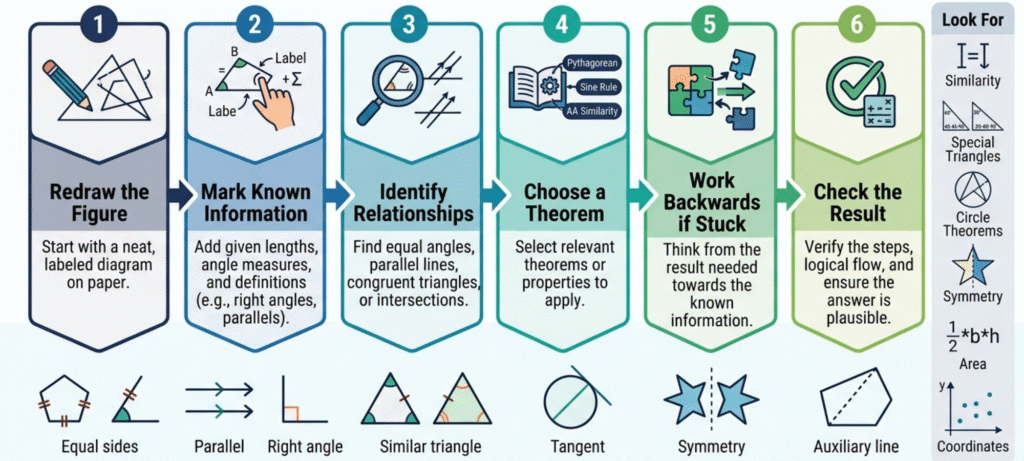
Most people don’t get stuck on the maths. They get stuck on the picture. So start there: redraw the figure bigger than feels necessary and mark everything you know, like equal sides, parallel lines and right angles. Half the time the relationship you need is sitting in plain sight once it’s labelled.
Then go hunting. Parallel lines usually mean similar triangles are nearby. The 3-4-5, 30-60-90 and 45-45-90 triangles turn up constantly, often in disguise. A figure that looks balanced probably has symmetry you can use. If nothing shows, add a line of your own: a diagonal, an altitude, a radius, a parallel. And if you’re still stuck, work backwards. What would you need to know to get the answer, and what would you need for that?
Once you’ve finished, ask what you noticed (or missed) that unlocked it. Our guide on how to study for a math exam covers turning that into a routine. If circles or right triangles feel shaky, our piece on building a strong foundation in higher-level mathematics is a good place to tighten the fundamentals.
Geometry Challenge Problems: Can You Solve These?
Draw each figure yourself, even when it’s described in words. What you notice while drawing is half the battle.
Warm-Up Challenges
Problem 1: The Split Base Angle
Triangle ABC is isosceles with AB = AC and a 40° angle at A. The bisector of angle B meets AC at D. What is angle BDC?
Stuck? Find the base angles first.
They share what’s left after 40°, so each is (180° − 40°) ÷ 2 = 70°. The bisector halves angle B, which makes angle DBC 35°. Triangle BDC now holds 35° and 70°, leaving 180° − 35° − 70° = 75°.
Answer: 75°
Problem 2: The Outside Angle
The exterior angle at C of triangle ABC measures 126°, and the interior angles at A and B are in the ratio 4 : 5. What’s the largest interior angle?
This one hangs on a single rule: an exterior angle equals the two remote interior angles added together. So A + B = 126°. The ratio 4 : 5 makes 9 parts of 14° each, giving A = 56° and B = 70°. Quick check: angle C is 180° − 126° = 54°, and 56° + 70° + 54° = 180°. B is the biggest.
Answer: 70°
Problem 3: The Shortest Walk
A right triangle has legs of 9 and 12. What’s the shortest distance from the right-angle vertex to the hypotenuse?
Hint: work out the area two different ways.
The hypotenuse is 15, since this is a 3-4-5 triangle scaled by 3. Using the legs, the area is ½ × 9 × 12 = 54. Using the hypotenuse as the base, it’s ½ × 15 × h. So 7.5h = 54 and h = 7.2.
Answer: 7.2 units
Got those three quickly? Good. From here you’ll need an actual idea, usually similarity or a circle theorem.
Intermediate Challenges
Problem 4: The Squeezed Line
In trapezoid ABCD, AB ∥ CD, AB = 12 and CD = 8. The diagonals meet at P. A line through P parallel to the bases hits the legs at E and F. Find EF.
Stuck? Look at triangles DPC and BPA. They’re similar.
AB and CD are parallel, so the diagonals get chopped in the same ratio as the parallel sides: DP : PB = 8 : 12 = 2 : 3. Out of the 5 parts that make up DB, DP takes 2, so DP : DB = 2 : 5. Now switch to triangle DAB. EP runs parallel to AB, which gives EP = (2/5) × 12 = 4.8. Same story on the other side, so PF is also 4.8. Add them up and EF = 9.6.
Answer: 9.6
Problem 5: Two Tangents
From an outside point P, tangents PA and PB touch a circle with center O. Angle APB is 50°. Point C sits on the major arc AB. Find angle ACB.
Two facts do all the work here. A radius meets a tangent at 90°, and an inscribed angle is half the central angle on the same arc. Quadrilateral OAPB has right angles at A and B and 50° at P, so angle AOB = 360° − 90° − 90° − 50° = 130°. Halve it for the inscribed angle on the major arc.
Answer: 65°
Problem 6: Crossing Chords
Chords AB and CD cross at P. AP = 4, PB = 9 and CD = 15. Find the shorter piece of CD.
Hint: when two chords cross, the products of their segments are equal.
So AP × PB = 36, which means CP × PD = 36 as well. Let CP = x, so PD = 15 − x. Then x(15 − x) = 36, which rearranges to x² − 15x + 36 = 0, or (x − 3)(x − 12) = 0. The pieces are 3 and 12.
Answer: 3
Problem 7: The Snug Circle
Find the radius of the circle inscribed in a right triangle with sides 8, 15 and 17.
Stuck? Tangent lengths from one vertex to the circle are equal.
At the right angle, the two tangent segments and the circle’s radii form a small square of side r. So the legs split as 8 = r + a and 15 = r + b, where a and b are the tangent lengths along the hypotenuse. Since a + b = 17, adding the two equations gives 23 = 2r + 17, so r = 3. That’s also where the right-triangle shortcut comes from: r = (a + b − c) ÷ 2 = (8 + 15 − 17) ÷ 2 = 3.
Answer: 3
Problem 8: The Lens
A square has side 10. Draw a quarter circle of radius 10 centered at corner A, passing through B and D. Draw another centered at the opposite corner C, also passing through B and D. Find the area where the two quarter circles overlap.
Hint: add the two quarter-circle areas, then compare with the square.
Each quarter circle has area ¼ × π × 100 = 25π, so 50π together. Together they also cover the whole square, but the lens gets counted twice. Subtract the square once and you’re left with the lens: 50π − 100.
Answer: 50π − 100 ≈ 57.1 square units
Hard Challenges
Here two ideas usually have to work together. Slow down and redraw.
Problem 9: The Cut Diagonal
Square ABCD has side 12. M is the midpoint of BC. Segment AM crosses diagonal BD at P. Find BP.
Hint: AD is parallel to BM.
Because AD ∥ BM, triangles APD and MPB are similar. Their sides are in the ratio AD : BM = 12 : 6 = 2 : 1, so DP : PB = 2 : 1. That makes BP one third of the diagonal. The diagonal is 12√2, so BP = 4√2.
Answer: 4√2 ≈ 5.66
Problem 10: Equal Distance
Find the point on the line y = x that’s equally far from A(2, 0) and B(0, 6).
Write the point as (t, t). The distance squared to A is (t − 2)² + t², and to B it’s t² + (t − 6)². Set them equal and the t² terms drop out, leaving (t − 2)² = (t − 6)². Solving gives t = 4. Check: both distances come out to √20.
Answer: (4, 4)
Problem 11: The Bridge Between Circles
Two circles with radii 3 and 5 touch externally. Find the length of the common external tangent between the two points of tangency.
Stuck? Draw both radii to the tangent points, then slide one across to build a right triangle.
The centers are 3 + 5 = 8 apart. Both radii are perpendicular to the tangent, so the shifted figure gives a right triangle with hypotenuse 8 and one leg 5 − 3 = 2. The other leg is the tangent segment: √(64 − 4) = √60 = 2√15.
Answer: 2√15 ≈ 7.75
Problem 12: The Corner Circle
A circle inside a square of side 10 touches two adjacent sides and passes through the opposite corner. Find its radius.
Start with where the center has to be. The circle touches two adjacent sides, so its center is the same distance r from both, which puts it on the 45° diagonal through that corner. Put that corner at the origin. The center is (r, r) and the far corner is (10, 10). The distance between them is √2 (10 − r), and it must equal r. So r(1 + √2) = 10√2, which gives r = 10√2(√2 − 1) = 20 − 10√2.
Answer: 20 − 10√2 ≈ 5.86
Advanced Geometry Challenges
The last three need more than direct substitution. They lean on cyclic geometry, area relationships and proof.
Problem 13: Two Squares, One Star
Two squares of side 6 share the same center, and one is rotated 45° against the other. Find the area of the region they share.
Hint: the overlap is a regular octagon. How far is its center from each side?
Every side of the octagon lies along a side of one of the squares, so that distance is 3. It’s the apothem. A regular octagon with apothem a has area 8a² tan 22.5°, and tan 22.5° = √2 − 1. So the area is 8 × 9 × (√2 − 1) = 72(√2 − 1).
Answer: 72(√2 − 1) ≈ 29.8
Problem 14: The Point on the Arc
An equilateral triangle ABC is inscribed in a circle. P lies on the minor arc BC with PB = 3 and PC = 5. Find PA and the side length of the triangle.
Hint: ABPC is a cyclic quadrilateral, so Ptolemy’s theorem applies.
Side first. Since ABPC is cyclic, angle BPC = 180° − 60° = 120°. The law of cosines in triangle BPC gives s² = 3² + 5² − 2(3)(5)cos 120° = 9 + 25 + 15 = 49, so the side is 7. Now for Ptolemy: PA · BC = AB · PC + AC · PB. All three sides equal 7, so PA(7) = 7(5) + 7(3), and PA = 8.
Answer: PA = 8, side = 7
Problem 15: The Hidden Parallelogram
Prove that joining the midpoints of the sides of any quadrilateral always makes a parallelogram.
Hint: draw one diagonal.
Call the quadrilateral ABCD, with E, F, G, H the midpoints of AB, BC, CD and DA. In triangle ABC, EF joins two midpoints, so EF ∥ AC and EF = ½AC. In triangle ACD, HG does the same job, so HG ∥ AC and HG = ½AC. That makes EF and HG parallel and equal. A quadrilateral with one pair of opposite sides both parallel and equal is a parallelogram, so EFGH is one.
Answer: Proved
Geometry Concepts These Challenges Test
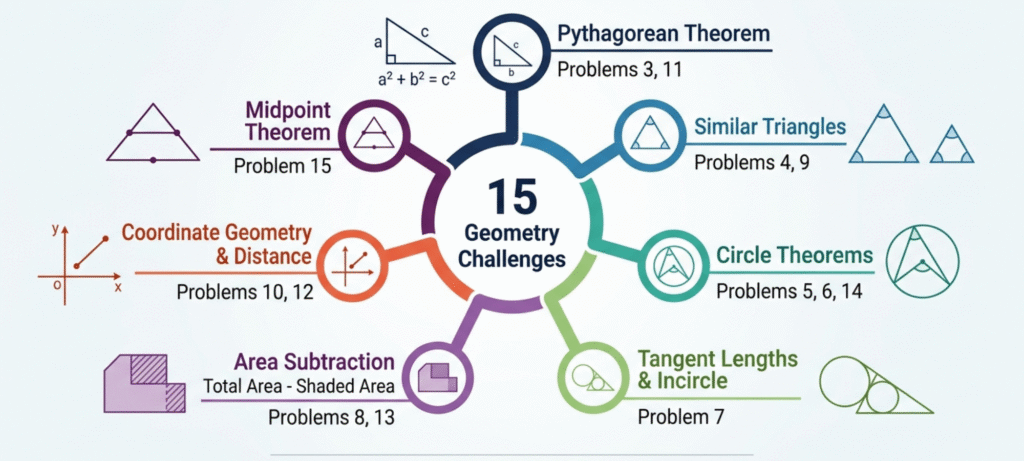
| Tool | Problems |
|---|---|
| Pythagorean theorem | 3, 11 |
| Similar triangles | 4, 9 |
| Circle theorems | 5, 6, 14 |
| Tangent lengths and the incircle | 7 |
| Area subtraction | 8, 13 |
| Coordinate geometry and distance formula | 10, 12 |
| Midpoint theorem | 15 |
Symmetry quietly helps almost everywhere.
If circles or right triangles feel shaky, our piece on building a strong foundation in higher-level mathematics is a good place to tighten the fundamentals.
Challenging Geometry Problems by Level
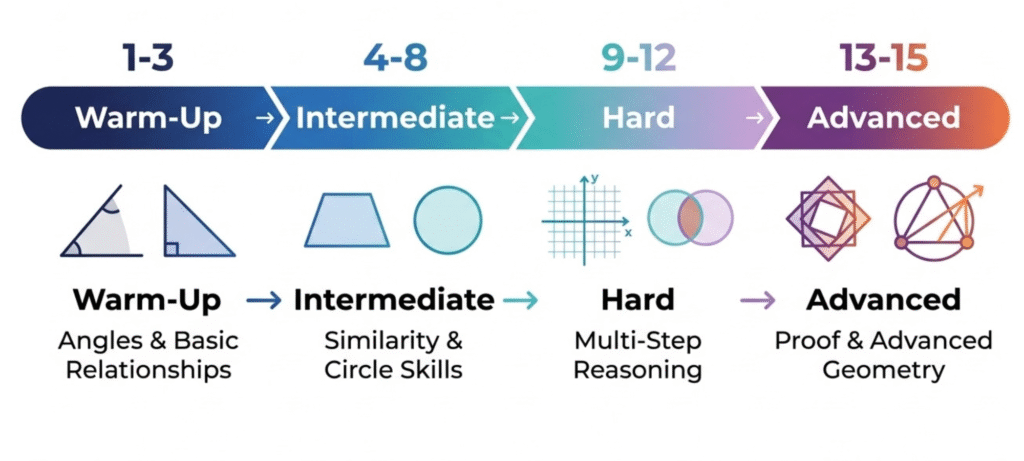
Curricula differ from country to country, so treat this as a rough guide. Problems 1 to 3 suit middle school or early secondary, depending on prior geometry knowledge. Problems 4 to 10 fit high school or GCSE-level practice, though some topics vary by curriculum. Problems 11 to 14 are advanced high school, and Problem 14 uses Ptolemy’s theorem, which many courses don’t cover, so treat it as enrichment. Problem 15 is proof practice.
Geometry Books and Other Resources
Want more once these are done? The NRICH short problems in geometry collection is a well-regarded free source. In print, Dover publishes Challenging Problems in Geometry by Alfred S. Posamentier and Charles T. Salkind (Dover edition first published in 1996), with nearly 200 non-routine problems, hints and detailed solutions, arranged roughly by difficulty.
FAQ
What makes a geometry problem challenging?
It usually needs more than one step or idea. You might have to spot a hidden relationship, combine theorems, or redraw the diagram before the path appears.
How do you solve challenging geometry problems?
Redraw the figure large, mark what you know, and look for special triangles, similarity, symmetry or a helpful auxiliary line. If you’re stuck, work backwards from what you need.
What are some challenging geometry problems with solutions?
This page has 15, covering angles, triangles, circles, areas, coordinate geometry and proof. Each comes with a hint and a worked solution.
Do these geometry challenge problems have answers?
Yes. Every problem ends with a bolded final answer, and the working sits just above it.
Where can I find more geometry challenge problems?
NRICH offers many short problems for free, and Dover’s Challenging Problems in Geometry is a print option with nearly 200 more.
How can I get better at these problems?
Try each one for a few minutes before reading the hint, then study the solution for the idea rather than the answer. Repeat with new problems weekly.
Are these good for high school students?
Yes. Problems 4 to 10 suit most high school levels, and 11 to 15 add a real stretch.
Final Thoughts
Geometry challenge problems reward patience more than speed. Most of these looked impossible before the hint and obvious after it, and that gap is exactly what you’re training. Pick two this week, try them cold, and only then peek at the hint. Next week, see which ideas stuck