Choosing a geometry homeschool curriculum is one of those decisions that somehow ends up feeling way bigger than it should. Post in any homeschool group and ask what the best option is, and within an hour you’ll have twenty different parents giving you twenty confident, completely contradictory answers. Some swear by video lessons their kid can just watch solo, headphones in, no hand-holding required. Others won’t touch anything that isn’t a physical textbook they can sit down with at the kitchen table together. Honestly, neither side is wrong. But the wrong fit for your particular kid can still turn an entire school year into a slog nobody wants to repeat least of all you.
Looking at the programs homeschool families actually use in practice, there are some real, meaningful differences: how each one teaches geometry, how much it demands from the parent, and how grading gets handled. This guide breaks down what each option actually offers, who tends to click with it, and — more importantly how to think through the decision yourself, instead of just being handed a top ten list and told to pick one.
What Is a Geometry Homeschool Curriculum
At its simplest, a geometry homeschool curriculum is a structured course — video-based, textbook-based, or fully online built to teach high school level geometry outside a traditional classroom setting. Most include instruction, practice problems, assessments, and enough documentation that a parent can actually use it for a transcript later. Some of these programs are fully self-contained, with a clear scope and sequence plus a syllabus you can just follow start to finish without much guesswork. Others hand you the lessons and leave the tests, pacing, and grading system entirely up to you.
What Should a High School Geometry Curriculum Cover
Before comparing brands, it helps to know what a solid course actually needs to include. Geometry is not just shapes and formulas. A real geometry homeschool curriculum should move a student through roughly nine units.
Foundations of Geometry
Points, lines, rays, segments, planes, angles, and how they connect to each other. Basic stuff, sure — but it’s the vocabulary the rest of the course leans on. Rush through this part and, more often than not, it comes back to bite a student a few months in, usually right when things start getting harder.
Logic and Proofs
This is where postulates, theorems, deductive reasoning, two-column proofs, and paragraph proofs all show up. Honestly? This unit is the real dividing line. It’s what separates a proper geometry course from something that’s basically a coloring book of shapes. Reasoning skills actually start forming here.
Triangles
Congruence. Similarity. The Pythagorean theorem. Special right triangles. Triangles keep popping up — in almost every unit after this one — so it’s worth slowing down and reviewing them regularly instead of rushing past.
Quadrilaterals and Polygons
Parallelograms, rectangles, rhombi, squares, trapezoids, and the properties that define each shape.
Transformations
Translations, rotations, reflections, dilations, symmetry. A lot of kids actually find this one the easiest to picture in their heads — probably the most visual unit in the whole course.
Coordinate Geometry
Distance formula. Midpoint formula. Slope. Writing equations on a coordinate plane. This is more or less the point where algebra and geometry stop being separate subjects.
Circles
Radius, diameter, arcs, chords, secants, tangents, circumference, area — all the usual circle terms bundled into one unit.
Measurement
Perimeter, area, surface area, volume. The shift here is from flat shapes to three-dimensional ones.
Introductory Trigonometry
Sine, cosine, tangent and applying them to right triangles. Most courses only touch the surface at this stage; the real depth comes later, in trig or precalculus.
If a curriculum skips proofs entirely, that is worth noticing. It usually means the program is treating geometry as a formula memorization exercise instead of a reasoning course.
Why Geometry Proofs Matter in Homeschool
Proofs deserve their own section because they are so often the reason parents feel nervous about teaching geometry at home. A proof asks a student to move from “I know this is true” to “I can explain why it is true,” using definitions, postulates, and theorems as building blocks.
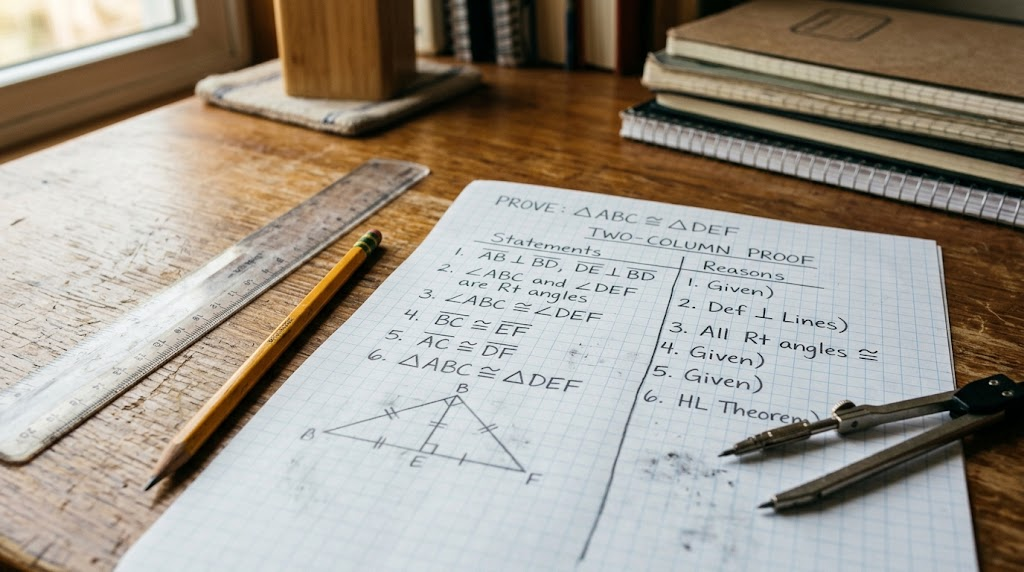
Two column proofs lay out statements and reasons side by side. Paragraph proofs ask the student to write the same logic out in full sentences. Some courses also introduce indirect proofs, where the student assumes the opposite of what they want to prove and shows it leads to a contradiction.
This is one of the clearest differences between basic geometry practice and a more rigorous high school geometry course. A curriculum that treats proofs seriously, with worked examples and a real solutions manual, will save you more headaches than any other single feature on this list.
What Makes a Good Geometry Homeschool Curriculum
Before you look at brand names, it helps to have a checklist in your head. A genuinely good geometry curriculum for homeschool families has a logical, building progression rather than jumping around. It has clear explanations a student can follow without you re-teaching everything from scratch. It includes enough practice to make ideas actually stick, not just enough to check a box. It offers real assessments, meaning tests and quizzes, not only practice sets. It comes with answer keys and, ideally, worked solutions. It treats proof instruction as central rather than optional. And it matches a workload your particular student can sustain, not someone else’s.
Grading this kind of work at home is its own challenge, especially once you are checking multi step proofs by hand every single week. If that is already wearing you down, it is worth reading how to cut your grading time in half without cutting corners before committing to a program with zero automated grading.

Best Geometry Homeschool Curriculum Options
Mr. D Math Geometry
Format: Video based, self paced or live Best for: Students who prefer teacher led video instruction over reading a textbook cold What stands out: Taught by Dennis DiNoia, this runs as a thirty four week course with graded quizzes and worksheets that include full solutions. The live class option adds a bit of accountability that pure self paced courses lack. Potential drawback: Less suitable for families who specifically want a traditional textbook first experience. Best fit: Independent students who need things explained out loud but do not need a parent teaching every lesson.
UnLock Math
Format: Fully online, interactive Best for: Independent learners who like instant feedback What stands out: Virtual manipulatives, automatic grading, and a prerequisite review unit at the start, which is handy if a student’s Algebra I is a little rusty. Potential drawback: Families wanting printed textbooks or offline work will find it entirely screen dependent.
Best fit: Tech comfortable students who want to move at their own pace without waiting on a parent to grade anything.
TabletClass Math
Format: Video and online, self paced
Best for: Students who want structure without constant parent oversight What stands out: John Zimmerman’s video lessons come with downloadable worksheets, automated quizzes, and a parent portal, so you can track progress without sitting next to your kid every day.
Potential drawback: The video style will not suit students who genuinely prefer a print textbook.
Best fit: A good middle ground between fully video based and fully self paced programs.
Thinkwell Geometry
Format: Digital subscription, twelve months
Best for: Students who prefer short lessons over long lectures What stands out: Video instruction from Prof. Edward Burger, auto graded exercises, and an included e-book, all built around bite sized segments.
Potential drawback: The subscription model means access ends after the term unless renewed.
Best fit: Students with shorter attention spans who do better with material broken into small chunks.
Khan Academy
Format: Free, online
Best for: Budget conscious families comfortable building their own structure What stands out: Nine units covering everything from transformations to circle theorems to trigonometry, all free of charge.
Potential drawback: It works best as a full course only if you are willing to add your own pacing, tests, and transcript documentation. It was not built as a turnkey homeschool package.
Best fit: Families who want a strong core resource and do not mind supplementing it themselves.
Master Books Geometry
Format: Textbook, independent study, grades ten to eleven
Best for: Traditional, faith based homeschool families What stands out: Real life applications, a full solutions manual, and optional video instruction for families who want extra support without going fully online.
Potential drawback: Less interactive than the online options, so students who need instant feedback may get restless.
Best fit: Families wanting a traditional, worldview integrated textbook approach.
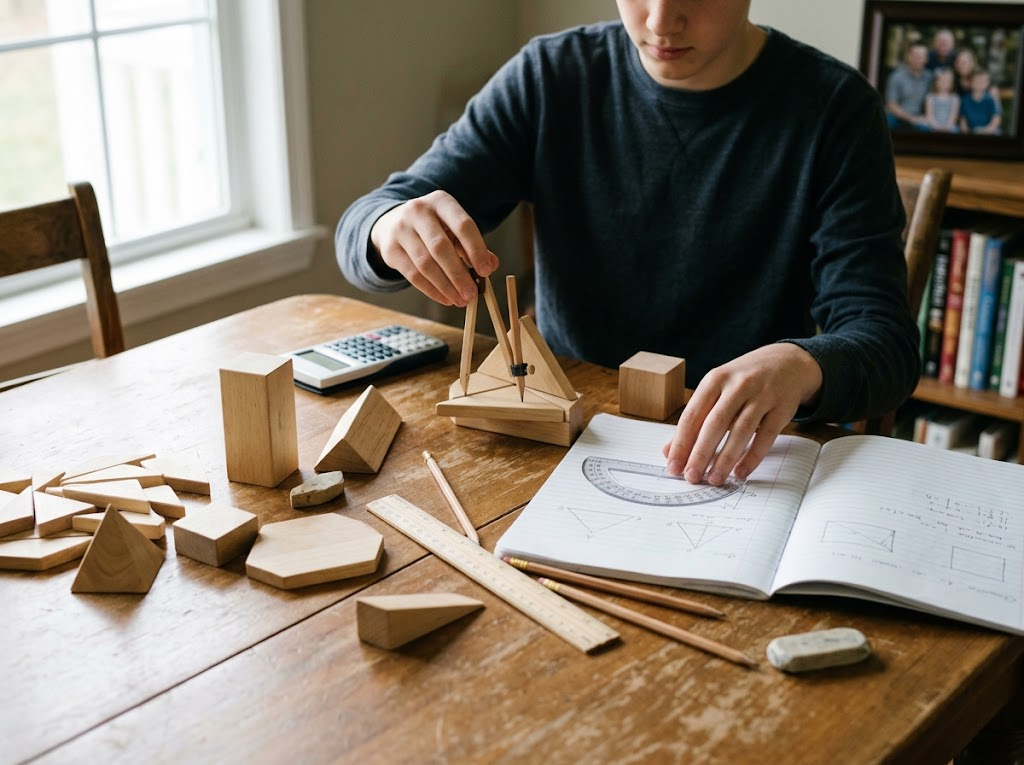
Math-U-See
Format: Hands on, multi sensory
Best for: Visual and tactile learners What stands out: Manipulatives based instruction that makes spatial concepts click for kids who learn better by touching and building than by reading a page.
Potential drawback: The hands on materials add cost and setup time compared to a straight textbook or video course.
Best fit: Younger feeling learners or students who have struggled with abstract math instruction elsewhere. Students who need to physically build a shape before they can reason about it tend to stick with this approach longer than they would with a purely page based course.
Jacobs Geometry
Format: Classic textbook
Best for: Conceptual, discovery based learners What stands out: A textbook that leans hard into visual logic and real world discovery rather than rote formula drills. It is often valued for its emphasis on conceptual understanding rather than pure memorization.
Potential drawback: It asks for more active parent involvement than most other options here, especially around the proof sections.
Best fit: Families who enjoy sitting down together and working through problems as a team.
Saxon Geometry
Format: Incremental textbook
Best for: Students who need heavy repetition to retain a skill What stands out: One new concept introduced per day, with constant review of everything that came before. This spiral approach means nothing gets learned once and forgotten.
Potential drawback: The daily pace can feel slow for students who grasp concepts quickly and get bored with repetition.
Best fit: Students who benefit from steady, incremental review rather than big conceptual leaps. Because older material keeps resurfacing in every problem set, students rarely hit a unit test feeling like they forgot everything from three months earlier.
Teaching Textbooks Geometry
Format: Online, self paced
Best for: Independent learners who want minimal parent involvement What stands out: Built in automated grading and a design aimed at letting the student work through material mostly on their own.
Potential drawback: Less depth on proofs compared to some of the more traditional textbook options.
Best fit: Students who are self motivated and do not need much daily parent guidance. The built in lecture and automatic grading also make it one of the easier options for a parent who is juggling multiple kids at different grade levels.
None of these is objectively the best geometry homeschool curriculum. The right one depends on how your student learns, how much time you have to teach directly, and what your budget looks like.
Geometry Homeschool Curriculum Comparison
| Curriculum | Format | Best For | Assessment / Grading | Parent Involvement |
|---|---|---|---|---|
| Mr. D Math | Video / self-paced | Video learners | Graded quizzes | Low–Moderate |
| UnLock Math | Online interactive | Independent learners | Automated | Low |
| TabletClass Math | Video / online | Self-paced students | Automated quizzes | Low–Moderate |
| Thinkwell | Digital subscription | Short-lesson learners | Auto-graded | Low |
| Khan Academy | Free online | Budget-conscious families | Practice-based | Moderate |
| Master Books | Textbook / video | Traditional / faith-based | Parent-led | Moderate |
| Math-U-See | Hands-on / textbook | Visual and tactile learners | Parent-led | Moderate |
| Jacobs Geometry | Textbook | Conceptual learners | Parent-led | High |
| Saxon Geometry | Incremental textbook | Repetition-based learners | Parent-led | Moderate |
| Teaching Textbooks | Online | Independent learners | Automated | Low |
Features and pricing change fairly often, so confirm current details on each program’s official page before you buy.
Which Curriculum Is Best for Different Learning Styles
Best for video instruction: Mr. D Math, TabletClass Math, Thinkwell
Best for automated grading: UnLock Math, Teaching Textbooks, Thinkwell
Best free resource: Khan Academy
Best for traditional textbook learning: Jacobs Geometry, Saxon Geometry, Master Books
Best for hands on learning: Math-U-See
Best for independent learners: Teaching Textbooks, UnLock Math, Mr. D Math
Best for proof focused learning: Jacobs Geometry and other traditional, proof heavy approaches
Think of these as best fit for a particular family, not absolute universal winners. A student who thrives with Saxon’s repetition might find Jacobs frustrating, and vice versa.
Online Homeschool Geometry Curriculum: Pros and Cons
A homeschool geometry curriculum online offers real advantages. Flexible scheduling, video explanations a student can rewind and rewatch, automatic grading, and progress tracking that saves you from marking every worksheet by hand all matter more than they sound like on paper.
The tradeoffs are worth naming honestly. More screen time. Ongoing subscription costs in some cases. Less face to face contact between parent and student. If your student needs a lot of encouragement or gets stuck easily, an online course without a live teacher component might leave gaps that a textbook and a parent working side by side would catch faster.

Free Geometry Homeschool Curriculum Options
Khan Academy is the standout free geometry homeschool curriculum resource, and a genuinely good one. You can browse the geometry course directly on Khan Academy at no cost. Before leaning on any free resource for a full high school credit, ask yourself a few things. Does it cover a complete course from start to finish. Are there real assessments, not just practice problems. Can this count for high school credit on a transcript. Will you need to build your own pacing schedule. Are answer keys or progress reports available anywhere.
Free does not mean incomplete, but it usually does mean you are the one filling in the structure around it.
Can You Find a Geometry Homeschool Curriculum PDF
This search comes up a lot, so it deserves a direct answer. Parents can find printable geometry worksheets, sample lessons, digital textbooks, teacher resources, practice tests, and proof worksheets in PDF form from various publishers and open educational resource sites.
The important distinction is that a PDF worksheet is not the same thing as a complete curriculum. A complete geometry homeschool curriculum normally needs a scope and sequence, actual instruction, enough practice to build fluency, real assessments, answer keys or solutions, and some method of tracking progress over the year. A stack of downloaded worksheets can be a useful supplement, but it is rarely enough on its own to carry a full course. It is also worth steering clear of pirated textbook PDFs floating around forums, both for legal reasons and because they are frequently missing pages or answer keys entirely.
What Grade Do Homeschool Students Take Geometry
Most students take geometry in grades nine through eleven, usually after finishing Algebra I. Some families introduce basic geometric ideas earlier as part of a broader math sequence, but formal geometry with proofs and trigonometry typically comes later. There is no single correct order every homeschool has to follow. A student needing extra review time, or one moving quickly through advanced coursework, will naturally land somewhere different from the standard path.
Algebra I is the standard prerequisite. A student who is shaky on algebra basics will likely struggle with coordinate geometry and equation based proofs once the course picks up speed.
How Much Time Does Homeschool Geometry Take
This is something parents actually care about but most articles barely touch. Daily lesson length varies a lot by program. A typical math day may include instruction, practice, corrections, and occasional assessment, so the actual workload can be considerably longer than the advertised lesson length. A thirty minute video, for example, does not necessarily mean a thirty minute math day. The student may still need time for practice problems, corrections, and periodic assessments once the video ends.
Over a full year, budget in review days after each major unit and extra time around proofs, since those tend to take longer to grade and correct than straightforward computation problems. A little cumulative review built into the weekly rhythm goes a long way toward keeping older material from slipping.
What Makes an Easy Geometry Homeschool Curriculum
Easy means different things to different families. It can mean easier for the student to understand, less parent teaching required, shorter daily lessons, automated grading, fewer worksheets, or more visual instruction. A program being easier to run does not automatically mean it is less rigorous. Teaching Textbooks and UnLock Math, for example, ask relatively little of the parent day to day without skipping proofs or cutting content from the course.
Homeschool Geometry vs Traditional School Geometry
| Area | Homeschool | Traditional School |
|---|---|---|
| Pace | Flexible and individualized | Fixed to the class calendar |
| Schedule | Family controlled | School timetable |
| Instruction | Parent, video, or online teacher | Classroom teacher |
| Grading | Parent or software | Teacher |
| Assessments | Flexible | School defined |
| Curriculum | Parent chooses | School chooses |
| Repetition | Can be student specific | Class wide pace |
| Proof practice | Can be customized to the student | Follows a standard sequence |
The flexibility cuts both ways. Homeschool families can slow down or speed up as needed, but they also carry more responsibility for making sure nothing important gets skipped.
Using Homeschool Geometry for High School Credit
For college-bound students, it makes sense to choose a rigorous course that includes proofs, coordinate geometry, and an introduction to trigonometry, then document the coursework clearly for the transcript. Rigor matters more than the label on the cover.
A full course description usually notes the curriculum used, the topics covered, the total instructional time, and how the grade was determined, whether through quizzes, unit tests, a final exam, or a combination. It is worth saying clearly that no single curriculum automatically counts for credit on its own. How coursework is documented for a transcript depends on your state’s homeschool requirements and, in some cases, on the receiving college’s own policies, so it is worth checking current guidance rather than assuming one program’s marketing claims apply to your situation.
How to Choose the Best Geometry Curriculum for Homeschool
A few questions worth sitting with before you buy anything. Where is your student right now, solid on Algebra I or needing a review unit first. What is your preferred teaching style, parent led, independent, video based, or some mix. What is your budget, free, one time purchase, or ongoing subscription. How much time can you personally give, since some programs need almost no parent involvement while others need you at the table daily. How will the work actually get assessed, meaning real quizzes and tests with answer keys rather than only practice sets. Does the program teach proofs seriously, since skipping deductive reasoning skips a large part of the point of the course. And does it prepare your student for what comes next, since college bound students especially need real rigor behind the label.
When comparing a homeschool math curriculum for geometry, look beyond the title and check the course sequence, proof instruction, assessments, and level of parent involvement. The best geometry curriculum for homeschool families is usually the one that fits the student’s pace and learning style rather than the one with the longest feature list.
If your student has a different pace or a learning difference a standard course does not account for, it is worth reading about how math curriculum for special education students gets adapted, since several of the same modification strategies apply directly to geometry.
How to Know When a Geometry Curriculum Isn’t Working
Sometimes the fit is wrong and it takes a few weeks to notice. A few signs worth watching for. The student understands the lesson but cannot solve the practice problems on their own. Every lesson seems to require you to re-teach the material from scratch. Proofs are being memorized rather than actually understood. The workload is creating constant frustration or tears. The student finishes lessons quickly but retains almost nothing a week later. Screen time is becoming its own daily battle. Assessments do not seem to match what was actually taught. Or the student is consistently far ahead of or behind the program’s pace.
Do not immediately assume the student is simply bad at geometry. More often than not, the curriculum is just a poor match for how that particular kid learns, and switching formats, from video to textbook or the reverse, solves the problem faster than pushing through.
How Much Should a Homeschool Geometry Curriculum Cost
Costs generally fall into a few tiers. Free resources like Khan Academy cost nothing but ask more of your time. Low cost digital programs and one time textbook purchases sit in the middle, often with a workbook or solutions manual as an added expense. Subscription based online courses tend to run higher but bundle in grading, video instruction, and progress tracking. Full curriculum packages with optional teacher support or live classes sit at the top end. Exact prices change often enough that it is worth checking each program’s current pricing directly rather than relying on older reviews, this one included.
Common Mistakes When Choosing a Geometry Curriculum
A few patterns show up again and again. Picking a curriculum based purely on price without checking whether it actually covers proofs. Assuming a video based course needs no parent involvement at all, when grading and review time are still required. Committing to a full year subscription before trying a sample lesson. And underestimating how much time proof heavy units will actually take compared to straightforward computation.
If proofs and exam prep specifically are the sticking point, twenty common geometry exam questions and how to solve them is a useful companion resource once you have a curriculum picked, and once grading itself becomes the daily grind, grading homeschool work without a class is worth a read before the workload piles up.
Frequently Asked Questions
What is the best geometry homeschool curriculum?
There is not one universal answer. Mr. D Math, UnLock Math, Teaching Textbooks, Saxon, and Jacobs are all strong choices, but the right geometry homeschool curriculum depends on your student’s learning style and how much parent involvement you want.
Is there a free geometry homeschool curriculum?
Yes. Khan Academy offers a genuinely thorough free geometry course, though you will likely need to add your own tests and pacing to use it as a full high school credit.
Is there a good online homeschool geometry curriculum?
Yes. UnLock Math, TabletClass Math, and Thinkwell are all fully online, with video lessons, automated grading, and progress tracking built in.
What math should a student take before geometry?
Algebra I is the standard prerequisite. A student who is shaky on algebra basics will likely struggle with coordinate geometry and equation based proofs later on.
What grade is geometry usually taught in homeschool?
Most students take it in grades nine through eleven, but homeschool families are not locked into one universal sequence.
Can Khan Academy be used for a full geometry homeschool curriculum?
It can serve as the backbone of one, especially for families comfortable building their own structure around it. Just plan to add tests, a grading system, and transcript documentation.
Is geometry hard to teach at home?
Proofs are often the section parents find hardest to teach, especially if it has been years since they last worked through a formal geometry proof. A curriculum with worked solutions and a real solutions manual makes this far less painful.
How do I choose a geometry curriculum for homeschool? Start with where your student is in Algebra I, how much teaching time you have, and your budget, then check that the program actually covers proofs and offers real assessments rather than only practice problems.
What does a high school geometry curriculum cover?
A complete course typically works through nine units: foundations of geometry, logic and proofs, triangles, quadrilaterals and polygons, transformations, coordinate geometry, circles, measurement, and an introduction to trigonometry. A program that skips proofs or trigonometry is missing a meaningful piece of the standard sequence.
Can I homeschool geometry without a textbook?
Yes. Video based and fully online programs like Mr. D Math, UnLock Math, TabletClass Math, and Thinkwell teach the entire course without a print textbook, and Khan Academy offers a free non-textbook option as well. The trade-off is usually more screen time in exchange for automated grading and less day to day parent teaching.
What is the best math curriculum for homeschool overall?
It depends heavily on the subject and grade level, but the same principles that apply to a geometry homeschool curriculum apply broadly, meaning a mix of solid instruction, real assessments, and a workload that fits your student.
Final Thoughts
A good geometry homeschool curriculum should match how your student actually learns, not just what happens to be popular this year. Video based programs like Mr. D Math and TabletClass work well for independent learners who like watching someone explain a concept before trying it themselves. Textbook based programs like Jacobs and Saxon suit families who want to sit down together and work through problems by hand. Free resources like Khan Academy are worth using, especially as a supplement, even if they are not always a complete standalone course on their own.
There is no real shortcut around trying something for a few weeks and watching how your student responds to it. But going in with a clear sense of learning style, budget, and how much parent involvement you are prepared for will save you from switching curricula three months into the school year, which happens more often than most parents expect and almost always costs more time than it saves.