Beyond the mainstream attachment types — buttons, clips, belt-loop systems — the suspender world keeps two specialist variants that most guides never explain, leaving the buyers who actually need them searching blind. Hook suspenders attach by curved metal hooks rather than jaws or tabs, serving workwear, waders and specific trouser hardware; side suspenders relocate the suspension geometry from front-and-back to the hips, serving concealment, comfort cases and several trades. Both are real solutions to real problems — and both have failure modes when bought for the wrong job. This guide explains the pair properly: each mechanism and its genuine use cases, the geometry differences that change how they wear, the quality screens per variant, and the decision guide that tells every reader whether a specialist variant is their answer or a detour.
Hook Suspenders: The Mechanism and Its Uses
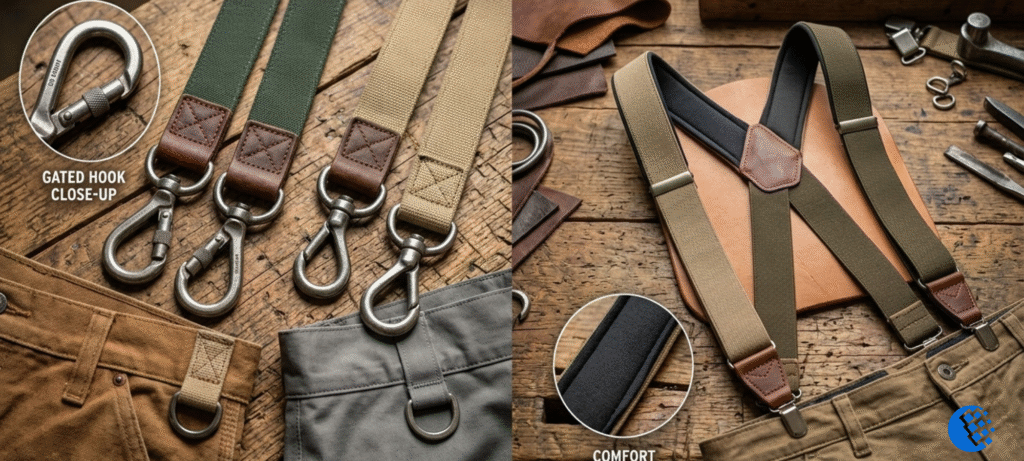
The hook end is the oldest attachment idea still in service: a curved metal hook that seats over an edge or through a receiving point — the waistband itself, a belt loop, or dedicated hardware (the buttonholes, D-rings and web tabs that work trousers, waders and some traditional garments carry). The mechanism’s character: simpler than a spring clip (nothing to fatigue), faster than buttons, and strong in the direction it’s loaded — a properly seated hook under downward tension holds like hardware — with its known weakness being the unloaded moment: slack straps can let an open hook lift free, which is why the quality tier closes the gap with locking and gated hook designs.
The genuine use cases: work trousers and bibs with hook-receiving hardware (the variant’s home territory), waders and technical gear whose systems specify hooks, belt-loop wear where a slim locking hook beats a bulky wrap closure, and the retrofit case — hooking over the waistband edge of trousers that offer nothing else, the variant’s roughest but real service. Outside those cases, the mainstream attachments serve better — the honest boundary the buying guide below enforces.
Side Suspenders: The Geometry and Its Uses
The second variant changes not the end but the architecture. Side suspenders run their support at or toward the hips — configurations from true side-strap systems (short straps over the hip crest, sometimes joined by a half-harness) to side-biased four-point setups — relocating load off the shoulder-top-and-spine lines the standard X, Y and H architectures use. What the geometry buys: concealment (side systems hide under layers where standard braces print), shoulder relief (the variant’s medical-and-comfort constituency — wearers whose shoulders, posture or gear conflict with topline straps), and gear compatibility (trades and outdoor wearers whose packs, harnesses or tool rigs already occupy the standard strap paths).
What the geometry costs, honestly: side systems carry less weight less far — the hip-adjacent path has shorter mechanical advantage than true shoulder suspension — so the variant suits light-to-medium trousers and comfort cases, not the loaded-workwear duty the standard architectures own. The variant is a specialist for named reasons, and the names are concealment, relief and clearance.
Wearing the Variants: The Adjustments That Matter
Each variant asks small technique changes. Hook wear: seat fully (the hook’s bend bottomed on its anchor), keep working tension always (the unloaded-hook lift is a slack problem — tensioned hooks don’t wander), and favor gated designs wherever the day includes bending and crouching; the two-second tug test per hook joins the leaving-the-house routine exactly as the clip press-check does. Side wear: side suspenders sit on the hip crest’s shelf — the geometry’s whole load path — so position the straps there, balance left-right tension precisely (asymmetry that standard braces forgive, side systems don’t), and size honestly — the variant’s shorter straps have narrower adjustment ranges, making the maker’s size chart non-optional. Both variants share the category’s universal law unchanged: real tension, straps flat, the system carrying actual weight — specialist geometry never excuses decorative slack.
The Quality Screens, Per Variant
Each variant concentrates its quality question in its specialty. The hook screen: metal and gauge first — solid formed steel or brass hooks with real thickness (thin bent wire is the failure tier), locking or gated closure on the quality rung, smooth finished surfaces that won’t chew waistbands, and stitched or riveted hook-to-strap junctions carrying the same integrity as any load terminal. The side screen: strap and pad quality first — the hip path puts hardware and edges against the body’s bony crest, so finished edges, comfort backing on the contact runs, and genuinely elastic sections are the wear-or-abandon difference; plus the standard hardware screen on whatever end type the system uses. Both variants inherit the category’s material line whole: named leather or quality woven elastic, metal adjusters, honest widths — specialist function bought at the same construction standard as everything else in the drawer.
The Decision Guide: Specialist or Standard
The variants exist for named cases, and the guide is the naming. Choose hooks when: the trousers or gear carry hook-receiving hardware, the wear is workwear-and-wader territory, or the belt-loop route wants its slimmest closure — and choose gated hooks within the choice wherever movement is real. Choose side systems when: concealment under layers is the actual goal, shoulder-topline relief is a genuine need, or gear clearance demands the alternate path — accepting the light-to-medium load ceiling knowingly. Choose the mainstream types otherwise: buttons for formal, heavy and traditional wear, quality clips for casual convenience, belt-loop systems for the no-sew middle — because the specialists solve their problems and only their problems. And the mixed-drawer note that resolves most real wardrobes: the variants coexist with the standards — the hook set living with the work gear, the side set with the winter layers, the button and loop sets running the rest of the week — each bought for its named case, which is the only way specialists were ever meant to be owned.
Frequently Asked Questions
What are hook suspenders for?
Trousers and gear with hook-receiving hardware — workwear, bibs, waders — plus slim belt-loop wear; strongest under load, gated designs closing the slack-lift gap.
What are side suspenders for?
Three named cases: concealment under layers, shoulder-topline relief, and clearance from packs and harnesses — at a light-to-medium load ceiling.
Are hooks secure compared to clips?
Loaded and seated, more so — nothing to spring open; the discipline is keeping working tension, since slack is the hook’s only wander condition.
Why do side systems carry less?
Geometry — the hip-adjacent path has shorter mechanical advantage than true shoulder suspension; the variant trades capacity for its three named benefits.
What’s the quality tell on each?
Hooks: metal gauge and gated closure. Side systems: finished edges and comfort backing on the hip contact runs — plus the category’s standard material screen on both.
Should a first suspender purchase be a specialist variant?
Only if a named case applies — otherwise the mainstream types serve better, with the specialists added when their problems actually arrive.