
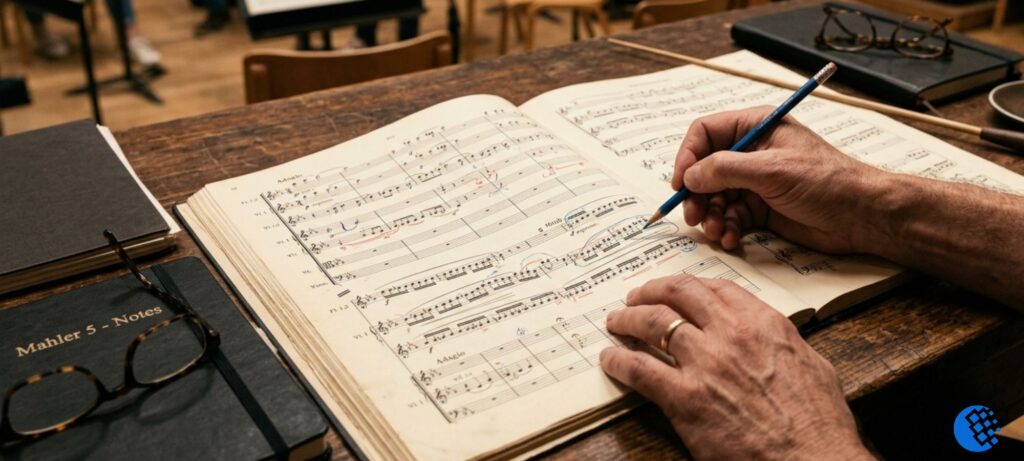
Opening a full orchestral score for the first time can feel intimidating. Twenty staves, transposing horns, dense counterpoint, dynamics that swing from a whisper to a wall of sound in four bars — it’s a lot to take in at once. Almost everyone who has stood in front of a full score for the first time remembers that “where do I even start” moment.
Watch someone experienced work through the same score, though, and they aren’t reading left to right like a novel. They’re hunting for the structure sitting underneath the notation. That process has a name: score study.
Score study is the practice of reading, marking, and internalizing a musical score before you ever step in front of an ensemble. It means working through the form, harmony, instrumentation, and performance markings of a piece so you walk into rehearsal with a real interpretation already in mind, instead of discovering the piece alongside your players. Many conductors find that the passages they expected to cause trouble go smoothly, while a seemingly simple sixteen-bar transition ends up eating half a rehearsal — which is really the whole argument for score preparation in one sentence.
What Is Score Study, Exactly?
At its core, conductor score study is an intellectual and ear-driven exercise. An instrumentalist practicing their own part is working on execution — getting fingers, breath, or bow arm to move automatically. A conductor doing score analysis is after something different: understanding how every line in the piece relates to every other line, why the composer scored a passage the way they did, and how the whole work is built from downbeat to final cutoff.
This is also where score study techniques differ meaningfully from ordinary sight-reading. Sight-reading gets you through the notes in real time. Score study slows everything down and asks why the music is built this way, and what that means for how you’ll rehearse it.
Score Study vs. Score Reading
These two terms get used interchangeably, which causes confusion. Score reading happens in real time — scanning notes, checking key signatures, following along as a recording plays. It’s how a player sight-reads, or how a conductor tracks a score while listening. Score study, on the other hand, is closer to editing a manuscript than reading one: you stop, ask why a phrase resolves where it does, trace a theme as it moves from oboe to viola, and mark exactly where a dynamic shift needs to happen.
Score reading tells you what happens in the music. Score analysis tells you why it happens — and what to actually do about it once you’re on the podium.
If you’ve worked through structured study guides for something like How to Study for Quiz Bowl, the underlying principle will feel familiar: broad recall first, then layered, focused passes that build depth. Score study follows almost the same logic, just applied to a page of orchestral notation instead of trivia categories.
Why Score Preparation Matters
A few concrete things change once a score has actually been studied rather than just read through:
- Clearer gestures. Knowing what’s coming three measures ahead means your hands cue it naturally, without an awkward pause or a scramble.
- Faster, more efficient rehearsals. Instead of stopping to work out why a chord sounds muddy, you already know which inner voice needs to come forward.
- Better stylistic accuracy. A Haydn symphony wants light, transparent bowing. A Bruckner symphony wants weight, space, and patience. Knowing the period and the composer’s habits keeps interpretive choices grounded instead of guessed.
- Sharper audiation. Studying a score in silence, away from a piano or a recording, trains the inner ear to hear written notes before a single sound is actually made.
Score Study Methods Used by Conductors
There’s no single universal system — different conductors lean on different frameworks, and most eventually build a personal hybrid. A few approaches come up often enough to be worth knowing.
The Hourglass Method. Some conductors describe score preparation as shaped like an hourglass: starting wide with overall form and style, narrowing down into fine harmonic and orchestrational detail, then widening back out as those details get rebuilt into a finished interpretation. It’s sometimes broken into three stages — Awareness, Investigation, and Vision — moving from a first general impression, through close technical digging, to a complete musical concept.
Seven Trips Through the Score. This is an approach some conductors use rather than a fixed rule everyone follows: instead of one exhaustive read-through, you go through the entire piece front to back several separate times, giving each pass a single focus — form on one trip, harmonic rhythm on the next, orchestration on a third — so understanding builds in layers instead of all at once.
SHRMG Analysis. Borrowed from style-analysis theory, this acronym stands for Sound, Harmony, Rhythm, Melody, and Growth. At any given point in a score, one or two of these elements usually dominate the texture, and identifying which one is doing the work tells you what to bring forward. It also doubles as a quick way to describe a composer’s voice — Debussy tends to lean on Sound and Harmony, while a Sousa march leans hard on Rhythm and Melody.
None of these frameworks are exclusive. They’re lenses that sit comfortably alongside the step-by-step workflow below, not replacements for it.
A Practical Score Study Workflow
| Step | Focus |
|---|---|
| 1. First Reading & Context | Broad overview of form, era, and composer background |
| 2. Structural Mapping | Mark major sections, key areas, cadence points |
| 3. Harmonic & Melodic Analysis | Trace progressions, motifs, counterpoint |
| 4. Reference Listening | Compare recordings — after your own initial read |
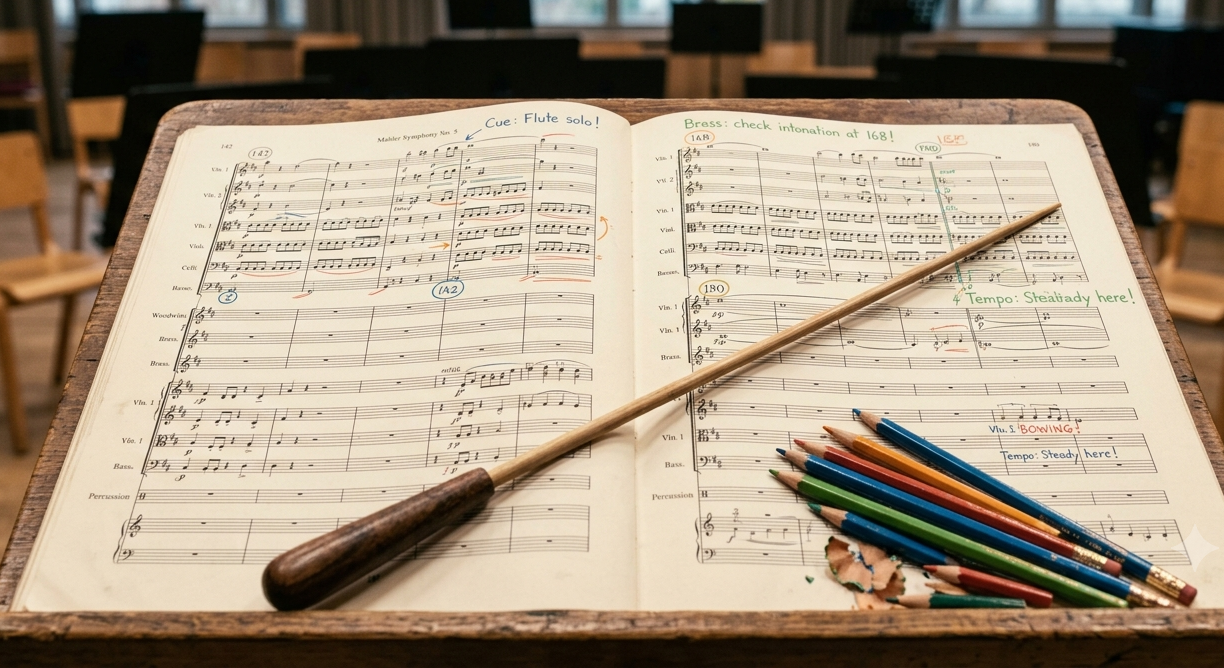
| 5. Score Marking | Annotate cues, dynamics, tempo changes |
| 6. Silent Conducting | Practice gestures and physical cues with no sound |
| 7. Rehearsal Strategy | Flag the passages players are likely to struggle with |
How to Analyze a Full Orchestra Score
Research the Background First
Before touching harmony or form, gather the basics:
- Title, composer, and editor or arranger — was this originally written for this ensemble, or transcribed from something else?
- Dedication or commissioning ensemble
- Publisher, publication date, and approximate performance length
- Program notes, if the composer provided any
- Whether the score is transposed or written in concert pitch
- Unusual instrumentation or special demands — flutter tonguing, extra mutes, an alto flute part — the kind of detail that catches a conductor off guard in the first rehearsal if it isn’t flagged early
A Bach chorale calls for clean voice leading across SATB parts. A Persichetti wind symphony calls for close attention to doublings and orchestral color. Knowing what you’re dealing with before diving into harmony shapes almost every decision that follows.
Map the Structural Form
- Sonata form, rondo, theme and variations, or something looser?
- Where do the exposition, development, and coda actually begin and end?
- How far does the key center wander from home, and at what point?
Trace the Harmony
Harmonic analysis is where a lot of the interpretive groundwork happens:
- Mark authentic, half, and deceptive cadences where phrases close.
- Find the pivot chords that pull the music into a new key.
- Flag dissonances and chromatic runs — they usually mark the emotional high points of a phrase.
Follow the Melodic Line and Counterpoint
Themes rarely sit in one instrument for long in a well-orchestrated piece. Track where the primary line hands off between sections, and just as importantly, find the countermelodies running underneath it. Those secondary lines are the ones that get lost in performance if a conductor is only listening to the top voice during rehearsal.
Prepare Your Gestures
This is where score interpretation turns into physical technique:
- Odd meters like 5/8 or 7/8 need a clean, readable conducting pattern worked out in advance, not improvised in the moment.
- Decide where large, expressive motion actually helps the music and where a small, precise pattern serves it better.
- Mark entrances and prepare tempo shifts — accelerandos, ritardandos, fermatas — before they show up as surprises in front of the ensemble.
Score Marking Systems: Two Approaches Compared
Marking is a personal habit, but two systems come up constantly in conducting circles. Here’s how a common five-color system compares with a leaner three-color approach some conductors prefer:
| Five-Color System | Three-Color System | |
|---|---|---|
| Red | Sudden dynamics, accents, warnings | Melody/primary line, crescendos, accelerandos |
| Blue | Entrances, cues, solos | Harmony/secondary line, diminuendos, ritardandos |
| Green | Tempo and meter changes, cutoffs | Tertiary lines, non-pitched percussion, form changes |
| Yellow | Primary melody as it passes between parts | — |
| Graphite | Phrase lengths, measure numbers, chord analysis | — |
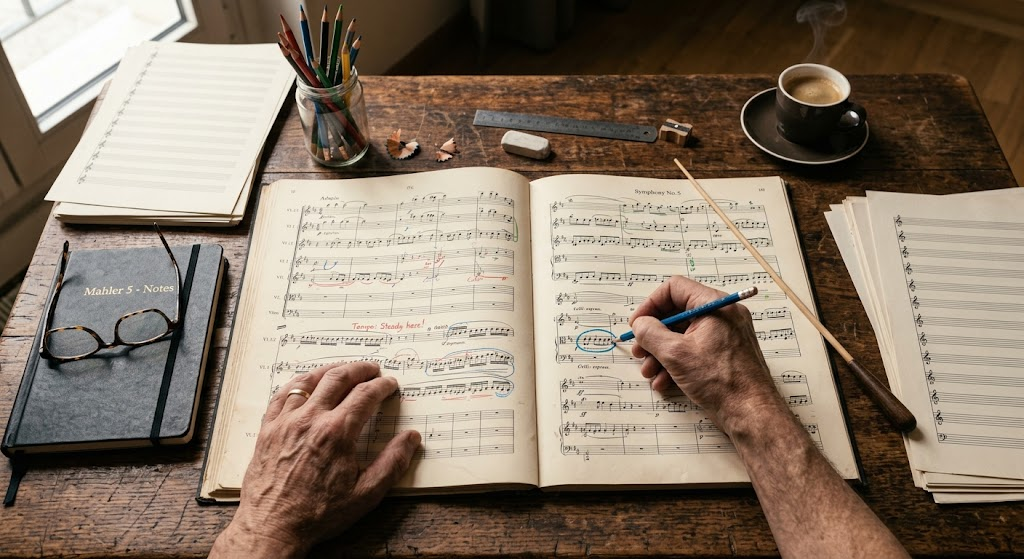
Neither system is objectively correct. The five-color version gives finer detail; the three-color version forces broader structural thinking, which some conductors find clarifies the overall form faster.
A few habits worth adopting regardless of which system is used:
- For crescendos and ritardandos, skip writing “cresc.” or “rit.” on its own — draw the actual shape (a widening wedge, or an arrow) across the exact measures it applies to. It communicates pacing, not just an instruction.
- Marks aren’t permanent. Expect to erase and rewrite as interpretation shifts across a rehearsal cycle. A well-used score often looks messier by opening night than it did on day one, and that’s normal, not a sign of poor preparation.
- In dense, pointillistic passages where instruments enter in rapid, scattered succession, some conductors skip writing instrument names altogether and just draw an arrow toward that player’s location in the ensemble — faster to read at a glance under stage lighting than a written label.
Studying a score away from an instrument is where a lot of this marking work actually gets tested. If you’ve ever looked at self-directed study strategies like the ones covered in AP Classes to Self-Study, the core idea translates well here too: working without a built-in support system — a teacher lecturing, or in this case a piano supplying the harmony — forces a level of internal understanding that passive review never quite builds.
Score Study Examples: Applying the Process
Beethoven, Symphony No. 5. Start by tracking how the four-note opening motif evolves rather than trying to absorb every note at once. The movement opens on an eighth rest — those three short notes are driving toward the held note that follows, which means the very first job on the podium is a clean, clear preparatory gesture. From there, follow the motif as Beethoven hands it from strings into woodwinds and eventually the full brass section.
Mozart, Requiem — Lacrimosa. The choir sits over a gentle, syncopated string pattern in 12/8. Studying the choral and instrumental staves together shows exactly how delicate those string figures need to stay so the sung text isn’t buried underneath them.
A Word on Memorization
Some conductors do eventually memorize scores, but it’s rarely the actual goal of score preparation — it tends to happen as a side effect of understanding a piece deeply enough. There’s a real risk in performing from memory purely for show: audiences come for the music, not a display of recall, and conductors who lean too hard on memorization alone can drift toward showy gestures that don’t serve the ensemble.
Interpretation itself is also more flexible than beginners often assume. Composers don’t always agree on how their own music should be played. Some are famously relaxed about tempo depending on how a given ensemble handles it on a particular day, while others insist on strict fidelity to what’s printed on the page. Neither approach is wrong — it’s a reminder that score study is meant to build an informed, personal interpretation, not a search for one single correct answer.
Beyond the Score: Rehearsal and Performance Habits
A few habits separate solid preparation from preparation that actually shows up on stage:
- Listen from the house, not just the podium. Before a performance, some conductors sit in the actual concert hall during a dress rehearsal to hear the real balance an audience will hear, then adjust from there, rather than trusting what things sound like from a few feet in front of the ensemble.
- Know your conducting field. Picture an imaginary box roughly from eye level to belt height, shoulder to shoulder. Rhythmic, march-style music tends to want a vertical pattern inside that box; lyrical lines want the same size field turned horizontal. Stepping outside that box is what makes an accent or a cue read clearly to a full ensemble.
- Rehearse related material together. If the same motif shows up in three different keys or orchestrations across a piece, rehearsing those passages back-to-back helps players hear the connection — and makes them sharper listeners across the whole rehearsal cycle.
A Daily 45-Minute Score Study Routine
Cramming the night before a rehearsal rarely produces the same results as short, consistent sessions spread across several weeks:
- 10 minutes — Context. Composer background, a recording or two, general form.
- 10 minutes — Structure. Measure numbers, key signature changes, section boundaries.
- 15 minutes — Harmony & Counterpoint. Chord progressions, motifs, light entrance marking.
- 10 minutes — Gesture Prep. Silent conducting through the tricky spots, singing inner lines.
Studying a Score Without a Piano
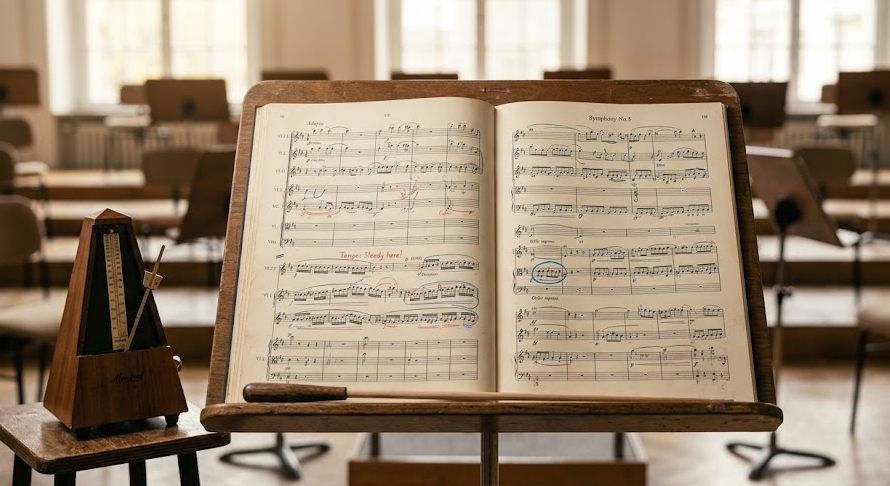
Working away from an instrument is uncomfortable at first, but it builds real audiation faster than leaning on a keyboard ever will.
- Use a metronome, not a piano, to check tempo relationships across meter changes.
- Sing every part separately — including inner voices and bass lines, not just the melody on top.
- Trace the melodic contour on the page and notice where the texture naturally thickens or thins.
- Read choral text as poetry first, before layering the music back on top, to see how the composer is actually setting the words.
For locating scores to practice this with, IMSLP remains the largest public-domain library of downloadable orchestral and chamber works, which makes it a practical starting point for conductors building a personal study library without waiting on a publisher.
Getting Started as a Beginner
- Start small — a Bach chorale or a short string quartet — before attempting a full symphony or wind ensemble score.
- Focus on the essentials first: major entrances, big dynamic shifts, tempo changes. Don’t try to mark everything on the first pass through.
- Watch recordings of experienced conductors while following the same score, and notice how their gestures line up with what’s actually printed on the page.
- Two texts worth having early: Elizabeth A. H. Green’s The Modern Conductor for gesture and preparation basics, and Samuel Adler’s The Study of Orchestration for understanding instrument ranges and balance once scores get denser.
Common Mistakes to Avoid
- Listening before reading. Hearing a recording first tends to import someone else’s interpretation before your own has had a chance to form.
- Ignoring transposing instruments. Forgetting that horns, clarinets, or trumpets read in a different key than concert pitch is a fast way to lose a rehearsal to confusion.
- Only following the top line. Miss the inner voices, and a conductor gets caught off guard the moment one of them takes over the texture.
- Over-marking the page. A score covered edge-to-edge in color is harder to read under stage lighting than a clean one carrying only the essential cues.
Modern Tools for Score Preparation
Beyond physical pencils, software has changed how a lot of conductors approach conductor preparation. MuseScore is a free, open-source notation program that makes it possible to build a quick piano reduction of a dense orchestral score — useful for working out harmony away from the original multi-staff layout, especially for conductors who don’t have easy access to a rehearsal piano.
Score Preparation Checklist
- [ ] Historical context and stylistic era identified
- [ ] Major sections, repeats, and codas marked
- [ ] Cadences and key shifts noted
- [ ] Tempos and tricky subdivisions worked out
- [ ] Entrances and cues clearly marked
- [ ] Transposed instruments checked against concert pitch
- [ ] Gestures rehearsed silently before the first rehearsal
Frequently Asked Questions
What is score study in music?
It’s the process of reading, marking, and internalizing a score before rehearsal — analyzing form, harmony, rhythm, and instrumentation to build a clear interpretation.
What’s the difference between score reading and score analysis?
Score reading is a real-time overview, similar to scanning a map. Score analysis is the slower, detailed work of understanding why the music is built the way it is.
How long does score study take for an orchestra?
Anywhere from a few hours for a short chamber piece to 20–40+ hours for a substantial symphonic work, usually spread across several weeks rather than done in one sitting.
Should you use a piano during score study?
It helps for working out tricky harmonies, but relying on it entirely slows the development of the inner ear. Most conductors combine both piano work and silent study.
What is audiation?
The ability to hear music internally while reading it, with no sound actually playing — the core skill that score study is training.
Is score study necessary for beginners?
Yes. Starting early prevents bad rehearsal habits from forming and builds sight-reading and ear-training skills that compound over time.
How do conductors memorize scores?
Through structural understanding rather than raw repetition — knowing the key transitions and phrase architecture creates a mental map that repetition alone doesn’t build on its own.
Final Thoughts
Score study is what turns time-beating into real musical leadership. Working through the history, structure, and harmonic language of a piece step by step builds a level of confidence an ensemble can feel the moment a conductor raises their hands — often before a single note is played.