
Look at the numbers: around 540,000 boys and 380,000 girls play high school hoops every year. But the reality of moving up is brutal. Fewer than 1 in 35 male players and 1 in 22 female athletes ever make a college squad. If your goal is figuring out how can you get a scholarship for basketball to cover your tuition, the odds get even tighter.
The harsh reality of sports recruitment is that relying entirely on your raw scoring average won’t get you noticed. If you want a program to fund your education, you have to understand how college scouting operates from the inside. So many athletes compete for a tiny handful of roster spots, which leaves tons of families asking the same question: how can you get a scholarship for basketball? An offer never just drops out of the sky. Scoring one means building a smart list of target schools, marketing yourself aggressively to coaches, and learning exactly how college athletic financial aid packages operate.
Key Takeaways: How to Secure a Roster Spot
- Act Early: Register with the NCAA and NAIA eligibility centers by your sophomore year to protect your clearance status.
- Film is Your Currency: Keep your highlight reels tight, under 3 minutes, and lead with your absolute best defensive and offensive clips.
- AAU is Vital for Exposure: Use the summer grassroots circuits to get evaluated live by college basketball recruiters during official open windows.
- Grades Open Doors: Your high school core GPA acts as a gatekeeper; coaches drop elite players instantly if their transcripts don’t clear admissions.
What Is a Basketball Scholarship? (And the Reality of the Odds)
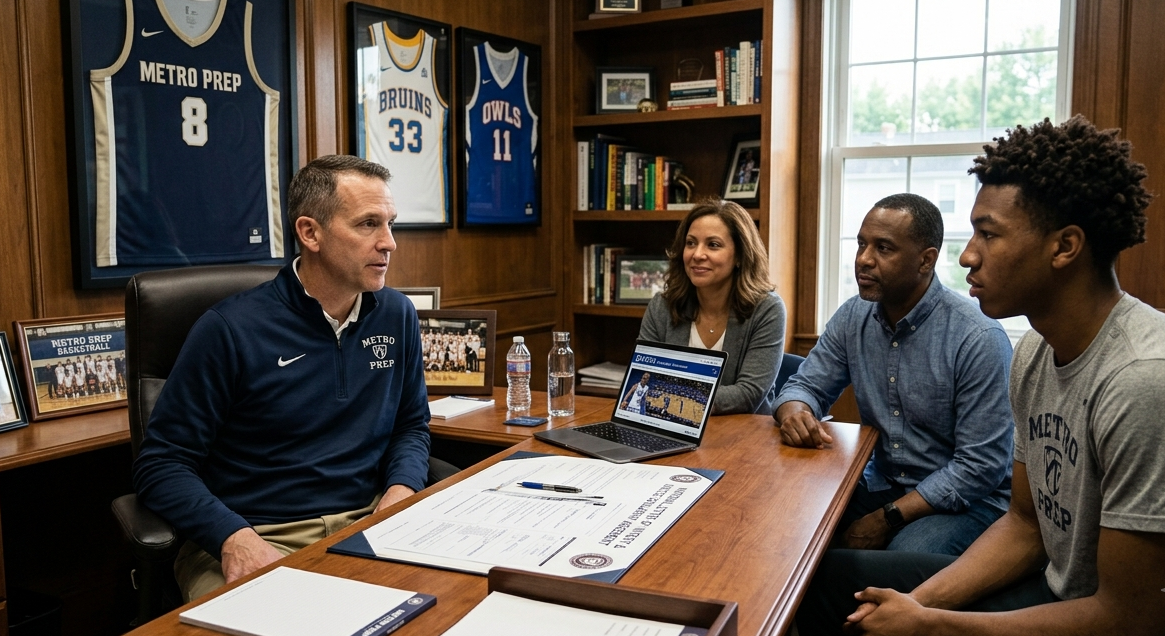
An athletic basketball scholarship functions as a contract where a university pays for your education and living costs while you play for their team. Depending on the school’s athletic budget, these offers typically bundle your tuition, housing, meal plans, textbooks, and mandatory fees into one package.
What most families get wrong during their initial research is assuming that every single offer is a “full ride.” In reality, when navigating the path of how can you get a scholarship for basketball, the specific type of financial package you receive depends entirely on the division level of the school and the governing athletic association.
Full-Ride vs. Partial Basketball Scholarships
College sports tracking programs divide sports into two strict accounting categories:
- Headcount Scholarships (Full-Rides): In NCAA Division I basketball, all scholarships are headcount awards. If a coach wants you on their roster, they must give you a 100% full ride. They are forbidden from splitting a single scholarship among multiple athletes.
- Equivalency Scholarships (Partial Rides): NCAA Division II, NAIA, and junior colleges use the equivalency model instead. These athletic departments work with a flat pool of money that the coaching staff can split up however they want. For instance, a coach might hand a 60% partial scholarship to their starting point guard and use the remaining 40% to secure a backup shooter, allowing them to stretch their total roster budget as far as possible.
By the Numbers: What Percentage of High School Players Get Recruited?
Making it onto a college roster is a massive hurdle. Looking at the hard data tracked by the NCAA and groups like ScholarshipStats shows you just how narrow that road really is:
| Division Level | High School Players (Boys/Girls) | Total College Roster Spots Available | % of High School Players Advancing to This Level |
| NCAA Division I | ~920,000 | ~10,400 | ~1.0% |
| NCAA Division II | ~920,000 | ~8,000 | ~0.9% |
| NCAA Division III | ~920,000 | ~15,600 | ~1.6% |
| NAIA Programs | ~920,000 | ~8,100 | ~0.9% |
| NJCAA (JUCO) | ~920,000 | ~12,500 | ~1.3% |
Hoping a scout randomly spots you in a gym is a losing bet with numbers like these. To actually beat the odds, you need to attack your recruiting with the exact same work ethic and intensity you bring to your daily workouts.
Understanding the Process: How Can You Get a Scholarship for Basketball?
To avoid wasting time on unrealistic expectations, you need to understand how different divisions fund their programs. For a deeper look at balancing your target schools, check out our companion NCAA recruiting guide or explore our deep dive on how to Get a Volleyball Scholarship to see how recruiting setups vary across different court sports.
NCAA Division I & Division II (Athletic Aid)
NCAA Division I represents the absolute peak of media exposure and resources. Men’s D1 teams are capped at 13 total full-ride headcount scholarships, while women’s D1 programs have 15.
Division II offers a phenomenal alternative that balances high-level sports with academic flexibility. D2 programs have a limit of 10 scholarships for men and 10 for women, typically distributed as partial rides mixed with merit aid. Knowing the operational rules of these divisions is essential when figuring out how can you get a scholarship for basketball at the varsity level.
NCAA Division III: The Truth About D3 and Financial Aid
Critical Recruiting Rule: NCAA Division III schools are strictly prohibited from offering any form of athletic scholarship funding.
If a Division III coach wants you on their team, you won’t be getting an athletic financial aid agreement. D3 schools are strictly banned from offering sports scholarships, but they still find ways to cut down your tuition costs. Instead of athletic money, these athletic departments coordinate with financial aid offices to piece together custom packages out of academic merit scholarships, need-based grants, and local leadership awards.
Getting your hands on these institutional funds depends heavily on your transcript. Keeping your GPA high also puts you in the running for outside corporate merit awards, which can step in to cover whatever balance is left on your tuition bill. When you have excellent high school grades, a strategic D3 financial aid package can routinely cost you less out of pocket than a partial D2 athletic offer.
NAIA and NJCAA (JUCO) Opportunities
The NAIA operates entirely outside the NCAA, but its top-tier programs routinely beat Division II teams on the court. These schools offer up to 12 scholarships per roster and don’t force coaches to deal with the same rigid recruiting windows that tie up NCAA programs.
Meanwhile, the NJCAA (National Junior College Athletic Association) serves as a vital tool if you need to bypass academic issues or build your game tape for two years before transferring into a four-year university.
Prep Schools and International Student-Athlete Paths
Heading to a post-grad basketball prep school is an excellent route if you graduate high school but still need another year of development to catch a coach’s eye. It lets you square off against elite competition without burning a single year of your college eligibility.
For international prospects trying to figure out how can you get a scholarship for basketball, the process means registering early with the international clearinghouse and getting verified game tape uploaded to platforms where US coaches can easily scout your skill level remotely.
The Step-by-Step Strategic Playbook
Earning an athletic scholarship requires a deliberate, step-by-step strategy that goes far beyond playing hard in your local gym. Here are the core pillars you must execute to get results.
[Academic Foundation] ➔ [AAU/Showcase Exposure] ➔ [3-Min Highlight Video] ➔ [Direct Coach Outreach]
1. Meet Academic Requirements & GPA Thresholds
Your high school transcript is the ultimate gatekeeper. A college coach will immediately drop a highly-ranked recruit if they don’t think the player can clear the college admissions office. For instance, a 6’3″ guard averaging 14 points with a 3.6 GPA is often much more attractive to Division II and mid-major Division I programs than a player averaging 22 points with poor grades who poses a high risk of academic suspension.
2. Maximize Academic Eligibility via NCAA Eligibility Center
If you want to play at the D1 or D2 level, you must build a profile on the official NCAA Eligibility Center website by your sophomore year. The eligibility center evaluates your high school transcript to ensure you complete the required 16 core courses (including 4 years of English, 3 years of math, and 2 years of science).
3. Play Competitive Basketball (AAU, High School, & Showcases)
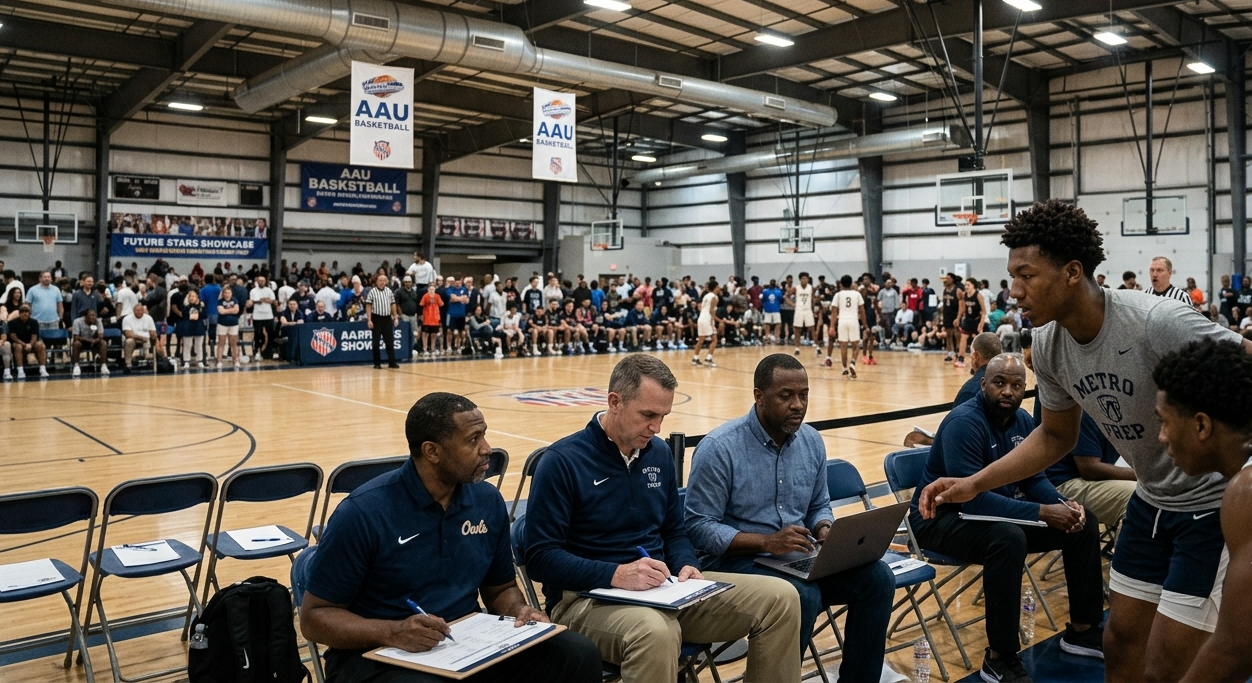
While high school basketball is wonderful for building local community pride, college coaches do the vast majority of their scouting over the spring and summer grassroots circuits.
Playing for an established AAU (Amateur Athletic Union) team puts you directly in front of college recruiters during official “live periods.” You should also look into our guides on basketball training drills to ensure your skills look polished before you step onto a showcase floor.
4. Build a High-Impact Highlight Video (Length & Content Strategy)
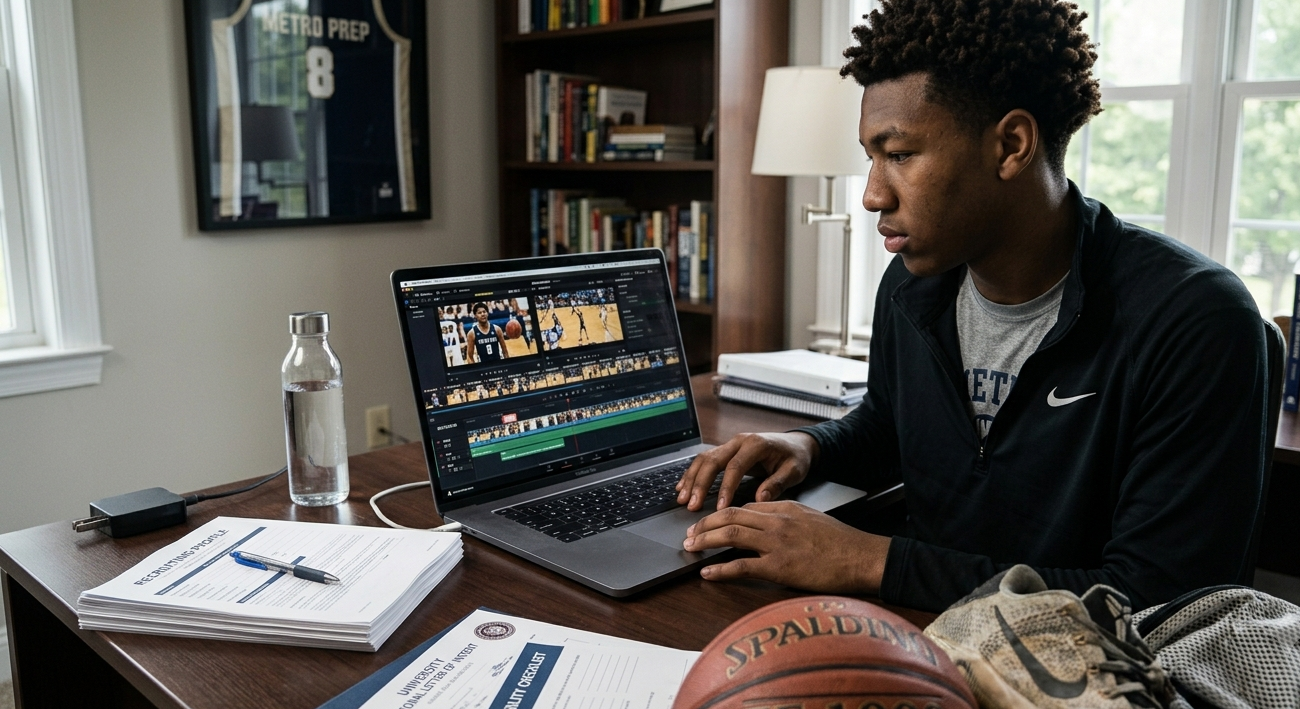
Your highlight video serves as your digital calling card. Coaches review thousands of tapes a year, meaning they make an initial decision on an athlete within the first 30 seconds of hitting play.
- Keep it Short: Keep the final runtime tightly capped between two and three minutes.
- Front-Load Your Best Plays: Lead with your top five highlights immediately. Skip the flashy graphic intros, slow-motion edits, or useless footage of you walking back to the huddle.
- Show Variety: Give them a complete look—mix in on-ball perimeter stops, quick lateral slides, catch-and-shoot depth, and overall floor awareness.
- Make it Accessible: Put the tape on a public YouTube channel or Hudl setup. Coaches should be able to open and watch it on their phones with one single tap.
5. Proactively Contact College Coaches
Sitting back and waiting for a college scout to stumble across your local games will leave you with an empty recruiting pipeline. Instead, take control by building a spreadsheet of 30 to 50 programs that fit your current grades and your style on the court. When you start sending emails, target the assistant coaches and recruiting coordinators directly. They are the ones actually grinding through film and managing the initial scouting databases for the program.
6. Attend Exposure Camps and Evaluate Basketball Rankings
National recruiting rankings are great for media hype, but they have zero impact on the thousands of available scholarship slots outside the top 100 players. Instead of chasing internet stars, spend your budget on official college team camps. Attending a camp held directly on a university’s campus allows you to work out right in front of the coaching staff, letting them evaluate your court intelligence, attitude, and coachability in real time.
The Structural Timeline
Recruiting is a four-year build, not a quick project for your senior year. If you are tracking your progress across high school, use this structural breakdown to hit every major benchmark on time.
Freshman Year: Foundation & Academic Focus
- Meet with your guidance counselor to ensure your schedule strictly follows the NCAA list of approved core courses.
- Build a strong academic GPA immediately so you never have to scramble to fix your grades during your junior year.
- Focus on developing elite physical conditioning habits and cleaning up your raw basketball mechanics.
Sophomore Year: Highlight Reels & Unofficial Visits
- Create your free profile account on the NCAA Eligibility Center platform.
- Compile your first structural highlight video using footage from your freshman varsity or club season.
- Take unofficial visits to local college campuses across various divisions to benchmark the actual talent level in person.
Junior Year: Live Periods, Official Visits, & Direct Coach Contact
Recruiting Milestone: On June 15 after your sophomore year, NCAA Division I and Division II coaches are legally allowed to begin directly texting and emailing you.
- Send your customized student-athlete resume and updated film link to assistant coaches before the spring evaluation windows.
- Schedule official visits if a program extends an invitation to bring you to campus on their budget.
Senior Year: Finalizing Offers & National Letter of Intent (NLI)
- Narrow down your target school list based on written, concrete financial commitments.
- Submit your final high school transcripts and graduation proof to the eligibility clearinghouse.
- Sign your National Letter of Intent (NLI) during the designated national signing windows to officially secure your scholarship.
How Coaches Evaluate Players: What Recruiters Look For
When a basketball recruiter sits in the stands, they aren’t just tracking the stat sheet. They are evaluating traits that translate directly to winning college games.
Physical Attributes & Skill Level vs. Basketball IQ
While coaches naturally prize length, elite vertical burst, and lateral speed, your positional basketball IQ can make up for minor physical limitations. Scouts watch closely to see how you make decisions coming off a screen, your willingness to make the extra pass, your positioning on help defense, and how consistently you box out your opponent.
Character, Leadership, and Social Media Red Flags
College scouts closely track how you handle adversity on the floor. They notice your exact body language toward your coach during tight timeouts, whether you actually support your teammates from the bench, and how you react right after a bad turnover.
Beyond the court, athletic departments thoroughly check public social media feeds before offering a spot. It takes just one reckless post showing a bad attitude, vulgar language, or terrible sportsmanship for a program to completely yank a scholarship offer.
How to Contact College Coaches (With High-Response Email Template)
Your digital outreach needs to be highly professional, structured, and entirely free of unnecessary filler text.
The Perfect Outreach Subject Line & Timing
Coaches get flooded with generic recruiting spam every single day. Your subject line must act as a clear billboard that gives them your essential details instantly.
- Avoid This: “Please look at my basketball clips”
- Use This: “Marcus Vance | 2027 Point Guard | 6’3″ | 3.7 GPA | 3-Min Highlight Video”
For the highest response rates, send your emails early in the morning on Tuesday or Wednesday, or late on Sunday evening when coaches are sorting their schedules for the upcoming week.
Email Template
Subject: [Your Name] | [Grad Year] | [Position] | [Height] | [GPA] - Recruiting Profile

Dear Coach [Coach's Last Name],

My name is [Your Name], and I am a [Position] in the class of [Grad Year] at [High School Name] in [State]. I am very interested in your basketball program at [College Name] due to your aggressive defensive style and your highly-ranked business school.

Here are my quick physical metrics, stats, and academic numbers:
- Height/Weight: [X'X"] / [XXX lbs]
- Varsity Stats: [X PTS, X AST, X REB per game]
- Core Course GPA: [X.X]
- NCAA Eligibility ID: [XXXXXXXXX]

You can view my complete, public 3-minute highlight video here: [Insert Link to YouTube/Hudl]

My upcoming spring AAU schedule with [Team Name] is attached below. I would appreciate the opportunity to have your staff evaluate my film, and I welcome any feedback you can share on my play.

Thank you for your time, coach.

Sincerely,

[Your Name]
[Your Phone Number]
[Link to Twitter / Recruiting Profile]
Follow-Up Strategy That Shows Commitment
If a coaching staff doesn’t respond to your first email within ten days, don’t worry. Send a polite follow-up note two weeks later to drop a fresh clip of a recent game or update them on a jump in your semester GPA. Staying consistent shows you have a genuine interest in their specific program.
Common Mistakes That Cost Players Their Basketball Scholarships
- Chasing the Division I Label Exclusively: Restricting your attention to D1 programs when your actual game fits perfectly with a top-tier Division II, D3, or NAIA school frequently results in you missing out on great financial aid packages.
- Allowing Parents to Run the Communication: Recruiters want to build a relationship with the athlete, not their mom or dad. If a parent is making all the phone calls or writing the emails, it raises a flag regarding your independence and maturity.
- Postponing the Process Until Senior Year: If you wait until your final high school season to build a film portfolio and reach out to programs, you will find that most college recruiting classes are already completely locked in.
The Ultimate Basketball Scholarship Checklist
Keep yourself completely accountable throughout your recruiting journey by checking off these vital benchmarks:
- [ ] Maintain a Strong Core GPA: Keep your academic averages well above the base eligibility floors.
- [ ] Organize Your Athletic Resume: Keep a clean, single-page document detailing your stats, metrics, and coach contacts.
- [ ] Produce a 3-Minute Highlight Video: Ensure your film link is public, clear, and updated every season.
- [ ] Register via the NCAA Eligibility Center: Secure your active registration ID profile number.
- [ ] Join a Strategic AAU Program: Play for a club team that prioritizes player exposure over winning empty tournaments.
- [ ] Run Your Email Outreach Campaign: Commit to messaging 5 new college coaches every single week.
- [ ] Audit Your Public Social Media: Ensure all your feeds show excellent character and a team-first mindset.
Frequently Asked Questions
How can you get a scholarship for basketball?
To secure a basketball scholarship, you must maintain excellent core academic grades, gain exposure by competing on the summer AAU circuits, build a short highlight video, and proactively email assistant coaches to market your skill set directly.
What GPA do you need to get a basketball scholarship?
The NCAA Eligibility Center requires a minimum 2.3 core GPA for Division I and a 2.2 core GPA for Division II initial eligibility. However, holding a 3.0 or higher expands your target list to include elite academic institutions.
How hard is it to get a college basketball scholarship?
It is exceptionally difficult. Less than 3% of high school basketball players make it onto an NCAA roster, and a minute fraction of those athletes secure a full headcount scholarship.
Can walk-ons earn basketball scholarships?
Yes. Walk-on athletes who join a college team through open or preferred tryouts can earn an athletic scholarship in later seasons if they work hard, demonstrate value, and win a spot in the regular playing rotation.
Do Division III schools offer basketball scholarships?
No, Division III schools do not offer athletic scholarships. Instead, they provide financial aid options by combining academic merit scholarships, need-based grants, and local institutional aid.
Can international students get basketball scholarships?
Yes. International athletes can earn basketball scholarships by clearing the NCAA academic and amateurism certification process and submitting verified game film to American college coaching staffs.
Is playing AAU basketball necessary to get recruited?
While not a legal requirement, playing AAU basketball is highly necessary because it serves as the primary ground where college coaches evaluate dozens of prospects under one roof during summer live periods.
How many scholarships does a D1 basketball team have?
NCAA Division I men’s basketball programs are limited to 13 full-ride headcount scholarships, while women’s programs are granted a maximum of 15 full-ride scholarships per season.
What age should you start preparing for the basketball recruiting process?
You should start preparing during your freshman year of high school (around 14 years old) by setting an excellent academic baseline and mapping out your core classes.
Final Thoughts: Taking Control of Your Recruiting Journey
A basketball scholarship isn’t earned through talent alone. Coaches recruit players who combine skill, academics, discipline, and consistent effort. Whether you’re aiming for Division I, NAIA, or junior college, starting early and following a structured recruiting plan can significantly improve your chances.
Do not leave your future up to chance or expect a scout to magically find your local gym. Build a crisp highlight film, protect your core course GPA, and start reaching out to programs directly. By taking complete control of your personal recruiting game plan, you put yourself in the best position when deciding how can you get a scholarship for basketball.