
If you are standing in front of your high school counselor’s office trying to plan next year’s schedule, you have probably asked yourself: how does ap class affect gpa? It is one of the most common questions high schoolers ask. You hear your teachers say that Advanced Placement classes are the golden ticket to a high grade point average and a stellar college application. But then you hear older students warn that a brutal workload could drag your numbers down.
The truth is, taking an AP course can drastically reshape your high school transcript, but the exact footprint it leaves depends entirely on how your specific school district handles grading. It is not just about getting an A or a B; it comes down to how those letters convert into numbers behind the scenes.
This guide will break down exactly how ap classes affect gpa, look at the math behind weighted versus unweighted systems, and explore how college admissions offices actually read these numbers when reviewing your application.
How Does AP Class Affect GPA? The Direct Answer
To give you the short answer immediately: an AP class boosts your GPA by using a weighted grading scale. While standard high school courses top out at a 4.0 for an A, an AP course typically adds an extra 1.0 point to your grade value, meaning an A can count as a 5.0.
However, this extra point only applies to your weighted GPA. Your unweighted GPA, which evaluates all of your courses on a strict, flat scale regardless of how hard they are, stays exactly the same. If you get a B in an AP class, your unweighted GPA sees a 3.0, but your weighted GPA gets a 4.0 bump.
Because every school district holds the keys to its own grading policies, this system can vary. Some private schools and public districts do not weight grades at all, while others might only give a 0.5 boost for advanced work. Let’s dive deeper into the two distinct tracking methods to see how this plays out on your transcript.
Weighted vs. Unweighted GPA: What Is the Difference?
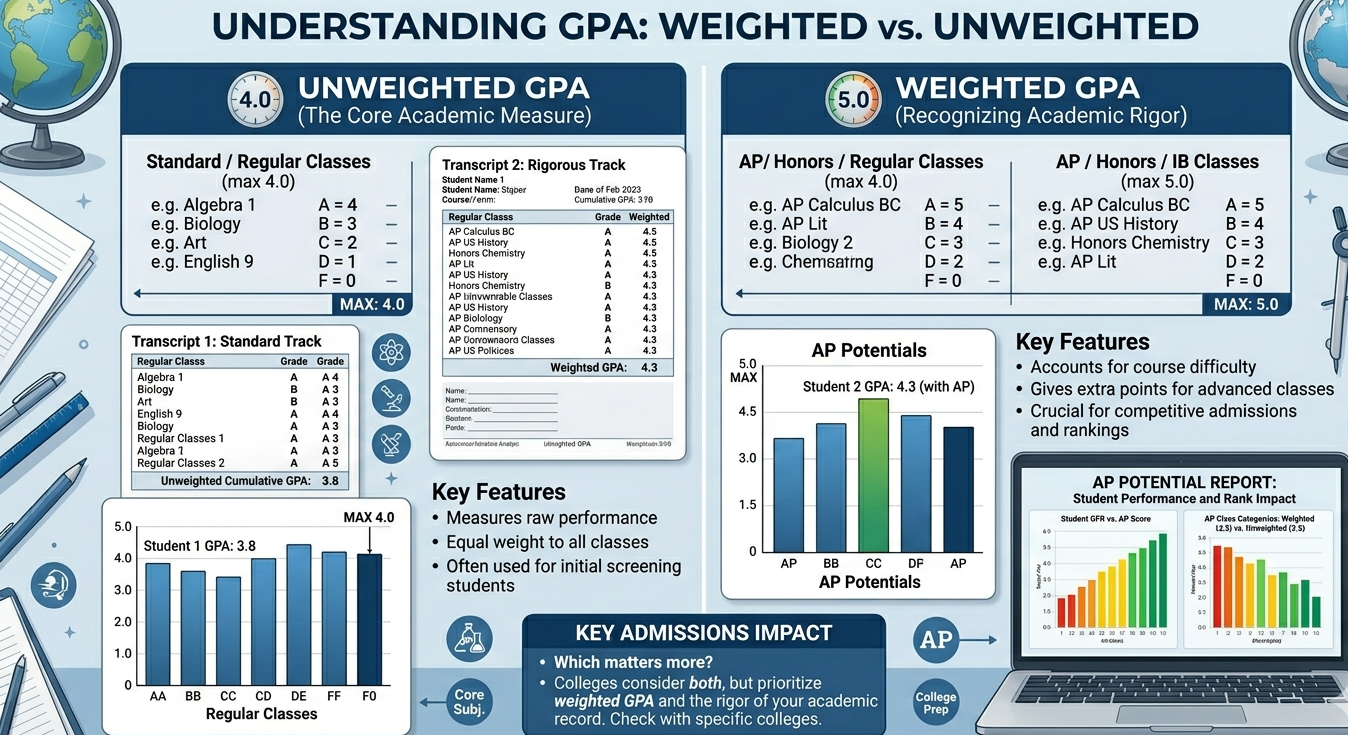
To truly grasp how an advanced class alters your academic record, you have to look at your transcript through two different lenses: weighted and unweighted.
What Is an Unweighted GPA?
An unweighted GPA measures your academic performance on a standard 4.0 scale, treating every single class with equal weight. It does not matter if you are taking AP Calculus BC, an honors English seminar, or a baseline introductory elective—an A is a 4.0, a B is a 3.0, and a C is a 2.0. Taking a massive load of advanced courses will not raise this specific number. In fact, if the extreme difficulty of an advanced class causes your grade to drop from an A to a B, your unweighted GPA will decrease.
What Is a Weighted GPA?
A weighted GPA is designed to reflect the academic rigor of your course load. This system adjusts for course difficulty so that students taking college-level curricula are not penalized for taking on tougher material. In a weighted grading system, advanced classes like AP and International Baccalaureate (IB) courses are typically graded out of 5.0, while honors classes often receive a 4.5 scale. This is how top-performing high school students manage to graduate with cumulative GPAs well above a perfect 4.0.
How Letter Grades Translate
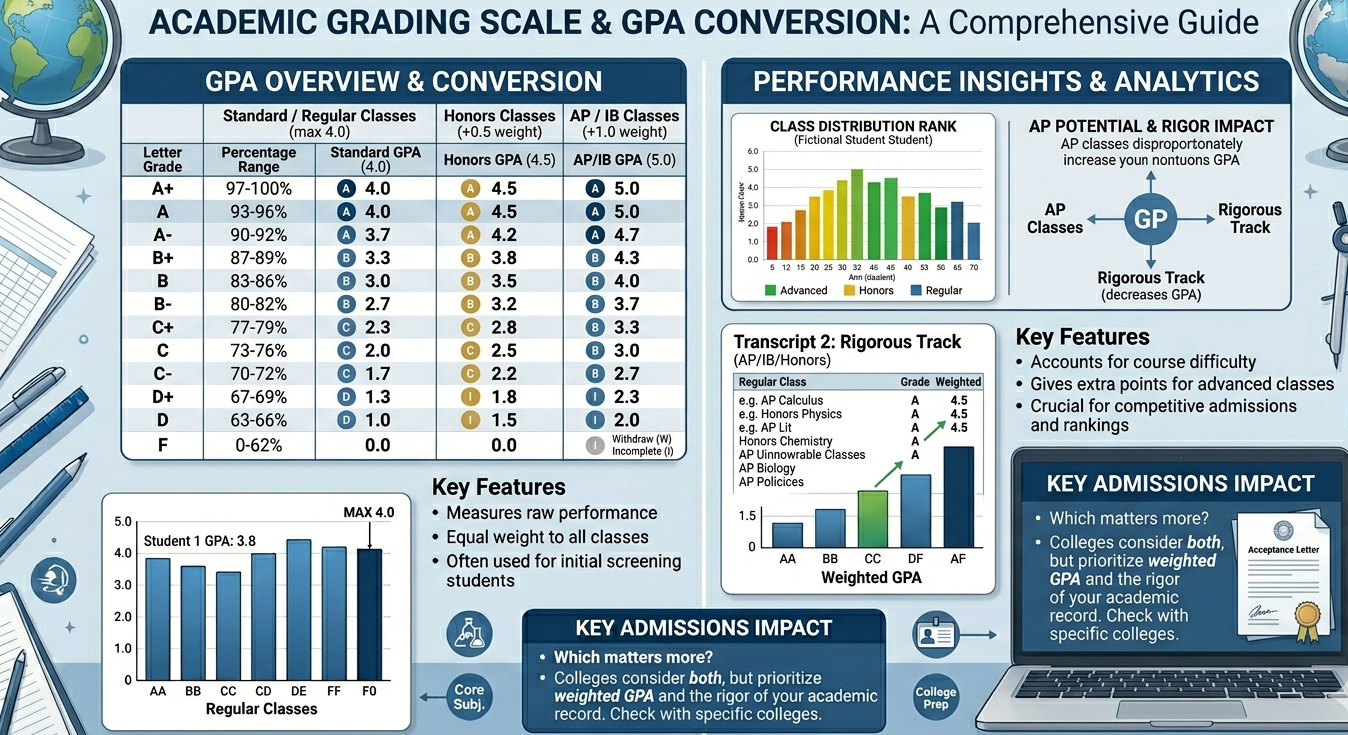
To see how these two systems compare side by side, look at this standard breakdown of how letter grades translate into grade points across regular, honors, and AP tracks:
| Letter Grade | Regular Class Value (4.0 Scale) | Honors Class Value (4.5 Scale) | AP Class Value (5.0 Scale) |
| A | 4.0 | 4.5 | 5.0 |
| B | 3.0 | 3.5 | 4.0 |
| C | 2.0 | 2.5 | 3.0 |
| D | 1.0 | 1.0 | 2.0 |
| F | 0.0 | 0.0 | 0.0 |
As you can see from the scale, earning a B in an AP course rewards you with 4.0 GPA points on a weighted scale—the exact same point value as earning a flawless A in a standard, unweighted class.
How AP Classes Boost Your GPA: The Math and Real Examples

When you enroll in an advanced track, the extra grade point weighting filters directly into your semester and cumulative totals. Every time an AP grade is calculated into your average, it pulls your weighted score upward. This cumulative shift plays an enormous role in determining your overall class rank, which many high schools calculate exclusively using weighted percentages.
Let’s look at a couple of real-world scenarios to see how this plays out for two different students over a single semester.
Example 1: The Balanced Schedule
Imagine a sophomore student taking four regular classes and one AP history course. They work hard and pull straight As across the board:
- Regular English: A (4.0 points)
- Regular Chemistry: A (4.0 points)
- Regular Algebra 2: A (4.0 points)
- Regular Spanish: A (4.0 points)
- AP European History: A (5.0 points)
To find their weighted average, add the points together ($4 + 4 + 4 + 4 + 5 = 21$) and divide by the five classes. This student finishes the term with a 4.2 weighted GPA, even though their unweighted score rests at a flat 4.0.
Example 2: The High-Rigor Trade-Off
Now let’s look at a student taking an incredibly demanding schedule filled with advanced work. Because the material is tough, they manage a mix of As and Bs:
- Regular English: A (4.0 points)
- AP Chemistry: B (4.0 points)
- AP Calculus: B (4.0 points)
- AP US History: A (5.0 points)
- Regular Art: A (4.0 points)
Let’s calculate the weighted points: $4 + 4 + 4 + 5 + 4 = 21$. Divide that by five classes, and this student also finishes with a 4.2 weighted GPA.
Even though this second student received two Bs in their science and math courses, their overall weighted average matches the student who got straight As in standard classes. This demonstrates how the extra point cushion protects your academic average when you step up to harder material.
Do All High Schools Weight AP Classes the Same Way?
A major point of confusion for families is assuming that a 4.5 or 5.0 means the same thing across state lines or even neighboring school districts. They don’t. High schools retain complete control over their transcript design, and there is no universal law forcing schools to award a full extra point.
Consider these common regional variations:
- The 0.5 Point System: Some districts feel a full 1.0 jump is too generous. They award a 0.5 bump for AP classes and a 0.25 bump for honors. In these schools, an A in an AP class gives you a 4.5.
- No Weighting At All: A surprising number of competitive private academies and traditional public schools completely refuse to weight grades. They keep everyone on a strict 4.0 ceiling to prevent artificial inflation, choosing instead to let the course titles speak for themselves.
- The Percentage Add-On: Instead of swapping out the 4.0 scale points, some schools calculate your raw numeric class average (like a 92%) and add a flat 5% or 10% to the final grade before running the numbers.
Because policies are highly localized, you should always check your high school’s official student handbook or schedule an afternoon chat with your guidance counselor to see exactly how your district processes advanced credits.
How College Admissions View AP Classes
When your application lands on a university admissions officer’s desk, they do not just glance at the raw cumulative number at the bottom of the page and move on. They view your GPA as part of a much larger puzzle.
The biggest secret of the college admissions world is GPA recalculation. Because high school grading policies are all over the place, most competitive universities strip your high school’s weighted numbers away entirely. Admissions counselors take your raw transcript and rebuild your score from scratch using their own internal formulas to create a level playing field for all applicants. You can read more about these distinct institution-specific systems in our detailed breakdown of How American Universities Calculate the GPA.
When stripping away local weights, admissions teams look directly at course rigor. If a college officer sees an applicant with a clean 4.0 who only took basic, unweighted classes, and another applicant with a 3.7 unweighted GPA who loaded their schedule with AP Biology, AP Physics, and AP Calculus, they will frequently favor the second student. Why? Because it proves the student can handle college-level curriculum and is willing to step outside their comfort zone.
Holistic admissions policies at selective schools weigh your transcript against your environment. They want to see that you took advantage of the most demanding courses your specific school had to offer. If your school offers twenty AP choices, they expect to see you tackle a fair share of them. If your school only offers two, you will not be penalized for not taking ten.
AP Exam Scores vs. High School GPA
It is easy to mix up your AP class grade with your final AP exam score, but they live in two completely separate worlds.
- Your Class Grade: This is the letter grade (A, B, C) you earn from your high school teacher based on your daily homework, lab reports, essays, and classroom tests over the course of the full school year. This is the grade that impacts your high school GPA and factors into your weighted transcript.
- Your AP Exam Score: This is the standardized test score from 1 to 5 that you earn on the national exam day in May, graded by the College Board.
The score you get on the final exam in May almost never impacts your high school class grade or your high school GPA. A high school policy might occasionally let a perfect exam score erase a final exam grade, but for 95% of students, the two are completely independent.
Instead, your exam score is used for earning actual college credit or placing out of introductory general education requirements once you arrive on campus. Earning a 4 or 5 on the AP exam can save you thousands of dollars in college tuition, but a low score on exam day will not ruin the solid “A” you spent nine months earning in the classroom. You can read official updates regarding scoring structures directly on the College Board AP Students Portal.
Can AP Classes Hurt Your GPA?
Yes, they absolutely can. While the 1.0 point cushion offers a great safety net, it is not a magic shield. If the pacing and depth of a college-level curriculum overwhelm a student, their grades can drop far enough to damage both their weighted and unweighted averages.
If a student typically pulls an A (4.0) in standard classes but ends up with a D (2.0) in AP Chemistry, the weighted boost only kicks that grade up to a 2.0 or 3.0 depending on the district. That is a massive drop that drags down their cumulative score.
Furthermore, overloading your schedule can trigger severe burnout. Taking five AP classes at the same time while balancing sports, family life, and extracurricular activities can cause a student’s grades to slide across all of their subjects. A transcript showing straight Cs in advanced classes looks far worse than a balanced transcript showing a couple of strategic As and Bs in tough areas alongside strong marks in standard courses.
AP Classes vs. Honors Classes for GPA
If you are trying to find the perfect balance for your schedule, it helps to look at how honors courses stack up against Advanced Placement courses:
- Curriculum Design: Honors courses are designed by your local high school teachers to be faster and more thorough than standard classes. AP courses follow a strict national curriculum built by college professors and are audited directly by the College Board to match actual university workloads.
- GPA Weighting: While an AP course usually grants a full 1.0 point boost, honors courses typically sit in the middle, offering a 0.5 bump.
- College Credit Potential: Honors classes never offer college credit. AP classes give you a direct pathway to college credit if you perform well on the standardized spring exams.
If you are struggling to decide between the two, it is often wise to choose your advanced classes based on your personal strengths. If you love reading and history but struggle with equations, taking AP English and AP US History alongside honors math classes is a great way to show academic rigor without tanking your grades. If you need step-by-step strategies to lift your existing baselines before taking on these advanced tracks, check out our action guide on How to Raise Your GPA.
How Many AP Classes Should You Take?
There is no single magic number that guarantees an acceptance letter. The ideal workload shifts depending on what year of high school you are in and what your long-term goals look like.
- Freshman Year: Keep it light. Most high schools do not even open advanced slots to freshmen, but if they do, taking one introductory course like AP Human Geography is perfect for testing the waters.
- Sophomore Year: Taking one or two courses allows you to build strong study habits without risking burnout.
- Junior Year: This is the most critical year for college applications. Taking two to four courses in your strongest subjects shows admissions officers that you are preparing for real academic challenges.
- Senior Year: Keep your foot on the gas with two to four courses, but make sure you leave enough time to write your college application essays and manage your extracurricular leadership roles.
Always protect your mental health first. If you find yourself staying up until 2:00 AM every single night just to keep up with the reading, you have taken on too much. Admissions officers look closely at trends, and they prefer to see a student steadily increase their rigor year over year rather than crashing out early. For a deeper look at balancing high-level coursework alongside clinical and developmental milestones across various career paths, you can explore the medical and cognitive guidelines curated by the American Academy of Neurology.
Frequently Asked Questions
How does AP class affect GPA?
An AP class raises your weighted GPA by assigning extra grade points to your final marks. In most high schools, an A in an AP course is calculated as a 5.0 out of 4.0, giving your cumulative average a major boost.
How does an AP class affect your unweighted GPA?
It doesn’t. Your unweighted GPA treats all classes completely equally on a strict 4.0 scale. If you get a B in an AP class, it goes into your unweighted calculation as a 3.0, exactly like a B in a standard class.
Do AP classes raise weighted GPA if you get a C?
Yes, a C in an AP course typically grants 3.0 weighted points, which is the GPA equivalent of getting a standard B. However, while it protects your weighted average, that C will still drop your unweighted score.
Can AP classes lower your GPA?
Yes. If the coursework is too hard and you end up earning a D or an F, the grade will drag down your cumulative averages. Overloading your schedule can also cause your grades to drop in other classes due to stress and burnout.
Do colleges care more about weighted or unweighted GPA?
Colleges care most about your raw grades paired with your overall course rigor. Because high school weighted systems vary wildly, admissions officers often strip local weights away and recalculate your score using their own internal unweighted scales, looking specifically at how many tough classes you attempted.
Is a B in an AP class better than an A in a regular class?
For competitive college admissions, a B in an advanced class is often viewed just as favorably—and sometimes more favorably—than an A in a regular class because it proves you challenged yourself against college-level material.
Check your grade now => Easygarder